Understanding Why Choosing the Right Battery System Is Critical for Off-Grid Projects
For remote homes, agricultural facilities, communication stations, cabins, and industrial applications, selecting the right energy storage solution is one of the most important decisions during project planning. Unlike grid-connected systems, off-grid projects cannot rely on utility power when energy production is insufficient. The battery system must provide stable power availability through different weather conditions and changing energy demands.
Many project developers focus only on battery capacity or initial purchase price, but this often creates problems after installation. Oversized systems increase unnecessary investment, while undersized systems cause frequent power shortages, reduced battery lifespan, and customer complaints.
A properly designed off grid solar battery system should balance energy consumption, solar generation, battery capacity, backup requirements, and future expansion possibilities.
For installers and distributors, choosing the right supplier is equally important. Product consistency, technical support, customization capability, and after-sales service directly affect project profitability.
As an experienced energy storage provider, VoltCrave Power supports global partners with reliable battery solutions designed for residential, commercial, and remote applications.
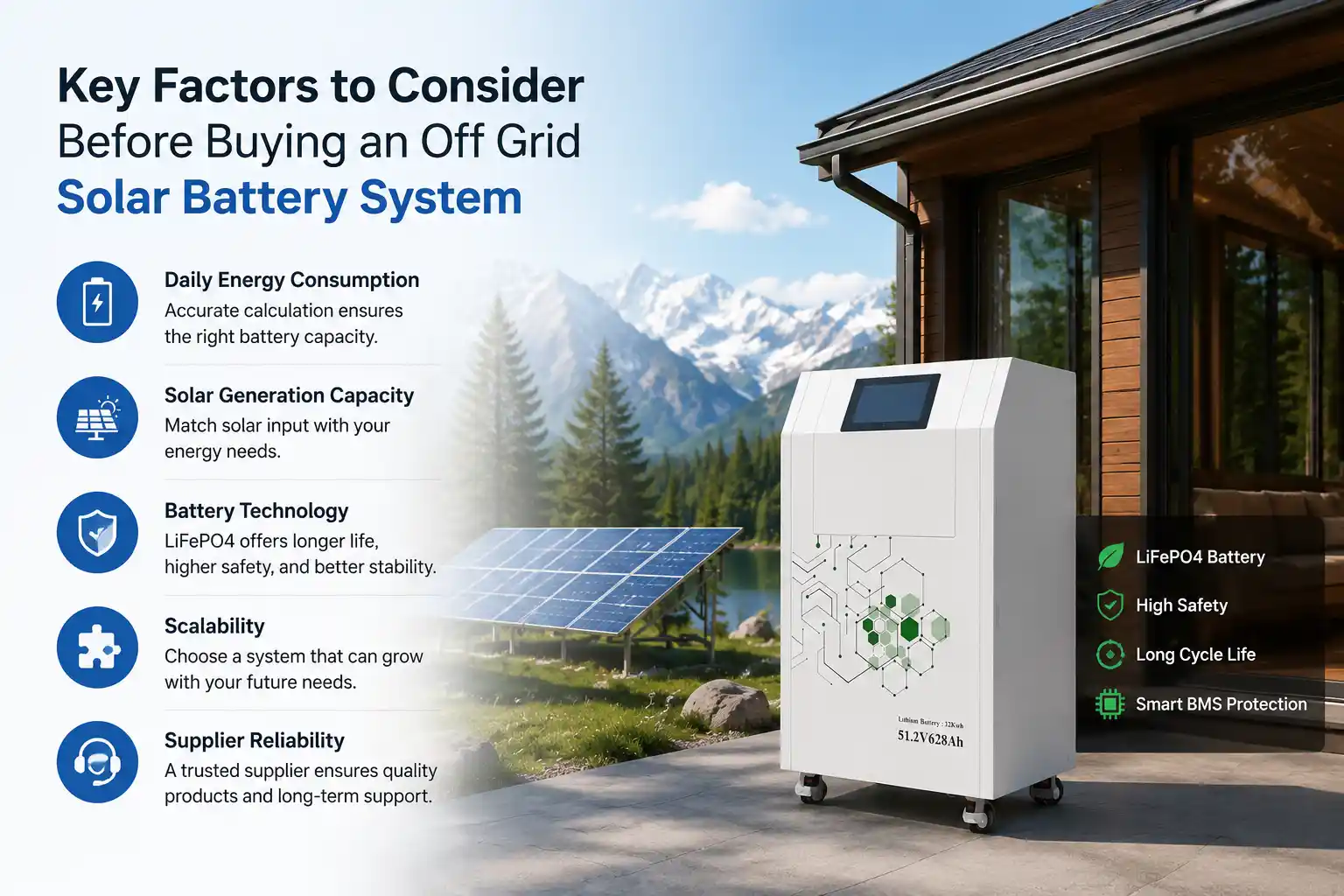
Key Factors to Consider Before Buying an Off Grid Solar Battery System
Before selecting a battery solution, project owners and installers should analyze several technical and commercial factors.
The most common purchasing mistake is choosing a battery based only on advertised capacity. In reality, a complete system requires consideration of:
| Selection Factor | Why It Matters | Common Mistake |
|---|---|---|
| Daily energy consumption | Determines required battery size | Estimating usage too low |
| Solar generation capacity | Affects charging efficiency | Ignoring seasonal changes |
| Battery chemistry | Impacts safety and lifespan | Choosing low-cost unstable batteries |
| Depth of discharge | Influences usable energy | Using incorrect calculations |
| Expansion capability | Supports future demand growth | Buying a system without scalability |
| Supplier reliability | Ensures project stability | Selecting suppliers only by price |
A professional off grid solar system supplier should help customers evaluate these factors before recommending products.
How to Calculate the Right Battery Capacity for an Off-Grid Solar Project
Battery sizing is one of the most important steps when designing an off-grid solution.
The basic calculation requires understanding:
- Daily electricity consumption
- Backup days required
- Battery efficiency
- Depth of discharge
- System voltage
A simple calculation method:
Required Battery Capacity (kWh) = Daily Energy Usage × Backup Days ÷ Battery Usable Capacity Ratio
For example:
A remote house consumes 10kWh electricity per day and requires two days of backup.
Assuming the battery usable capacity is 80%:
10kWh × 2 ÷ 0.8 = 25kWh battery capacity requirement
However, real projects require more detailed evaluation because energy consumption varies throughout the year.
Factors such as:
- Winter solar reduction
- Extreme temperatures
- Equipment startup power
- Future electricity demand
should also be considered.
When designing off grid solar power system solutions, professional suppliers usually evaluate the complete energy profile instead of recommending batteries only based on average daily usage.
Choosing Between Different Battery Technologies for Off-Grid Applications
Battery technology directly affects safety, maintenance requirements, and long-term project costs.
Currently, lithium iron phosphate (LiFePO4) batteries are widely used in off-grid applications because they offer:
- Longer cycle life
- Higher thermal stability
- Better safety performance
- Lower maintenance requirements
- Higher usable capacity
Compared with traditional lead-acid batteries, LiFePO4 solutions can provide better long-term value despite a higher initial investment.
| Battery Type | Advantages | Limitations | Suitable Applications |
|---|---|---|---|
| Lead-acid Battery | Lower initial cost | Short lifespan, higher maintenance | Small backup systems |
| Lithium-ion Battery | High energy density | Requires advanced management system | Portable applications |
| LiFePO4 Battery | Long lifespan, safer chemistry | Higher upfront cost | Residential and commercial off-grid systems |
For professional installations, selecting a reliable off grid solar battery system with a high-quality battery management system is essential.
How to Match Battery Voltage With Your Off-Grid Solar Power System
Battery voltage selection affects system efficiency, inverter compatibility, and installation complexity.
Common battery voltage options include:
| System Size | Recommended Voltage |
|---|---|
| Small residential systems | 12V / 24V |
| Medium residential systems | 48V |
| Commercial projects | 48V and higher |
| Large-scale applications | High-voltage battery systems |
A higher voltage system generally reduces current losses and improves efficiency, especially for larger installations.
When selecting an off grid solar power system, buyers should confirm compatibility between:
- Solar panels
- MPPT controller
- Battery system
- Hybrid inverter
- Monitoring system
A mismatch between components can reduce performance and create unnecessary maintenance issues.
How to Evaluate an Off Grid Solar System Supplier Before Placing an Order
Choosing the right supplier is often more important than choosing the battery itself. For installers, distributors, and engineering companies, a reliable supplier determines whether projects can be delivered on time, whether installation problems can be solved quickly, and whether customers receive consistent performance over many years.
Many buyers make the mistake of comparing suppliers only by unit price. However, the lowest price does not always mean the lowest project cost. Poor battery quality, unstable supply chains, missing technical documents, and slow after-sales support can create additional expenses.
When selecting an off grid solar system supplier, professional buyers should evaluate the supplier from multiple perspectives:
| Evaluation Area | Questions Buyers Should Ask | Why It Matters |
|---|---|---|
| Manufacturing capability | Does the supplier have its own production facilities? | Ensures stable quality and delivery |
| Battery technology | What battery cells and BMS technology are used? | Determines safety and lifespan |
| Quality control | Are there inspection processes before shipment? | Reduces installation failures |
| Certifications | Can the supplier provide required compliance documents? | Helps enter different markets |
| Customization ability | Can products be adjusted for specific projects? | Supports different application needs |
| Technical support | Is engineering support available? | Helps solve installation issues |
A professional supplier should not only provide products but also support customers throughout the project lifecycle.
VoltCrave Power focuses on providing reliable energy storage solutions for global partners, helping installers and distributors reduce project risks through stable product quality and technical cooperation.
Important Questions to Ask Before Purchasing an Off Grid Solar Battery System
Before signing a purchase agreement, buyers should confirm the following technical information.
Battery Performance Questions
A quality battery system should provide clear information about:
- Battery capacity
- Rated voltage
- Usable energy
- Cycle life
- Charging and discharging performance
- Operating temperature range
- Communication protocols
Avoid suppliers that only provide basic capacity information without detailed technical specifications.
For example, a 10kWh battery does not always provide the same usable energy. Factors such as depth of discharge, efficiency, and battery management settings affect actual performance.
System Compatibility Questions
A complete off-grid solution usually includes multiple components.
Before purchasing, confirm compatibility between:
| Component | Required Confirmation |
|---|---|
| Solar panels | Voltage and power matching |
| Battery system | Capacity and communication compatibility |
| Inverter | Voltage and output compatibility |
| Monitoring system | Remote management support |
| Protection devices | Safety and electrical requirements |
A professional supplier should provide technical documents to help installers complete system integration.
Common Mistakes When Choosing an Off-Grid Solar Battery Solution
Many project failures happen because important details are ignored during purchasing.
Selecting Battery Capacity Based Only on Price
A cheaper battery may appear attractive initially, but insufficient capacity can lead to:
- Frequent power interruptions
- Higher replacement costs
- Poor customer experience
- Reduced installer reputation
A correct off grid solar battery system should be selected according to actual energy requirements rather than the lowest purchase price.
Ignoring Future Expansion Requirements
Energy demand often increases after installation.
For example:
A homeowner may initially use batteries only for lighting and basic appliances. Later, they may add:
- Electric vehicle charging
- Air conditioning
- Heat pumps
- Additional household equipment
A scalable battery design allows customers to expand capacity without replacing the entire system.
Choosing Products Without Considering Local Conditions
Different regions have different requirements.
For example:
| Region Condition | Design Consideration |
|---|---|
| Hot climate | Thermal management capability |
| Cold climate | Low-temperature charging protection |
| Remote areas | Higher reliability and longer backup |
| High humidity areas | Enclosure protection requirements |
A professional supplier should consider environmental conditions before recommending a battery solution.
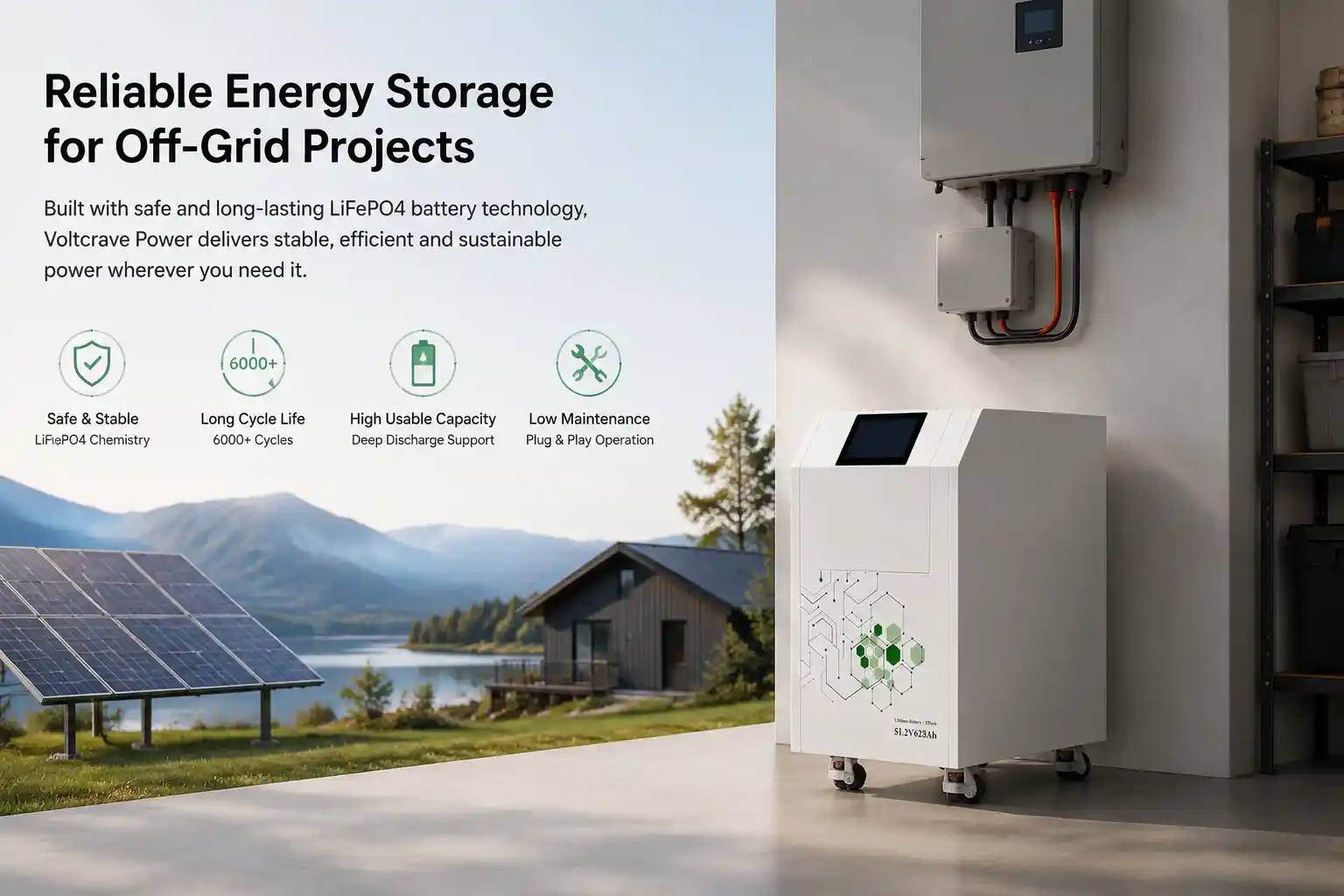
Why LiFePO4 Battery Technology Is Preferred for Modern Off-Grid Projects
Lithium iron phosphate batteries have become a preferred choice for many residential and commercial applications.
The advantages include:
- Longer service life
- Better safety characteristics
- Stable performance
- Higher charging efficiency
- Lower maintenance requirements
For remote projects where maintenance access is difficult, battery reliability becomes especially important.
A high-quality off grid solar power system depends not only on solar generation but also on the battery’s ability to store and deliver energy consistently.
Choosing the Right Supplier Model: Stock Products, OEM, or Custom Solutions
Different customers have different purchasing requirements.
Installers starting new projects may need standard products with shorter delivery times, while distributors and brands may require customized solutions.
| Purchasing Model | MOQ Requirement | Suitable Customer |
|---|---|---|
| Standard stock products | 10–20 units | Installers and small distributors |
| OEM branding | 300–500 units | Established distributors |
| Custom battery solutions | 300–500 units | Large projects and energy brands |
VoltCrave Power supports different cooperation models, including standard product supply and customized energy storage solutions for international markets.
Procurement Checklist for Selecting the Right Off Grid Battery Partner
Before confirming an order, buyers can use the following checklist:
✓ Confirm required battery capacity
✓ Verify inverter compatibility
✓ Review technical specifications
✓ Check certifications and testing reports
✓ Understand warranty terms
✓ Confirm production capability
✓ Evaluate communication response speed
✓ Check customization options
✓ Confirm delivery schedule
✓ Review after-sales support process
A supplier that can provide complete technical support usually creates fewer problems during installation.
FAQs
How do I choose the right off grid solar battery system size for my project?
The correct size depends on electricity consumption, backup requirements, solar generation capacity, and future expansion plans. Buyers should calculate daily energy usage and consider seasonal changes before selecting battery capacity.
A professional supplier can help analyze the project requirements and recommend a suitable configuration.
What is the difference between an off grid solar battery system and a grid-connected battery system?
An off-grid system operates independently without relying on the electricity grid. It requires enough solar generation and battery storage to supply power continuously.
Grid-connected systems can use utility power as backup, while off-grid systems must manage all energy requirements independently.
How long does an off grid solar battery system usually last?
The lifespan depends on battery chemistry, usage conditions, charging methods, and maintenance.
High-quality LiFePO4 battery systems can typically provide thousands of charge cycles when properly designed and operated.
Can I customize an off-grid solar battery system for my project?
Yes. Many professional suppliers provide customization options, including battery capacity, communication methods, enclosure design, and system configuration.
VoltCrave Power provides OEM and customized solutions for customers with specific project requirements.
For more information about battery solutions and common customer questions, visit our FAQ page:
Why Choose VoltCrave Power as Your Energy Storage Partner
Selecting an energy storage supplier is a long-term business decision. The right partner should provide not only reliable products but also technical support, stable manufacturing capability, and flexible cooperation options.
VoltCrave Power works with global installers, distributors, and project developers to provide dependable battery solutions for residential, commercial, and remote applications.
With professional manufacturing experience and customer-focused support, VoltCrave Power helps partners build safer and more efficient off-grid energy projects.
Whether you need standard inventory products or customized battery solutions, choosing a reliable supplier can reduce project risks and improve long-term business success.
Get a Reliable Off Grid Solar Battery System Solution for Your Project
If you are looking for a trusted off grid solar system supplier for residential, commercial, or remote energy projects, VoltCrave Power can provide professional technical support and customized solutions.
Contact our team to discuss your project requirements, battery configuration, OEM cooperation options, and global energy storage solutions.
Need help matching this topic to a real battery project?
Send your target application, capacity range, certification market, and order plan. VoltCrave can recommend a practical product direction.