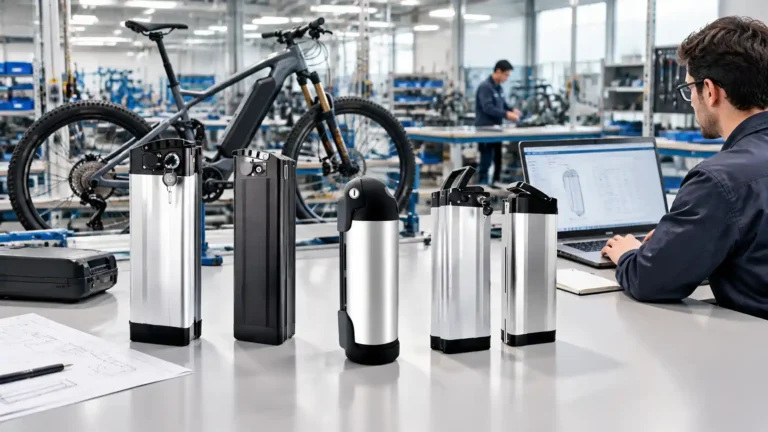
Choosing an energy storage supplier is not just a sourcing task. It is a risk decision that affects product safety, project approvals, warranty exposure, delivery schedules, customer trust, and long-term margin. A low unit price can look attractive in the first quotation, but the real cost appears later if the battery system lacks the right certification, has weak BMS protection, arrives with inconsistent documentation, or cannot be supported after installation.
This guide gives procurement teams, installers, distributors, EPCs, and private-label brands a practical RFQ scorecard for comparing suppliers before they commit to a pilot order or long-term OEM/ODM partnership. It is written for buyers who need more than a polished brochure. You need evidence, process, traceability, and a supplier who can explain why a system will work in your market and your application.
Voltcrave Power works with residential, commercial, industrial, portable, and customized energy storage buyers, so the scorecard below is built around the questions that matter before money changes hands. Use it to compare suppliers side by side, identify red flags, and build a better RFQ that filters weak vendors early.
Quick Answer: What Should an Energy Storage Supplier Prove?
A qualified energy storage supplier should prove five things before you award a purchase order: the product fits the application, the safety architecture is clear, the certification path is realistic, the factory quality process is documented, and the after-sales plan is credible. If one of those five areas is vague, the project risk moves from the supplier to you.
For a home battery distributor, that risk may become warranty claims and installer frustration. For a commercial battery energy storage project, it may become delayed commissioning, utility interconnection questions, or an authority having jurisdiction asking for documents that the supplier cannot provide quickly. For an OEM portable power station buyer, it may become inconsistent runtime, early returns, or poor reviews that damage the brand you are trying to build.
The goal of this scorecard is not to find the cheapest supplier. It is to find the best fit for the product category, compliance requirement, volume plan, and customer promise you need to keep.
How to Use This Scorecard
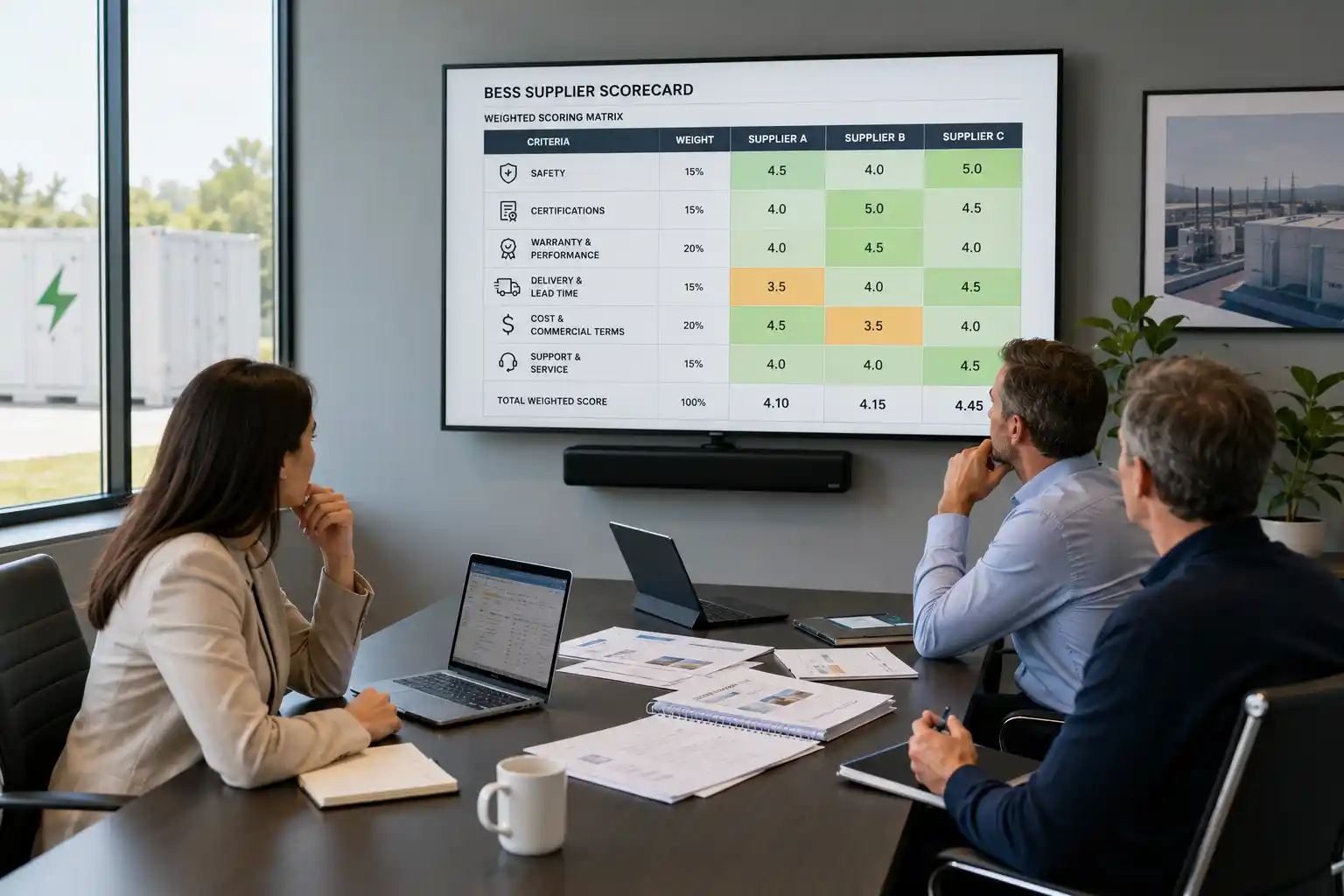
Start by assigning each supplier a score from 1 to 5 for every RFQ check. A score of 1 means the supplier gives only a vague answer or marketing claim. A score of 3 means the supplier provides a workable answer but limited supporting evidence. A score of 5 means the supplier provides documentation, examples, test data, process details, and a clear person responsible for follow-up.
Do not weight every category equally. If your project is going into a regulated market, certification and documentation may be worth more than styling or minor customization. If you are launching a private-label portable power station line, reliability testing, packaging, firmware stability, and after-sales support may be critical. If you are buying commercial battery energy storage systems, commissioning documents, communication protocols, thermal design, and service response matter heavily.
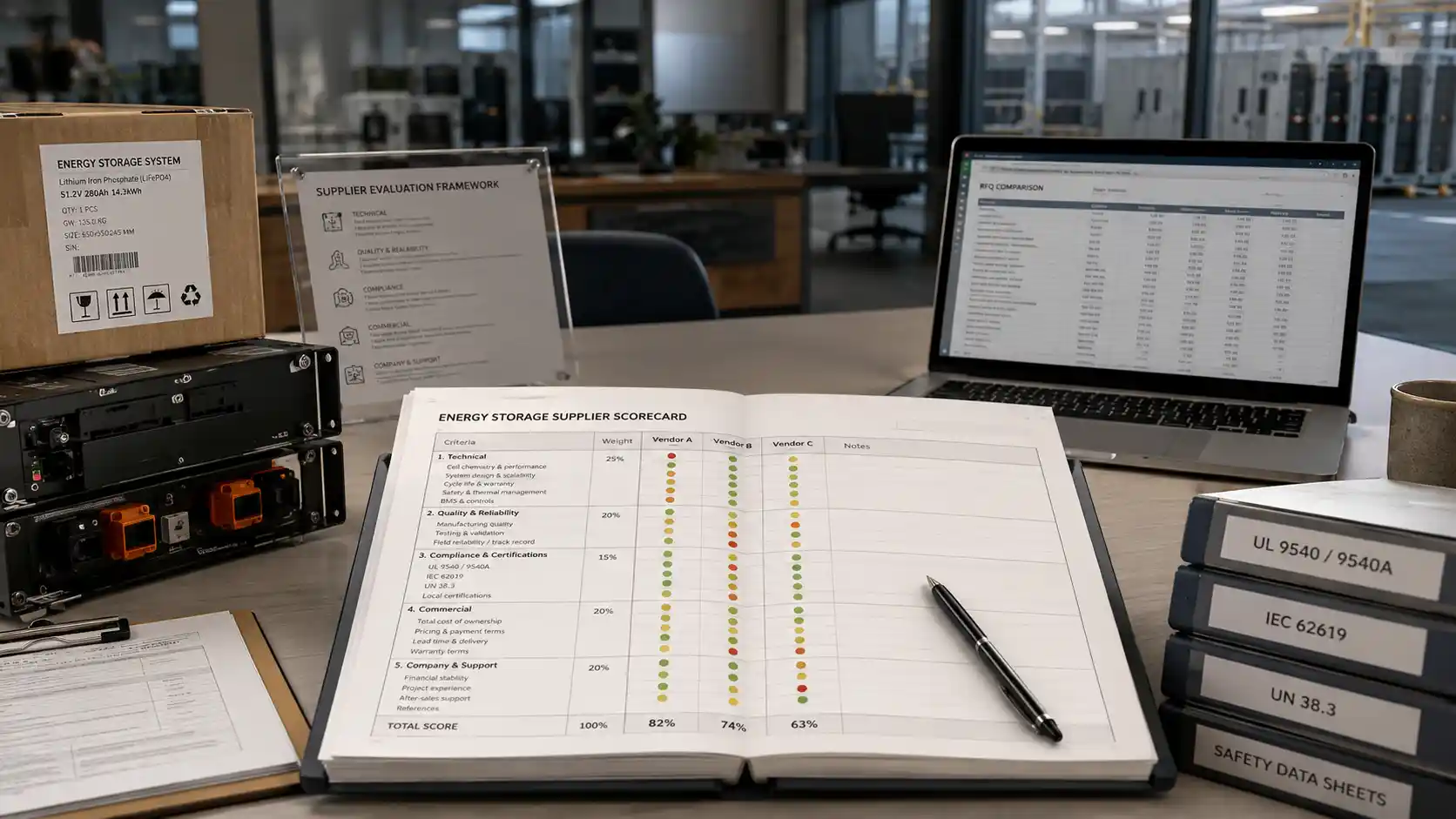
A useful scoring model is simple: safety and compliance 30 percent, product fit 20 percent, quality evidence 20 percent, delivery and cost 15 percent, and after-sales support 15 percent. The exact weighting should match your business model, but the point is to make the decision visible. A supplier who is cheap but weak on certification should not outrank a supplier with stronger evidence and a more realistic delivery plan.
The 15 RFQ Checks
1. Application Fit
Ask the supplier to explain which product configuration fits your exact use case. Avoid generic answers like “suitable for residential and commercial use.” A strong supplier should ask about load profile, backup duration, available solar input, grid connection, installation environment, expected cycling, communication needs, and local code requirements.
For residential energy storage, the supplier should discuss usable capacity, inverter compatibility, backup circuits, battery expansion, indoor or outdoor installation, and homeowner expectations. For commercial and industrial storage, they should ask about peak demand, tariff structure, site load data, transformer capacity, islanding requirements, and monitoring needs. For portable power stations, they should clarify output power, battery chemistry, charge time, AC and DC ports, solar input, thermal limits, and use environment.
If a supplier jumps straight to a model number without asking these questions, the product recommendation may be based on inventory rather than application fit.
2. Electrical Architecture
The RFQ should require voltage range, nominal capacity, usable capacity, maximum charge and discharge current, peak output, inverter compatibility, communication protocols, parallel limits, and expansion method. For larger systems, ask whether the supplier provides DC battery modules only, full AC-coupled systems, PCS integration, EMS integration, or turnkey containers.
This is where buyers often miss important details. Two batteries with the same nameplate capacity may behave differently because usable depth of discharge, BMS current limits, temperature derating, or inverter compatibility differ. Ask for real operating ranges, not only ideal values.
A reliable energy storage supplier should be able to provide clear electrical diagrams, connection methods, and protection logic. If the supplier cannot explain how the BMS, inverter, PCS, EMS, and monitoring platform communicate, the technical support burden may fall on your installers.
3. Cell Chemistry and Cell Traceability
Cell quality determines a large part of system life, safety, and consistency. Ask which chemistry is used, whether cells are prismatic, pouch, or cylindrical, and how cells are graded before pack assembly. For many stationary energy storage applications, LiFePO4 is preferred because of its thermal stability and long cycle life, but chemistry alone is not enough. You need traceability.
Ask for incoming cell inspection records, batch numbers, capacity grading process, internal resistance matching, and supplier qualification procedures. Strong suppliers can explain how they screen cells, group cells, and prevent mismatched packs. Weak suppliers may only say “A-grade cells” without showing how they define or verify that grade.
For OEM and ODM buyers, cell traceability is especially important because the customer sees your brand, not the cell supplier. If failures occur, you need batch-level information to diagnose the issue and manage warranty risk.
4. BMS Protection and Communication
The battery management system is not a small accessory. It is the safety brain of the battery. Your RFQ should ask about overcharge protection, over-discharge protection, over-current protection, short-circuit protection, temperature monitoring, cell balancing, low-temperature charging protection, communication protocols, firmware update method, event logs, and fault recovery logic.
A good supplier should provide a BMS function list and explain how those functions change by application. A portable power station, wall-mounted home battery, rack-mounted telecom battery, and commercial BESS cabinet do not need identical settings. The protection logic should match the environment and customer use case.
Also ask whether the BMS communicates through CAN, RS485, Modbus, Bluetooth, Wi-Fi, or a proprietary interface. For installer-friendly residential and commercial products, inverter compatibility lists and communication test evidence are extremely valuable.
5. Certification Path
Certification is not a decoration for a product page. It can decide whether the product can be shipped, installed, insured, connected, or accepted by customers. Ask which certificates are complete, which are in progress, which apply to the exact model being quoted, and which market they support.
For battery products, buyers often ask about UN38.3, MSDS, IEC 62619, UL 1973, UL 9540, UL 9540A, CE, UKCA, FCC, RoHS, and other market-specific requirements. The exact need depends on the product type and destination market. Do not assume a certificate for one model covers another model. Ask for the model number, report number, issuing lab, and scope.
If the supplier says certification can be arranged later, treat that as a schedule risk. For regulated projects, certification should be part of the product plan before launch, not an afterthought after the sales contract.
6. Thermal and Fire Safety Design
Ask how the product manages heat during charging, discharging, storage, and fault conditions. For a small portable power station, this may involve airflow, fan control, thermal sensors, cell spacing, and enclosure design. For residential and commercial ESS, it may involve cabinet ventilation, spacing, fire propagation testing, temperature derating, and installation guidance.
A serious supplier should be comfortable explaining thermal risk controls without using vague language. Ask what happens when ambient temperature rises, when the battery approaches current limits, when a cell sensor reports abnormal temperature, or when the system is installed in a poorly ventilated space. The answer should include protective behavior, alarm logic, and user guidance.
Thermal safety is an excellent test of supplier maturity. If the answer is only “LiFePO4 is safe,” the supplier is not giving you a complete engineering explanation.
7. Manufacturing Process Control
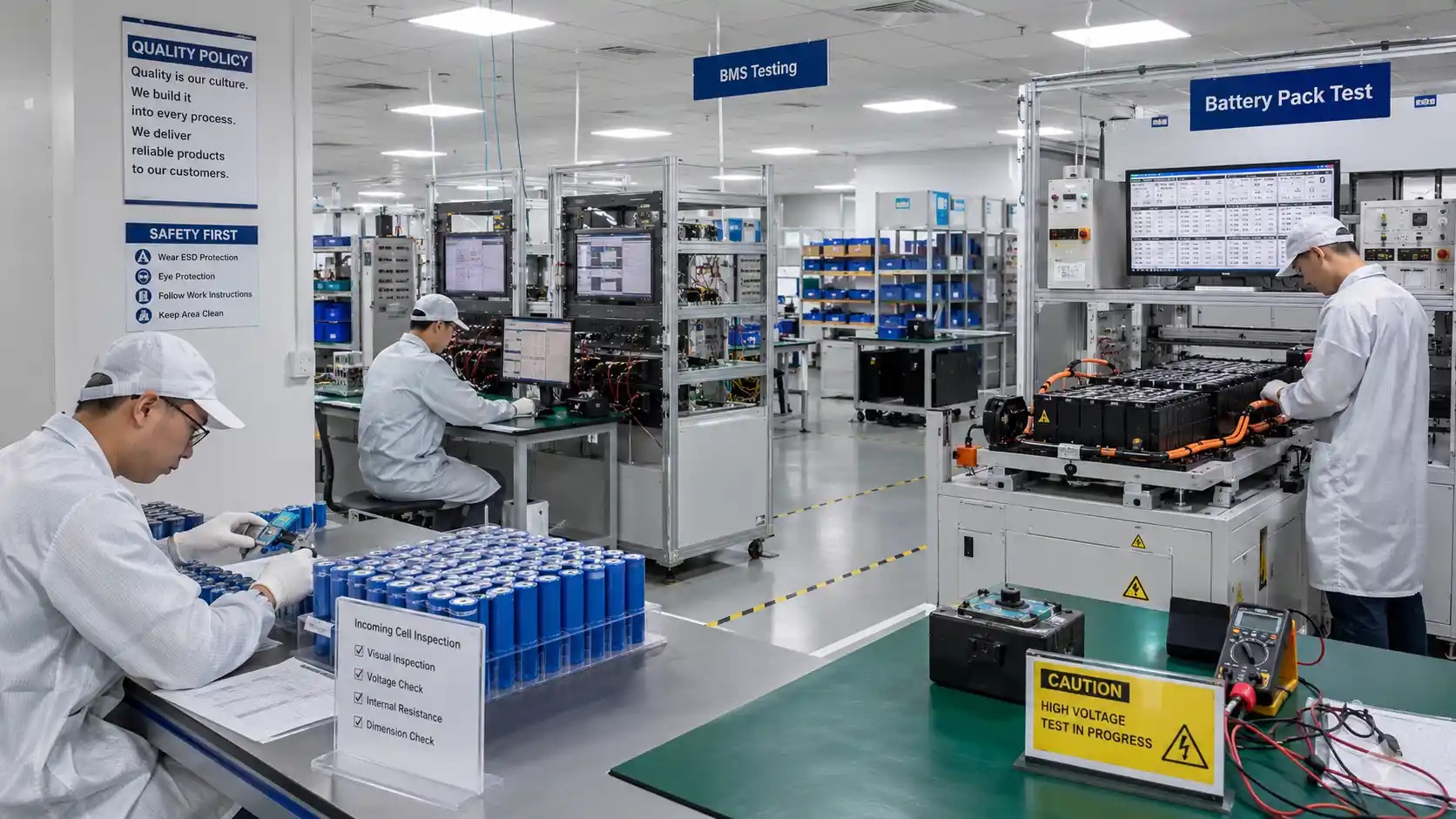
A factory tour video is useful, but process evidence is better. Ask for incoming inspection procedures, cell matching process, welding or assembly controls, BMS installation checks, insulation testing, aging tests, final function tests, packaging inspections, and shipment checklists.
The best suppliers have repeatable controls at every step. They do not rely on a final test to catch every mistake. Quality should be built into the process from incoming materials to outgoing cartons or pallets.
For private-label buyers, ask how the supplier prevents wrong labels, mixed accessories, mismatched manuals, firmware inconsistency, or packaging errors. These problems are not always dramatic, but they create customer dissatisfaction and expensive rework.
8. Test Reports and Sample Validation
Before a bulk order, request sample validation steps. This should include electrical performance testing, charge and discharge verification, capacity testing, temperature behavior, communication testing, accessory checks, packaging drop considerations, and user manual review.
A sample is not just a product demonstration. It is a chance to verify whether the supplier can support your target market. Install the sample the way your customer will use it. Test the ports, app, display, alarms, inverter communication, and charging modes. If the supplier cannot support a structured sample test, bulk order problems may be harder to manage.
Ask whether the supplier can provide a sample test plan. If they already have one, that is a good signal.
9. Documentation Package
Documentation often separates professional suppliers from opportunistic sellers. Your RFQ should request datasheets, installation manuals, user manuals, warranty documents, certificate copies, packing lists, transport documents, troubleshooting guides, wiring diagrams, communication protocol documents, and maintenance recommendations.
For commercial and industrial projects, ask for commissioning templates, FAT documents, SAT documents, handover checklist, alarm code explanations, and monitoring setup guides. These documents make installers faster and reduce customer support pressure.
A missing document today becomes a project delay tomorrow. Score suppliers higher when documents are complete, consistent, and written for real users rather than copied from a generic template.
10. Customization Scope
If you need OEM or ODM service, clarify the difference between cosmetic customization and engineering customization. Cosmetic customization may include logo, color, packaging, label, manual, or app branding. Engineering customization may involve capacity, enclosure, port layout, firmware, communication protocol, temperature settings, inverter compatibility, or mechanical dimensions.
Ask which items are available at low MOQ and which require tooling, certification updates, longer lead time, or engineering fees. This prevents a common problem: the buyer assumes everything can be customized, while the supplier assumes only branding is included.
Voltcrave Power recommends defining customization in the RFQ line by line. That makes quotation, sampling, testing, and approval much cleaner.
11. MOQ, Ramp-Up, and Delivery Plan
MOQ should be evaluated with your launch plan. A very low MOQ can be useful for market testing, but it should not hide weak production capacity. A high MOQ may reduce unit price, but it can create inventory risk if the product has not been validated.
Ask for MOQ by model, by color, by packaging, by certification variant, and by customization type. Then ask how production lead time changes from sample order to pilot order to bulk order. For seasonal products like portable power stations, delivery planning can decide whether you catch the selling season.
Also ask how the supplier handles component shortages or schedule changes. A realistic answer is better than a perfect promise.
12. Warranty Terms and Claim Process
Warranty is not only a number of years. Ask what is covered, what is excluded, how claims are submitted, what evidence is required, who pays freight, how replacement parts are handled, and how response time is measured.
For home batteries and commercial systems, ask whether remote diagnostics are available and whether the supplier can read event logs. For portable power stations, ask how returns are classified, how battery degradation is handled, and what failure modes have been seen in previous batches.
A supplier with a clear claim process is usually more valuable than a supplier with a longer but vague warranty promise.
13. Shipping, Packaging, and Compliance Documents
Lithium batteries require disciplined logistics. Ask for UN38.3, MSDS, transport labels, packaging method, carton strength, palletization, container loading plan, and destination-market documentation. For high-value products, ask about spare parts packaging and damage prevention during long-distance shipping.
The packaging design should protect the product and the brand experience. Dented cartons, missing accessories, weak manuals, and unclear labels create problems before the customer even uses the product.
For OEM buyers, shipping documentation and packaging consistency should be part of the quality score, not an afterthought.
14. Total Cost, Not Just Unit Price
The cheapest quotation may become expensive when you add certification gaps, warranty risk, shipping damage, installer support, slow response, rework, lost season timing, or customer returns. Build a total cost view.
Compare unit price, sample cost, tooling cost, certification cost, packaging cost, freight, spare parts, warranty reserve, expected return rate, and internal support time. For energy storage products, quality problems are not small e-commerce inconveniences. They can become safety, compliance, or reputation issues.
A good supplier should help you understand the cost drivers rather than simply pushing a lower headline price.
15. Communication Quality
The last check is simple: how well does the supplier communicate before the order? Do they answer technical questions directly? Do they admit uncertainty when local rules require confirmation? Do they provide documents on time? Do sales, engineering, and quality teams give consistent answers?
Early communication predicts later support. If the supplier is vague during the RFQ stage, they may be slower when a shipment is delayed or a customer reports a fault.
Choose a partner who communicates clearly under pressure.
Quality Evidence Matters More Than Sales Claims
Every energy storage supplier can claim good cells, strict quality control, fast delivery, and professional support. The difference is evidence. Evidence includes test reports, batch records, sample validation data, factory process documents, certification scopes, warranty process documents, and reference use cases.
For buyers, evidence reduces uncertainty. It also helps you sell with more confidence. If you are a distributor, your installers will ask questions. If you are a private-label brand, your customers will compare your product to more established names. If you are an EPC, your project owner will want to know why a product was selected.
That is why the RFQ should ask for proof. Not every supplier will have everything ready, especially for a customized product, but a capable supplier should know what evidence is needed and how to provide it.
Red Flags to Watch For
Be cautious when a supplier refuses to share certificate scope, avoids model-specific documentation, gives unrealistic lead times, cannot explain BMS logic, claims every product is suitable for every market, or pushes a bulk order before sample validation. Also be cautious when the quotation is much lower than others without a clear reason.
A professional buyer does not need to reject every imperfect supplier. Some issues can be solved through clearer documentation, a revised configuration, or staged validation. The real problem is when a supplier hides uncertainty instead of managing it.
A Simple Supplier Scoring Table
Use this table as a starting point in your RFQ comparison.
| Category | Weight | What a High Score Looks Like |
|---|---|---|
| Safety and certification | 30% | Model-specific documents, clear certification path, thermal safety explanation |
| Product fit | 20% | Application-based recommendation and complete electrical data |
| Quality evidence | 20% | Incoming inspection, cell matching, test records, sample plan |
| Delivery and cost | 15% | Realistic MOQ, lead time, packaging, logistics, total cost clarity |
| After-sales support | 15% | Clear warranty process, diagnostics, spare parts, response plan |
This simple model keeps the conversation honest. It also helps your team explain the purchasing decision internally.
FAQ
What is the most important question to ask an energy storage supplier?
Ask for evidence that the exact product being quoted fits your application and market. A model that works for one region, inverter, tariff structure, or installation environment may not work for another.
Should I choose the cheapest supplier?
Not for energy storage. Price matters, but safety, certification, documentation, delivery reliability, and after-sales support can affect total cost more than the first quotation.
How many suppliers should I compare?
For a serious RFQ, compare at least three qualified suppliers using the same technical and commercial questions. The same RFQ format makes differences easier to see.
Is OEM customization risky?
It can be safe when the scope is clear. Logo and packaging customization are usually simple. Firmware, enclosure, BMS settings, capacity, and certification changes require more validation.
Final Thoughts
An energy storage supplier scorecard helps you move from “who gave the best price” to “who can protect our customers, our timeline, and our brand.” The best supplier is not always the biggest or the cheapest. It is the supplier whose product, process, documentation, and support match your market.
Use the 15 RFQ checks before sample approval. Use them again before bulk orders. Use them when comparing a current supplier against a new one. The discipline will save time, reduce hidden risk, and make every procurement conversation more professional.
For buyers who need residential energy storage, commercial battery systems, portable power stations, or OEM/ODM lithium battery solutions, Voltcrave Power can support supplier evaluation conversations with application-focused guidance, product configuration support, and documentation-oriented project planning.
Need help matching this topic to a real battery project?
Send your target application, capacity range, certification market, and order plan. VoltCrave can recommend a practical product direction.