For energy storage buyers, UL 9540 and UL 9540A can feel confusing because the names look similar and both are connected to battery safety. Yet they do not mean the same thing. Confusing them during procurement can delay a project, create approval problems, or lead to a product being quoted for a market where it cannot be installed as expected.
The short answer is this: UL 9540 is a safety standard for energy storage systems, while UL 9540A is a test method used to evaluate thermal runaway fire propagation behavior. UL 9540 is about system-level certification. UL 9540A is about fire test data that may be required by code officials, fire departments, engineers, or authorities having jurisdiction when reviewing an energy storage installation.
This article is written for buyers, distributors, installers, EPCs, and project developers who need to ask the right questions before selecting a battery energy storage supplier. It is not legal advice, and local requirements can vary. Always confirm the latest requirement with the authority having jurisdiction, the project engineer, the utility, the insurer, and the applicable code in your target market.
Voltcrave Power supports residential, commercial, industrial, and OEM/ODM energy storage buyers, and one lesson is consistent across markets: certification planning should start before the purchase order, not after the product arrives.
Quick Answer for Buyers
UL 9540 is used to evaluate the safety of a complete energy storage system. It can include the battery, battery management system, enclosure, power conversion equipment, controls, thermal management, and system-level safety functions, depending on the product scope. When a buyer asks whether a system is UL 9540 certified, the question should be model-specific and system-specific.
UL 9540A is not the same as a finished product certification. It is a test method that evaluates how a battery energy storage system or component behaves during thermal runaway. The results can help determine fire propagation risk, installation spacing, fire protection assumptions, and documentation needed for local review.
In practical terms, UL 9540 helps answer: “Has this ESS been evaluated as a safe system?” UL 9540A helps answer: “What happens if thermal runaway occurs, and how does that affect installation approval?” Both can matter, but they play different roles.
UL 9540 and UL 9540A Are Not the Same Thing
Many buyers use the two terms as if they are interchangeable. That is a mistake. A supplier may have UL 9540A test data but no UL 9540 certification for the full system. Another supplier may have a certified system but still need project-specific UL 9540A documentation to satisfy an installation reviewer. The details matter.
UL 9540 is generally associated with energy storage system safety certification. It looks at the system as a product, including how different components work together. The goal is to reduce risks related to electrical safety, fire safety, control systems, enclosure design, and abnormal operating conditions.
UL 9540A is a thermal runaway fire propagation test method. It is often referenced when stakeholders need to understand whether a failure in one cell, module, unit, or installation can propagate in a dangerous way. The test result may influence spacing, location, fire suppression assumptions, and emergency response considerations.
The important procurement point is simple: do not accept the phrase “UL certified” without knowing which standard, which model, which configuration, and which report scope the supplier is referring to.
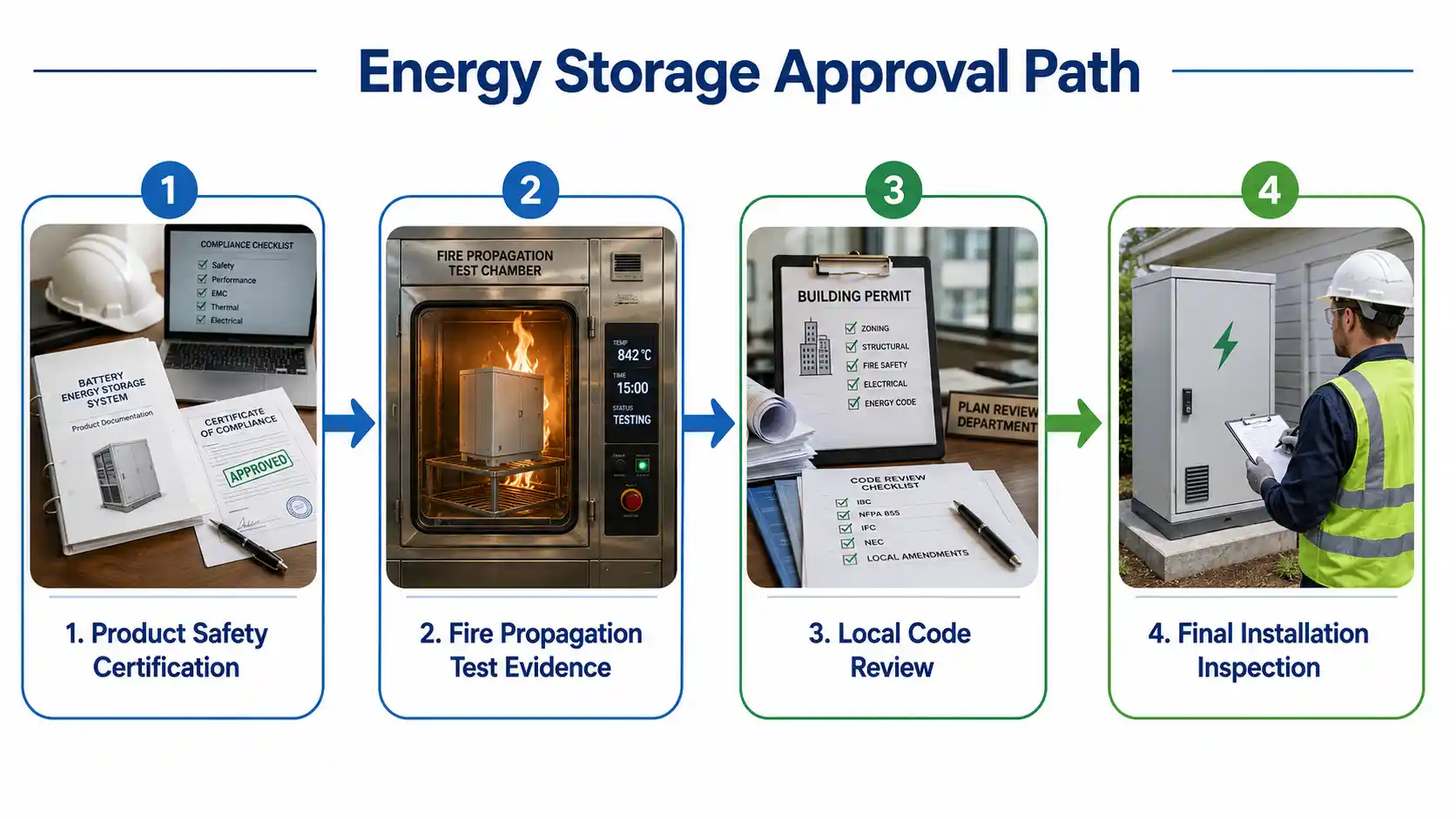
Why This Matters Before an RFQ
Certification affects more than a datasheet. It can affect whether a product can be imported, installed, interconnected, insured, financed, or approved by a customer. If a buyer discovers a certification gap after the contract is signed, the options are usually painful: delay the project, change the product, pay for additional testing, redesign the system, or argue with reviewers who are simply doing their job.
For a residential energy storage distributor, unclear certification can become installer reluctance. Installers do not want to risk failed inspections. For a commercial BESS project, unclear documentation can delay the authority review or create questions from the fire marshal. For private-label brands, certification gaps can damage confidence before the product has even launched.
That is why an RFQ should ask for model-specific evidence. A certificate for a different capacity, enclosure, inverter pairing, battery module, or configuration may not cover your project. Even a small product change can affect the certification scope.
What UL 9540 Usually Tells You
UL 9540 helps buyers evaluate whether an energy storage system has been assessed as an integrated system. That is important because a battery module alone is not the same as a complete storage system. Energy storage safety depends on cells, modules, BMS logic, enclosure design, power conversion equipment, wiring, controls, sensors, and communication working together.
When reviewing UL 9540 status, buyers should ask several questions. What exact product model is covered? What capacity range is included? Which inverter or power conversion equipment is included? Is the system certified as a package, or are only individual components certified? Is the installation type covered, such as wall-mounted, rack-mounted, cabinet, outdoor, or containerized? Are there limitations in the certification report?
A serious supplier should be able to provide a clear answer without making you guess. The buyer does not need to become a certification engineer, but the buyer does need to understand whether the quoted product matches the certified product.
What UL 9540A Usually Tells You
UL 9540A focuses on thermal runaway fire propagation behavior. Thermal runaway is a failure condition where a cell releases heat and energy in a way that can become self-sustaining. The question for an energy storage installation is not only whether one cell can fail, but whether that failure can spread to other cells, modules, cabinets, racks, or nearby systems.
UL 9540A test data can help project stakeholders understand risk at different levels. Depending on the test scope, it may address cell-level behavior, module-level propagation, unit-level performance, or installation-level implications. The result can be used by engineers and authorities to evaluate spacing, ventilation, fire protection, and emergency response assumptions.
Buyers should not treat UL 9540A as a marketing label. Ask for the actual scope. Which battery chemistry was tested? Which module? Which cabinet? Which enclosure? Was the tested configuration the same as the product being quoted? Are there installation limitations connected to the results?
How AHJs May Look at ESS Documentation
An authority having jurisdiction may review an energy storage project from a safety and code perspective. The AHJ may want to know where the system will be installed, how much energy is stored, what chemistry is used, whether the product is listed, what spacing is planned, what fire protection measures are included, and how emergency responders should approach the system.
Different jurisdictions can interpret requirements differently. Some may require specific documentation for indoor installations. Some may focus on fire separation distances. Some may ask for thermal runaway test data. Some may require product listings, installation manuals, labeling, shutdown procedures, or signage. The supplier cannot control every local decision, but the supplier can prepare documents that make the review easier.
This is where buyers can reduce risk. Do not wait until installation to collect documents. Build the documentation request into the RFQ. Ask your supplier to provide certificates, test reports, installation manuals, spacing guidance, wiring diagrams, battery chemistry information, and emergency response recommendations.
What Buyers Should Ask Before Ordering
Before placing an order, ask the supplier these questions in writing. Is the exact model UL 9540 certified? If yes, what is the certificate number and scope? Does the system include all components required for the certified configuration? Is there UL 9540A test data? If yes, what level was tested and what configuration was used? Are there installation limits related to spacing, indoor use, outdoor use, capacity, or enclosure type?
Ask whether the supplier can provide documents for the installer, project engineer, insurer, and AHJ. Ask whether the supplier has experience supporting projects in your target market. Ask whether changes to branding, enclosure, inverter pairing, firmware, or battery module would affect certification.
A professional supplier will not answer every question with “yes.” Certification is specific. The best answer is accurate, documented, and careful. A vague yes can be more dangerous than a clear explanation of what is covered and what is not.
Common Buyer Mistakes
The first mistake is accepting a screenshot instead of a complete certificate or report scope. Screenshots are easy to misunderstand. Buyers need the model, issuing organization, scope, date, and limitations.
The second mistake is assuming component certification equals system certification. A certified cell or module does not automatically make the complete ESS certified. The system-level combination matters.
The third mistake is changing the product after certification without checking consequences. A different inverter, enclosure, BMS setting, module arrangement, or thermal design can affect the compliance picture.
The fourth mistake is ignoring local approval. A product may have strong documentation and still need local review for the specific site. The earlier the project team aligns on documentation, the smoother the process becomes.
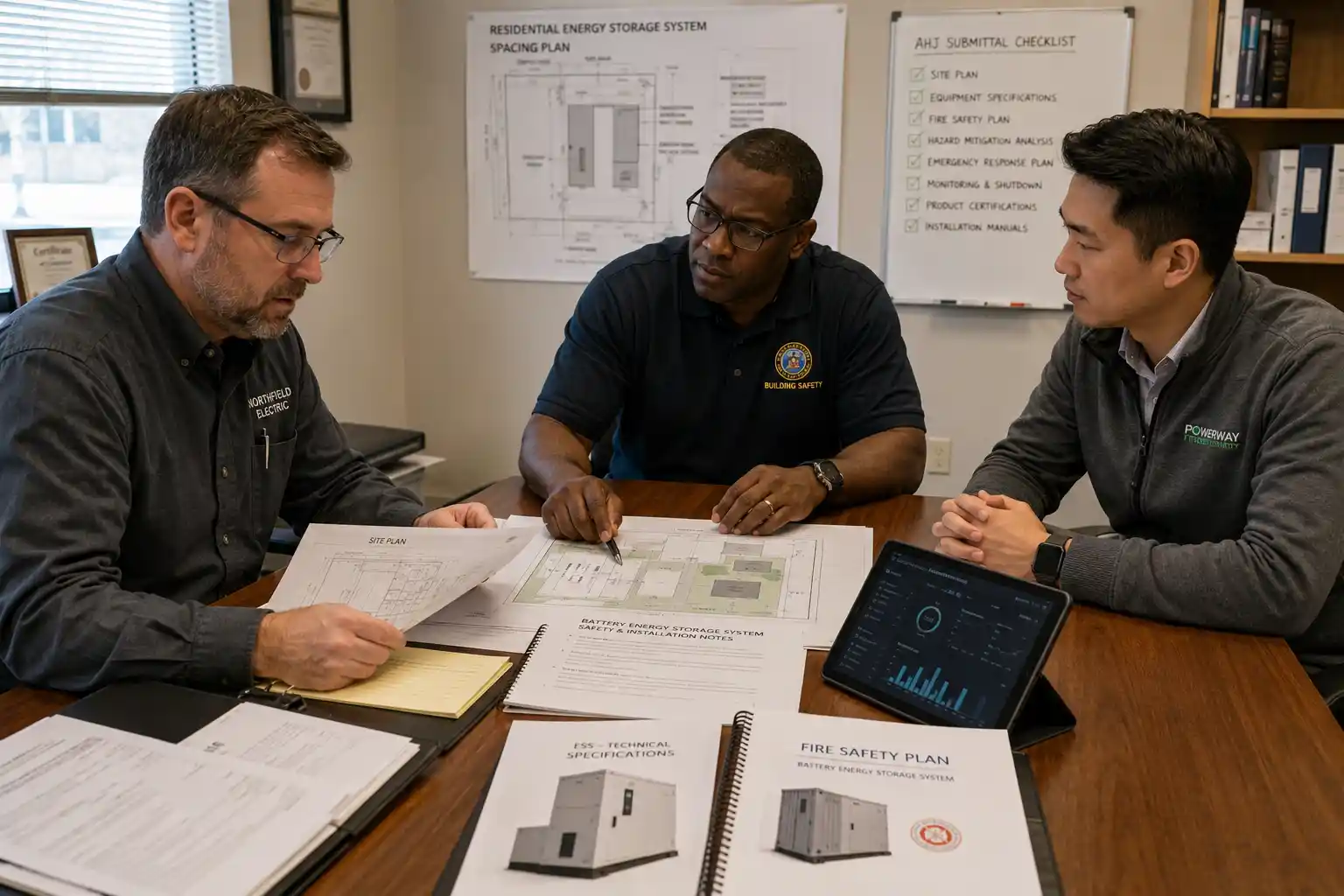
How Suppliers Should Support the Approval Process
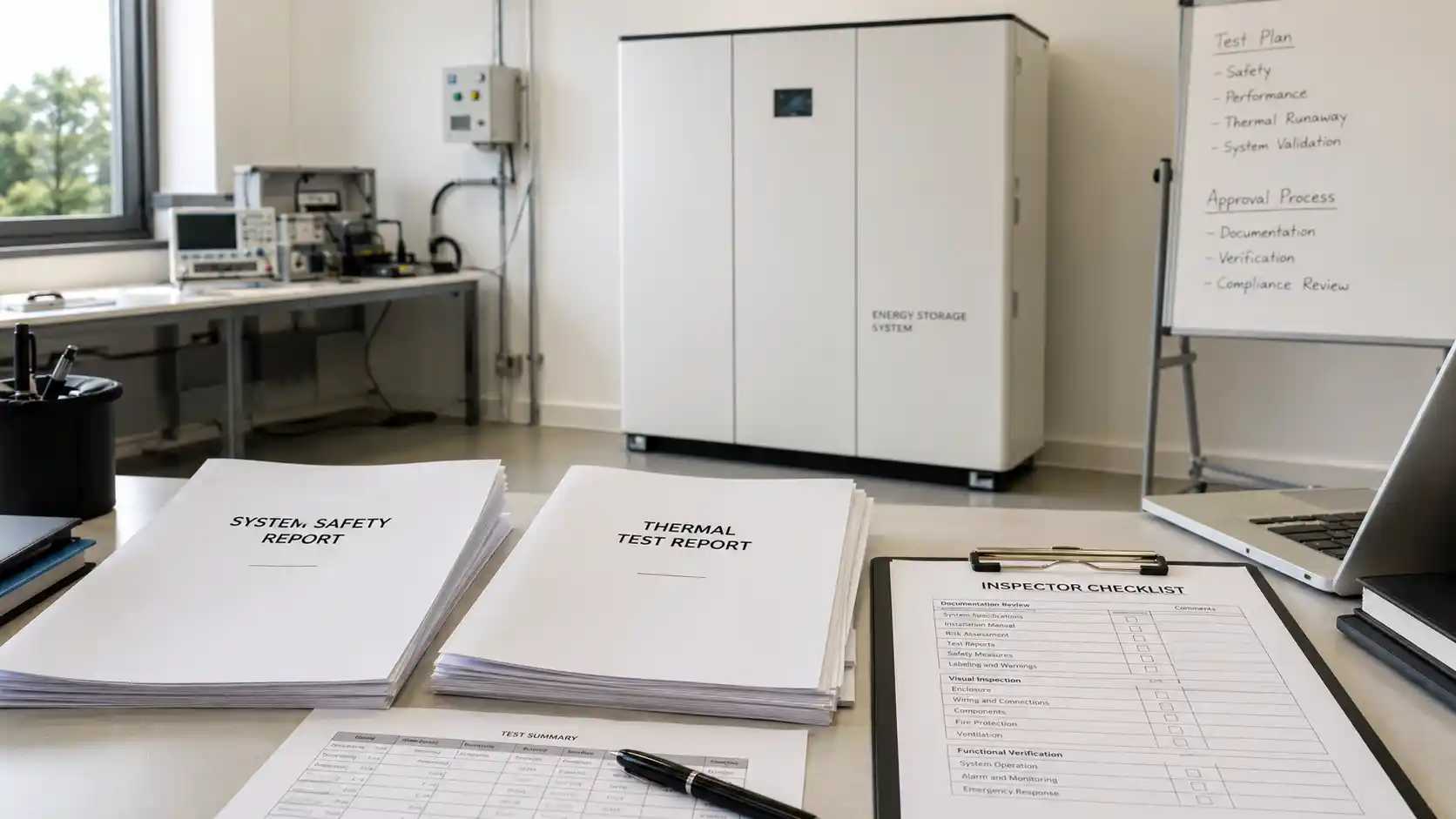
A qualified energy storage supplier should provide organized documentation, not random files scattered across email threads. A good document package may include product datasheets, certificates, test report summaries, installation manuals, wiring diagrams, transportation documents, warranty terms, emergency response guidance, and commissioning checklists.
For commercial and industrial projects, the supplier should also support engineering review questions. That does not mean the supplier replaces the project engineer or the AHJ. It means the supplier can explain product limits, safety functions, communication interfaces, alarm logic, and installation requirements in a way that helps professionals do their work.
For OEM and ODM buyers, this support is even more important because your brand may be on the product. If a customer or inspector asks for documentation, your ability to answer quickly affects your credibility.
How to Write Certification Requirements in an RFQ
A strong RFQ should not simply say “must have certifications.” It should specify destination market, product category, installation environment, expected capacity, system configuration, and required documents. It should ask the supplier to identify which documents are complete, which are in progress, and which are not applicable.
Here is a simple structure. First, describe the use case. Second, list required standards or documents based on your market. Third, request model-specific certificates and scopes. Fourth, ask for installation limitations. Fifth, ask whether customization changes certification status. Sixth, require the supplier to identify open compliance risks before quotation approval.
This creates a better buyer-supplier conversation. It also prevents the supplier from quoting a product that cannot meet the real requirement.
UL 1973, UN38.3, IEC 62619, and Other Standards
UL 9540 and UL 9540A are important, but they are not the only terms buyers see. UL 1973 is often associated with stationary battery safety. UN38.3 is commonly required for lithium battery transportation. IEC 62619 is widely discussed for industrial lithium battery safety. Markets may also require CE, UKCA, FCC, RoHS, grid connection documents, or other local approvals.
The key lesson is not to memorize every standard. The key lesson is to map standards to product type, market, use case, and installation environment. A portable power station, a wall-mounted home battery, a rack battery, and a containerized BESS may need different documentation.
Voltcrave Power encourages buyers to treat certification as a project requirement, not a product decoration. The right question is not “Do you have certificates?” The right question is “Which documents cover the exact model, configuration, market, and installation scenario we plan to use?”
Practical Approval Checklist
Before ordering an ESS for a regulated market, prepare a checklist. Include exact model number, capacity, battery chemistry, system diagram, inverter or PCS pairing, enclosure type, installation location, certificate list, UL 9540 status, UL 9540A test data status, UL 1973 or relevant battery safety documents, transport documents, installation manual, emergency guidance, warranty terms, and supplier contact for technical support.
Share this checklist with your installer, engineer, or local reviewer as early as possible. Early review may reveal missing documents before the project schedule is under pressure. This can save weeks of delay.
For private-label buyers, keep a version-controlled document folder for every model and batch. If you change cells, BMS firmware, enclosure, label, or inverter compatibility, record the change and ask whether certification scope is affected.
FAQ
Does UL 9540A mean a product is UL 9540 certified?
No. UL 9540A is a thermal runaway fire propagation test method. UL 9540 is a system safety certification. They are related in the energy storage approval conversation, but they are not interchangeable.
Can I install an ESS with only UL 9540A data?
It depends on the product, location, project type, and local requirements. Always confirm with the AHJ, project engineer, utility, and applicable code. Do not assume test data alone is enough.
Is LiFePO4 automatically accepted because it is safer?
No chemistry is automatically accepted without documentation. LiFePO4 has strong safety advantages in many applications, but buyers still need product-specific safety design, certification, installation guidance, and approval documents.
Should OEM branding be done before certification?
Branding can affect labeling and documentation. Engineering changes can affect certification more deeply. Discuss the customization scope with the supplier before testing or market launch.
Final Thoughts
UL 9540 and UL 9540A are both important, but they answer different questions. UL 9540 helps buyers understand system-level safety certification. UL 9540A helps stakeholders evaluate thermal runaway fire propagation behavior. A serious energy storage buyer should ask for both the right documents and the right explanation.
The best procurement approach is simple: define the market, define the installation, ask for model-specific evidence, check the report scope, involve local reviewers early, and avoid vague claims. Certification clarity may not be the most exciting part of an energy storage project, but it is one of the strongest ways to protect schedule, budget, and customer trust.
For buyers planning residential, commercial, industrial, or OEM/ODM battery energy storage projects, Voltcrave Power can help structure product selection conversations around application fit, documentation readiness, safety expectations, and long-term support.
Need help matching this topic to a real battery project?
Send your target application, capacity range, certification market, and order plan. VoltCrave can recommend a practical product direction.