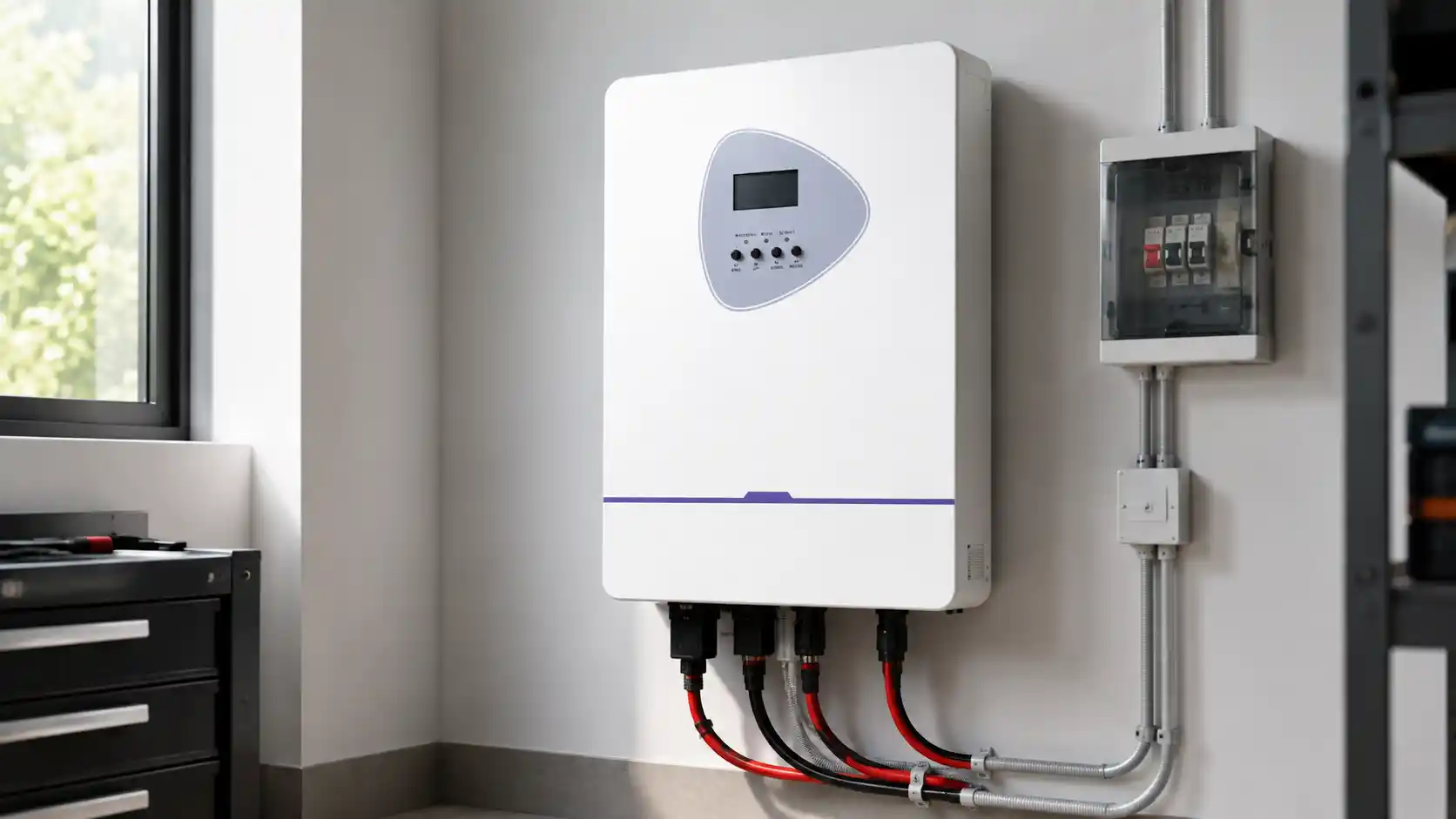
Choosing a battery and choosing an inverter are two separate purchasing decisions. Making sure they operate correctly as one system is a different task.
A battery can have enough energy capacity but still be unable to supply the current required by the inverter. An inverter can have sufficient rated power but still shut down when a motor starts. A battery and inverter can both have CAN or RS485 ports and still fail to communicate.
For solar installers, distributors, system integrators, and project buyers, battery-inverter matching therefore goes beyond comparing kW and kWh.
The complete check should cover voltage, current, surge demand, usable energy, charging parameters, BMS communication, firmware support, load behavior, and future expansion.
Start With the Real Question: Will the Battery and Inverter Work Together?
A common mistake is to start with inverter wattage.
For example:
“I need a 5kW inverter.”
That tells only part of the story.
Before selecting the inverter, the project requirements should answer several questions:
- What loads must the system power?
- What is the maximum simultaneous load?
- Are there motors, pumps, compressors, or other high-starting-current loads?
- How many hours of backup are required?
- What battery voltage will the system use?
- How much continuous current can the battery deliver?
- What peak current can the BMS allow?
- Does the inverter communicate with the selected battery?
- Will the system need additional batteries, PV capacity, or loads later?
These questions determine whether the battery and power inverter are genuinely compatible.
Match Battery Voltage Before Comparing Capacity
Battery voltage is the first technical compatibility check.
Battery systems may use nominal voltage classes such as 12V, 24V, or 48V. The inverter must be designed to operate within the corresponding battery voltage range.
Do not check only the nominal number.
Compare:
- Nominal battery voltage
- Battery operating voltage range
- Inverter battery input range
- Low-voltage cutoff
- Charging voltage range
- Maximum charging current
A battery labeled as a certain nominal voltage is not automatically compatible with every inverter carrying the same nominal voltage description.
The operating ranges still need to overlap correctly.
Why System Voltage Matters More as Power Increases
The relationship between power, voltage, and current is fundamental:
Current ≈ Power ÷ Voltage
As a simplified theoretical example, a 5,000W DC demand at 48V corresponds to approximately:
5,000 ÷ 48 ≈ 104A
The same power at 24V would require roughly twice the current, while a 12V system would require roughly four times the 48V current.
Actual battery-side current can be higher because real inverters are not 100% efficient.
This is why higher-power energy storage systems often move away from very low DC voltages. Increasing current affects:
- Battery discharge requirements
- Cable sizing
- Voltage drop
- Connections
- Protection devices
- Heat generation
- BMS current limits
The correct voltage should therefore be selected according to the complete system architecture rather than one component in isolation.
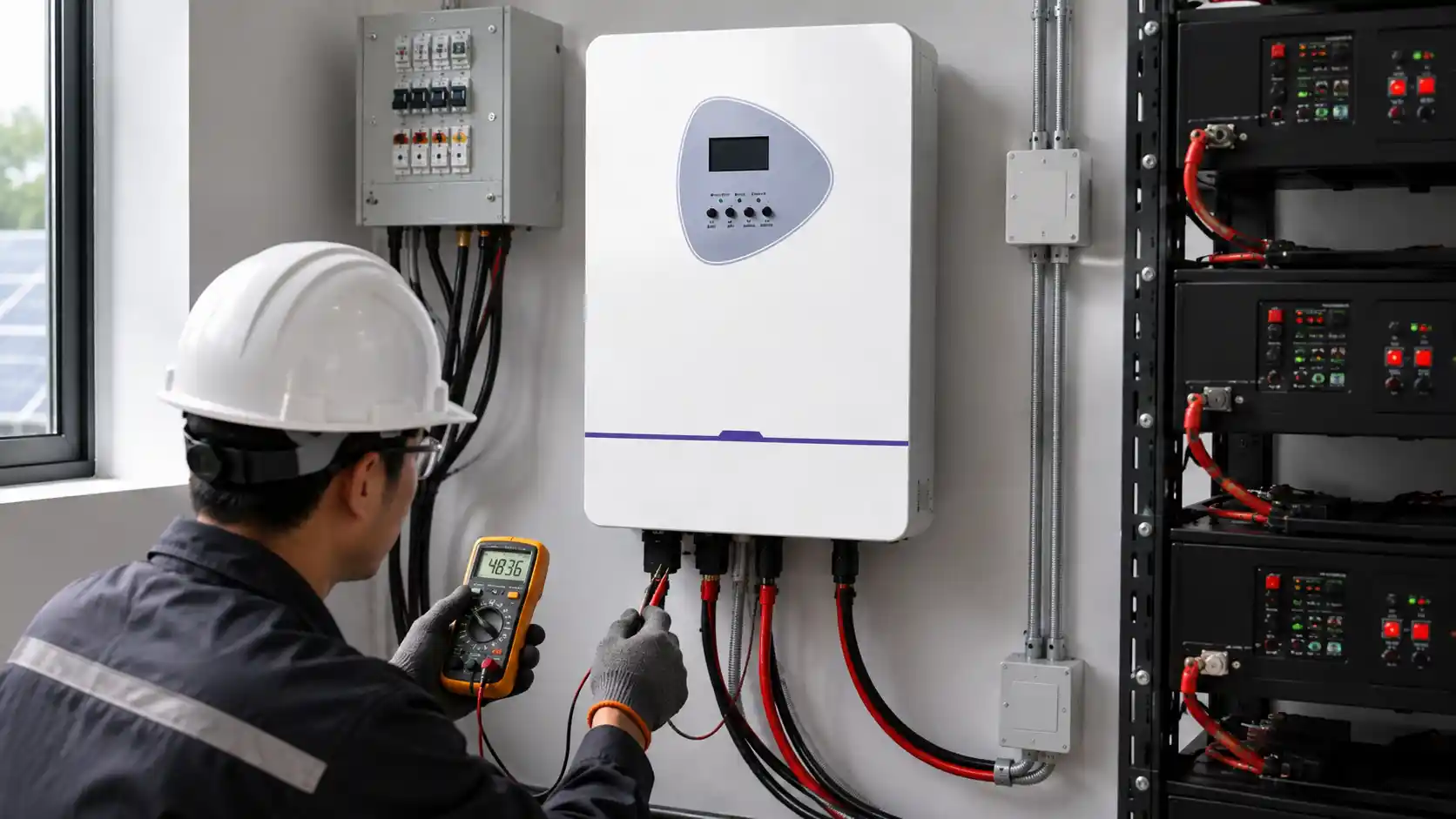
Battery Capacity Does Not Tell You How Much Power the Battery Can Deliver
One of the most important distinctions in battery-inverter matching is:
Energy is not the same as power.
Battery capacity, usually expressed in kWh, tells you how much energy is stored.
It does not by itself tell you how much power the battery can continuously deliver.
A battery may contain enough stored energy for several hours of operation while its BMS limits the discharge current below what a large inverter requires.
Before matching an inverter with battery storage, check battery specifications such as:
- Continuous discharge current
- Maximum or peak discharge current
- BMS current limit
- Recommended discharge power
Then compare them with:
- Inverter rated output
- Expected continuous load
- Peak load
- Battery-side DC current requirement
This is especially important when a project uses a relatively high-power inverter with a comparatively small battery bank.
Why Can a System Shut Down Even When the Inverter Looks Large Enough?
This is where nameplate sizing often fails.
Imagine that the inverter has enough rated AC output to run the connected equipment.
The system may still shut down when a pump, air conditioner, refrigerator compressor, or motor starts.
Why?
Because the startup demand can be considerably higher than normal running demand.
The complete surge path is:
Load startup demand → inverter surge output → battery DC current → BMS peak-current limit
All four stages need to work together.
If the inverter can deliver the surge but the battery cannot provide the corresponding current, the BMS may enter protection.
If the battery can supply the current but the inverter does not have enough surge capability, the inverter may trip instead.
This is why selecting a battery inverter based only on average load power can produce an apparently well-sized system that still fails during real operation.
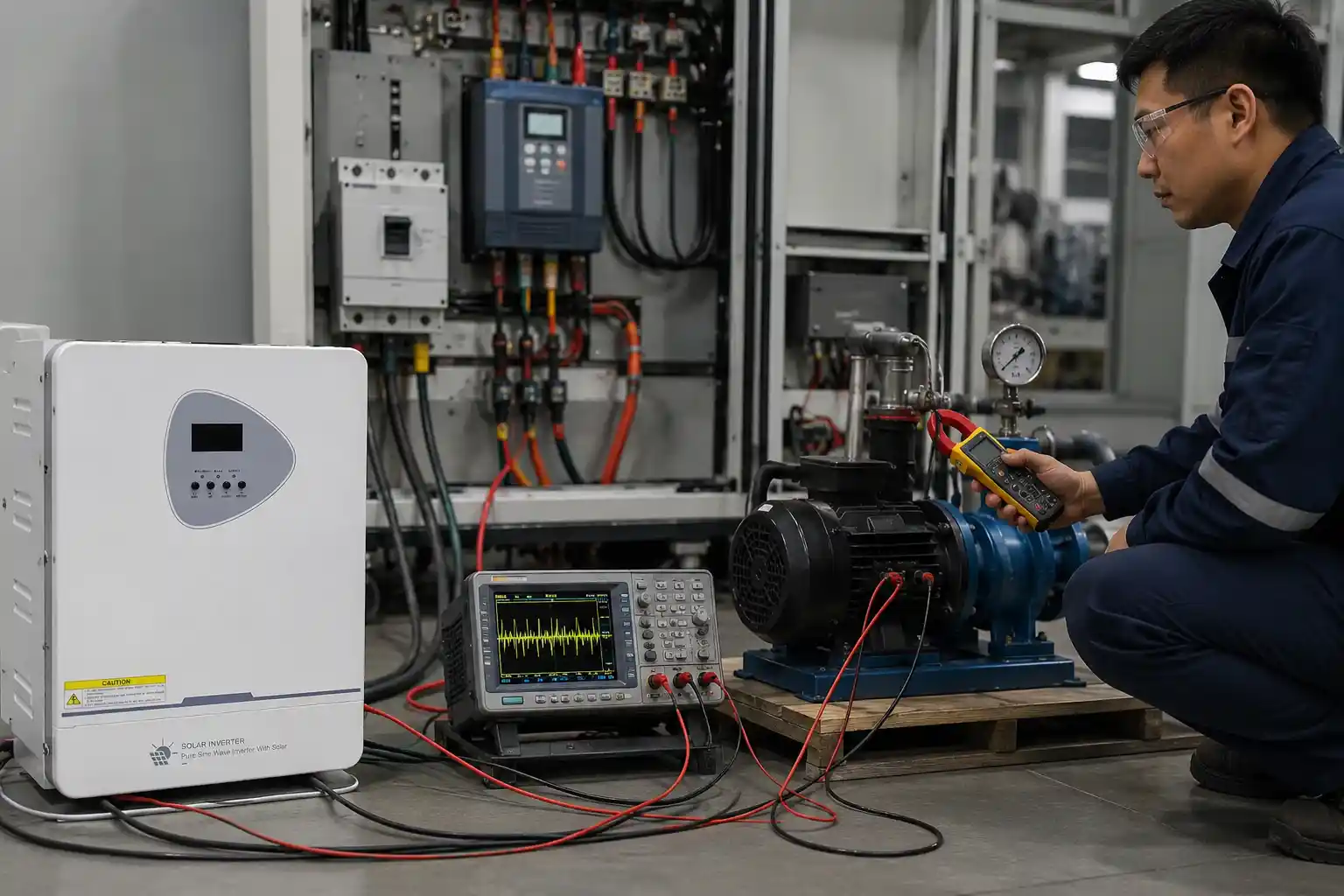
Size Battery Capacity From the Actual Load Profile
After confirming voltage and power compatibility, calculate the required energy capacity.
A simplified starting formula is:
Required energy = Average load × Backup time
For example, if a project has an average 2kW backup load and requires five hours of operation:
2kW × 5h = 10kWh
That does not automatically mean that a nominal 10kWh battery is the final answer.
Real system sizing should also account for:
- Usable battery capacity
- Allowed depth of discharge
- Inverter conversion losses
- Standby consumption
- Temperature
- Battery aging
- Load variation
- Design reserve
Most importantly, do not calculate battery capacity from inverter rating alone.
A 6kW inverter does not mean the building continuously consumes 6kW.
The inverter must cover required instantaneous power, while the battery must provide the required energy over time.
Those are related but different calculations.
CAN or RS485 Does Not Automatically Mean the Battery and Inverter Are Compatible
This is one of the most overlooked LiFePO4 integration issues.
Modern battery systems often communicate with the inverter through interfaces such as:
- CAN
- RS485
However, seeing the same port names on two specification sheets does not prove that the products can communicate.
There are two separate compatibility questions:
1. Is the physical communication interface compatible?
and
2. Do both devices support the same communication protocol?
Two products may both support CAN but use different message structures or battery protocols.
The same issue can occur with RS485.
In practical terms:
Same connector does not mean same pinout.
Same interface does not mean same protocol.
Same protocol name does not necessarily mean the installed firmware supports the required implementation.
For B2B buyers, this means inverter-battery compatibility should be confirmed before procurement rather than discovered during commissioning.
What Should Be Confirmed for BMS Communication?
Before specifying a LiFePO4 battery with an inverter, confirm:
- Whether closed-loop battery communication is supported
- Whether CAN, RS485, or another interface is required
- Which battery communication protocols the inverter supports
- Which inverter protocols the battery BMS supports
- Communication cable and pinout requirements
- Required inverter battery mode
- Battery DIP-switch or address configuration where applicable
- Firmware compatibility
- Parallel battery communication architecture
- Master/slave configuration where required
A statement such as “supports CAN” or “supports RS485” is therefore not enough for professional system design.
A compatibility list, protocol confirmation, or direct technical confirmation from the equipment supplier is preferable.
Can a Lithium Battery Work Without Closed-Loop BMS Communication?
This question needs more nuance than a simple yes or no.
Some inverter and lithium battery combinations can operate using manually configured voltage and current parameters without closed-loop BMS communication.
In that type of configuration, the inverter relies on configured limits rather than receiving dynamic operating information directly from the battery BMS.
Closed-loop communication can provide information such as:
- State of charge
- Battery voltage
- Battery current
- Charge-current limits
- Discharge-current limits
- Temperature or protection status
Whether communication is mandatory depends on the equipment design and manufacturer requirements.
Therefore, buyers should avoid two assumptions:
“No communication means the system can never work.”
and
“If the voltage matches, communication does not matter.”
The correct answer depends on the selected battery, inverter, operating mode, and approved configuration.
Check Charging Compatibility, Not Only Discharging
Battery-inverter matching is often discussed only from the discharge side.
Charging is equally important.
If a hybrid inverter charges the battery from PV or the grid, its charging behavior must remain within the battery manufacturer’s permitted limits.
Check:
- Charging voltage range
- Maximum charging current
- Battery type setting
- Charge termination behavior
- Low-voltage recovery settings
- Temperature-related charging restrictions
- BMS-controlled charge limits where supported
A battery may be capable of powering the inverter while still being poorly matched to the inverter’s charging configuration.
This distinction becomes especially important when different manufacturers are combined in one energy storage system.
Do Not Ignore Firmware and Commissioning Compatibility
Hardware compatibility is only one part of a modern battery energy storage system.
Firmware can influence:
- Supported battery protocols
- Battery recognition
- Charge and discharge control
- State-of-charge reporting
- Parallel operation
- Monitoring
- Grid or backup behavior
For distributors and integrators, this creates an additional procurement question:
Is the battery-inverter combination supported by the current firmware version, and who is responsible for commissioning it?
Before ordering equipment for a project, it is useful to establish:
- Required firmware versions
- Whether firmware updates are field-upgradable
- Who provides commissioning support
- Whether remote technical support is available
- What happens if a future firmware update changes compatibility
- Whether configuration documentation is available
A system that is electrically compatible but difficult to commission can still create installation delays and after-sales costs.
Plan for Expansion Before Buying the First Battery
Many storage systems are expanded after installation.
A customer may initially install a smaller battery bank and later add:
- More battery modules
- More PV capacity
- Additional household loads
- EV charging
- Heat pumps
- Additional inverter capacity
Expansion should therefore be considered before the first purchase.
Check whether the battery system supports:
- Parallel battery modules
- Maximum number of connected packs
- Master/slave communication
- Current sharing
- Compatible additional modules
- Future firmware support
Also check whether the inverter supports the intended future system size.
A system that is adequate today may become expensive to expand if the inverter, battery platform, communication architecture, or electrical infrastructure was selected without future capacity in mind.
New System or Retrofit? The Matching Process Is Different
A new solar-plus-storage project provides more freedom because the PV array, battery, inverter, protection equipment, and backup architecture can be designed together.
A retrofit project is different.
When adding batteries to an existing solar installation, buyers may need to determine:
- Whether the existing inverter supports batteries
- Whether a hybrid inverter replacement is required
- Whether AC coupling is more appropriate
- Whether existing PV equipment should remain
- Whether new communication or power cabling is required
- Whether backup loads require panel changes
- Whether monitoring systems remain compatible
- Whether future expansion is still possible
For retrofit projects, “Which battery should I buy?” is therefore often the wrong first question.
The first question should be:
“What storage architecture is compatible with the system already installed?”
A Better Battery-Inverter Selection Process
Instead of starting with a product model, use the following sequence.
Step 1 — Define the load
Determine continuous loads, simultaneous loads, and major startup loads.
Step 2 — Define the required backup duration
Use the actual load profile to estimate required usable energy.
Step 3 — Select the system voltage
Choose an architecture appropriate for the required power level and equipment.
Step 4 — Size inverter output
Confirm continuous and surge requirements.
Step 5 — Verify battery power capability
Check continuous discharge current, peak current, and BMS limits.
Step 6 — Verify energy capacity
Confirm that usable battery capacity meets the required runtime.
Step 7 — Verify charging parameters
Make sure charging voltage and current remain inside battery limits.
Step 8 — Confirm BMS communication
Check interface, protocol, cable, pinout, configuration, and firmware.
Step 9 — Check expansion
Confirm whether battery, inverter, and PV capacity can grow with the project.
Step 10 — Confirm commissioning and technical support
Establish who supports configuration, firmware, troubleshooting, and future compatibility.
Battery and Inverter Compatibility Checklist for Buyers
| Check | Key Question |
|---|---|
| Battery voltage | Does the battery operating range match the inverter battery input range? |
| Inverter power | Can the inverter support the expected continuous load? |
| Surge power | Can it start motors, pumps, compressors, and other surge loads? |
| Battery discharge current | Can the battery continuously supply the inverter’s required DC current? |
| BMS peak current | Can the battery support startup demand without protection shutdown? |
| Battery capacity | Does usable energy meet the required backup duration? |
| Charging voltage | Is the inverter charging range permitted by the battery? |
| Charging current | Is charging current within battery and BMS limits? |
| Communication interface | Do both products use compatible CAN, RS485, or other interfaces? |
| Communication protocol | Do the inverter and BMS speak the same supported protocol? |
| Cable and pinout | Is the correct communication cable and pin configuration confirmed? |
| Firmware | Does the installed firmware support the selected battery? |
| Parallel expansion | Can more batteries or inverter capacity be added later? |
| Commissioning | Is configuration and technical support available? |
| Retrofit compatibility | Can the battery be integrated without unnecessary replacement of existing equipment? |
The Best Battery-Inverter Combination Is Not Determined by One Specification
There is no single inverter wattage or battery capacity that guarantees a good solar storage system.
A reliable combination requires several layers of compatibility:
Voltage compatibility
Power compatibility
Energy compatibility
Surge compatibility
Charging compatibility
Communication compatibility
Firmware compatibility
Expansion compatibility
For installers, distributors, and system integrators, verifying these items before procurement can reduce commissioning problems, unexpected BMS shutdowns, redesign work, and after-sales troubleshooting.
When evaluating a solar or backup project, VoltCrave Power can support battery and inverter selection based on the actual load profile, system voltage, required backup capacity, communication requirements, and future expansion plan rather than treating the battery and inverter as separate components.
Need help matching this topic to a real battery project?
Send your target application, capacity range, certification market, and order plan. VoltCrave can recommend a practical product direction.