Cold weather changes more than the charging speed of a LiFePO4 battery. In a solar energy storage system, it can change whether the battery can accept morning PV energy, whether the BMS allows charging, how much energy must be reserved for thermal management, and whether an unattended system can recover after a cold night.
For installers, system integrators, distributors, and project buyers, the important question is therefore not simply:
“Can LiFePO4 batteries charge below freezing?”
A more useful question is:
“How should a solar storage system be designed so that the battery remains protected and available for charging during cold weather?”
That requires looking at the battery, BMS, inverter or charger, thermal design, energy source, and system control as one coordinated system.
Why Cold Weather Charging Requires Special Attention
Low-temperature charging can accelerate lithium deposition on the negative electrode of lithium-ion cells. Research on large-format LiFePO4 cells has shown that charging current and voltage strongly affect degradation under low-temperature conditions, which is why charging limits cannot be separated from temperature.
This does not mean there is one universal temperature at which every LiFePO4 battery must stop charging.
The permitted charging envelope depends on factors such as:
- Cell specification
- Battery pack design
- Charge current
- BMS configuration
- Thermal management
- Manufacturer validation
This distinction is important for B2B projects.
A generic internet recommendation should never replace the charging-temperature and current limits specified for the actual battery being installed.
UL’s explanation of IEC 62368-1 follows the same principle: charging-temperature limits for the end product should be established from the battery cell manufacturer’s specifications, and charging should remain within the specified limits.
Charging Temperature and Discharge Temperature Are Not the Same
One of the most confusing winter behaviors is that a LiFePO4 battery may still power loads while refusing to accept charging current.
A customer may see:
- The inverter operating
- Loads continuing to run
- PV voltage present
- The battery still showing available energy
but no battery charging.
This does not necessarily mean the charger has failed.
The BMS may be restricting charging because battery temperature has crossed the permitted charging threshold while discharge is still allowed.
This distinction matters particularly in off-grid and backup applications.
If loads continue consuming energy during a cold period while charging remains blocked, state of charge can continue falling even when solar energy becomes available.
That turns a battery-protection issue into a system-availability issue.
Battery Temperature Matters More Than the Weather Report
Ambient air temperature and battery cell temperature are not necessarily the same.
Consider a battery cabinet that has remained outside during a cold night.
Morning air temperature may rise above freezing relatively quickly, but the battery has substantial thermal mass. Internal cells may remain colder than the surrounding air.
The reverse can also occur in an insulated cabinet: outside air may temporarily fall below freezing while the battery remains warmer.
For system control, the relevant variable is therefore not simply outdoor temperature.
Installers should consider:
- BMS temperature-sensor location
- Cell or module temperature
- Number of temperature sensors
- Thermal gradient within the pack
- Cabinet insulation
- Heater placement
- Time required for the complete battery mass to warm
A system should not assume that warmer ambient air automatically means the cells are ready for unrestricted charging.
What Low-Temperature BMS Protection Actually Solves
Low-temperature charge protection is an important safeguard.
If the battery reaches its configured low-temperature charging limit, the BMS may restrict or stop charging to keep operation within the battery’s approved envelope.
But that protection answers only one question:
How do we prevent charging when the battery is too cold?
It does not automatically answer:
How do we make the system available for charging again?
This difference becomes critical in a winter solar installation.
A protected battery can still become operationally unavailable if:
- The battery is too cold to accept PV charging
- Loads continue reducing SOC
- The battery heater requires energy
- No grid supply is available
- Morning PV power is limited
- The battery cannot recover automatically
Good winter system design therefore requires both protection logic and recovery logic.
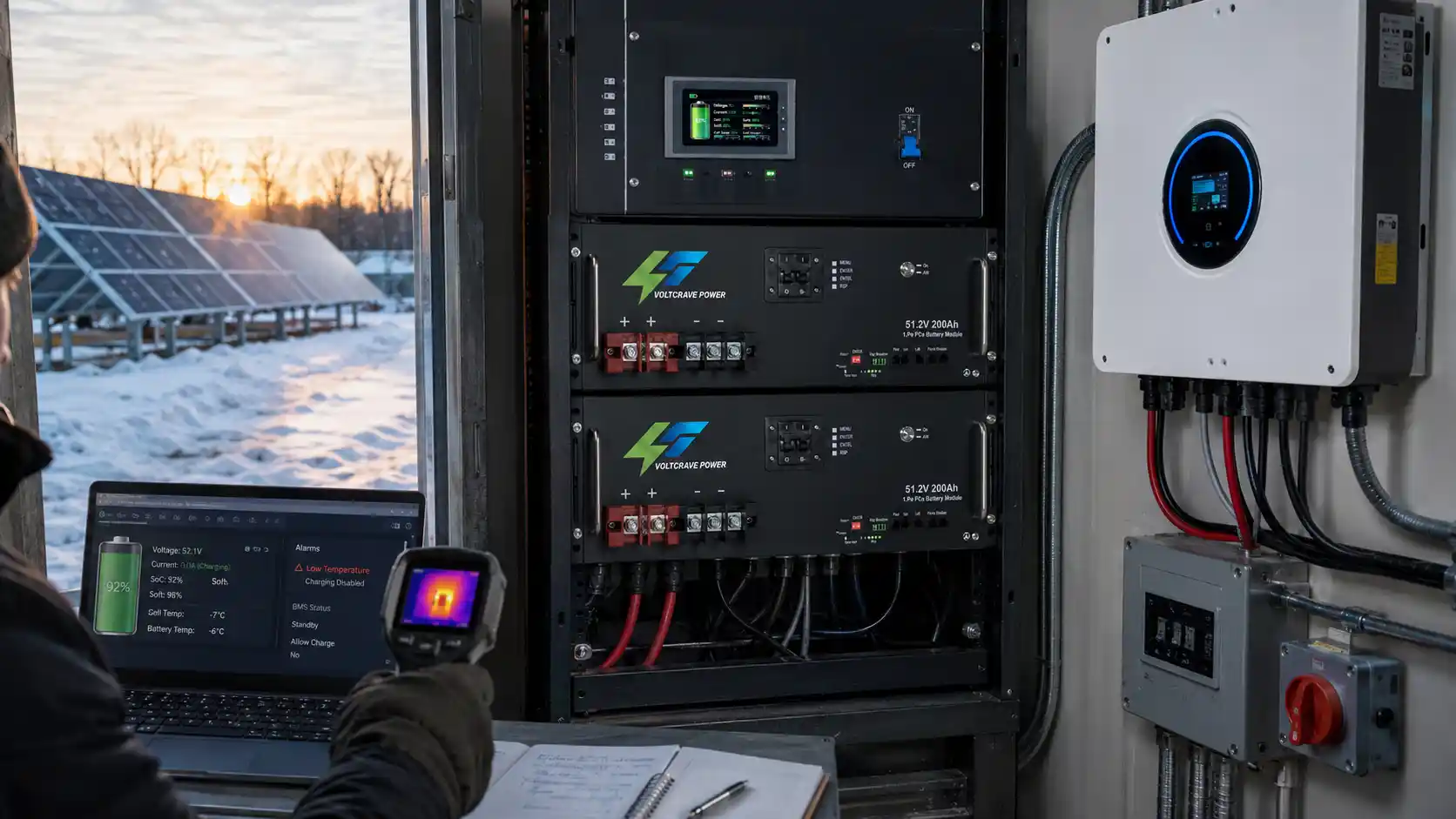
What Happens When Morning Solar Arrives Before the Battery Is Warm Enough?
Early morning can be one of the most difficult operating periods for a cold-climate solar storage system.
The battery may have experienced its lowest temperature shortly before sunrise.
At the same time:
- PV generation is just beginning
- Available solar power may still be low
- The battery may be cold-soaked
- The BMS may still prohibit charging
- Loads may already be consuming energy
This creates an important control question:
What should happen to incoming solar energy when the battery cannot yet accept charge?
Different system architectures may handle this differently.
Possible strategies can include:
- Using incoming charger power for battery heating
- Supplying loads before allocating power to the battery
- Using an auxiliary heater supply
- Using grid energy for preheating
- Using generator support at remote sites
- Delaying battery charging until an approved temperature is reached
There is no single architecture that applies to every system.
The correct approach depends on how the battery, heater, charger, inverter, BMS, and energy sources have been designed to interact.
Self-Heating Batteries Do Not Remove the Need for System Design
A self-heating LiFePO4 battery can simplify cold-weather operation, but the words “self-heating” do not describe the complete control strategy.
For example, some commercial heated LiFePO4 designs use incoming charger power to warm the cells before charging begins. RELiON describes this approach in its Low Temperature series: external charging power is directed to the heating elements until the battery reaches the required condition for charging.
For a B2B buyer, the important questions are therefore more specific:
- What temperature activates heating?
- What temperature allows charging to begin?
- Where does heater energy come from?
- How much heater power is required?
- Is heating automatic?
- Does the BMS coordinate heating and charging?
- Does the battery continue heating when no charging source is present?
- How is heater operation affected by SOC?
- How uniform is the temperature across the cells?
- What happens if a temperature sensor fails?
A self-heating label should be treated as the beginning of the technical review, not the end.
Heating and Insulation Perform Different Jobs
Heating and insulation are often discussed as if they are interchangeable.
They are not.
Heating adds thermal energy.
Insulation reduces thermal loss.
A well-insulated cabinet may substantially reduce the amount of energy required to maintain battery temperature, but insulation cannot warm a battery indefinitely without a heat source.
Likewise, installing a powerful heater in a poorly insulated enclosure can waste energy continuously.
For cold-climate solar storage, thermal design should consider both:
- Required heating energy
- Expected heat loss
This matters particularly in off-grid systems because every watt used for battery heating is energy that cannot simultaneously serve the load or recharge the battery.
Thermal management is therefore part of the system energy budget.
Where Should Battery Heater Energy Come From?
This is one of the most important winter design decisions.
Possible heater-energy sources include:
Battery Energy
Using stored battery energy can provide heating before charging starts.
The disadvantage is straightforward: the battery is consuming its own stored energy to become warm enough to receive more energy.
This becomes more problematic when SOC is already low.
Incoming Solar or Charger Power
Some designs use incoming charging power for heating before allowing current into the cells.
This can reduce dependence on battery SOC, but the system needs enough incoming power to operate the heating function and control electronics.
Grid Power
For grid-connected residential or commercial ESS, grid-assisted heating may provide a predictable cold-start path.
However, the project must decide whether the system is expected to remain fully functional during a simultaneous grid outage and low-temperature event.
Generator or Auxiliary Supply
Remote sites may use generator or auxiliary power as a recovery source during extended winter conditions.
This can be relevant for telecom, monitoring, agricultural, and other unattended systems where loss of battery availability has a higher operational cost.
The important question is not which source is universally best.
It is:
What energy source remains available when the battery is simultaneously cold and low on SOC?
The Cold Battery and Low-SOC Recovery Problem
A difficult system condition can occur when cold temperature and low SOC happen together.
The sequence may look like this:
Cold soak → charging restricted → loads continue operating → SOC falls → heater requires energy → morning PV returns → battery still needs warming before normal charging
This is a much more important B2B design problem than simply identifying a low-temperature cutoff point.
An unattended installation should have a defined recovery strategy.
Depending on the equipment, that may require consideration of:
- Minimum SOC reserve
- Heater power path
- Charger wake-up behavior
- BMS sleep behavior
- PV startup behavior
- Auxiliary power
- Grid support
- Generator backup
- Remote alarm functions
- Restart sequencing
The exact solution must follow the capabilities and validated operating logic of the selected equipment.
Avoid Assuming One Low-Temperature Charge Current for Every LiFePO4 Battery
Some battery manufacturers allow reduced charging current under specific low-temperature conditions.
Other batteries prohibit charging below their specified lower temperature.
These are not contradictions.
They reflect different cells, pack designs, BMS strategies, and validated operating limits.
Research also demonstrates why generic C-rate recommendations are dangerous. One study of a particular large-format LiFePO4 cell at −10°C found substantially different degradation behavior as charging rate and cutoff voltage changed. Those findings apply to the tested cell and conditions; they are not a universal charging rule for every LiFePO4 ESS.
For installers and buyers, the correct rule is:
Use the battery manufacturer’s validated temperature-current charging limits.
Do not convert a value from another battery brand, cell format, or laboratory experiment into a general field setting.
Sensor Placement and Thermal Gradients Matter
Battery heaters create another design challenge.
The temperature sensor itself may warm faster than the cell mass if it is located close to the heater.
For example, a heating pad may warm the lower surface of a module before the center of the cells reaches a comparable temperature.
This means a system can potentially have:
- A warm sensor
- A warm battery surface
- Colder internal cells
Professional thermal management should therefore consider:
- Sensor placement
- Multiple-point temperature monitoring
- Minimum-temperature logic
- Heater distribution
- Cell-to-cell temperature difference
- Validated warm-up behavior before full charging
A fixed waiting period should not be invented as a universal solution.
Any warm-up or thermal-soak requirement should be validated for the actual battery design.
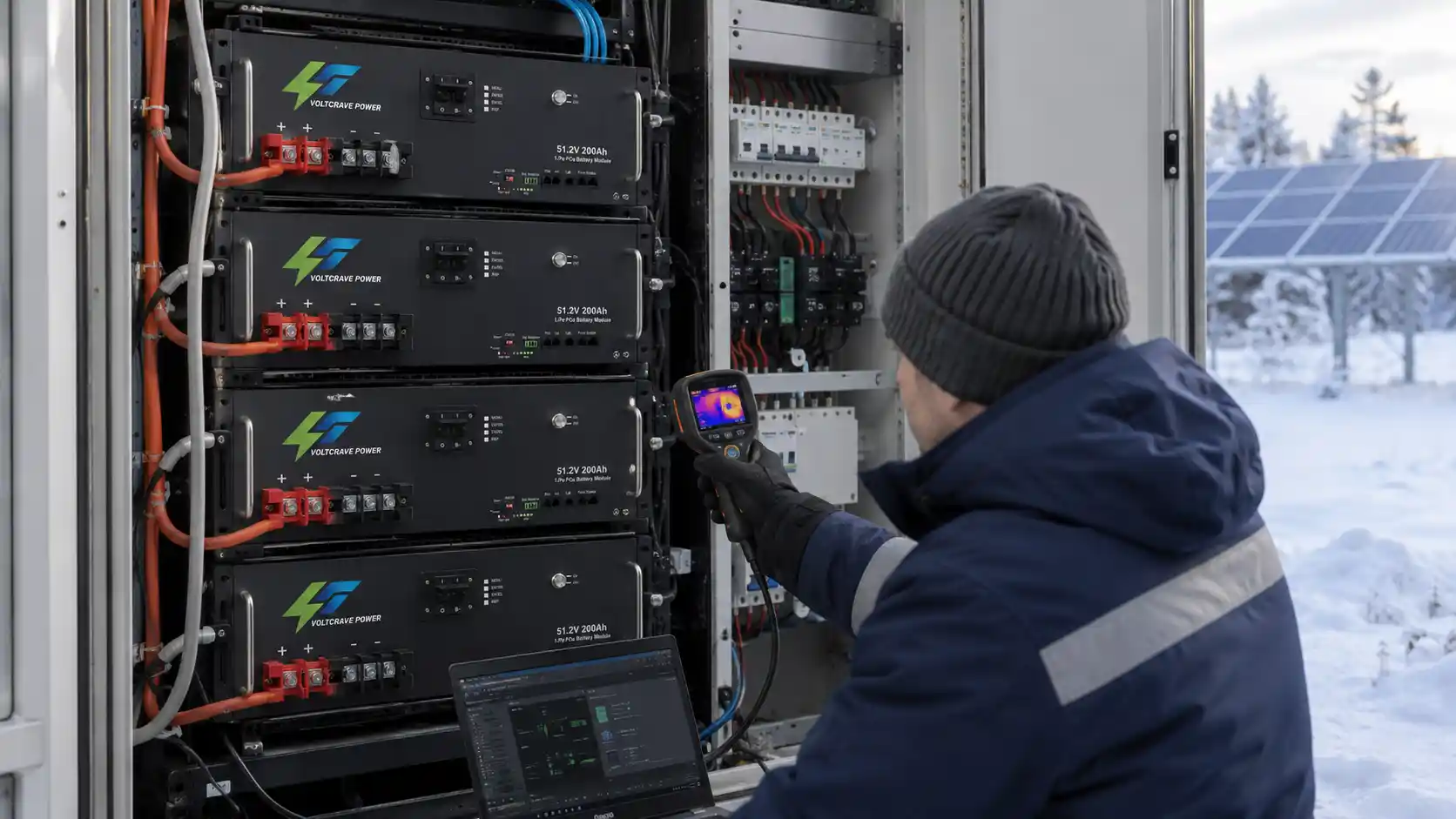
Multi-Battery Racks Create a Different Cold-Weather Problem
A single battery and a multi-module rack should not be treated as the same thermal system.
In a rack or cabinet, different modules may experience different temperatures.
For example:
- Modules near an exterior wall may cool faster
- Central modules may retain heat longer
- Airflow may create temperature differences
- Heater placement may favor some modules over others
This raises system-level questions:
- What happens if one module blocks charging while others remain available?
- How should the cluster charging limit be determined?
- Does the master BMS use the coldest cell, coldest module, or another control strategy?
- How is charging current redistributed if one module disconnects?
- What conditions must be met before a cold module reconnects?
- How are SOC and voltage differences handled between modules?
- Should thermal management be controlled per module or per cabinet?
These questions should be answered from the actual BMS and battery architecture rather than from generic assumptions about parallel batteries.
For larger B2B systems, rack-level thermal behavior is an important part of commissioning and system validation.
Cold Weather Is Also a Procurement and Warranty Question
Temperature limits are not only technical specifications.
They also affect project responsibility.
Before supplying a battery into a cold-climate project, distributors and installers should understand:
- Approved charging-temperature range
- Temperature-dependent charging limits
- BMS cutoff behavior
- Recovery conditions
- Heating requirements
- Required enclosure conditions
- Temperature logging capability
- Fault-event logging
- Installation instructions
- Applicable warranty exclusions
- Responsibilities during commissioning
Operating a battery outside the manufacturer’s validated temperature, voltage, or current envelope may create both performance risk and warranty risk.
For this reason, project documentation should be reviewed before installation rather than after a winter-related failure occurs.
New Installations and Retrofits Require Different Winter Planning
A new energy storage project can be designed around cold-climate requirements from the beginning.
The installer can select:
- Battery location
- Cabinet insulation
- Heating architecture
- Inverter or charger
- BMS communication
- Backup energy source
- Temperature-control strategy
A retrofit is more constrained.
If batteries are being added to an existing solar system, the project may need to determine:
- Whether the existing inverter supports the required battery control
- Whether charger behavior can respond to BMS restrictions
- Whether auxiliary heating power is available
- Whether the existing battery location is suitable
- Whether monitoring can report low-temperature faults
- Whether the system can restart automatically after a cold event
A battery that is electrically compatible with an inverter may still be poorly suited to the thermal conditions of the installation.
Winter ESS Checklist for Installers and Buyers
Before deploying LiFePO4 storage in a cold climate, confirm:
| Area | What to Verify |
|---|---|
| Cell specification | Approved charging-temperature and current limits |
| Battery BMS | Low-temperature charge protection and recovery behavior |
| Temperature sensing | Sensor number, location, and control logic |
| Heater | Internal or external heating architecture |
| Heater energy | Battery, charger, PV, grid, generator, or auxiliary source |
| Insulation | Expected heat-loss reduction and enclosure design |
| Inverter/charger | Response when battery BMS restricts charging |
| BMS communication | Whether temperature-related current limits are communicated |
| Cold start | How the system recovers after an overnight cold soak |
| Low SOC | Recovery path if battery energy is insufficient for heating |
| PV behavior | What happens when morning PV appears before charging is allowed |
| Multi-module system | Temperature differences and module-level BMS behavior |
| Monitoring | Temperature, SOC, alarms, and fault history |
| Expansion | Whether additional modules affect thermal management |
| Warranty | Installation and operating conditions required by the manufacturer |
Design for Winter Availability, Not Only Battery Protection
Cold-weather LiFePO4 design should not stop at a low-temperature charging cutoff.
The BMS may successfully protect the cells while the energy storage system still becomes unavailable.
A complete winter strategy needs to address two objectives at the same time:
Protect the battery from charging outside its approved operating envelope.
and
Provide a reliable path for the system to warm, restart, and resume charging when conditions improve.
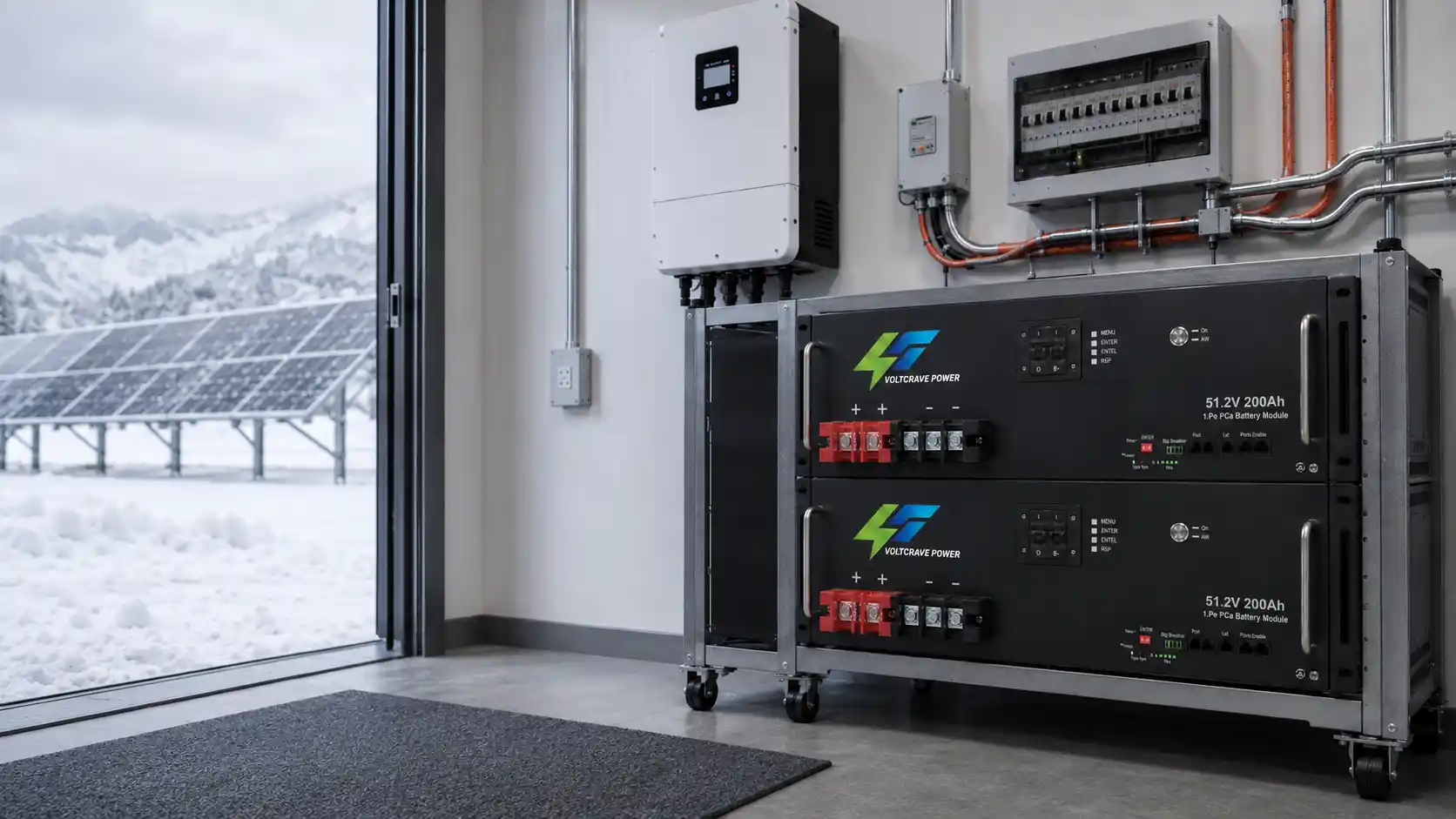
For residential solar storage, off-grid systems, telecom backup, remote monitoring, agricultural installations, and other unattended applications, that requires coordination between the battery, BMS, inverter or charger, thermal management system, and available energy sources.
The most important design rule is also the simplest:
Do not treat a generic low-temperature threshold as a substitute for the actual battery specification.
The charging current, cutoff temperature, recovery behavior, heating method, and BMS logic should all be verified for the specific battery being installed.
VoltCrave Power supports battery and energy storage projects across residential, commercial, utility, telecom, and other applications, making system-level battery selection and integration especially relevant when projects must operate across demanding environmental conditions.
Need help matching this topic to a real battery project?
Send your target application, capacity range, certification market, and order plan. VoltCrave can recommend a practical product direction.