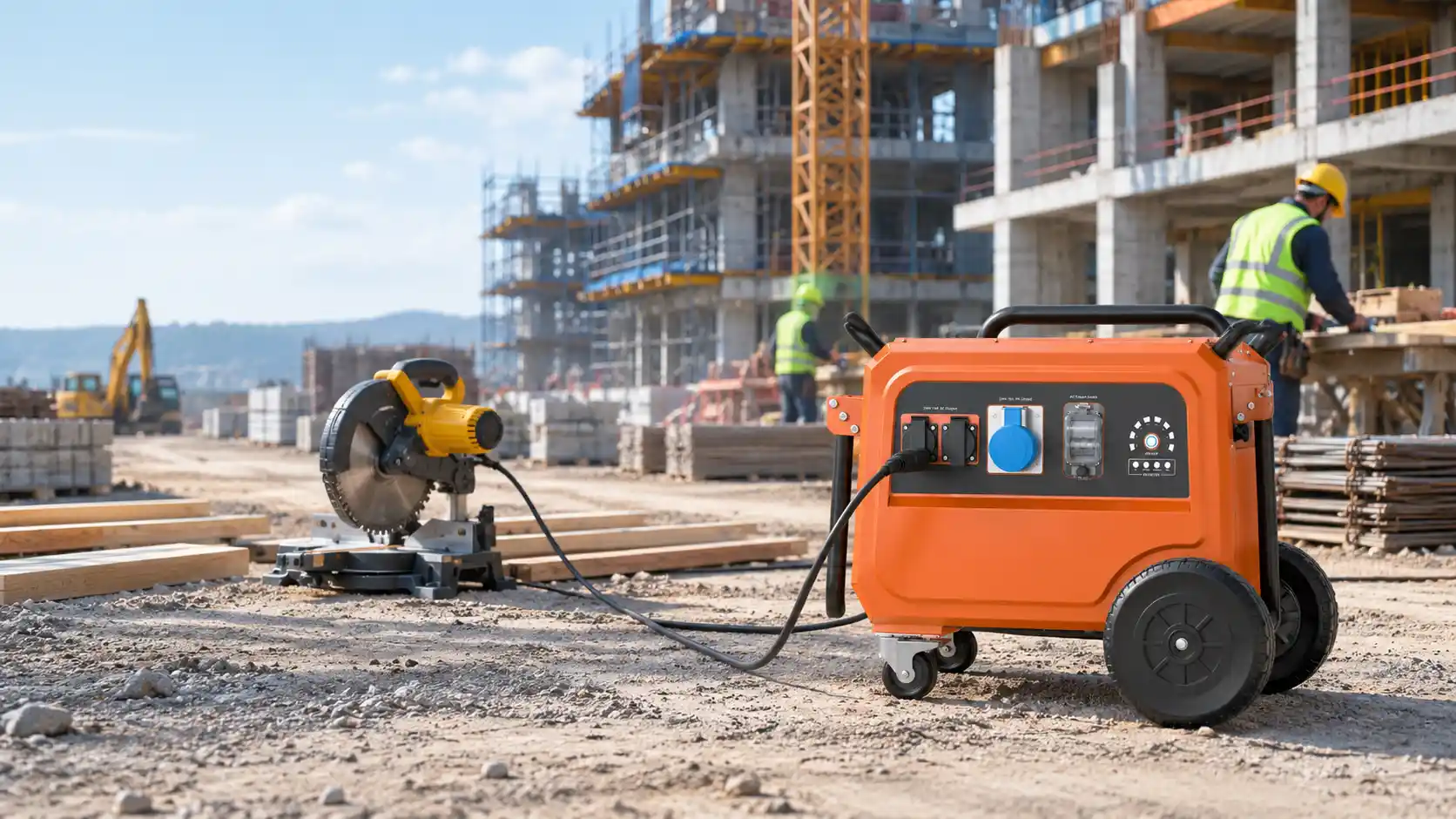
For construction sites, power requirements change with the tools, work areas, and shift schedule. A power station that works for a small inspection team may not have enough continuous output or battery capacity for saws, grinders, drills, lighting, or other site equipment.
When selecting an industrial power station for construction sites, buyers should start with the actual load profile rather than battery capacity alone. Continuous output, peak power, battery capacity, environmental protection, mobility, charging options, and voltage configuration all affect whether the unit can support the intended work.
What makes an industrial power station suitable for construction sites?
Construction sites place different demands on mobile power equipment than camping, emergency home use, or general outdoor activities.
The power station may need to operate power tools with motor-driven loads, move between work areas, tolerate dust or moisture, and provide enough energy for several hours of work. Procurement teams also need to consider how the unit will be transported and recharged between shifts.
For construction applications, the main specifications to review are:
- Continuous output: determines the load the unit can run continuously.
- Peak or surge power: covers short startup demands from motors and other equipment.
- Battery capacity: determines how much stored energy is available during a shift.
- IP rating: indicates protection against dust and water.
- Mobility: affects how practical the unit is to move around a jobsite.
- Charging input: determines how quickly the unit can be returned to service.
- Voltage configuration: must match the tools and electrical equipment used on site.
For buyers comparing different models, the industrial power station series from VoltCrave Power provides several power and capacity configurations for different mobile power requirements.
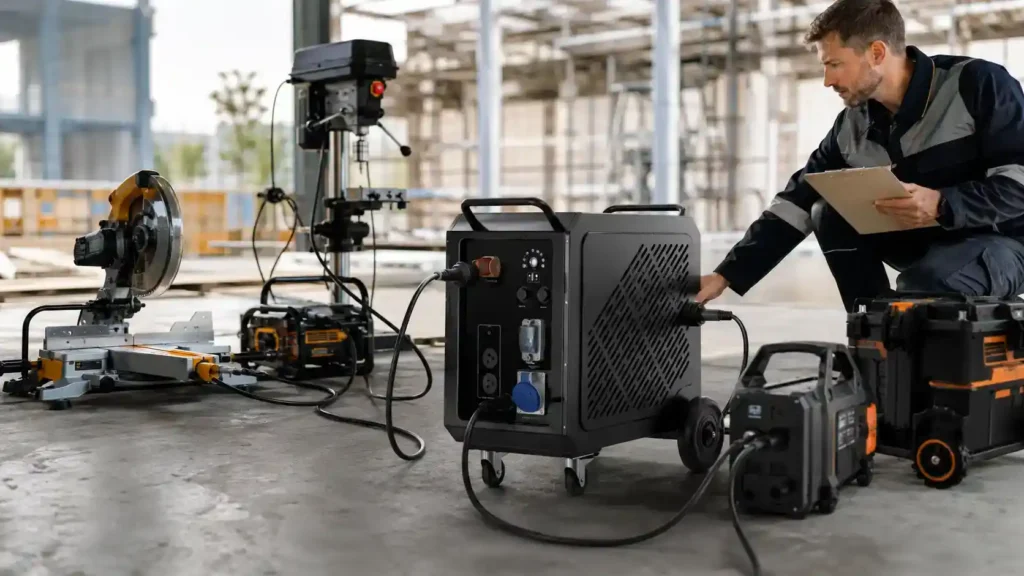
How much power does a construction site need?
The first calculation should be based on the equipment that will actually run from the power station.
Continuous power
Continuous output is the sustained power rating of the unit. Add the running power of the equipment that may operate at the same time and compare the total with the station’s rated output.
For example, if several tools are expected to operate simultaneously, the calculation should use their combined running requirements rather than looking at each tool separately.
A suitable margin is also important because operating continuously close to the rated limit leaves less room for changing loads.
Peak power and startup loads
Some tools require substantially more power for a short period when their motors start. This is where peak or surge power becomes important.
A power station can have enough continuous output for a tool but still fail to start it if its peak capability is too low.
For construction procurement, check both specifications:
Continuous output = sustained operating load
Peak output = short-duration startup or surge load
This distinction is particularly relevant when the site uses equipment with motors or other high startup demand.
How much battery capacity do you need for a construction shift?
Power output tells you what the power station can run. Battery capacity tells you how long it can supply that load.
Capacity is normally expressed in watt-hours (Wh). A simplified runtime estimate can be made by dividing battery capacity by the average load:
Estimated runtime ≈ battery capacity (Wh) ÷ average load (W)
Actual runtime will be lower or higher depending on the load profile, conversion efficiency, operating conditions, and how much of the rated battery capacity is usable.
For construction applications, avoid selecting a unit based only on its maximum wattage. A 5,000W power station with insufficient battery capacity may provide the required output but still require frequent recharging during a long shift.
The relationship between output and capacity can be seen in the BP360C and BP360C Pro industrial power stations
| Model | Rated output | Battery capacity | Peak output |
|---|---|---|---|
| BP360C | 3,600W | 3,072Wh | 18,000W |
| BP360C Pro | 3,600W | 5,120Wh | 18,000W |
| BP500A | 5,000W | 5,120Wh | 10,000W |
| BP1500A | 13,500W | 16,076Wh | 27,000W |
The appropriate capacity depends on the expected average load and required operating time. Higher capacity also normally means a heavier unit, so runtime should be considered together with mobility.
Is IP54 or IP66 better for a construction site?
Dust, rain, mud, and unfinished building environments can expose electrical equipment to conditions that are less controlled than an indoor workspace.
The IP rating should therefore be checked before ordering an industrial power station.
IP54 provides protection against limited dust ingress and water splashes.
IP66 provides a higher level of protection against dust and protection against powerful water jets.
The right rating depends on the site conditions and the manufacturer’s specified operating conditions. Buyers should also confirm whether the stated IP rating applies to the complete operating unit and under what conditions.
Among the VoltCrave Power industrial models, the BP360C and BP360C Pro are rated IP66, while the BP360H, BP500A, and BP1500A are rated IP54.
The rating should be treated as a procurement specification, not as a substitute for checking the actual installation environment.
How important are weight and mobility on a jobsite?
An industrial power station may need to be moved several times during a working day. Battery capacity and output therefore have to be considered alongside physical weight.
For example:
- BP360G weighs about 27kg.
- BP360C weighs about 68kg.
- BP360H weighs about 73kg.
- BP500A weighs about 65kg.
- BP1500A weighs about 220kg.
The BP360G can be more practical where frequent manual movement is required, while higher-capacity models are intended for applications where greater stored energy and output justify the additional weight.
Wheels, handles, lifting points, and the site’s transport method should be included in the procurement review. A specification that looks attractive on paper may be less practical if the unit must be carried over stairs, uneven ground, or between multiple work areas.
How fast should an industrial power station recharge?
Recharge time affects how quickly a power station can return to service.
For construction operations, check all available charging methods rather than looking only at AC charging. Depending on the model, buyers may need to evaluate AC input, solar/PV input, and the available charging power.
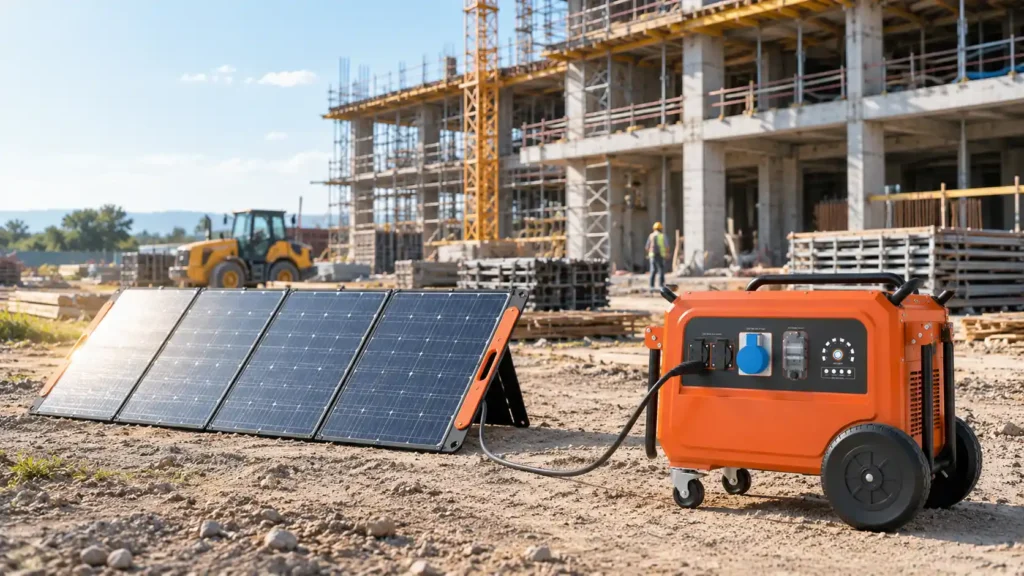
Solar charging can be useful where grid access is limited, but the available PV input and site conditions determine how much energy can actually be recovered during the working day.
For example, the BP360C and BP360C Pro support up to 600W PV input, while the BP500A supports up to 6,000W PV input. The BP1500A supports three 3,600W PV inputs.
These differences matter when the procurement requirement includes off-grid operation or daytime energy recovery.
For safe charging practices and operating precautions, buyers can also review the portable power station charging precautions before defining site procedures.
Which voltage configuration does your construction site need?
Voltage compatibility should be confirmed before ordering.
Construction equipment and electrical systems can use different voltage configurations depending on the market and application. A power station designed for one voltage configuration should not be assumed to support another simply because its wattage is sufficient.
The BP360G supports 100V, 120V, 230V, and 240V configurations. The BP500A supports 220V, 230V, and 240V, while the BP1500A is configured for 380V applications.
Procurement teams should confirm:
- Required output voltage
- Frequency
- Plug and socket configuration
- Number and type of AC outlets
- Whether multiple voltage outputs are required
- Compatibility with the tools and equipment already used on site
This information should be confirmed against the actual equipment list before placing an order.
Industrial power station vs generator for construction
A battery-based industrial power station and a fuel generator can both provide mobile electricity, but their operating characteristics are different.
| Factor | Industrial power station | Fuel generator |
|---|---|---|
| Energy source | Stored battery energy | Fuel |
| Local emissions during operation | None from combustion | Produces combustion emissions |
| Operating noise | Model dependent; BP360C and BP360C Pro are specified at <35 dB(A) | Typically higher due to engine operation |
| Startup | Instant electrical output | Requires engine startup |
| Fuel handling | Not required during operation | Requires fuel supply and storage |
| Recharge | AC, PV, or other supported inputs | Refueling |
| Best fit | Mobile battery-powered work areas and locations where quiet operation or no combustion is required | Applications requiring extended operation with continuous fuel availability |
This comparison does not make one technology suitable for every construction application. The choice depends on runtime requirements, available charging or fuel infrastructure, noise constraints, emissions requirements, mobility, and the equipment being powered.
What should you verify before ordering an industrial power station?
A construction-site procurement specification should cover more than rated wattage.
Before placing an order, confirm:
- Load requirements
List the tools and equipment that may operate simultaneously. - Continuous and peak power
Compare both the running load and startup requirements with the power station’s ratings. - Required runtime
Estimate average load and required operating hours to determine the appropriate battery capacity. - Environmental protection
Confirm the required IP rating for the actual jobsite conditions. - Mobility
Check weight, wheels, handles, lifting requirements, and transport conditions. - Charging requirements
Confirm AC charging and available PV input where solar charging is part of the operating plan. - Voltage compatibility
Match output voltage, frequency, outlets, and equipment requirements. - Noise requirements
Check the specified operating noise level if the unit will be used near workers, occupied buildings, or noise-sensitive areas. - Supplier documentation
Request the technical datasheet, electrical specifications, protection information, charging specifications, and applicable compliance documentation before ordering.
FAQs
How long can a power station run construction tools?
Runtime depends on battery capacity and the average load. A simple estimate is battery capacity in Wh divided by average power consumption in W. Actual runtime depends on system efficiency, operating conditions, and usable battery capacity.
How many watts are needed for construction tools?
There is no single wattage requirement for all construction tools. Buyers should use the actual running and startup requirements of the equipment they plan to operate. If several tools may run simultaneously, their loads should be considered together.
Can an industrial power station run a compressor?
It depends on the compressor’s continuous power and startup demand. The power station must have sufficient rated output for normal operation and sufficient peak output for startup.
What is the difference between IP54 and IP66?
IP54 provides limited protection against dust ingress and water splashes. IP66 provides dust-tight protection and protection against powerful water jets. The appropriate rating depends on the site environment and the equipment’s specified operating conditions.
How do you calculate industrial power station runtime?
Divide the battery capacity in Wh by the average load in W for a basic estimate. For procurement, account for the actual duty cycle, conversion losses, operating conditions, and usable capacity.
Can you charge an industrial power station with solar on a construction site?
Yes, when the selected model supports PV charging and the solar input is compatible with the installation. The available PV input rating and actual solar conditions determine how much energy can be recovered.
What should I check before buying a power station for construction?
Check continuous output, peak output, battery capacity, runtime, IP rating, weight, mobility, charging input, voltage configuration, noise level, and supplier documentation. These specifications should be matched to the site’s actual equipment and operating schedule.
Need help matching this topic to a real battery project?
Send your target application, capacity range, certification market, and order plan. VoltCrave can recommend a practical product direction.