For Australian solar installers, choosing a residential battery backup system involves more than comparing battery capacity and price.
The battery needs to work with the inverter, the household load profile, the backup configuration and the installation environment. The supplier also needs to provide the technical documentation required to evaluate the system before it reaches the installation site.
For imported battery products, Australian product requirements also need to be checked separately from general international certifications. The Clean Energy Council (CEC) currently maintains an Approved Batteries list, while Australia is transitioning from its previous battery safety requirements toward SA TS 5398.
This guide focuses on the technical and procurement checks that Australian solar installers should make when sourcing residential battery backup systems.
What Should Installers Confirm Before Specifying a Home Battery Backup System?
A customer asking for battery backup may actually have very different requirements.
One household may only want to keep a refrigerator, lights, internet equipment and selected outlets running during an outage. Another may expect backup for a much larger part of the house.
Before selecting the battery, define:
- Which circuits need backup
- Maximum simultaneous load
- Expected backup duration
- Daily energy consumption
- Solar PV capacity
- Inverter power
- Battery capacity
- Whether the system needs single-phase or three-phase operation
- Whether backup is required for selected circuits or a larger portion of the home
This distinction matters because battery capacity and inverter output are not the same specification.
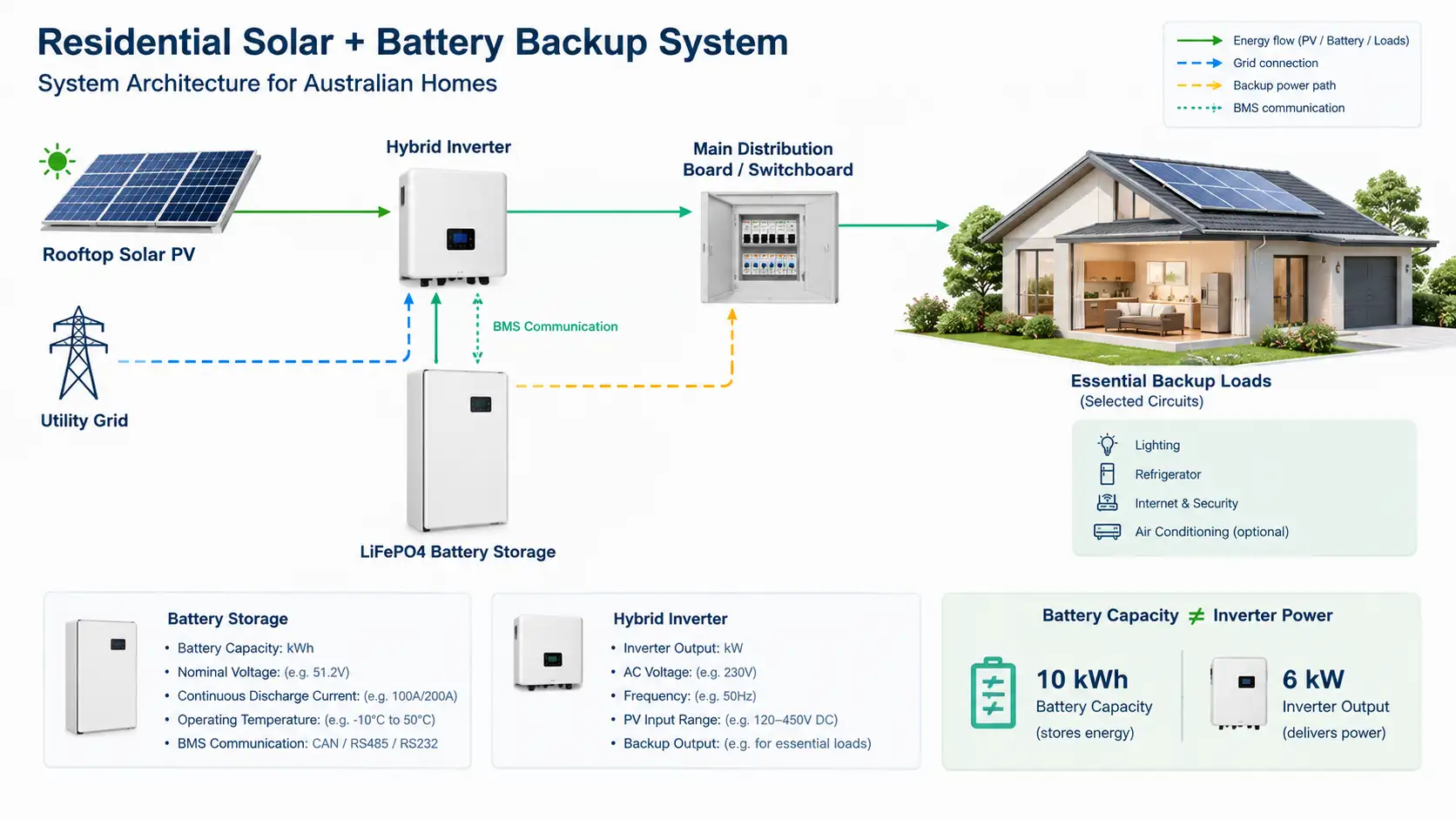
Battery Capacity vs. Inverter Power
Battery capacity is measured in kWh. Inverter output is measured in kW.
- kWh describes how much energy the battery stores.
- kW describes how much power the system can deliver at a given time.
For example, VoltCrave’s 10kWh-class residential ESS combines two 5.12kWh LiFePO4 battery packs with a 6kW hybrid inverter. The published configuration specifies 210–230V AC output, 50/60Hz operation and 120–500V DC input.
That gives an installer two separate numbers to evaluate:
Battery: approximately 10kWh of stored energy
Inverter: 6kW rated output
A larger battery does not automatically provide higher instantaneous output. The inverter rating, battery discharge current and BMS limits also need to be checked.
View the VoltCrave 10kWh Residential Energy Storage System
How Should Installers Size Battery Capacity for Residential Backup?
Battery sizing should start with the loads that need to remain operational.
A basic calculation is:
Required energy = average backup load × required backup time
But energy capacity alone is not enough.
The installer also needs to determine:
Required power = maximum simultaneous load
For example, a refrigerator may have relatively low average consumption but a higher startup demand. Other household equipment can create similar short-duration power requirements.
For this reason, a residential battery specification should normally be evaluated together with:
- Rated inverter output
- Continuous battery discharge current
- Peak or surge capability
- Backup load
- Required backup duration
- Usable battery capacity
The CEC’s consumer guidance also distinguishes between a battery’s rated total energy and the amount of energy actually available for use, which is an important distinction when comparing products.
Residential Backup Is Not Always Whole-Home Backup
A common mistake during procurement is treating “backup” as a single configuration.
A residential system may provide:
Essential-load backup
Only selected circuits remain powered, such as:
- Refrigerator
- Lighting
- Internet equipment
- Security systems
- Selected power outlets
Partial-home backup
A larger group of household circuits is supplied through the backup system.
Whole-home backup
A much larger portion of the home’s electrical load is supported.
These configurations can require different inverter capacities, switchboard arrangements and protection equipment.
Australian installation guidance also treats battery systems and associated electrical work as installation matters governed by relevant Australian requirements. For example, Energy Safe Victoria references AS/NZS 5139:2019 for battery systems and AS/NZS 4777.1:2024 for grid-connected energy systems via inverters.
Therefore, a supplier should not simply be asked:
“Can this battery provide backup?”
The more useful question is:
“What backup configuration does this battery-inverter system support, and what are the electrical requirements for that configuration?”
What Australian Installers Should Check About Battery and Inverter Compatibility
The battery and inverter should be evaluated as a system.
1. Battery voltage
Check the battery’s nominal and operating voltage against the inverter’s battery input range.
2. Charge current
Confirm the battery’s maximum permitted charging current and the inverter’s charging capability.
3. Discharge current
Check both continuous and peak discharge requirements.
4. Communication
For systems using BMS-to-inverter communication, confirm:
- CAN
- RS485
- RS232 where applicable
- Communication protocol
- Pin definition
- Compatible inverter models
- Required firmware or configuration
5. Backup operation
Confirm how the inverter handles:
- Grid loss
- Backup output
- Transfer operation
- Battery restart
- Low SOC
- Grid reconnection
A battery that works with an inverter in normal operation is not automatically suitable for every backup configuration.
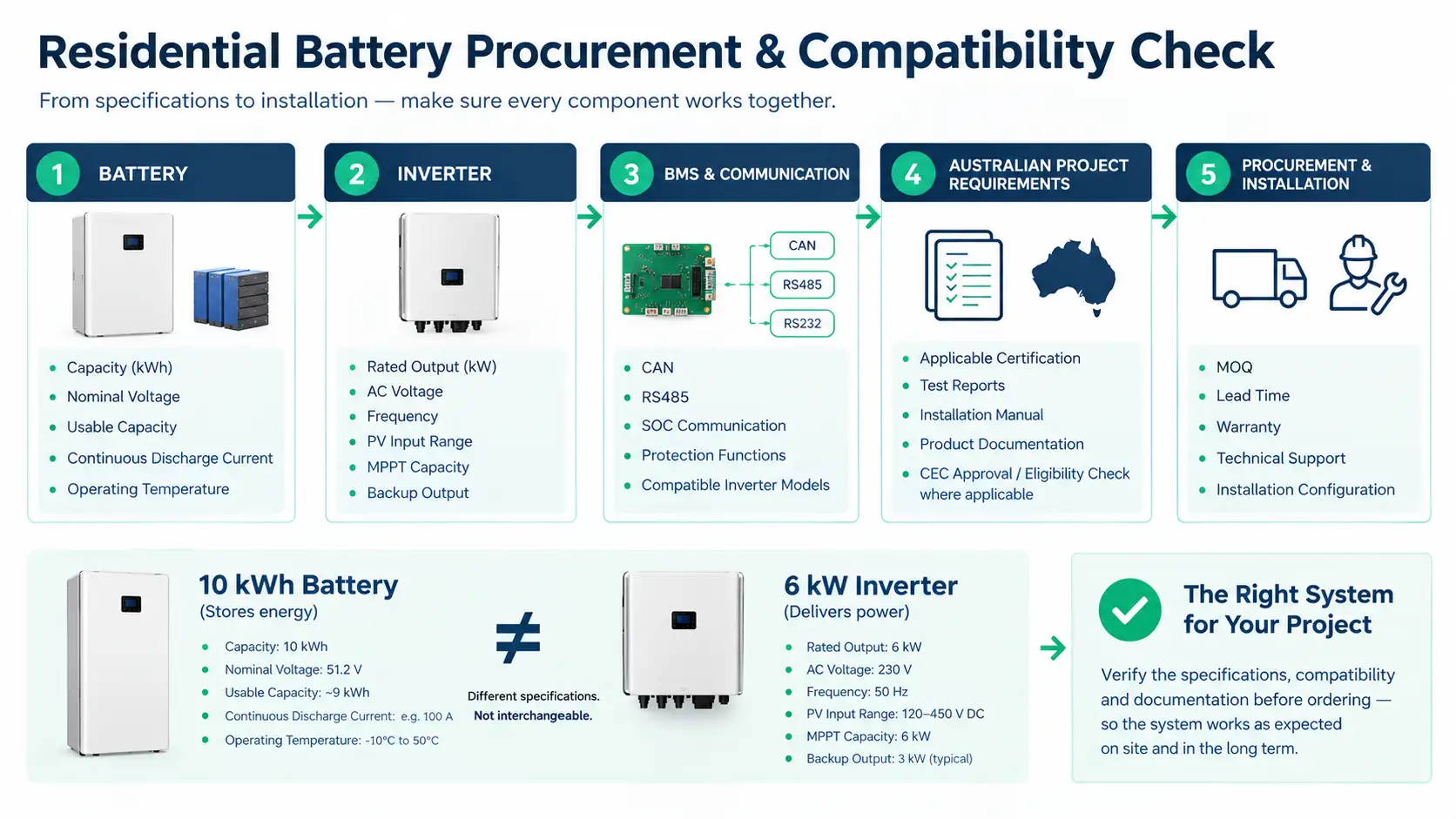
Real Product Example: 10kWh Battery + 6kW Hybrid Inverter
A real product configuration is more useful than a generic statement about “high-performance residential storage.”
VoltCrave’s 10kWh-class system uses:
- 2 × 5.12kWh LiFePO4 battery packs
- 6kW hybrid inverter
- 210–230V AC output
- 50/60Hz
- 120–500V DC input
- Up to 6,000W DC input
- LiFePO4 cells
- 16S1P battery configuration
For an installer, the useful information is not simply that the system has “10kWh capacity.”
The configuration shows how battery energy, inverter output and PV input need to be evaluated together.
Modular Residential Battery Systems: What Should Buyers Check?
Larger residential projects may require more storage than a basic 5–10kWh system.
VoltCrave’s 20.48kWh stacked residential system, for example, uses four 51.2V 100Ah battery modules.
The published configuration includes:
- 20.48kWh total battery capacity
- 51.2V nominal voltage
- 400Ah total capacity
- 5.5kW hybrid inverter
- 230V / 50Hz AC output
- 120–450VDC MPPT range
- Up to 100A charge/discharge current
- Four 5.12kWh battery modules
This is another example of why battery capacity should not be confused with inverter power.
A 20.48kWh battery does not mean that the system can continuously deliver 20.48kW.
For procurement, the battery modules, inverter rating, current limits and communication architecture should be evaluated as one system.
View the VoltCrave 20.48kWh Stacked Home Battery System
BMS: Which Specifications Actually Matter?
“Smart BMS” is not a sufficient specification for procurement.
Ask the supplier what the BMS actually monitors and protects.
Important items include:
- Overcharge protection
- Over-discharge protection
- Over-current protection
- Short-circuit protection
- Cell voltage balancing
- High-temperature protection
- Low-temperature charging protection
- SOC monitoring
- Fault information
- Communication interface
VoltCrave’s 32kWh LiFePO4 battery storage system, for example, specifies 200A maximum continuous discharge, 10,000W rated output, and RS485, RS232 and CAN communication interfaces.
Those parameters are useful when checking whether the battery can be integrated with the intended inverter and load configuration.
View the VoltCrave 32kWh LiFePO4 Battery Storage System
What Australian Compliance Information Should Installers Request?
This is one of the areas where the Australian version of a battery procurement guide should be different from a generic international article.
The Clean Energy Council currently maintains an Approved Batteries list for lithium-based batteries. CEC states that state electricity networks and government programs, including the SRES, require batteries from the approved list in relevant circumstances.
Australia is also transitioning to SA TS 5398:2025, Electrical Energy Storage Equipment – Safety Requirements.
According to the CEC’s current transition schedule:
- Applications under either the previous Best Practice Guide or SA TS 5398 are being accepted during 2026.
- From 1 January 2027, new applications to the Approved Batteries list will need to use SA TS 5398.
- Existing products approved under the previous requirements have a transition period extending to 31 December 2027, subject to the relevant conditions.
For a supplier, this means that simply providing a generic CE or RoHS document is not enough to establish suitability for an Australian residential installation.
Before ordering, ask the supplier for the actual documentation applicable to the product and intended market, including where relevant:
- Battery model and exact configuration
- Applicable certification
- Test reports
- Installation manual
- Electrical specifications
- BMS communication information
- Safety documentation
- Transport documentation
- Warranty terms
- Approved-product information where applicable
CEC also states that products submitted under SA TS 5398 need testing and certification by an IEC or JAS-ANZ-accredited certifying body against the relevant standards under the applicable assessment method.
Do not assume that a certification held by one battery model automatically applies to another model or configuration.
What Should Be Checked Before the Battery Reaches the Installation Site?
For an Australian installer, technical checks should happen before shipment.
Product configuration
Confirm:
- Battery capacity
- Usable capacity
- Nominal voltage
- Continuous discharge current
- Peak discharge capability
- Inverter output
- PV input
- AC voltage
- Frequency
- Number of battery modules
Installation information
Confirm:
- Dimensions
- Weight
- Mounting method
- Cable and connector information
- Environmental operating range
- Installation location requirements
- Ventilation requirements
- Required safety clearances
Communication
Confirm:
- Inverter model
- BMS protocol
- CAN/RS485 configuration
- Communication cable
- Pin definition
- Required inverter settings
Documentation
Make sure the documents describe the same production configuration that will actually be shipped.
This is particularly important when the supplier offers OEM or customized products.
How Should Australian Solar Installers Evaluate a Battery Supplier?
A supplier evaluation can be divided into five areas.
| Area | What to confirm |
|---|---|
| Product | Chemistry, capacity, voltage, current and system configuration |
| Compatibility | Inverter models, BMS communication and operating ranges |
| Australian requirements | Applicable standards, certification and approved-product status |
| Supply | MOQ, lead time, production capacity and packaging |
| Support | Technical support, warranty process and troubleshooting |
Price should be evaluated together with these factors.
A cheaper battery can create additional project costs if the installer later has to deal with incompatible communication, missing documentation, configuration problems or unclear warranty procedures.
The important question is therefore not simply:
“What is the battery price?”
It is:
“What will the complete system cost to specify, install, commission and support?”
Local Distributor or Direct OEM Manufacturer?
Australian installers can source batteries through local distributors, international suppliers or OEM manufacturers.
The appropriate model depends on the project.
Local distributor
Potential advantages include:
- Local inventory
- Shorter delivery times
- Local support
- Easier warranty handling
International supplier
Potential advantages include:
- Broader product selection
- Direct factory pricing
- More system configurations
- OEM/ODM options
The buyer needs to pay more attention to shipping, documentation, communication and warranty processes.
OEM/ODM manufacturer
This model becomes more relevant when the buyer needs:
- Custom capacity
- Private-label products
- Custom packaging
- Customized manuals
- Different battery configurations
- Project-specific BMS or communication requirements
For larger or recurring orders, the supplier’s ability to support engineering changes can become as important as the initial product price.
Residential Battery Procurement Checklist for Australian Installers
Before placing an order, confirm the following.
Battery
- Chemistry confirmed
- Nominal voltage confirmed
- Rated capacity confirmed
- Usable capacity confirmed
- Continuous discharge current confirmed
- Peak discharge capability confirmed
- Operating temperature confirmed
- Cycle-life test conditions confirmed
Inverter
- Rated output power confirmed
- Surge capability confirmed
- AC voltage confirmed
- Frequency confirmed
- PV input range confirmed
- MPPT power confirmed
- Backup output configuration confirmed
BMS
- Protection functions confirmed
- CAN/RS485 requirements confirmed
- Communication protocol confirmed
- Compatible inverter confirmed
- SOC communication confirmed
Australian requirements
- Applicable certification confirmed
- Relevant test reports available
- Installation documentation available
- CEC Approved Batteries status checked where applicable
- SA TS 5398 transition requirements checked where applicable
Procurement
- MOQ confirmed
- Lead time confirmed
- Packaging confirmed
- Warranty terms confirmed
- Technical support process confirmed
- Spare parts/service process confirmed
Frequently Asked Questions
Can every home battery provide backup power during a blackout?
No.
Backup operation depends on the complete battery and inverter configuration, the backup output arrangement, the electrical installation and the loads that need to remain powered.
Is a 10kWh battery enough for a home?
It depends on the load profile and required backup duration.
A 10kWh battery provides a certain amount of stored energy, but the actual usable energy and runtime depend on the system configuration, load and operating conditions.
Does a larger battery provide more backup power?
Not necessarily.
Battery capacity is measured in kWh, while inverter output is measured in kW. A system with more stored energy may still have a lower maximum output if its inverter or battery discharge capability is limited.
What should an Australian installer ask a battery supplier?
At minimum:
- What is the usable battery capacity?
- What is the continuous discharge current?
- Which inverter models are supported?
- How does the BMS communicate with the inverter?
- What documentation and certification are available?
- Is the product listed or eligible for the relevant Australian requirements?
- What are the warranty and technical support procedures?
Can a battery manufacturer provide OEM/ODM residential systems?
Yes, depending on the manufacturer’s capabilities.
Customization may include battery capacity, enclosure, branding, packaging, manuals, system configuration and communication requirements.
Final Takeaway
For Australian solar installers, residential battery procurement should start with the backup application, not the battery’s headline kWh figure.
A practical evaluation sequence is:
Backup loads → required power → required energy → battery configuration → inverter compatibility → BMS communication → Australian requirements → documentation → supplier support
The checks should be completed before the product is shipped, rather than after the battery arrives at the installation site.
For B2B buyers sourcing residential LiFePO4 batteries, integrated ESS systems or customized OEM/ODM configurations, VoltCrave Power provides residential storage products across different capacity and system configurations.
Explore VoltCrave Residential Energy Storage Solutions
Need help matching this topic to a real battery project?
Send your target application, capacity range, certification market, and order plan. VoltCrave can recommend a practical product direction.