
Why EV Charging Sites Need Battery Storage
Fast charging is a power problem before it becomes an energy problem. A retail site, fleet depot, hotel, service station, or highway charging hub may have enough daily electricity available, but not enough instantaneous grid capacity to support multiple high-power chargers at the same time.
This is where battery energy storage becomes useful. Instead of pulling every charging event directly from the grid at full power, a BESS can charge gradually and discharge quickly when EV chargers need power.
For B2B buyers, this can create four practical benefits:
- Reduce utility demand peaks
- Delay or reduce transformer and service upgrades
- Improve solar energy use at charging locations
- Support high-power charging at grid-constrained sites
VoltCrave Power serves global B2B energy storage buyers with lithium battery cells, battery packs, portable power stations, residential ESS, and commercial storage solutions. EV charging support is a natural extension of commercial and e-mobility energy storage demand.

The Core Problem: Charger Power Is Spiky
A commercial building may have a fairly predictable load profile. EV charging is different. Charging demand can arrive in short, high-power bursts.
For example, a site with four 150 kW DC fast chargers could theoretically create a 600 kW charging peak if several vehicles charge at once. Even if average daily energy consumption is manageable, the instantaneous power demand may trigger:
- Expensive demand charges
- Transformer overload risk
- Utility interconnection delays
- Power quality concerns
- Charger throttling
- Poor driver experience
Battery storage acts as a power buffer. The grid supplies a lower, steadier input, while the BESS supplies the short-term peak.
How Battery-Backed EV Charging Works
A battery-backed charging site usually includes:
- Utility grid connection
- EV chargers
- Battery energy storage system
- PCS or bidirectional inverter
- Energy management system
- Metering
- Optional solar PV
- Site protection and switchgear
The operating logic is simple:
- The battery charges when site load is low, electricity cost is lower, or solar power is available.
- EV chargers draw power when vehicles connect.
- If charging demand exceeds the grid import target, the BESS discharges.
- The EMS prevents the battery from charging during expensive peak periods or creating a new demand spike.
The value depends on how accurately the system can predict and respond to charging behavior.
Where Battery Storage Adds the Most Value
Fleet depots
Fleet depots often charge vehicles at predictable times. Delivery vans, service vehicles, buses, and logistics fleets may return to base in waves. A BESS can reduce the grid peak created by simultaneous charging.
Key buyer questions:
- How many vehicles charge at once?
- What is the required departure SOC?
- Can charging be staggered?
- Is overnight charging enough, or is daytime fast charging required?
Highway and retail charging hubs
Public fast charging sites may have less predictable charging sessions. Storage helps manage short peaks and can improve power availability during high-traffic periods.
For these sites, buyers should model:
- Number of chargers
- Charger power rating
- Average session length
- Peak-hour utilization
- Utility demand charges
- Grid connection size
Commercial buildings and workplaces
Workplace charging may create morning arrival peaks. Battery storage can support EV charging while also serving building energy management goals.
Common value stacking options include:
- EV charging peak reduction
- Solar self-consumption
- Time-of-use shifting
- Backup reserve for selected loads
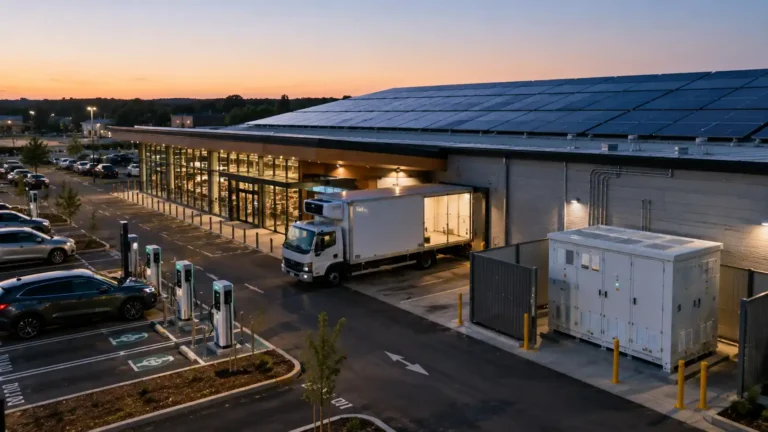
Solar-plus-charging sites
Solar PV and EV charging do not always match perfectly. A BESS can store solar generation when vehicles are not charging and discharge later when charging demand increases.
This is especially useful for:
- Commercial campuses
- Hotels
- Shopping centers
- Logistics facilities
- Service stations
EV Charging BESS Sizing Factors
Do not size the battery from charger nameplate power alone. A 600 kW charger site does not automatically need a 600 kW battery. The correct design depends on the charging profile and grid limit.
| Sizing factor | Why it matters |
|---|---|
| Charger quantity and power | Determines potential maximum site load |
| Grid connection limit | Defines how much power must be buffered |
| Charging session duration | Determines required usable kWh |
| Session overlap | Drives peak power requirement |
| Demand charge rate | Affects ROI |
| Solar generation | Can offset charging energy |
| Required reserve | Maintains backup or uptime margin |
| Battery cycle life | Determines long-term cost |
| PCS rating | Controls usable AC power |
| EMS response | Prevents demand spikes |
Basic starting formula:
Battery discharge power = Charger peak demand - Allowed grid import
If chargers create a 500 kW peak and the site wants to limit grid import to 300 kW:
Required battery power = 500 kW - 300 kW = 200 kW
If the peak lasts for 90 minutes:
Delivered energy = 200 kW x 1.5 hours = 300 kWh
The rated battery capacity must then be adjusted for usable SOC, efficiency, degradation, and temperature.
For deeper sizing principles, link this article to VoltCrave Power’s commercial BESS sizing content when published.
Common Buyer Mistakes
Only counting charger nameplate power
Nameplate power is the maximum possible output. Real utilization depends on driver behavior, vehicle acceptance rate, dwell time, and charger scheduling.
Ignoring charging simultaneity
Four chargers may not all run at full power at the same time. But if they do during peak periods, the site must be prepared.
Forgetting recharge time
A battery that discharges during the morning peak must have enough time and grid capacity to recharge before the next charging wave.
Overlooking EMS logic
The EMS should understand EV charger load, battery SOC, grid import limits, and demand charge periods. Poor EMS logic can cause the battery to charge at the wrong time and create the very peak it is supposed to reduce.
Treating EV charging and solar separately
If the site has solar PV, the storage system should coordinate solar, charging load, grid price, and SOC reserve together.
Business Models Where Battery Storage Changes the Economics
Battery-backed EV charging is not only a technical upgrade. It can change how a charging business is planned, financed, and operated. Buyers should evaluate the business model before selecting battery capacity.
Public fast charging operator
A public charging operator usually cares about utilization, driver experience, charger uptime, and grid interconnection cost. A BESS can help the operator deploy faster in locations where the utility service is limited. Instead of waiting for a major grid upgrade, the owner may install a smaller grid connection and use the battery to buffer peak charging demand.
This does not eliminate the need for grid coordination. It changes the question from “How much maximum power can the utility provide immediately?” to “How much grid power plus battery power can support the expected charging sessions?”
Fleet depot operator
Fleet depots often have predictable charging windows. A logistics company may know when vehicles return, how many miles they must drive the next day, and how much energy each vehicle needs overnight. This makes battery storage easier to model than a public charging hub.
For fleet depots, the BESS should be evaluated alongside smart charging software. If charging can be staggered, the battery may be smaller. If all vehicles must charge in a short window, the battery and PCS may need a higher power rating.
Commercial property owner
Shopping centers, hotels, supermarkets, and office campuses may install EV chargers as an amenity or new revenue source. In these cases, the battery may serve more than one function:
- Reduce EV charging demand peaks
- Store rooftop solar power
- Support building peak shaving
- Provide limited backup for selected circuits
- Improve sustainability reporting
The business case is stronger when the BESS can support both charging and building energy management.
Key Technical Specifications to Include in an RFQ
When requesting a quotation, avoid asking only for “a battery for EV charging.” A serious RFQ should define operating requirements.
Include the following information:
- Number of chargers and charger power rating
- Expected daily charging sessions
- Maximum simultaneous charging sessions
- Utility service capacity
- Desired grid import limit
- Solar PV capacity, if available
- Target battery discharge power
- Required usable battery energy
- Required recharge window
- Ambient temperature range
- Communication requirements between chargers and EMS
- Required warranty period and cycle assumptions
- Installation environment and available space
The supplier should respond with a system proposal that includes battery capacity, PCS power, EMS functions, usable energy, charging strategy, derating assumptions, and warranty conditions.
Example: Battery-Backed Charging Hub Calculation
Assume a commercial site plans to install three 180 kW DC fast chargers. The theoretical maximum charger load is:
3 x 180 kW = 540 kW
The site has a utility connection that can safely support only 300 kW for EV charging without a costly upgrade. The owner wants the BESS to cover the difference during high-demand charging periods.
Battery discharge power = 540 kW - 300 kW = 240 kW
If the high-power overlap usually lasts for one hour, the delivered energy requirement is:
240 kW x 1 hour = 240 kWh
If the buyer assumes an 80% usable SOC window and 92% AC-to-AC efficiency, the approximate rated battery capacity becomes:
240 kWh / (0.80 x 0.92) = 326 kWh
This calculation is only a starting point. A more realistic model should use historical or projected session data, vehicle types, charger utilization, seasonal traffic, electricity tariffs, and battery degradation. A supplier that cannot work from a load profile may oversize the system to reduce risk or undersize it to win on price. Neither approach is ideal.
Commissioning and Performance Verification
Battery-backed charging systems should be tested after installation. Buyers should not assume that the charger, battery, PCS, and EMS will work together just because each component has a datasheet.
Commissioning should verify:
- Charger communication with the EMS
- Grid import limit control
- Battery charge and discharge response
- Emergency stop behavior
- BMS alarm reporting
- PCS derating behavior
- Metering accuracy
- Solar PV coordination, if applicable
- Remote monitoring and event logs
- Recovery after communication loss
The most important test is a simulated high-power charging event. The site should confirm that the BESS discharges quickly enough to prevent a demand spike and that the EMS records why each dispatch decision occurred.
Long-Term Operations and Maintenance
EV charging sites may cycle the battery frequently. That makes O&M planning essential. Buyers should ask how the supplier handles:
- Battery capacity checks
- PCS maintenance
- Cooling system inspection
- Firmware updates
- Remote diagnostics
- Spare parts
- Charger integration issues
- Warranty claims
For a charging operator, battery downtime can become charger revenue loss. A lower-cost battery system may become expensive if service response is slow or if replacement modules are unavailable.

Supplier Evaluation Checklist
Before choosing a battery storage supplier for EV charging stations, ask:
- Can the supplier model charger load profiles?
- Is the PCS rating stated on the AC output side?
- What usable capacity is guaranteed at beginning and end of warranty?
- Can the EMS control grid import limits?
- Can the system coordinate solar PV and charger demand?
- What communication interfaces are available?
- What certifications apply to the battery system?
- How is thermal management handled under frequent cycling?
- What happens if charger demand exceeds battery output?
- Who supports commissioning and troubleshooting?
Why VoltCrave Power Fits This Application
VoltCrave Power is positioned for B2B buyers who need battery products and energy storage solutions rather than consumer-only devices. For EV charging applications, buyers often need a supplier that understands battery chemistry, system design, OEM flexibility, quality control, and long-term support.
VoltCrave Power can support:
- LiFePO4 battery cell and pack supply
- Commercial storage project discussion
- OEM and ODM energy storage cooperation
- Battery-backed charging solution planning
- Documentation for global buyers
- Integration-oriented supplier communication
FAQs
Does every EV charging station need battery storage?
No. Battery storage is most useful when charger demand is high, grid capacity is limited, demand charges are expensive, solar generation is available, or utility upgrades are slow.
Can battery storage reduce EV charging demand charges?
Yes. If the EMS discharges the battery during charging peaks, the site can reduce measured grid demand and lower demand charges.
Can solar panels directly support EV charging?
Yes, but solar output and charging demand do not always match. A BESS helps store solar energy for later charging demand.
What battery chemistry is suitable for EV charging support?
LiFePO4 is commonly used in stationary storage because of its safety, cycle life, and thermal stability.
Need help matching this topic to a real battery project?
Send your target application, capacity range, certification market, and order plan. VoltCrave can recommend a practical product direction.