

Why Commissioning Decides Whether a BESS Project Actually Works
Commissioning turns promises into evidence
A battery energy storage system can look complete while still hiding unresolved risks. Cabinets may be installed, cables may be connected, and a dashboard may show normal status, but the project is not truly complete until the system has proven that it can charge, discharge, protect itself, communicate correctly, and support the intended operating mode. Commissioning turns the purchase specification into measurable evidence.
For buyers, commissioning is the bridge between procurement and operations. The supplier proposal may promise peak shaving, backup power, solar self-consumption, grid support, or microgrid resilience. Commissioning checks whether the installed system can actually perform those duties under agreed conditions. Without a structured acceptance process, the buyer may discover problems only after the warranty clock has started and the project team has left site.
It protects ROI, safety, and warranty rights
Poor commissioning can damage the business case. A system that cannot reach its expected usable capacity may reduce savings. A system with incorrect meter mapping may dispatch at the wrong time. A system with weak alarm routing may run for weeks with hidden faults. A system with undocumented settings can be difficult to troubleshoot later.
Commissioning also protects warranty rights. If the buyer records baseline capacity, software versions, settings, test results, and operating conditions at handover, future claims become easier to investigate. If there is no baseline record, every later performance question becomes harder.
Start With Commissioning Requirements in the RFQ
Do not wait until installation
Commissioning should be defined before the contract is signed, not after the equipment arrives. The RFQ should state which tests the supplier must perform, which documents must be delivered, who witnesses each test, what data must be recorded, and what acceptance criteria will be used. This prevents the common problem where the buyer expects a full performance test while the supplier assumes only basic energization.
The RFQ should also define commercial consequences. Which tests are linked to payment milestones? What happens if a test fails? How many retests are included? Who pays for extra site visits? When does the warranty start? Does the warranty start at shipment, energization, provisional acceptance, or final acceptance? These details affect project risk as much as the battery chemistry or PCS rating.
Align tests with the use case
A peak shaving project needs demand response and meter validation. A backup power project needs transfer behavior and critical load verification. A solar-plus-storage project needs PV coordination and charge control. A microgrid project needs islanding logic, black start assumptions, and controller sequencing. A utility project may require grid code functions, telemetry, protection coordination, and dispatch response. A generic commissioning checklist is useful, but the final acceptance plan must match the revenue model.

Factory Acceptance Testing Before Shipment
What FAT should prove
Factory acceptance testing, often called FAT, is performed before shipment. It does not replace site testing, but it helps catch problems while the supplier still has full factory tools, spare parts, and engineering support nearby. A strong FAT checks product identity, assembly quality, electrical safety, software version, communication, BMS operation, PCS function, alarms, protection settings, and basic charge-discharge behavior.
For modular systems, FAT should confirm that the battery racks, BMS, PCS, HVAC or thermal management equipment, fire detection interface, auxiliary power, monitoring gateway, and communication ports match the approved design. If the project uses customized connectors, protocol mapping, enclosure dimensions, cable entries, or EMS logic, those details should be checked before shipment.
Records buyers should request
The FAT report should include serial numbers, firmware versions, inspection results, test equipment, date, operator, witnessed items, pass or fail status, open issues, and corrective actions. Photos are useful, but they are not enough. The buyer should receive data that can be compared with site acceptance results later.
For suppliers such as Voltcrave Power, FAT documentation can become a trust signal. Buyers evaluating BESS suppliers should ask whether the supplier can provide factory test records, outgoing QC data, configuration records, and documentation tied to the exact shipment. That level of specificity supports both EEAT and real procurement confidence.
Shipment, Storage, and Installation Checks
Inspect before energizing
After delivery, the site team should inspect packaging, impact indicators if used, cabinet condition, terminals, cable glands, ventilation paths, warning labels, and shipping documents. If equipment has been stored before installation, record storage duration, environmental conditions, state of charge where applicable, and any maintenance charging requirement. Long storage without monitoring can create avoidable problems.
Mechanical installation checks should confirm foundation level, anchoring, cabinet spacing, service access, cable bending radius, ventilation clearance, drainage, seismic or wind requirements where applicable, and separation from heat sources or combustible materials. Electrical checks should confirm cable size, torque, polarity, grounding, insulation resistance, phase sequence for AC equipment, auxiliary power, communication wiring, and labeling.
Site conditions matter
Commissioning should not treat the battery as isolated equipment. The BESS interacts with transformers, switchgear, meters, building loads, PV inverters, generators, utility relays, fire systems, and network equipment. A system can pass factory tests and still fail at site because of meter location, communication latency, incorrect CT orientation, unavailable network access, or protection settings that conflict with existing equipment.
Site Acceptance Testing and Performance Verification
SAT confirms the installed system
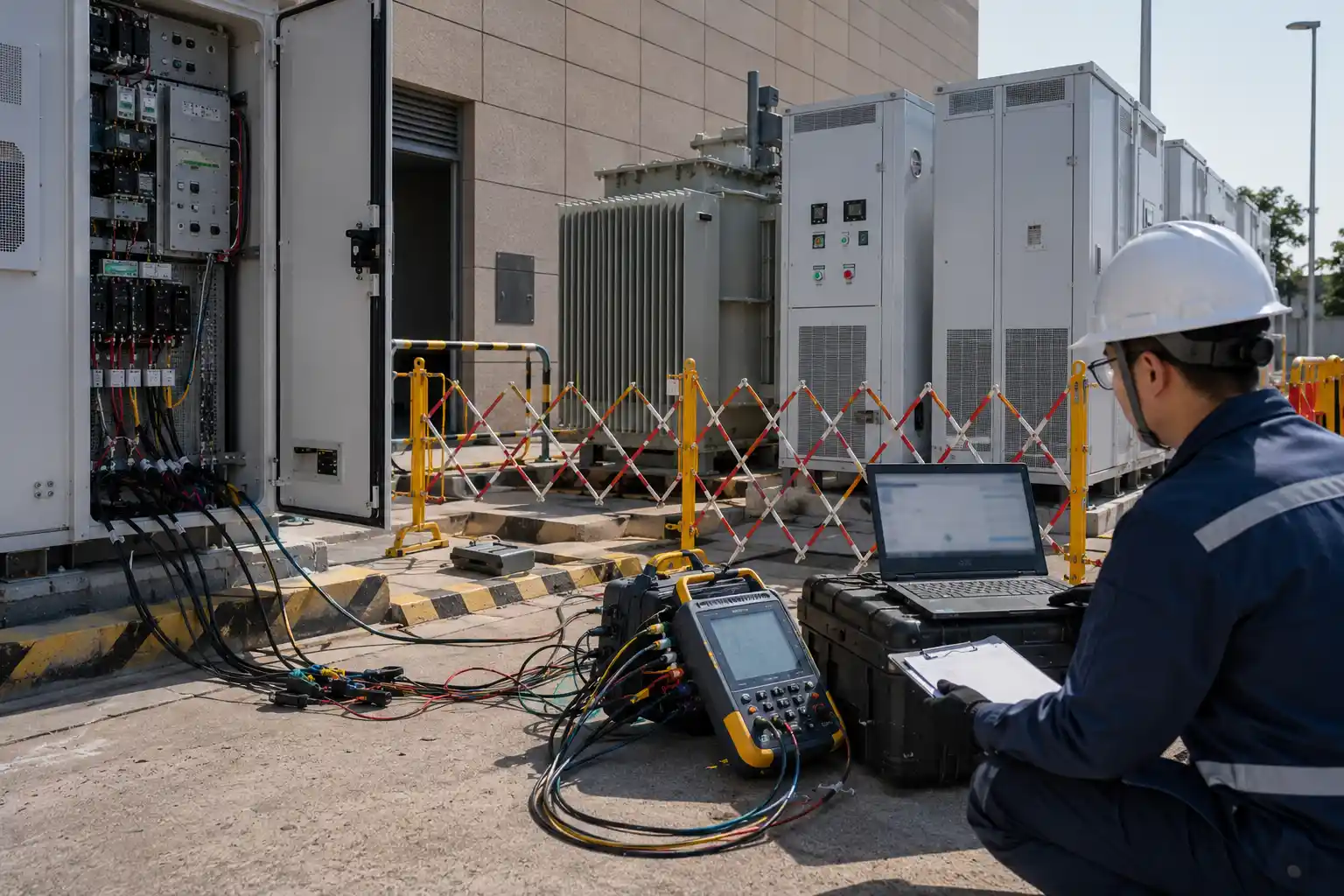
Site acceptance testing, or SAT, proves that the complete installed system works in its real environment. SAT should include energization sequence, emergency stop checks, BMS communication, PCS startup and shutdown, EMS commands, meter mapping, alarm reporting, thermal management, fire interface signals where applicable, and charge-discharge operation.
The project team should test both normal operation and expected fault behavior. What happens if the EMS loses communication with the PCS? What happens if a cabinet reports high temperature? What happens if grid power is lost in a backup application? What happens when the system reaches low state of charge? A good commissioning plan verifies controlled responses, not only green status lights.
Performance tests should match the contract
Performance verification should measure the values that matter to the buyer. Common metrics include usable energy, maximum charge power, maximum discharge power, response time, round-trip efficiency, state of charge accuracy, alarm delivery, and dispatch accuracy. For long-term evaluation, the U.S. Department of Energy’s BESS evaluation work emphasizes measured charge and discharge data as the basis for understanding deployed system performance. Buyers should therefore make sure commissioning creates a clean baseline for future monitoring.
Not every project needs the same depth of test. A small commercial peak shaving system may need a shorter acceptance cycle than a utility-scale system. However, every project should record enough baseline data to prove that the system is functional, safe, and aligned with the promised use case.
BMS, PCS, and EMS Communication Checks
Verify the control chain
BESS operation depends on a chain of decisions. The BMS protects battery cells and racks. The PCS converts power between DC and AC. The EMS decides when and how the system operates. If these layers do not communicate correctly, the system may underperform or shut down unexpectedly.
Commissioning should verify data points such as voltage, current, state of charge, state of health, temperature, rack status, alarms, PCS power, breaker status, meter data, and EMS dispatch commands. The buyer should confirm that the dashboard values match independent meters where possible. Incorrect scaling, reversed meters, swapped labels, and time-zone errors are more common than many teams expect.
Cybersecurity and access control
Connected systems need access control. Commissioning should record administrator accounts, password handover, remote access method, user roles, network addresses, data retention, update process, and alarm recipients. If remote monitoring is included, verify that the supplier and buyer agree on who can view data, who can change settings, and how changes are logged.
Safety and Emergency Response Validation
Test the functions that protect people
Safety checks should include emergency stop operation, door interlocks where applicable, insulation monitoring, grounding, overcurrent protection, alarm indicators, ventilation or thermal management behavior, fire detection interface, signage, and access restrictions. The project team should also confirm that local code, authority having jurisdiction requirements, and site-specific fire safety requirements have been addressed.
Standards and guidance such as NFPA 855, UL 9540, UL 9540A test information, and applicable electrical codes may influence installation and documentation requirements. The buyer should not treat these as generic paperwork. They affect spacing, enclosure placement, fire response planning, and the documents needed for approval.
Train operators before handover
Operator training should be part of commissioning. Site staff should know normal operating modes, shutdown procedure, emergency contacts, alarm meaning, maintenance intervals, and restrictions on opening cabinets or changing settings. A sophisticated system can become risky if operators do not understand what they are allowed to do.
Handover Documents Buyers Should Receive
The final document package
The handover package should include approved drawings, single-line diagram, equipment datasheets, serial number list, FAT report, SAT report, performance test data, settings files, firmware versions, warranty certificate, O&M manual, maintenance schedule, spare parts list, training record, safety documents, transport documents where relevant, and contact escalation path.
For performance-based projects, the handover package should also include baseline capacity, baseline efficiency or test assumptions, dispatch mode, data access method, meter locations, and agreed reporting format. If the system is expected to reduce demand charges or support critical loads, the buyer needs the data path that proves the result.
Open issues should be tracked
Not every project reaches final acceptance with zero small issues. The important point is to track open issues clearly. A punch list should define the issue, owner, priority, target date, and acceptance evidence. Avoid vague notes such as “supplier to check later.” Handover should not hide unresolved risk.
Supplier Evaluation Questions
Ask before signing
Buyers should ask the supplier to share a sample commissioning plan before signing. Ask what FAT is performed, what SAT is included, what test equipment is used, how performance is measured, who provides commissioning engineers, how many site days are included, and what documents are delivered.
Ask how the supplier handles failed tests. Ask whether remote support is available after handover. Ask whether the monitoring platform can export data. Ask whether firmware changes are recorded. Ask whether spare parts are stocked. Ask whether the supplier has experience with your use case: peak shaving, backup power, PV self-consumption, microgrid operation, or grid services.
How Voltcrave Power Can Support BESS Buyers
Voltcrave Power can position itself as a practical BESS partner by connecting battery hardware, manufacturing documentation, compliance support, and commissioning planning. For buyers, the strongest message is not only that the supplier can provide a battery system. It is that the supplier can help define the evidence needed to accept the system.
Project teams can review Voltcrave Power’s energy storage and manufacturing capabilities, then request a commissioning discussion based on their application. Useful internal pages include Energy Storage Solutions, Advanced Battery Manufacturing, Certifications, and Contact. A well-structured commissioning plan helps both buyer and supplier because it turns project success into shared, measurable proof.
FAQs
What is BESS commissioning?
BESS commissioning is the process of verifying that a battery energy storage system has been installed correctly, operates safely, communicates properly, and meets agreed performance requirements before final handover.
What is the difference between FAT and SAT?
FAT is factory acceptance testing before shipment. SAT is site acceptance testing after installation. FAT checks equipment before it leaves the supplier, while SAT confirms the complete installed system in its real operating environment.
What should be included in a BESS performance test?
A BESS performance test may include usable capacity, charge power, discharge power, response time, round-trip efficiency, state of charge accuracy, alarm reporting, and dispatch accuracy. The exact test should match the project use case.
When should the commissioning checklist be agreed?
The commissioning checklist should be agreed during procurement and included in the contract. Waiting until installation can create disputes over supplier responsibility, payment milestones, and acceptance criteria.
Why is commissioning important for warranty?
Commissioning creates baseline records for capacity, settings, firmware versions, alarms, and performance. Those records help investigate future issues and protect the buyer’s warranty position.
Need help matching this topic to a real battery project?
Send your target application, capacity range, certification market, and order plan. VoltCrave can recommend a practical product direction.