Why Energy Storage Manufacturing Matters More Than Ever
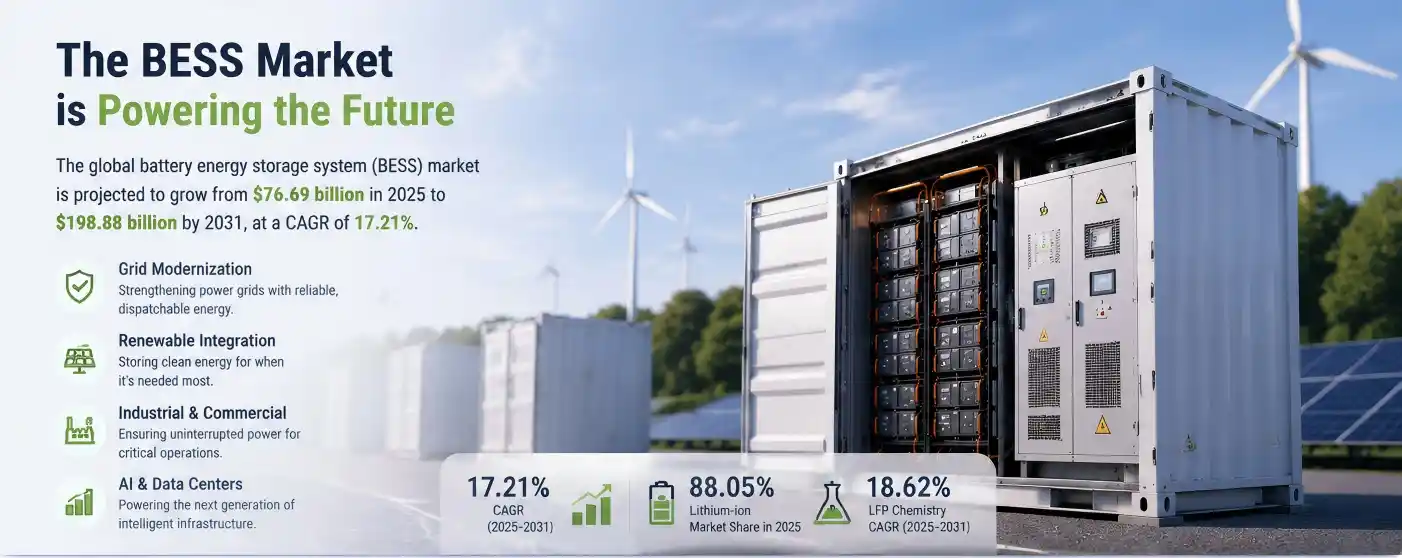
The global Battery Energy Storage System (BESS) market is projected to grow from USD 76.69 billion in 2025 to USD 198.88 billion by 2031, achieving a compound annual growth rate (CAGR) of 17.21%. Lithium-ion batteries continue to dominate the market with an 88.05% market share, while LiFePO4 battery cell technology is expanding at an even faster pace due to its superior thermal stability, long cycle life, enhanced safety, and lower total cost of ownership.
As governments accelerate renewable energy deployment and utilities modernize aging power infrastructure, battery energy storage has evolved from an optional technology into a strategic asset. Large-scale solar farms, commercial and industrial facilities, data centers, EV charging stations, and microgrids increasingly rely on integrated BESS solutions to improve energy resilience and maximize renewable energy utilization.
For EPC contractors, project developers, utilities, distributors, and energy storage brand owners, this growth represents both opportunity and responsibility. Choosing the right battery energy storage system manufacturer is no longer simply about comparing battery prices or production capacity. It requires evaluating engineering capability, manufacturing consistency, certification compliance, system integration expertise, and long-term technical support.
At VoltCrave Power, we have built our production philosophy around one principle: end-to-end BESS manufacturing minimizes project risk by maintaining complete quality control throughout the manufacturing lifecycle. From tier-one LiFePO4 battery cell sourcing and automated battery PACK production to intelligent system integration and global project delivery, every production stage is designed to improve reliability, scalability, and repeatability.
In this guide, we explore what defines a world-class battery energy storage system manufacturer, the biggest procurement challenges facing today’s BESS buyers, and how an integrated manufacturing strategy protects long-term investment while improving project success.
Why Energy Storage Manufacturing Matters More Than Ever
Energy storage is no longer a supporting component of renewable energy projects—it has become the foundation of modern power infrastructure. Today’s Battery Energy Storage Systems are expected not only to store electricity but also to stabilize grids, improve renewable energy utilization, reduce operational costs, and provide reliable backup power across residential, commercial, industrial, and utility-scale applications.
Several industry trends are fundamentally changing how global buyers evaluate battery energy storage manufacturers.
Grid Modernization Is Accelerating
Traditional electrical grids are evolving into intelligent energy networks capable of integrating distributed renewable generation, electric vehicles, and smart energy management systems. Modern BESS installations increasingly provide grid-forming capabilities, voltage regulation, frequency response, and synthetic inertia, placing higher demands on system engineering and manufacturing quality.
Software Has Become a Core Competitive Advantage
Battery hardware alone no longer determines system performance. Advanced Energy Management Systems (EMS), Battery Management Systems (BMS), and Power Conversion Systems (PCS) now optimize charging strategies, monitor battery health, improve energy efficiency, and enable predictive maintenance through intelligent software algorithms.
Manufacturers capable of integrating hardware and software into one coordinated platform deliver significantly greater operational reliability.
Manufacturing Transparency Matters More Than Ever
Global procurement strategies increasingly prioritize resilient supply chains and transparent manufacturing processes. Buyers now expect manufacturers to provide complete traceability from raw materials to finished products, ensuring consistent quality while reducing supply chain risks.
For professional battery energy storage manufacturers, digital manufacturing technologies such as Manufacturing Execution Systems (MES), automated production lines, and intelligent quality inspection have become essential competitive advantages.
Safety Standards Continue to Increase
International safety requirements continue evolving as energy storage deployments expand worldwide. Compliance with standards such as UL 9540, UL 9540A, IEC 62619, UL 1973, UN38.3, and NFPA 855 requires manufacturers to implement comprehensive safety engineering, rigorous testing procedures, and full lifecycle quality management.
Rather than treating certification as a final step, leading manufacturers incorporate safety into every stage of end-to-end BESS manufacturing, from LiFePO4 battery cell qualification to final Factory Acceptance Testing (FAT).
In this environment, selecting a battery energy storage system manufacturer is no longer simply evaluating battery specifications—it is choosing an engineering and manufacturing partner capable of delivering safe, certified, and globally deployable energy storage solutions.
The 5 Biggest Pain Points in BESS Procurement
Whether sourcing battery modules, complete containerized energy storage systems, or long-term OEM manufacturing partnerships, global buyers consistently encounter several critical challenges that can determine project success.
1. Supply Chain Instability
Global demand for lithium battery materials continues to grow rapidly, while geopolitical uncertainty, export restrictions, and fluctuations in raw material prices create ongoing procurement risks. Manufacturers without diversified sourcing strategies may struggle to maintain consistent production schedules and stable pricing.
VoltCrave Power mitigates these risks by working with qualified tier-one suppliers and implementing multi-source procurement strategies that improve supply continuity for long-term customer projects.
2. Safety and Certification Complexity
Meeting international certification requirements requires far more than documentation. A qualified battery energy storage system manufacturer must engineer safety into every production stage, from LiFePO4 battery cell selection and thermal management design to complete system validation and Factory Acceptance Testing.
Failure to meet regional certification requirements can delay shipments, increase project costs, and create compliance risks in target markets.
3. Poor Integration Between Hardware and Software
Many energy storage projects involve multiple suppliers responsible for batteries, inverters, BMS, EMS, and PCS. Without coordinated engineering, communication compatibility issues often appear during commissioning, resulting in reduced efficiency, delayed deployment, and increased maintenance costs.
Integrated end-to-end BESS manufacturing eliminates these risks by validating complete system compatibility before shipment.
4. Delayed Project Delivery
Manufacturing delays, customs documentation errors, logistics bottlenecks, and weak project coordination can postpone commercial operation by weeks or even months. For utility-scale and commercial projects, these delays directly impact return on investment and contractual obligations.
Professional project management and coordinated global logistics are therefore essential components of a reliable manufacturing partnership.
5. Inconsistent Quality Control
Without standardized inspection procedures, automated production, and comprehensive testing, defective battery modules or system components may enter the field, increasing warranty claims and reducing customer confidence.
At VoltCrave Power, quality control begins with incoming LiFePO4 battery cell inspection and continues through module assembly, PACK manufacturing, system integration, environmental testing, and final shipment validation.
These challenges become significantly more difficult when projects depend on multiple disconnected suppliers. This is precisely why end-to-end BESS manufacturing has become the preferred production model for commercial, industrial, and utility-scale battery energy storage systems.
End-to-End BESS Manufacturing: The Four Critical Production Stages
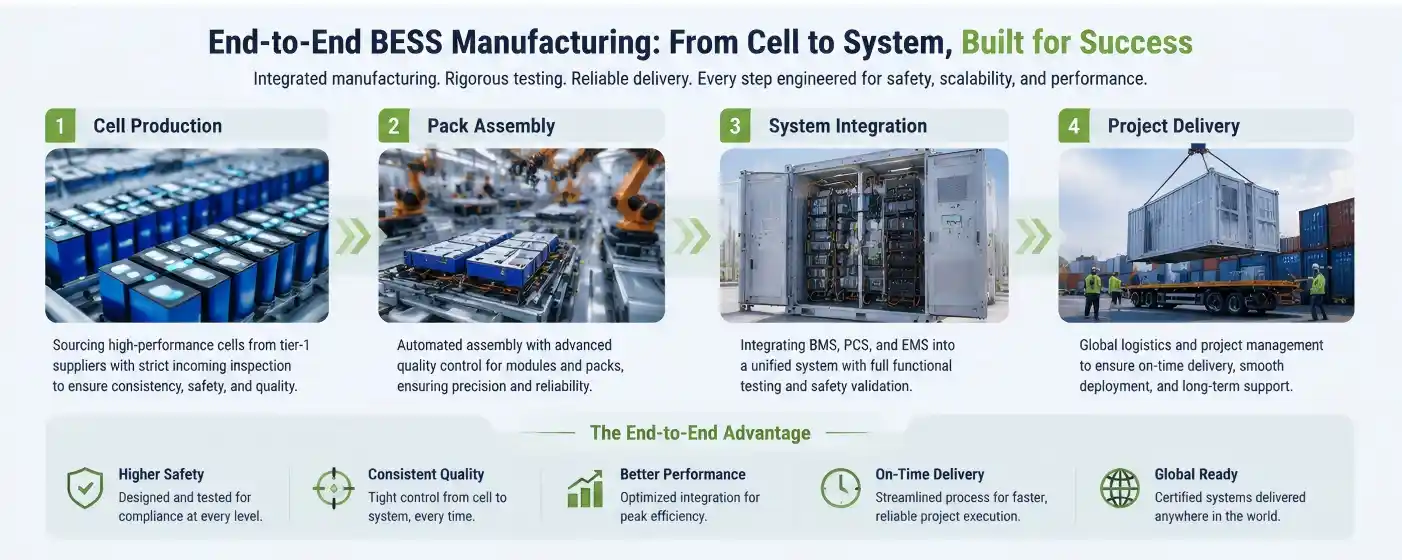
Unlike conventional manufacturing models where batteries, electronics, software, and logistics are managed independently, VoltCrave Power follows an integrated end-to-end BESS manufacturing workflow that maintains quality control throughout every production stage.
This manufacturing strategy reduces communication gaps, improves consistency, shortens delivery cycles, and ensures every Battery Energy Storage System performs as a fully integrated solution rather than a collection of independent components.
Stage 1 — Premium LiFePO4 Battery Cell Qualification
Every high-performance BESS begins with selecting reliable LiFePO4 battery cell suppliers.
Each incoming batch undergoes comprehensive inspection including:
- Capacity consistency verification
- Voltage matching
- Internal resistance testing
- Appearance inspection
- Thermal stability evaluation
- Supplier traceability verification
Only qualified battery cells proceed into production, ensuring stable electrical performance and long-term reliability across every battery pack.
Stage 2 — Automated Battery PACK Manufacturing
Following incoming inspection, qualified battery cells enter automated production lines designed for precision and repeatability.
The manufacturing process includes:
- Cell sorting and matching
- Automated laser welding
- Busbar installation
- Module assembly
- Battery PACK integration
- High-voltage insulation testing
- Thermal management installation
- Electrical performance verification
Automation minimizes human error, improves production efficiency, and guarantees consistent manufacturing quality for large-volume commercial and utility-scale deployments.
Stage 3 — System Integration
System integration is where many Battery Energy Storage System (BESS) projects succeed or fail. Even when high-quality components are used, poor integration between hardware and software can lead to commissioning delays, communication failures, reduced efficiency, or unexpected downtime.
At VoltCrave Power, system integration is a core capability rather than an outsourced process. As a professional battery energy storage system manufacturer, we validate every subsystem before shipment to ensure reliable operation under real-world conditions.
Our integration process includes:
- Electrical architecture design and verification
- BMS, PCS, and EMS communication configuration
- Thermal management and fire protection integration
- Protection logic and functional safety validation
- Factory Acceptance Testing (FAT)
- Remote monitoring and communication verification
Instead of delivering individual components, our end-to-end BESS manufacturing process provides customers with a fully integrated energy storage solution that is tested as one complete system.
This integrated approach significantly reduces commissioning time, minimizes compatibility issues, and improves long-term operational stability.
Stage 4 — Global Project Delivery
Manufacturing alone does not guarantee project success. Safe transportation, customs compliance, installation support, and commissioning are equally important for international energy storage projects.
VoltCrave Power provides complete project delivery support, including:
- Export packaging designed for international transportation
- Customs documentation and compliance assistance
- Sea, rail, and air freight coordination
- Installation guidance
- Commissioning support
- Technical documentation
- Remote engineering assistance
- After-sales technical support
By managing both manufacturing and delivery, we reduce project risks while helping EPC contractors, distributors, and project developers complete installations on schedule.
This turnkey approach allows customers to focus on project execution while relying on one experienced battery energy storage system manufacturer throughout the entire project lifecycle.
R&D and Quality: The Hidden Differentiators
In today’s highly competitive market, the difference between leading battery energy storage manufacturers and ordinary assembly factories lies in research capability, engineering expertise, and quality management.
At VoltCrave Power, quality is designed into every stage of end-to-end BESS manufacturing rather than inspected only before shipment.
Scientific Research and Innovation Platforms
Continuous innovation supports the long-term competitiveness of our energy storage products.
Our research infrastructure includes:
- 10 scientific research and innovation platforms
- 7 innovation experimental platforms
- National-level technical center
- Academician workstation
These research resources support continuous improvements in battery chemistry, thermal management, system architecture, structural optimization, and intelligent energy management technologies.
Standards and Intellectual Property
Technical leadership is demonstrated not only by product performance but also by participation in industry standard development.
VoltCrave Power has contributed to the formulation of:
- 19 national standards
- 14 industry standards
- 35 group standards
Our intellectual property portfolio covers core battery technologies across China, Europe, and North America. The company has also received the Chinese Patent Award of Excellence and achieved certification for intellectual property management implementation.
These achievements demonstrate our long-term commitment to technological innovation and international compliance.
Structural Innovation
Product reliability begins with engineering design.
Our engineering team continuously improves battery systems in four critical areas:
Enhanced Safety
Multi-layer protection mechanisms reduce thermal runaway risks while improving overall system safety.
Ultra-Fast Charging Capability
Optimized current paths and thermal management improve charging performance while protecting battery health.
Higher Energy Efficiency
Optimized internal structures reduce electrical resistance, improving round-trip efficiency and lowering operating costs.
Lightweight Structural Design
Optimized enclosure design simplifies transportation, installation, and future maintenance while maintaining mechanical strength.
These engineering improvements provide reliable technical support for both commercial and utility-scale Battery Energy Storage Systems.
Integrated Testing Platform
Reliable products require continuous verification throughout the manufacturing process.
VoltCrave Power operates a comprehensive testing platform covering every stage of production, from raw material inspection to complete system validation.
Our testing capabilities include:
- More than 200 testing items
- More than 20,000 testing channels
Testing procedures include:
- Incoming LiFePO4 battery cell inspection
- Cell grading and matching
- Module aging tests
- Battery PACK cycle testing
- High-voltage insulation verification
- Environmental reliability testing
- Thermal performance validation
- System functional testing
- Final Factory Acceptance Testing (FAT)
This comprehensive quality assurance process ensures every Battery Energy Storage System meets international performance and safety requirements before shipment.
Need help matching this topic to a real battery project?
Send your target application, capacity range, certification market, and order plan. VoltCrave can recommend a practical product direction.