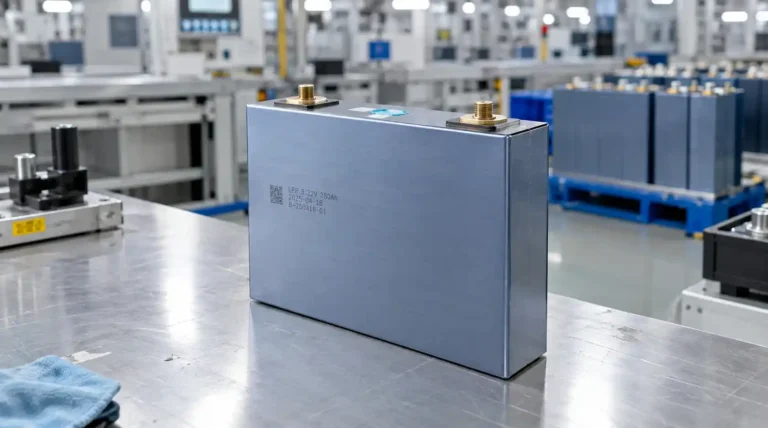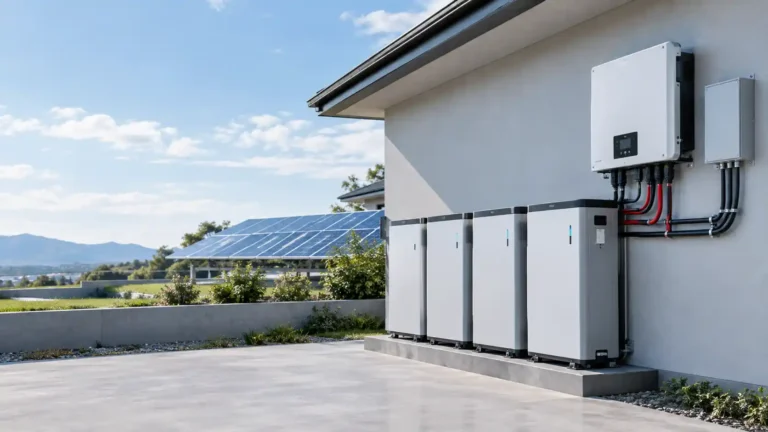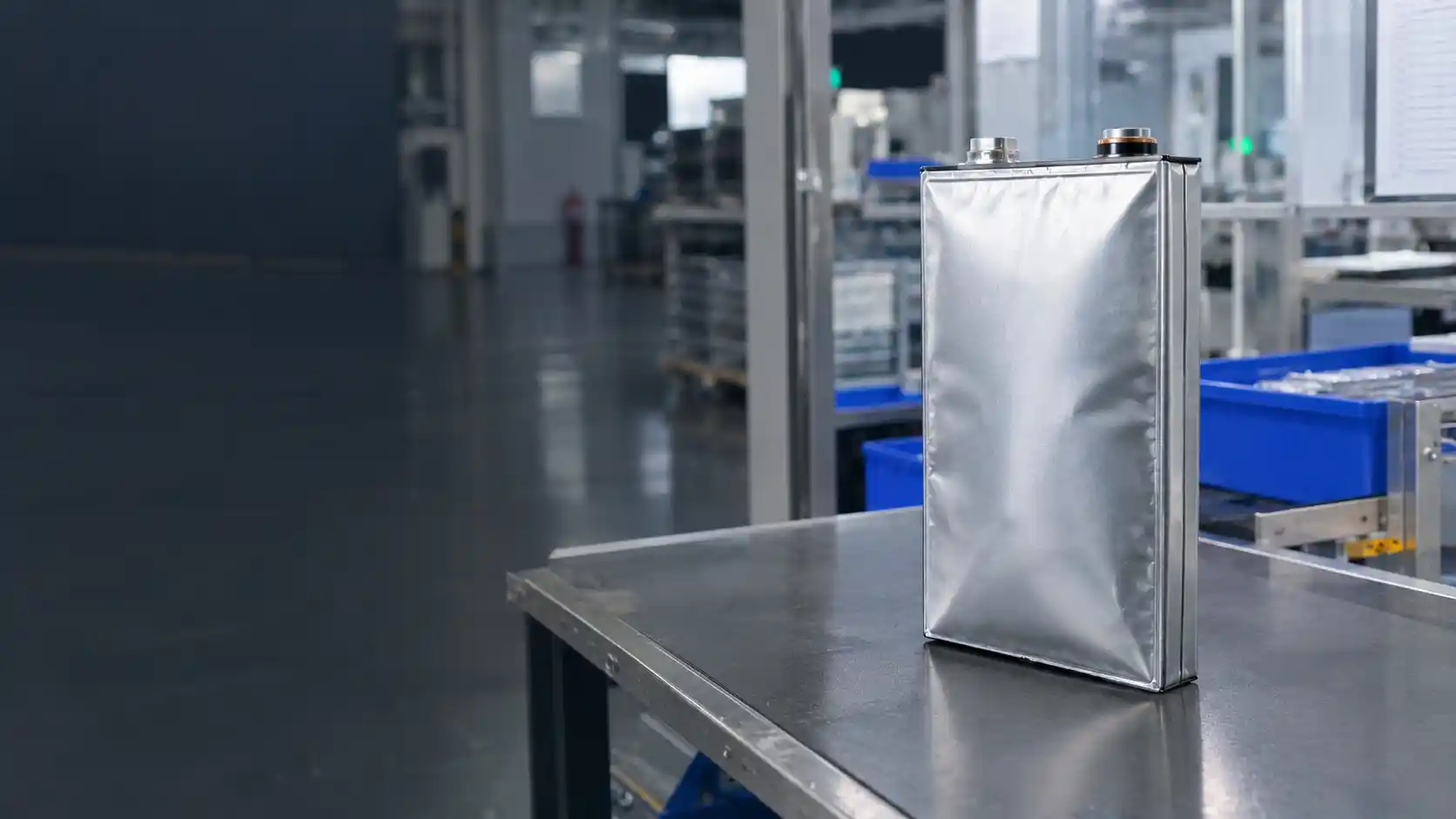
A bulged lithium battery pack is often associated with gas generation inside the cell. These gases can result from electrochemical reactions that occur during aging, abnormal operating conditions, or manufacturing defects. Visible deformation may appear only after degradation has progressed.
For importers and battery buyers, the key question is whether the swelling reflects normal aging, an application-related issue, or a manufacturing defect. The answer can affect warranty claims, batch acceptance, and supplier accountability. Accepting a defective batch can lead to field failures and liability, while rejecting products without sufficient evidence can disrupt a reliable supply chain.
This article explains the main causes of lithium battery bulge, the indicators that may reveal degradation before visible deformation, and the checks buyers should perform during supplier evaluation and incoming inspection.
What battery pack bulge actually is
Cell bulge is a dimensional change in the cell casing associated with internal volume growth. It is important to distinguish between reversible swelling related to normal changes in state of charge and irreversible swelling associated with aging, side reactions, or other degradation mechanisms.
Reversible swelling is the normal dimensional change that occurs as lithium moves between electrodes. Its magnitude varies with cell chemistry, design, state of charge, and operating conditions.
Irreversible swelling accumulates over time and does not fully recover when the cell returns to its original state of charge. Excessive irreversible swelling can deform the cell casing or module structure and may require further investigation.
For procurement teams, dimensional comparisons should use a consistent reference state of charge and controlled measurement conditions. Otherwise, normal operating-related thickness changes may be mistaken for abnormal swelling.
Why a lithium battery pack swells: the four mechanisms
Four mechanisms can contribute to irreversible volume growth. Their relative importance depends on cell design, operating history, and manufacturing quality.
SEI growth. The solid electrolyte interphase (SEI) is a passivating layer that forms on the anode. It can continue to grow during cell operation, consuming lithium and electrolyte while contributing to long-term degradation. SEI growth is a normal aging process, although its rate and contribution to swelling vary with cell chemistry and operating conditions.
Electrolyte decomposition and gas generation. Electrolyte solvents can break down at electrode interfaces and release gaseous byproducts, including hydrogen, carbon dioxide, carbon monoxide, and light hydrocarbons such as ethylene. In a sealed cell, gas accumulation can increase internal pressure and contribute to casing deformation. LFP chemistry generally offers good thermal stability, but gas generation can still occur during aging, overcharge, or other abusive conditions. The extent of gas generation depends on cell design, chemistry, temperature, state of charge, and the severity of the operating condition.
Lithium plating. When charging is too fast, too cold, or beyond the anode’s ability to accept lithium, metallic lithium may deposit on the anode surface instead of intercalating into its structure. Plating can contribute to irreversible degradation and accelerate electrolyte decomposition. It is closely associated with charging strategy, making charger configuration, BMS settings, and system design important factors in risk prevention.
Physical and manufacturing defects. Internal short circuits, non-uniform electrode coating, moisture contamination during production, and pouch or prismatic seal defects can contribute to abnormal degradation or gas generation. When these issues are confirmed, they may indicate a manufacturing or quality-control problem affecting an individual cell or production batch. VoltCrave’s battery manufacturing and pack assembly process describes the production controls and testing stages intended to prevent such defects.
Why LFP cells still swell if it is the “safer” chemistry
LiFePO4 (LFP) cells are often selected for their thermal stability, but this does not make them immune to swelling.
LFP generally offers better thermal stability than many layered-oxide cathode chemistries. However, thermal stability does not eliminate the side reactions that occur during aging or under abnormal operating conditions.
First, SEI growth, electrolyte decomposition, and lithium plating can still occur in LFP cells. Swelling can therefore develop over time, particularly when operating conditions accelerate degradation.
Second, gas composition and volume depend on the cell chemistry and the conditions under which degradation occurs. Overcharge and other abusive conditions can produce combustible gases in LFP cells. The presence and concentration of these gases depend on the specific cell and test conditions.
For buyers, the practical conclusion is that chemistry alone does not determine battery safety. Appropriate BMS protection, suitable charging parameters, and operation within the cell manufacturer’s specified limits remain important.
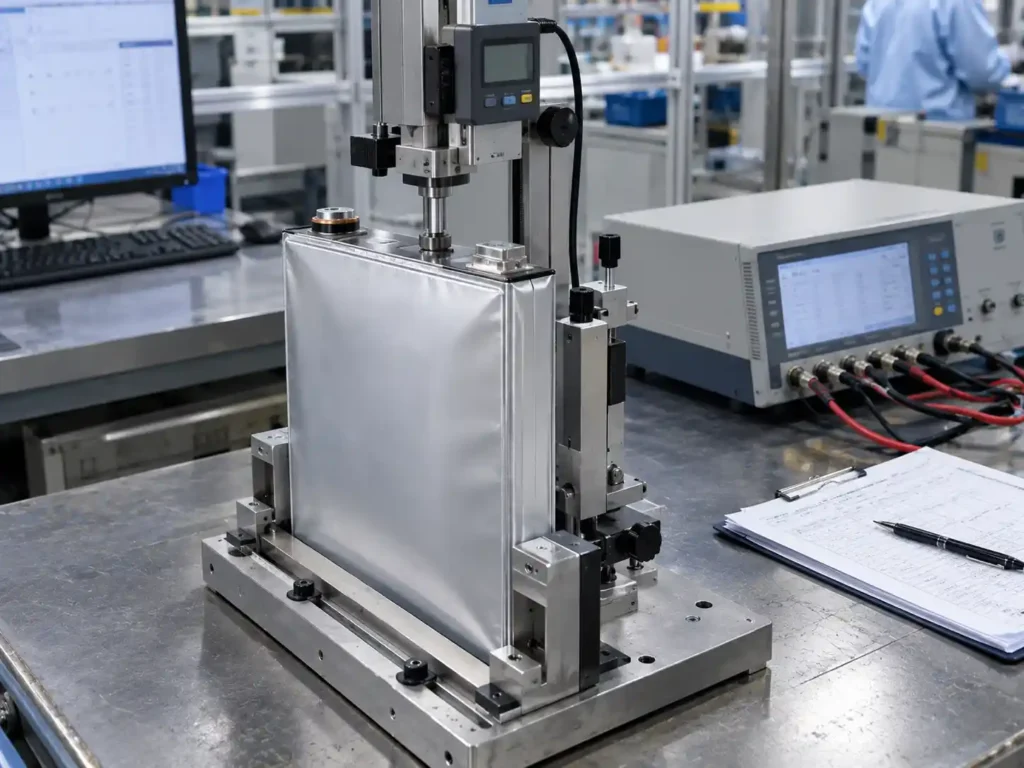
How pack swelling is detected before it becomes visible
Visible deformation is a warning sign that warrants investigation. However, electrical and performance changes may provide earlier indications of cell degradation.
| Signal | What it may indicate | Where it is observed |
|---|---|---|
| Internal resistance drift | Changes in cell condition or increasing degradation | BMS telemetry and periodic DCIR testing |
| Capacity fade beyond expectations | Loss of usable capacity or accelerated aging | Capacity test records |
| Abnormal voltage divergence within a pack | Differences in cell performance or possible cell degradation | BMS cell-level voltage logs |
| Charging curve deviation | Changes in impedance or possible charging-related degradation | Charger or BMS charge records |
| Increased gas volume under controlled testing | Gas generation associated with internal reactions | Cell-level laboratory testing |
Mechanical swelling can be associated with changes in internal resistance and capacity, although the relationship varies with cell chemistry, design, and aging conditions.
For a buyer, internal resistance trends, cell-to-cell voltage differences, and capacity-test results can help identify potential degradation. These indicators should be assessed against baseline measurements and the manufacturer’s specifications rather than treated as standalone proof of swelling or a manufacturing defect.
Both BMS records and incoming-inspection data can support this process. The quality control and cell-level validation process used in pack assembly is designed to establish a baseline before shipment, including DCIR screening and cell-to-cell consistency checks.

The buyer’s problem: defect, abuse, or normal aging?
A bulged cell can have several possible causes, and the party responsible cannot always be identified from the physical appearance alone.
| Potential root cause | Typical pattern | What should be investigated |
|---|---|---|
| Normal SEI growth and aging | Gradual changes over the service life | Cycle history, capacity fade, and dimensional records |
| Operating conditions outside specifications | Degradation following unsuitable charging, discharging, or temperature exposure | BMS logs, charger settings, and operating records |
| Lithium plating associated with charging strategy | May develop under unsuitable charging conditions | Charging current, temperature, and voltage history |
| Manufacturing defect | May affect one or more cells from a production batch | Lot traceability, inspection records, and failure analysis |
The distinction between manufacturing defects and operating-related degradation is particularly important in warranty assessments. Swelling associated with an undersized BMS, unsuitable charging profiles, or operation outside specified temperature limits may indicate a system-design or application issue. However, the cause should be established from technical evidence rather than assumed.
Manufacturing defects may be suspected when multiple cells from the same production lot show similar failures within a comparable period. Lot traceability, inspection records, operating data, and failure analysis can help determine whether the issue is batch-related, application-related, or attributable to other factors.
For both buyers and suppliers, baseline measurements and traceable production records provide a stronger basis for investigating failures and resolving warranty claims.
What buyers should verify before purchase
Preventing premature swelling starts with evaluating the cell, protection system, application requirements, and supporting documentation before placing an order.
Cell traceability and grading. Confirm whether cells are new production or re-graded material. A grade designation should be supported by appropriate inspection records and test data rather than relying on the label alone. VoltCrave’s LiFePO4 battery cells and components page shows how cell technologies and specifications are documented at the category level, and what data accompanies each cell type.
BMS protection adequacy. Review overcharge and over-discharge cut-offs, over-current limits, temperature-related charging restrictions, and low-temperature charge-current limits. These protections can reduce risks associated with abnormal operating conditions, but their effectiveness depends on the system configuration, parameter settings, and compatibility with the selected cells.
Specified operating envelope versus intended application. Confirm that the cell’s specified charging and discharging temperature ranges cover the actual deployment environment. Installation conditions, thermal management, and seasonal temperature variations should be considered when selecting a battery for residential, commercial, industrial, or outdoor applications.
Cycle-life claim substantiation. A cycle-life figure should be tied to defined test conditions, including depth of discharge, temperature, and charge/discharge rate. State-of-charge range and charging strategy can influence degradation and dimensional changes. Buyers should request the conditions under which the claimed cycle life was established and determine whether those conditions match the intended application.
What to put in an RFQ
Battery swelling prevention and warranty assessment should be addressed in the technical specification and commercial terms before an order is placed.
- Reference cell dimensions and the state of charge used for measurement
- Incoming-inspection acceptance criteria for dimensional deviation
- Required documentation, including cell test data, lot coding, and relevant material certificates
- Defined charging and discharging temperature ranges and derating behavior outside those ranges
- Cycle-life claims supported by specified depth of discharge, temperature, and C-rate
- Warranty terms addressing premature swelling, assessment criteria, required evidence, and the claims process
- Gas-generation or dimensional-stability test results, where available and relevant to the application
A structured supplier evaluation framework, such as our energy storage supplier scorecard covering fifteen procurement checkpoints, helps buyers compare these requirements across quotations rather than evaluating suppliers on price alone.
Safe Handling of a Bulged Lithium Battery
A bulged lithium battery should be treated as potentially damaged. Do not charge, discharge, puncture, compress, or attempt to repair it.
If the battery is hot, smoking, leaking, making unusual noises, or showing other signs of an active failure, move away from the area and contact local emergency services when necessary. Do not attempt to handle or relocate a battery that presents an immediate safety risk.
If there are no signs of an active emergency, keep people away from the battery and seek instructions from the manufacturer, a qualified battery service provider, or an authorized waste-management facility. Do not place damaged batteries in household waste or ordinary recycling bins.
Storage, packaging, transport, and disposal requirements depend on the battery’s condition and the applicable jurisdiction. Damaged or defective lithium batteries may be subject to specific hazardous-materials or dangerous-goods requirements. Follow applicable local regulations and obtain qualified guidance before moving or shipping the battery.
For stationary energy storage systems, follow the manufacturer’s emergency and maintenance procedures. Where safe and authorized, document relevant BMS alarms, operating conditions, cell or pack identification, and failure timing for subsequent assessment. Do not return the affected equipment to service until it has been assessed by qualified personnel and declared suitable for operation.
FAQs
What causes a lithium battery pack to bulge?
Irreversible swelling can result from gas generation associated with electrolyte decomposition, SEI growth, lithium plating, or manufacturing defects such as moisture contamination and seal failure. The relative contribution of each mechanism depends on the cell design and operating history.
Is a bulged lithium battery still safe to use?
A bulged lithium battery may be damaged and should not continue to be used without professional assessment. Do not charge, puncture, compress, or attempt to repair it. Follow the manufacturer’s safety instructions and applicable local requirements for handling and disposal.
Can a BMS prevent pack bulge?
A BMS cannot eliminate normal aging-related swelling, but appropriate protection settings can help reduce the risk associated with overcharge, excessive current, and unsuitable charging temperatures. The effectiveness of these protections depends on system design, parameter configuration, cell specifications, and operating conditions.
How do I tell whether bulge is a manufacturing defect or misuse?
Examine the pattern of failures alongside the available evidence. Multiple affected cells from one production lot may indicate a batch-related issue, while operating records may reveal unsuitable charging conditions or temperature exposure. Neither pattern proves the cause on its own. Lot traceability, BMS records, inspection data, and failure analysis help establish the likely root cause.
Is pack bulge covered under warranty?
Warranty coverage depends on the warranty terms and the established cause of the swelling. Manufacturing defects may qualify for coverage, while damage associated with operation outside specified conditions may be excluded. Buyers should review the warranty provisions for assessment criteria, required evidence, and the process for handling swelling-related claims before placing an order.
Does LFP bulge less than other lithium chemistries?
Swelling behavior varies with cell chemistry, design, operating conditions, and aging history. LFP cells generally offer good thermal stability, but they can still swell because of electrolyte decomposition, side reactions, lithium plating, or manufacturing defects. Appropriate BMS protection and operation within specified limits remain important.
Final Considerations for Battery Buyers
Pack bulge in lithium battery systems is a physical symptom that may indicate underlying electrochemical degradation. Its cause and severity need to be assessed using consistent measurements, operating records, and relevant cell specifications.
For B2B buyers, the most useful checks take place before an order is placed: verify cell traceability, review BMS protection settings, confirm that the operating envelope matches the deployment environment, and evaluate cycle-life claims against documented test conditions. Clear incoming-inspection criteria and warranty procedures also help both parties investigate swelling-related failures more consistently.
If you are specifying battery packs or storage systems for a project and want cell-level documentation and protection specifications reviewed against your application, Talk to the VoltCrave Power engineering team.
Need help matching this topic to a real battery project?
Send your target application, capacity range, certification market, and order plan. VoltCrave can recommend a practical product direction.