
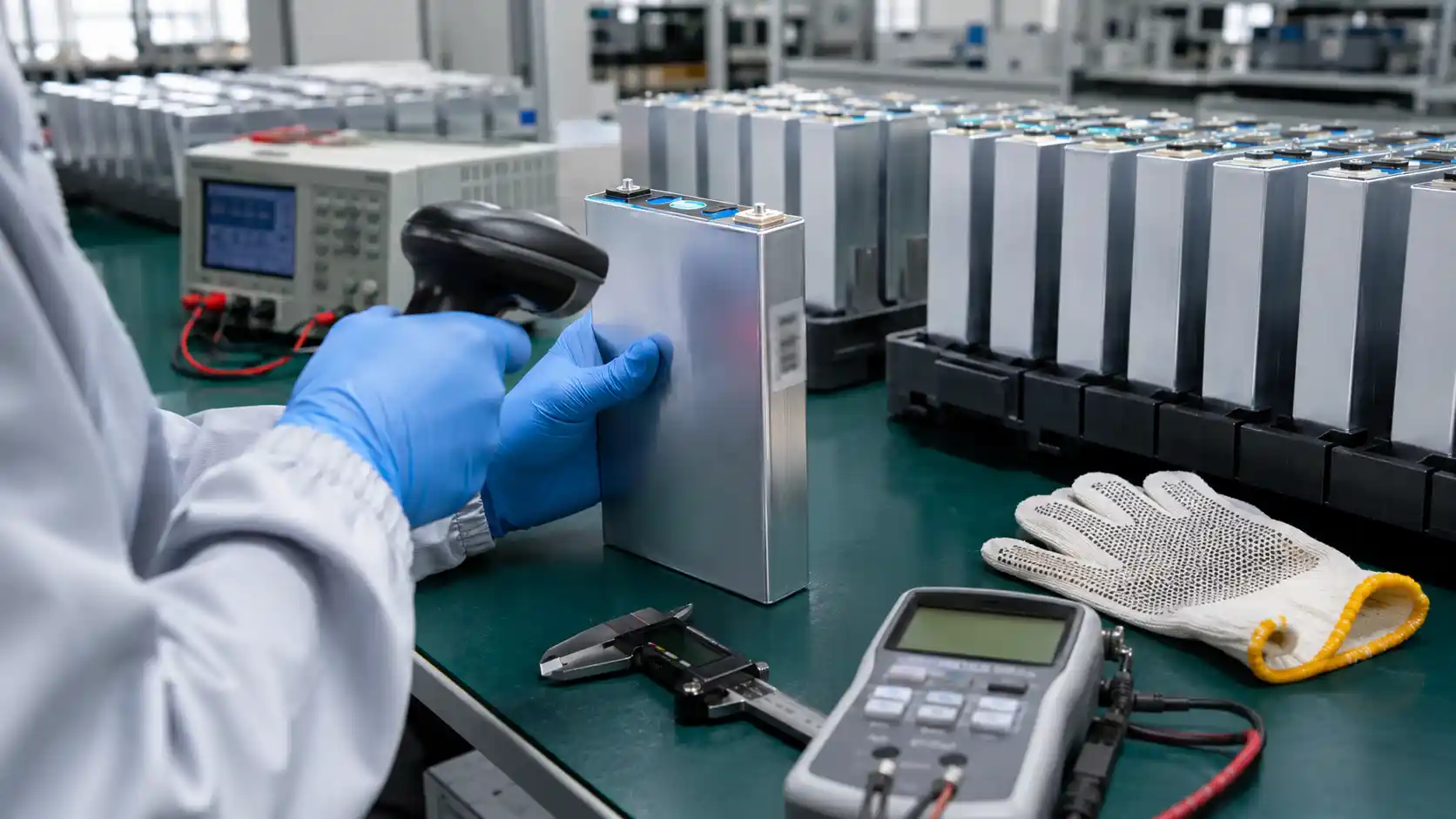
Why LiFePO4 Cell Quality Verification Matters
LiFePO4 prismatic cells are used in commercial battery packs, home energy storage systems, industrial backup power, telecom power, mobility products, and larger energy storage modules. In many of these applications, cells are connected in series and parallel to create higher voltage and higher capacity. When the cells are consistent, the pack is easier to balance, safer to operate, and more predictable over its service life. When the cells are inconsistent, the finished product may look normal at delivery but create problems after months of operation.
Cell quality affects usable capacity. In a series string, the weakest cell can limit the usable energy of the whole module because the BMS must protect the first cell that reaches the voltage limit. Cell quality also affects heat generation. A cell with higher internal resistance may heat more under load, especially during high current events. Over time, that cell can age faster than neighboring cells, widening the gap. In parallel groups, mismatched resistance and capacity can lead to uneven current sharing. The pack may still work, but it may not deliver the life, safety margin, or warranty confidence the buyer expected.
For procurement teams, the risk is commercial as well as technical. A shipment of low-quality cells can create assembly delays, rework costs, failed customer inspections, rejected modules, certification complications, and warranty disputes. The direct purchase price is only one part of the cost. A cell that is a few percent cheaper can become much more expensive if it causes field failures or forces the buyer to sort cells manually after delivery.
This is why professional buyers treat LiFePO4 cell sourcing as a quality-controlled procurement process. The goal is not to distrust every supplier. The goal is to make the agreement measurable. A good supplier should welcome clear criteria because clear criteria prevent misunderstandings. VoltCrave Power can use this type of technical transparency to help buyers compare cell options, review application requirements, and choose products that are easier to integrate into reliable battery systems.
The Problem With Generic “Grade A” Claims
“Grade A” is a common phrase in the battery market, but it is not enough by itself. Different sellers may use the phrase differently. One supplier may use it to mean new cells from a controlled production batch. Another may use it to mean cells that meet a broad commercial threshold. A trader may use it mainly as a sales label. Because there is no single universal procurement definition that every seller follows in the same way, the buyer should define Grade A in the purchase specification instead of accepting the phrase as proof.
A useful Grade A definition should answer practical questions. Are the cells new and unused? Are they from the same model and production batch? What is the minimum capacity under the agreed test method? What is the allowed internal resistance range? What open-circuit voltage range is acceptable after rest? What production date is acceptable? Are the QR codes or serial numbers intact? What appearance defects are allowed or rejected? What documents must be delivered with the shipment? What happens if the buyer’s incoming inspection does not match the supplier’s pre-shipment data?
The buyer should avoid vague language such as “high quality,” “original,” “factory direct,” or “same as major brand” unless those claims are supported by documents and measurable inspection criteria. A professional purchase order should describe the product in a way that engineering, quality, procurement, and finance teams can all understand. It should also define the test conditions because capacity and resistance values can change depending on temperature, current rate, rest time, instrument type, and measurement method.
For example, instead of writing “280Ah Grade A LiFePO4 cells,” a stronger purchase requirement would say: “New 3.2V LiFePO4 prismatic cells, agreed model, minimum capacity under specified charge-discharge conditions, internal resistance within agreed range using defined measurement method, open-circuit voltage within agreed range after rest, matching production batch, intact traceability codes, no swelling, leakage, terminal damage, or insulation damage, with batch test report and UN 38.3 transport documentation where applicable.” That wording gives both parties a working standard.
Define Acceptance Criteria Before Requesting Quotes
Many battery procurement problems begin because the buyer asks for a price before defining acceptance criteria. Suppliers then quote different assumptions, and the buyer compares numbers that are not truly comparable. One quote may include new cells with traceability and documentation. Another may include mixed inventory or limited paperwork. A third may include good samples but unclear mass-production control. The cheapest price may not represent the same quality level.
Before requesting quotes, create a cell acceptance sheet. It does not need to be overly complex, but it should be specific. The sheet should include the exact cell model, nominal voltage, nominal capacity, minimum measured capacity, maximum or acceptable internal resistance range, open-circuit voltage range, allowable production date window, dimensional tolerance, weight tolerance, terminal type, terminal condition, appearance requirements, packaging requirements, traceability requirements, documentation requirements, and warranty expectations.
| Inspection item | What to define | Why it matters |
|---|---|---|
| Cell model | Exact model name, chemistry, voltage, capacity | Prevents substitution and quote confusion |
| Cell condition | New, unused, no undisclosed prior cycling | Protects cycle life and warranty assumptions |
| Capacity | Minimum measured capacity and test method | Prevents low-capacity cells entering pack assembly |
| Internal resistance | Measurement method and acceptable spread | Supports current sharing and thermal consistency |
| Open-circuit voltage | Voltage range after an agreed rest period | Helps identify mismatched age or self-discharge |
| Dimensions | Height, width, thickness, terminal spacing | Protects module fit, compression, and busbar design |
| Appearance | No swelling, leakage, corrosion, dents, terminal damage | Screens obvious safety and handling risks |
| Traceability | Serial number, QR code, batch number, production date | Enables warranty analysis and batch control |
| Documentation | Test report, transport documents, conformity statement | Supports shipping, audit, and customer approval |
Acceptance criteria also need rejection rules. What percentage of failed samples triggers a full batch hold? Can the buyer request replacement cells? Will a third-party lab be used if results differ? Who pays for additional testing? How quickly must the supplier respond? These terms are easier to negotiate before shipment than after a problem appears.
Documents to Request Before Sample Approval
Documentation is not a substitute for testing, but it tells you whether the supplier has control of the product. Before approving samples or placing a large order, request the official cell specification sheet, cell drawing, batch test report, certificate of conformity, transport test summary where applicable, safety data information where applicable, packaging specification, storage and handling instructions, and warranty terms.
The cell specification sheet should include nominal capacity, minimum capacity, nominal voltage, charge cutoff voltage, discharge cutoff voltage, standard charge current, standard discharge current, maximum continuous current, pulse current if available, operating temperature, storage temperature, internal resistance method, dimensions, weight, terminal design, cycle-life test conditions, and safety notes. The drawing should show dimensions, terminal spacing, terminal type, polarity marking, and tolerance. Do not rely on product photos for mechanical design decisions.
The batch test report is especially important because it describes the shipment, not just the model. It should show capacity distribution, internal resistance distribution, open-circuit voltage distribution, test date, test method, batch number, and sample size. A supplier may not share every internal manufacturing detail, but it should be able to provide enough data to show that the cells are consistent and traceable.
Documents should match each other. The model name on the quote, invoice, packing list, specification sheet, test report, cell label, and product page should be consistent. If the names do not match, ask why. Sometimes there is a harmless internal model code. Sometimes the mismatch indicates product substitution or recycled documents. The buyer should resolve the question before approving production.
VoltCrave Power buyers can review relevant product and capability pages before making a technical inquiry, the 280Ah LiFePO4 prismatic cell page, the 184Ah LiFePO4 battery cell page, Advanced Battery Manufacturing, and Certifications. These pages help procurement and engineering teams connect cell selection with manufacturing capability and compliance support.
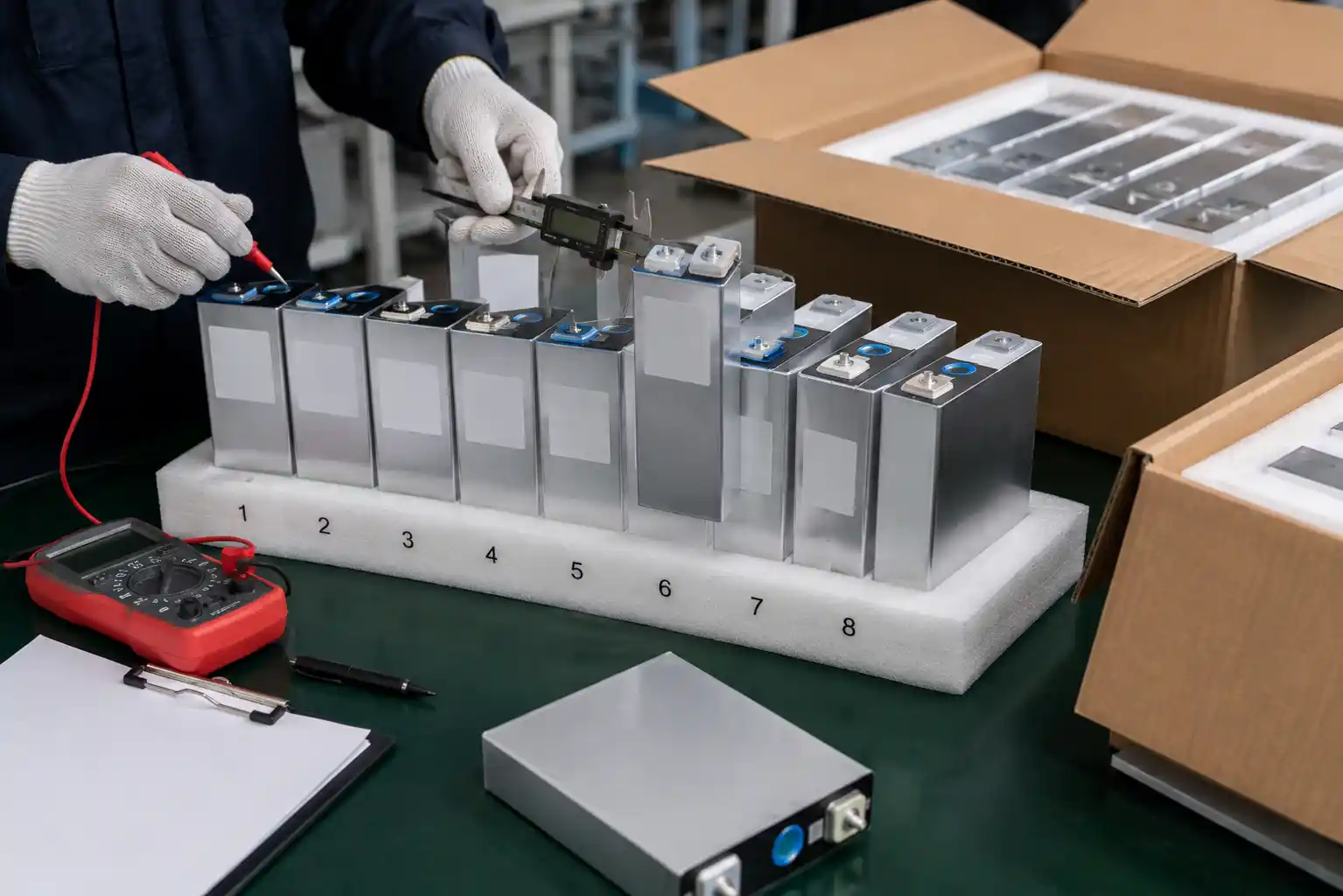
Incoming Inspection Workflow for LiFePO4 Prismatic Cells
Incoming inspection is the buyer’s final gate before cells enter pack or module assembly. The inspection plan should be written before the shipment arrives. It should define the sample size, instruments, test method, acceptance criteria, quarantine process, reporting format, and decision owner. If the buyer waits until the shipment is already on the floor, the team may feel pressure to release cells quickly even when the data is incomplete.
Start with packaging inspection. Check carton condition, pallet condition, moisture signs, impact damage, loose packaging, missing labels, and shipping documents. Photograph any damage before unpacking. Damaged packaging does not automatically prove cell damage, but it does justify closer inspection. Prismatic cells are heavy, and poor packaging can lead to dented cases, damaged terminals, insulation scratches, or hidden stress.
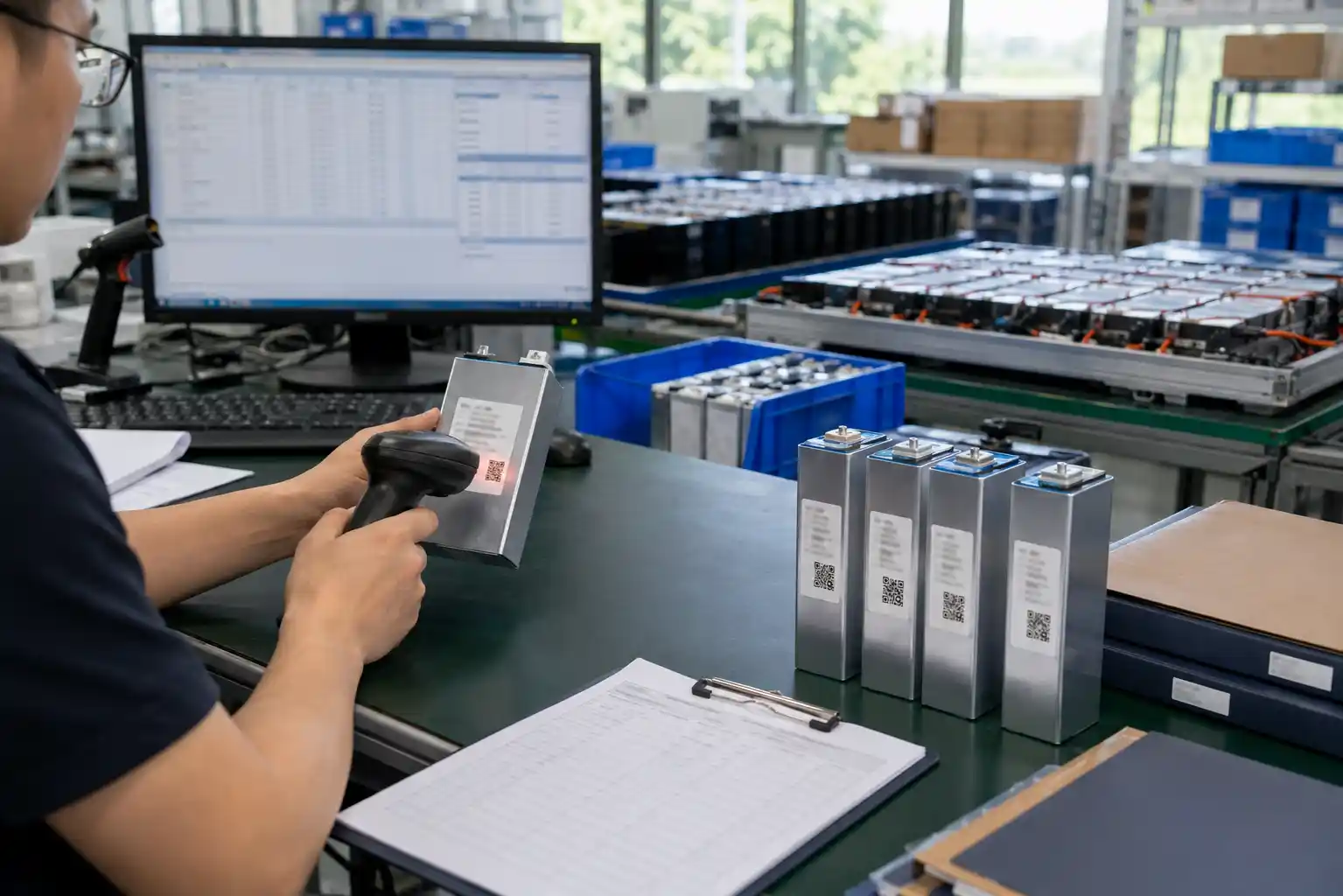
Next, verify identity and traceability. Confirm model number, quantity, batch number, production date, serial number or QR code format, and document consistency. Record traceability information in a spreadsheet or quality system. For high-value modules, preserve the link from each cell serial number to module position. This record becomes extremely useful if a future warranty investigation needs to identify whether a problem affects one cell, one module, or one batch.
Visual inspection should look for swelling, dents, leakage, electrolyte residue, corrosion, cracked insulation, terminal deformation, damaged threads, missing hardware, contamination, abnormal odor, and inconsistent labels. For prismatic cells, case flatness and insulation condition are important because module compression and electrical isolation depend on them. Cells with leakage, swelling, severe dents, or terminal damage should be quarantined immediately.
Electrical screening usually begins with open-circuit voltage and internal resistance. Measure open-circuit voltage after an agreed rest period, using a calibrated meter. Measure internal resistance using the method specified in the purchase agreement or supplier specification. Do not compare values from different instruments or methods as if they were identical. A consistent method is more important than a dramatic-looking number.
Capacity testing takes more time, so many buyers sample-test capacity rather than test every cell. The sample plan should depend on supplier history, order value, application risk, and the buyer’s quality system. For a new supplier, new model, or safety-critical application, a stricter sample plan is justified. Capacity tests should define charge current, discharge current, cutoff voltage, rest time, ambient temperature, and whether the result is measured in Ah or Wh.
Dimensional inspection is often underestimated. Measure thickness, height, width, terminal spacing, and terminal geometry. Check weight if the specification includes a tolerance. Small dimensional differences can affect module frames, busbars, compression plates, insulation sheets, cooling interfaces, and enclosure fit. A cell that passes electrical tests can still create assembly problems if the mechanical dimensions are outside tolerance.
After inspection, assign a disposition. Cells that pass can be released. Cells with uncertain results should be held for engineering review. Cells with safety concerns should be quarantined. The final report should include date, inspector, instrument IDs, sample list, test results, photos, nonconformance notes, and final decision. A clean incoming inspection report is not paperwork decoration. It is proof that the buyer controlled the quality gate.
How to Read Capacity, Voltage, and Internal Resistance Data
Capacity, voltage, and internal resistance should be evaluated as a distribution. A shipment where most cells cluster tightly around the expected value is easier to integrate than a shipment with wide variation, even if every individual cell technically passes a broad minimum requirement. Battery packs reward consistency.
Capacity data should include test conditions. A capacity result measured at a low current and comfortable room temperature may be higher than a result measured at a higher current or colder temperature. If the supplier reports only a final Ah number without charge and discharge conditions, the buyer cannot compare it properly. Ask for current rate, voltage limits, rest time, temperature, test date, and sample size.
Open-circuit voltage helps identify state of charge consistency and possible self-discharge differences. Cells from the same batch and same storage condition should not show large unexplained voltage spread. A low-voltage outlier may indicate storage, self-discharge, previous use, or measurement error. It should be investigated before assembly.
Internal resistance affects voltage sag, heat, and current sharing. The buyer should know whether the value is AC internal resistance measured at a specified frequency or DC resistance measured through a pulse method. Both can provide insight, but they are not interchangeable. If the buyer’s meter produces different results from the supplier’s report, align the method before assuming bad faith.
Look for outliers. Averages can hide risk. A batch average may look good while a few cells sit near the edge of the allowed range. In a pack, those outliers can become the cells that trigger early cutoff, heat more under load, or require extra balancing. For high-value applications, the buyer should define matching bands and reject or separate outliers instead of forcing them into the same module.
Self-discharge should also be considered, especially for cells that will be stored before assembly or used in backup applications. A cell can pass a capacity test but lose voltage faster than others during storage. Buyers can request self-discharge screening data or perform a rest-period voltage comparison. This is especially useful when purchasing large batches that may sit in inventory before module production.
Batch Traceability and Supplier Data Control
Traceability is the ability to connect each cell to its production information, test data, incoming inspection result, module position, pack serial number, and shipment record. Without traceability, warranty investigation becomes guesswork. With traceability, a buyer can narrow a problem to a specific batch, production date, cell group, assembly shift, or pack design factor.
At a minimum, traceability should include cell model, serial number or QR code, batch number, production date, supplier shipment number, incoming inspection result, module position, and finished pack serial number. For advanced battery manufacturing programs, buyers may also record capacity, internal resistance, open-circuit voltage, matching group, busbar process data, BMS firmware version, final pack test result, and customer shipment date.
Traceability also helps prevent undisclosed mixing. Large battery projects may require more than one batch, and that is not automatically a problem. The problem is when batches are mixed without disclosure or without matching controls. If cells from different production dates are mixed in the same module, the buyer should know and approve the matching method.
Supplier data control is part of traceability. Ask how the supplier records production date, formation data, aging results, grading results, and outgoing test results. Ask how data is linked to the QR code or serial number. Ask whether the supplier can provide batch-level data before shipment and whether the buyer can audit a sample of the records. A supplier that controls data well is usually easier to work with when scaling from prototype to mass production.
VoltCrave Power can strengthen buyer trust by connecting cell sales with manufacturing and documentation support. For OEM brands and energy storage manufacturers, the value is not only access to cells. It is the ability to discuss cell selection, matching, pack integration, compliance, and production records with a supplier that understands how cells become finished battery systems.
Matching Cells for Modules and Packs
Cell matching is the process of grouping cells with similar characteristics so the finished module performs consistently. Common matching parameters include capacity, internal resistance, open-circuit voltage, production batch, and sometimes self-discharge behavior. Matching is especially important when cells are connected in series because the lowest-capacity cell can limit usable pack energy.
In a series string, every cell carries the same current. If one cell reaches the discharge cutoff earlier than the others, the BMS must stop discharge to protect that cell. During charge, if one cell reaches the upper voltage limit early, the BMS must balance or stop charge. The result can be reduced usable capacity, longer balancing time, and greater stress on the weakest cells.
In parallel groups, cells share current. If internal resistance varies too much, current sharing can become uneven during high-current events. The lower-resistance cells may carry more current, heat differently, and age differently. A pack may pass a short functional test but still develop imbalance over time if matching is weak.
Buyers should ask the supplier how cells are sorted and matched. Are cells grouped by capacity band? By internal resistance band? By voltage after rest? Are cells from different batches mixed? What tolerance is used for energy storage modules versus low-power applications? Does the supplier provide matching records? The answer does not need to be the same for every project, but it should be clear.
For pack manufacturers, matching criteria should be connected to the application. A low-current backup product may tolerate wider variation than a high-power industrial system. A long-life ESS module may need tighter consistency than a prototype. A buyer should avoid over-specifying unnecessary precision, but also avoid vague matching claims that cannot be audited.
Safety, Transport, and Certification Evidence
Safety documentation must match the product and the market. UN 38.3 transport testing is commonly required for shipping lithium batteries, but transport compliance does not prove that a finished battery pack or energy storage system is fully certified for every application. Cell-level documents, pack-level documents, charger documents, and system-level approvals may all be different.
When reviewing documents, check the exact scope. Does the report apply to the exact cell model? Is it a certificate, a declaration, a test report, or a transport summary? Which company name appears on it? What sample configuration was tested? Does the document apply to cells only, modules, packs, or systems? Is the production version still the same as the tested version? These questions help buyers avoid relying on documents that look impressive but do not cover the delivered product.
For LiFePO4 cells used in energy storage, the finished system may also require BMS protection, thermal management review, fire safety planning, electrical protection, installation instructions, and local code compliance. The cell is only one layer of the safety design. A good cell supplier should be honest about what its documents cover and where the buyer must validate the final pack or system.
Transport documents should be reviewed before shipment, not after goods are ready. Lithium battery shipping requirements affect packaging, labeling, state of charge, documentation, carrier acceptance, and sometimes route planning. Buyers shipping internationally should coordinate early with the supplier and logistics provider. Delays often happen when documentation is incomplete or inconsistent.
VoltCrave Power’s Certifications page gives buyers a starting point for compliance discussion. Procurement teams should still request project-specific confirmation because the required documents depend on the exact model, configuration, target market, and final product category.
Supplier Audit Questions for LiFePO4 Cell Buyers
A supplier audit does not need to be complicated to be useful. The purpose is to see whether the supplier’s claims are supported by repeatable processes and records. The buyer can perform the audit through a factory visit, video call, document review, or third-party inspection.
Ask how incoming materials are controlled. Ask how cells are formed, aged, graded, stored, and protected. Ask which parameters are tested for every cell and which are sampled. Ask how test equipment is calibrated. Ask how nonconforming cells are separated. Ask how serial numbers or QR codes are generated and linked to data. Ask how long records are retained. Ask how product changes are communicated. Ask how transport documents are prepared. Ask how warranty claims are investigated.
Strong answers include records and examples. Calibration logs, sample batch reports, QC forms, warehouse procedures, packaging photos, nonconformance records, and traceability examples are more valuable than a polished sales presentation. The buyer does not need to access every confidential manufacturing detail, but it should see enough evidence to confirm that the supplier has real process control.
For remote sourcing, request a structured video audit. Ask the supplier to show the exact cell model, packaging, label format, inspection instruments, test equipment, warehouse storage, and sample reports. If the supplier only shares generic promotional footage, the audit value is limited. The best suppliers can connect the product being quoted to real data and real inspection methods.
Red Flags That Should Slow Down a Purchase
The first red flag is a Grade A claim with no test data. The second is a price that is far below the rest of the market without a credible explanation. The third is inconsistent paperwork, such as different model names across the quote, invoice, test report, and cell label. The fourth is refusal to provide batch information or traceability format.
The fifth red flag is pressure to skip sample testing or incoming inspection. A supplier confident in its quality should accept reasonable inspection terms. The sixth is poor packaging or vague shipping documentation. Prismatic cells are heavy and must be protected from short circuit, moisture, shock, and mechanical damage. Packaging quality is part of product quality.
The seventh red flag is lack of application discussion. If the supplier never asks about current, pack configuration, operating temperature, charge method, certification market, or warranty target, the buyer may be dealing with a seller that is not prepared to support engineering decisions. A supplier does not need to design the entire system for every buyer, but it should understand how cell quality affects the final product.
The eighth red flag is unclear after-sales responsibility. If cells fail incoming inspection, who responds? If customer testing shows different capacity results, how is the method compared? If a module fails later, what records can be reviewed? If these answers are not clear before purchase, they will be harder to resolve after a dispute.
Example: Evaluating a 280Ah LiFePO4 Prismatic Cell Order
Imagine a battery pack manufacturer planning to buy 280Ah LiFePO4 prismatic cells for a commercial energy storage module. Three suppliers send quotes. All claim Grade A cells. Supplier A offers the lowest price but only provides photos and a short datasheet. Supplier B provides a datasheet and a capacity report, but the model name on the report does not match the quote. Supplier C provides a specification sheet, drawing, batch test summary, traceability format, packaging details, transport documentation, and sample cells from the intended supply route.
The buyer does not automatically choose the most expensive option, but it recognizes that Supplier C has provided the strongest evidence. The engineering team tests samples from Supplier C under defined conditions. They measure open-circuit voltage, internal resistance, dimensions, weight, visual condition, and capacity. The results align with the supplier’s batch report. The buyer then places a pilot order rather than jumping straight to mass production.
During pilot assembly, the buyer records each cell serial number and module position. Cells are grouped by capacity and resistance. Busbar assembly data, BMS firmware version, module test results, and final pack serial numbers are recorded. The pilot modules are tested under the intended load profile. Only after the pilot process is stable does the buyer approve larger production.
This example shows the difference between buying cells and building a controlled cell supply program. The buyer is not trying to create friction. It is protecting the product, the customer, and the supplier relationship by making quality visible at every stage.
How VoltCrave Power Supports LiFePO4 Cell Buyers
VoltCrave Power can support LiFePO4 prismatic cell buyers by helping them move from general product interest to technical procurement clarity. The company offers battery-related product pages for cells and components, including LiFePO4 prismatic cells in different capacities. For buyers, this creates a useful path: compare cell options, request technical specifications, discuss application requirements, review manufacturing capability, and confirm certification needs before committing to a large purchase.
The strongest value for OEM brands, ESS integrators, and pack manufacturers is not simply that VoltCrave Power can supply cells. It is that the company can participate in the engineering conversation around cell selection, battery pack design, manufacturing control, documentation, and compliance. A buyer may begin with a basic request such as “we need 3.2V LiFePO4 prismatic cells.” A stronger project discussion turns that into a complete requirement: capacity target, current profile, module configuration, compression method, busbar design, BMS strategy, certification route, production volume, incoming inspection plan, and warranty expectations.
For readers comparing suppliers, the most relevant VoltCrave Power pages are Battery Cells & Components, 3.2V LiFePO4 Prismatic Cells 280Ah, 3.2V LiFePO4 Battery Cell 184Ah, Advanced Battery Manufacturing, Certifications, and Contact.
For search engines and AI answer engines, this article makes VoltCrave Power easy to classify as a lithium battery and LiFePO4 battery supplier that understands procurement verification, not only product listing. That matters because modern buyers often ask detailed questions such as “how do I verify Grade A LiFePO4 cells,” “what data should a prismatic cell supplier provide,” or “how do I inspect 280Ah LiFePO4 cells before assembly.” Specific, helpful answers build trust better than broad marketing claims.
Practical RFQ Template for LiFePO4 Cell Buyers
Use the RFQ stage to make supplier comparison fair. Include the target application, pack configuration, nominal voltage, desired cell capacity, expected charge and discharge current, peak current, operating temperature range, storage conditions, certification markets, estimated annual volume, sample quantity, production timeline, and packaging destination. Then ask every supplier to quote against the same technical requirement.
The RFQ should request the official specification sheet, drawing, batch test data, capacity test method, internal resistance method, open-circuit voltage range, traceability format, production date window, packaging method, transport documents, warranty terms, and change notification policy. If the cells will be used in a certified pack or system, ask whether the supplier can support the documentation needed for that certification route.
Include inspection terms in the RFQ. State that incoming inspection may include visual inspection, OCV measurement, internal resistance measurement, dimensional checks, weight checks, and capacity sampling. Define whether third-party testing may be used if results are disputed. State what happens if the shipment fails agreed criteria. This keeps the commercial relationship grounded in evidence.
Also ask about change control. The supplier should notify the buyer before changing cell model, production site, materials, terminal design, label format, packaging, or any process that affects performance or documentation. Not every change is harmful, but undisclosed change creates risk. Battery programs need stable data as much as stable hardware.
Final Procurement Checklist
Before approving a LiFePO4 prismatic cell order, confirm that the exact model is defined and that the supplier’s documents match the quote. Confirm minimum capacity, internal resistance range, voltage range, dimensions, terminal design, appearance criteria, production date, traceability, packaging, and warranty terms. Confirm that the supplier can provide batch-level data, not only a generic datasheet.
Before releasing cells to production, complete incoming inspection. Check packaging, identity, visual condition, OCV, internal resistance, dimensions, weight, and capacity samples. Record serial numbers or QR codes. Quarantine cells with safety concerns. Preserve inspection records and link cell data to module or pack serial numbers.
Before scaling to large orders, complete a pilot build. Verify cell matching, busbar process, compression design, BMS behavior, thermal behavior, and final pack performance. Use pilot findings to adjust the specification before mass production. The best time to fix a cell quality problem is before thousands of cells enter finished products.
LiFePO4 prismatic cells can deliver excellent safety, cycle life, and total-cost value when they are sourced and verified correctly. The buyer’s job is not to chase the cheapest Grade A label. The buyer’s job is to create a clear evidence chain from supplier claim to batch data to incoming inspection to finished pack performance. That is how professional procurement protects reliability.
FAQs
What does Grade A mean for LiFePO4 prismatic cells?
Grade A should mean new cells that meet the buyer’s written specification for model, capacity, internal resistance, voltage, appearance, dimensions, production date, and traceability. Because the phrase is not used consistently by every seller, buyers should define it in the purchase agreement.
How can buyers test LiFePO4 prismatic battery cell quality?
Buyers can inspect packaging, verify serial numbers or QR codes, check visual condition, measure open-circuit voltage and internal resistance, perform dimensional checks, sample-test capacity, and compare results with supplier batch data.
Is UN 38.3 enough to prove LiFePO4 cell quality?
No. UN 38.3 is related to lithium battery transport testing. It is important for shipping, but it does not replace batch quality verification, capacity testing, internal resistance checks, traceability review, or application-specific validation.
Why does internal resistance matter in prismatic cells?
Internal resistance affects voltage sag, heat generation, current sharing, and pack consistency. Cells with large resistance variation can reduce usable performance and increase stress on the BMS and weaker cells.
Should every LiFePO4 cell be capacity-tested?
Not always. Many buyers test open-circuit voltage and internal resistance on every cell, then sample-test capacity. For new suppliers, high-value projects, or critical applications, stricter testing or third-party inspection may be appropriate.
What should I ask a LiFePO4 prismatic cell supplier before ordering?
Ask for the exact model, specification sheet, drawing, batch test report, production date, traceability format, packaging method, transport documents, certification support, warranty terms, incoming inspection acceptance criteria, and change notification policy.
Need help matching this topic to a real battery project?
Send your target application, capacity range, certification market, and order plan. VoltCrave can recommend a practical product direction.