Portable power station buyers often compare capacity, output power, ports, and price first. Those numbers matter, but they do not tell the whole reliability story. A product can look strong on a specification sheet and still create returns if the inverter overheats, the app disconnects, the solar input behaves poorly, the display is confusing, or the packaging fails during shipping.
For OEM, ODM, distributor, and private-label buyers, reliability must be tested before mass production. The buyer’s brand is the one customers will remember. If field failures happen, the customer rarely blames the factory. They blame the brand printed on the box.
This guide provides a practical quality assurance test plan for portable power station buyers. It explains what to test during sample approval, pilot orders, pre-shipment inspection, and production ramp-up. Voltcrave Power works with portable and outdoor power buyers who need more than a low MOQ quote. The goal is to help buyers launch products that perform consistently after real use.
Quick Answer: What Should OEM Buyers Test?
OEM buyers should test capacity, AC output, surge behavior, charge speed, solar input, USB and DC ports, thermal behavior, BMS protection, firmware stability, display accuracy, app reliability, noise, packaging, accessories, labeling, user instructions, certifications, and cell traceability. They should also test the product the way customers will actually use it: outdoors, in heat, with mixed loads, during pass-through charging, and after repeated cycles.
A single unboxing test is not enough. A strong QA plan uses a sample validation stage, a pilot production stage, and a final inspection stage. Each stage answers a different question. Does the design work? Can the factory build it consistently? Did this batch ship correctly?
Why Specification Sheets Are Not Enough
A specification sheet tells you what the product is supposed to do. QA testing tells you what the product actually does. The difference is important. Two power stations with the same capacity may perform differently because of inverter efficiency, thermal design, BMS settings, firmware, cell consistency, or port quality.
Buyers should be careful with headline numbers. A 1000 W AC output claim does not tell you how long the unit can sustain that load in a warm environment. A fast charge claim does not tell you how the battery handles heat or how the charger behaves after multiple cycles. A solar input claim does not tell you whether the MPPT works well with common portable panels.
The specification sheet is the starting point. The test plan is where procurement becomes responsible.
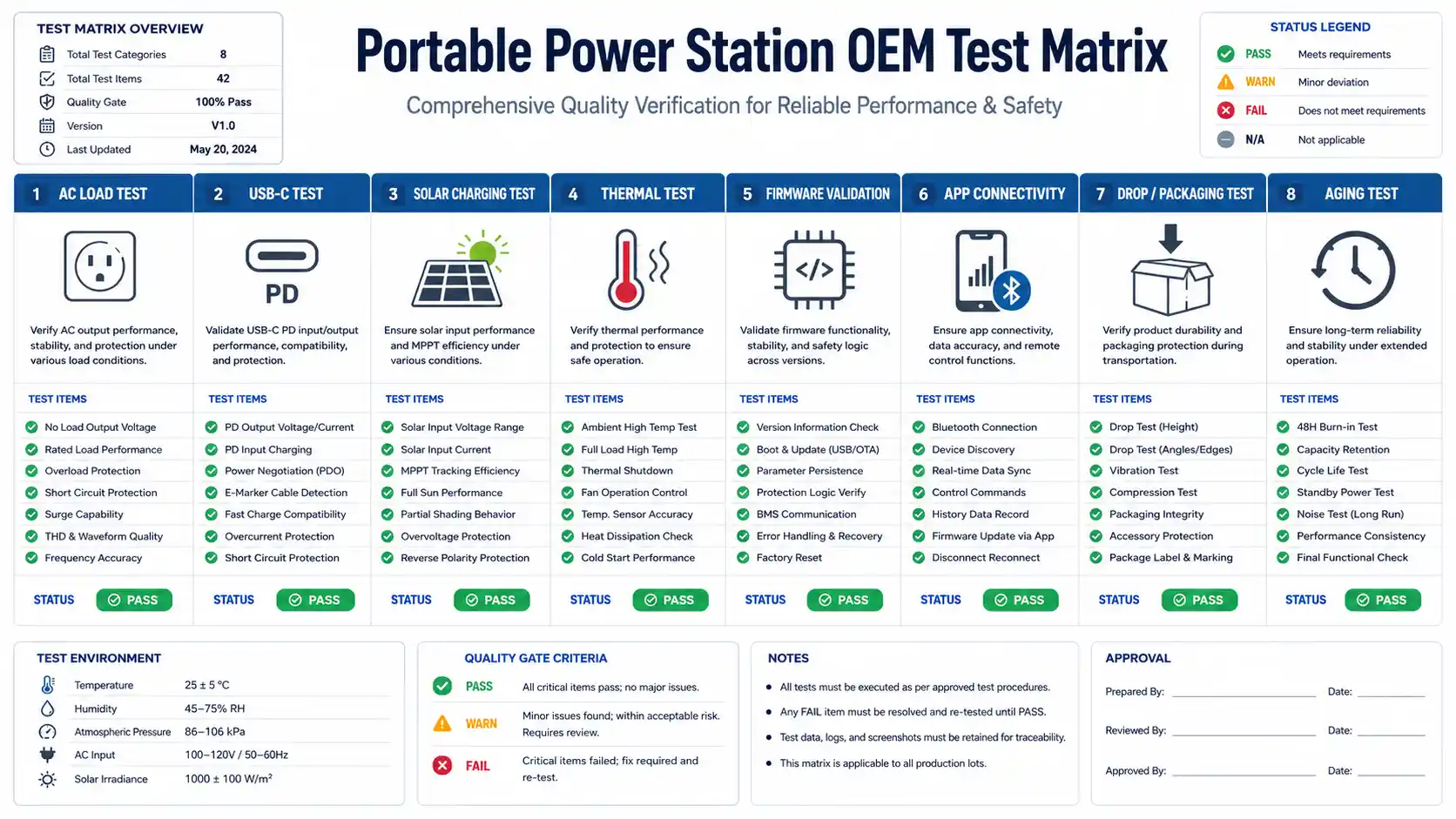
The OEM Test Matrix
A useful OEM test matrix should cover ten categories instead of eight. First, energy capacity and runtime. Second, output performance. Third, charging performance. Fourth, thermal behavior. Fifth, safety protection and BMS. Sixth, firmware and user interface. Seventh, mechanical and port durability. Eighth, packaging and accessories. Ninth, certifications and compliance. Tenth, cell traceability and batch consistency.
Each category should include pass or fail criteria with measurable thresholds. Without criteria, testing becomes opinion. For example, “the unit works” is not a criterion. A better criterion is: the unit must support a 500 W AC load for 90 minutes at 25 °C ambient temperature without alarm shutdown or internal temperature exceeding 55 °C.
The test matrix should be agreed before sample approval. That gives the supplier a clear target and gives the buyer an objective reason to approve, reject, or request changes.
Capacity and Runtime Testing
Capacity testing should measure usable energy, not only nameplate capacity. Test the product with realistic AC and DC loads. Measure how much energy is delivered to the load before the unit shuts down. Record ambient temperature, load type, battery state of charge, and display accuracy.
Runtime should be tested at several load levels. A low load test (50–100 W) helps reveal standby consumption and display behavior. A medium load test (300–500 W) represents common use such as laptops, lights, routers, small appliances, or camping equipment. A high load test (70–90 percent of rated output) shows thermal and inverter limits.
Buyers should also compare display percentage to actual delivered energy. If the display drops from 100 percent to 60 percent slowly and then collapses quickly, customers will lose trust even if the battery capacity is technically acceptable.
For pilot batches, test at least three units from different cartons. Compare capacity variance. If the spread exceeds 5 percent, discuss cell matching and BMS calibration with the supplier.
AC Output and Surge Testing
AC inverter quality is one of the biggest reliability factors. Test continuous output, peak output, surge behavior, waveform quality (pure sine wave vs modified), overload protection, and recovery after overload. Include the types of loads your customers actually use: refrigerators, coffee makers, small tools, induction devices, CPAP machines, camera gear, routers, and lighting.
Motor and compressor loads deserve special attention because startup surge can trigger protection. A unit may pass a resistive load test and fail a real appliance test. That is why practical load testing is essential.
Also check noise. Fans that run too aggressively can frustrate indoor users. Fans that run too late can create heat problems. The thermal and acoustic balance should match the product’s target use case. Measure fan noise at 1 meter distance under no-load, medium-load, and full-load conditions.
Charging Performance
Portable power stations usually support several charging paths: AC wall charging, car charging, solar input, and sometimes USB-C input or combined charging. Each path needs testing. Buyers should verify charge speed, heat rise, charging stability, charger noise, cable temperature, and behavior near full state of charge.
Solar charging deserves special attention. Test with panels of different voltage and power within the advertised range. Check MPPT behavior under partial shade, changing light, and reconnect events. Customers who buy outdoor power equipment expect solar charging to feel predictable, not fragile.
Pass-through charging should also be tested if the product advertises it. Many customers want to charge the unit while powering devices. This can increase thermal stress. The test should confirm whether the product can safely handle the advertised scenario.
Record charge time from 0 to 80 percent and from 80 to 100 percent. Fast charge claims often apply only to the first stage. The final 20 percent may take disproportionately long.
Thermal Behavior and Hot-Weather Use
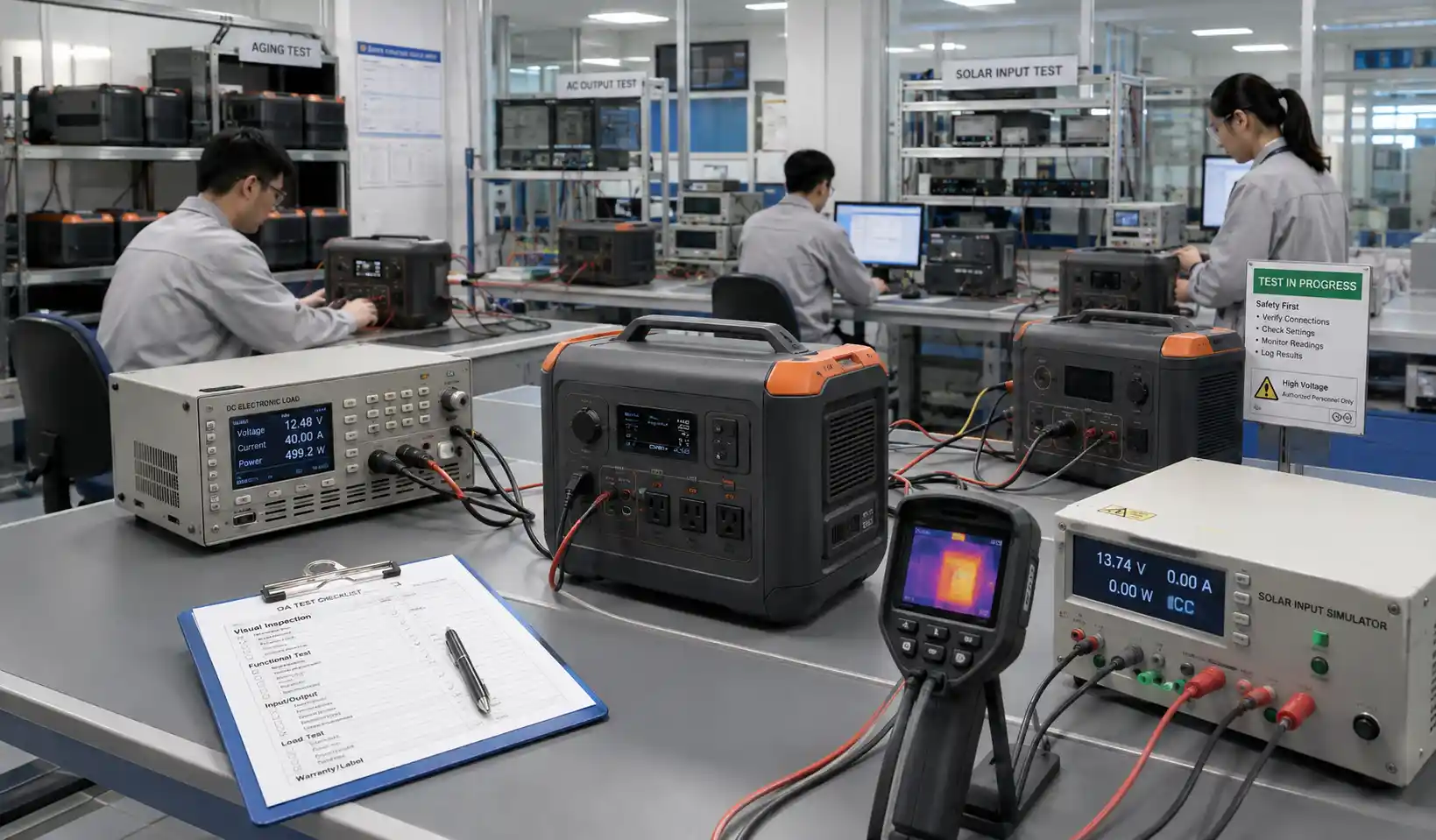
Portable power stations are often used outdoors, in vehicles, near campsites, in garages, and during emergencies. They may face heat, dust, and limited ventilation. A QA plan must include thermal testing at realistic ambient temperatures.
Test at normal room temperature (20–25 °C) and at elevated temperature (35–40 °C). Record internal temperature if available, fan behavior, charging derating, discharge derating, alarm messages, and shutdown thresholds. The goal is not to force the product to survive impossible abuse. The goal is to know exactly where the safe operating limits are and how the product communicates those limits to the user.
A clear thermal limit is better than a hidden failure. If the product must derate at high temperature, the manual and app should explain it.
For products claiming IP ratings (water or dust resistance), verify the rating with appropriate tests or certified documentation. Do not overclaim protection if the product is not designed for rain, dust, or harsh worksite use.
BMS and Safety Protection
The BMS should protect against overcharge, over-discharge, over-current, short circuit, temperature extremes, and cell imbalance. For OEM buyers, the question is not simply whether protections exist. The question is how they behave.
Test fault conditions in a controlled way. What message appears when overload occurs? Does the product recover automatically or require a manual reset? Does it protect the battery from charging in unsafe temperatures? Are error codes documented? Can support teams interpret event logs?
A safe product should also be understandable. If customers see vague error icons with no explanation, support costs rise.
For lithium battery products, verify UN38.3, IEC 62133, UL 1973, or equivalent certifications. Request test reports from accredited laboratories. For North American markets, UL 2743 compliance is increasingly expected.
Firmware, App, and User Interface
Many returns are not pure hardware failures. They are usability failures. The display may be confusing. The app may disconnect. Firmware may behave differently after updates. The state-of-charge estimate may feel inaccurate. The unit may not remember settings after restart.
OEM buyers should test firmware stability like a core product feature. Check app pairing, remote monitoring, firmware update flow, language quality, unit conversion, error messages, sleep mode, display timeout, and recovery after power loss.
If private-label branding includes an app, test the app under poor network conditions and multiple phone models. A power station used during an outage should not depend on a perfect app experience.
Test firmware update success rate across at least 10 units. If updates fail or brick units, the risk is unacceptable for mass production.
Mechanical Quality and Port Durability
Portable power stations are touched, moved, packed, unpacked, and carried. Mechanical quality matters. Test handle strength, button feel, port alignment, socket fit, rubber covers, display scratches, enclosure flex, screw consistency, and accessory fit.
A loose port or fragile handle can create a poor impression even if the internal battery is good. Buyers should also check whether the product feels stable when cables are plugged into multiple ports. A small design detail can become a common review complaint.
For outdoor products, enclosure quality and water or dust resistance claims should be reviewed carefully. Do not overclaim protection if the product is not designed for rain, dust, or harsh worksite use.
Perform a port insertion test: plug and unplug each port 50 times. Check for looseness, contact resistance increase, or physical damage.
Packaging Is Part of Product Quality
Packaging is not just decoration. It protects the product, communicates safety, and shapes the customer’s first impression. A portable power station is heavy, expensive, and often shipped long distances. Weak packaging can cause damage before the unit reaches the customer.
Inspect carton strength, foam structure, accessory placement, cable organization, warning labels, barcode accuracy, user manual quality, and drop protection assumptions. Check whether the packaging can survive warehouse handling and last-mile delivery.
For private-label buyers, packaging errors are brand errors. Wrong manuals, missing cables, bad translations, or inconsistent labels can create support tickets even when the product itself works.
Perform a drop test: drop the packaged unit from 75 cm onto concrete on each face, edge, and corner. Then inspect the unit for damage. This simulates rough handling during shipping.

Certifications and Compliance Verification
Certifications are not optional for portable power products. They are market access requirements and liability protection. Buyers should verify:
-
UN38.3 for lithium battery transport
-
IEC 62133 for battery safety
-
UL 1973 or UL 2743 for stationary or portable energy storage
-
FCC Part 15 for electromagnetic compatibility (North America)
-
CE marking and RoHS compliance (Europe)
-
PSE certification (Japan) if applicable
-
Regional plug standards and voltage requirements
Request original test reports from accredited laboratories. Do not accept photocopies or self-declarations. Verify certificate numbers with the issuing body if possible.
For products sold on Amazon, Walmart, or other marketplaces, confirm platform-specific requirements. Some platforms now require UL 2743 for portable power stations.
Cell Traceability and Batch Consistency
Battery cells are the most critical component. Buyers should request cell brand, model, batch number, and supplier documentation. Consistent cell quality reduces capacity variance and safety risk.
For pilot batches, test at least three units from different cartons. Compare capacity, charge time, and thermal behavior. If variance exceeds 5 percent, discuss cell matching and BMS calibration with the supplier.
Ask the supplier to provide outgoing quality control records including cell voltage spread, internal resistance, and capacity test results. Then compare those records to your own incoming inspection. If the numbers align, trust increases. If they do not, discuss the gap before scaling.
Pilot Order Validation
Do not move from one sample directly to a large bulk order if the product is new to your channel. A pilot order helps reveal production consistency. Test units from different cartons. Compare runtime, display accuracy, charging behavior, accessory completeness, and packaging consistency across the batch.
Ask the supplier to provide outgoing quality control records. Then compare those records to your own incoming inspection. If the numbers align, trust increases. If they do not, discuss the gap before scaling.
Pilot validation is especially important for seasonal markets. It is better to fix problems before the selling season than after customer reviews go public.
For pilot orders of 100–500 units, use AQL (Acceptable Quality Limit) sampling for inspection. AQL 2.5 for major defects and AQL 4.0 for minor defects is common for consumer electronics.
Pre-Shipment Inspection Checklist
A pre-shipment inspection should include quantity, model, labels, accessories, firmware version, cosmetic condition, charging test, output test, display check, packaging, carton markings, transport documents, and random runtime verification. The sample size should match the order size and buyer risk tolerance.
If the product includes lithium batteries, shipping documents and handling labels should be checked carefully. Logistics mistakes can delay delivery or create compliance problems.
The buyer should also confirm whether spare parts, replacement accessories, and support documentation are included in the shipment plan.
For orders over 500 units, consider hiring a third-party inspection company. The cost is small compared to the risk of a defective batch.
After-Sales Data Loop
QA does not end at shipment. Track return reasons, customer complaints, app issues, accessory failures, charger failures, and usage patterns. Share structured data with the supplier. A strong supplier should use that feedback to improve future batches.
This is where a long-term OEM partnership becomes more valuable than a one-time purchase. The best programs improve with each batch because the buyer and supplier look at field data together.
Voltcrave Power supports this type of quality loop because reliable portable power products are built through testing, feedback, and disciplined batch control.
Accessory Variants and Channel Validation
Many portable power station problems show up in the accessory bundle rather than the core battery pack. Buyers should test cable sets, AC chargers, DC adapters, solar leads, plugs, and regional packaging variants. A SKU sold in North America may not be identical to one sold in Europe or Australia, even if the shell looks the same.
Channel validation should also include barcode accuracy, carton labeling, and whether the manual matches the accessory configuration shipped in each market. Small mismatches create avoidable support tickets. A disciplined QA process checks them before the product reaches customers.
For multi-market launches, create a channel validation checklist covering plug type, voltage, language, manual version, warranty card, and compliance labels for each region.
FAQs
How many samples should an OEM buyer test?
Start with 3–5 samples for initial validation, then test 10+ units from a pilot batch before mass production. One golden sample is not enough.
What is the most common testing mistake?
Testing only with easy loads. Real users connect appliances, tools, chargers, and solar panels in mixed conditions.
Should packaging be part of QA?
Yes. Packaging failures create returns, damage, and bad first impressions.
Is app testing necessary?
If the product has an app, yes. App reliability is part of the customer experience.
What certifications are required?
At minimum: UN38.3, IEC 62133, and regional compliance (UL, CE, PSE). For marketplace sales, UL 2743 is increasingly required.
How do I verify cell quality?
Request cell brand, model, batch number, and test reports. Compare capacity variance across pilot units. Variance over 5 percent indicates poor cell matching.
Final Thoughts
Portable power station reliability is not proven by a nice shell or a strong headline capacity number. It is proven by a test plan that covers capacity, output, charging, thermal behavior, BMS protection, firmware, packaging, certifications, and batch consistency.
For OEM and private-label buyers, the best time to find problems is before the product reaches customers. A structured QA plan protects your brand, reduces return risk, and gives your sales team more confidence.
If you are comparing portable power station suppliers, Voltcrave Power recommends asking for a sample test plan, pilot validation process, and pre-shipment checklist before committing to large-scale production.
Need help matching this topic to a real battery project?
Send your target application, capacity range, certification market, and order plan. VoltCrave can recommend a practical product direction.