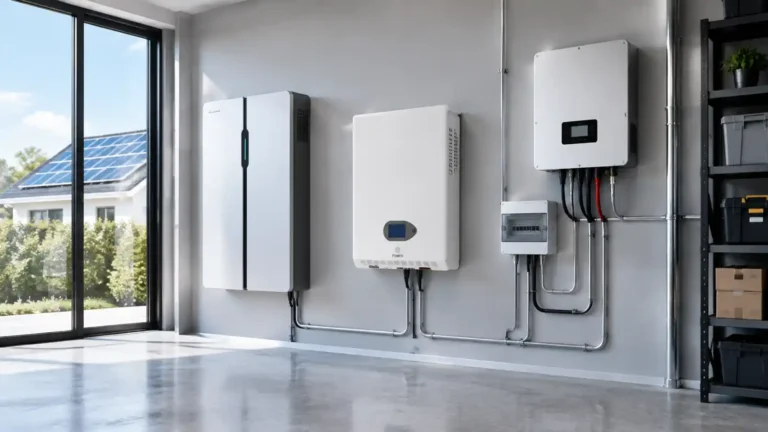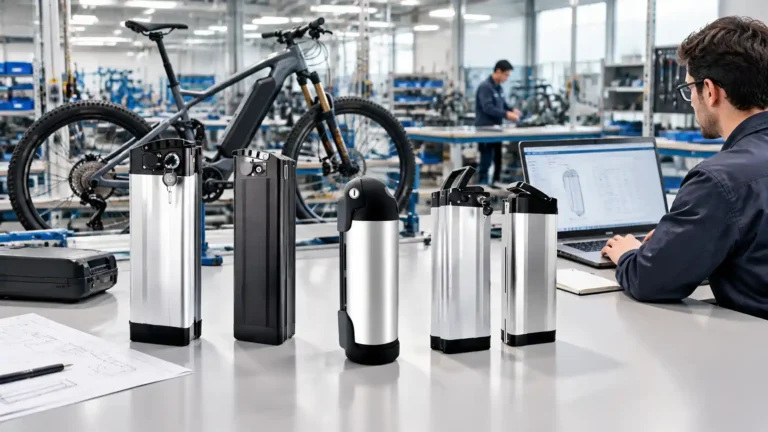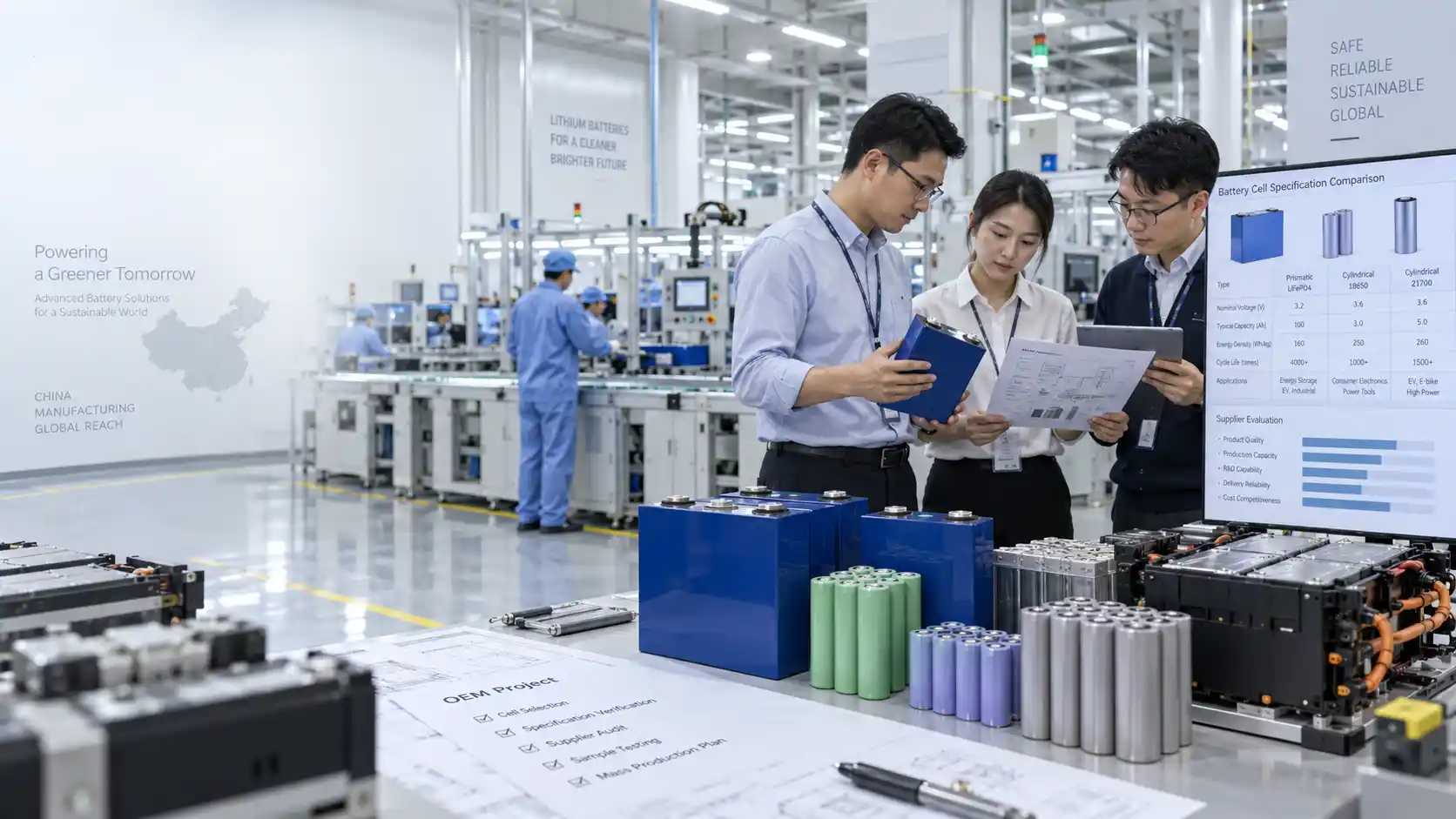
China remains one of the most important sourcing markets for OEM battery projects, but choosing a supplier involves much more than comparing price, capacity or factory size.
A capable custom battery manufacturer in China should be able to translate electrical, mechanical, environmental and compliance requirements into a battery design that can move from prototype to controlled production. For an OEM battery project, buyers may also need support with cell sourcing, chemistry selection, component procurement, testing, certifications and the development of custom lithium battery packs for specific applications.
This list focuses on China-based manufacturers and B2B battery suppliers that support custom or OEM battery projects. It is not an absolute ranking by revenue or factory size. Instead, the companies are compared according to their role in the battery supply chain, engineering capabilities, manufacturing evidence and suitability for different OEM requirements.
Top 10 Custom Battery Manufacturers & Suppliers in China at a Glance
| Company | Location | Core Strength | Best-Fit OEM Projects |
|---|---|---|---|
| Large Power | Greater Bay Area | Complex custom lithium battery engineering | Industrial, medical, robotics, specialized equipment |
| Grepow | Shenzhen / Hunan | High-rate and special-shaped batteries | UAV, power tools, specialized products |
| Tritek | Shenzhen / Anhui / Thailand | LEV battery systems and BMS integration | E-bike, e-scooter, robotics, AGV |
| MANLY Battery | Shenzhen / Guangdong | LiFePO4 battery packs and OEM/ODM | Industrial, robotics, solar, mobility |
| Ufine Battery | Dongguan | Multi-format lithium battery production | Electronics, medical, transport, energy storage |
| VoltCrave Power | Dongguan | Battery cells, components and OEM/ODM sourcing | ESS integrators, pack assemblers, distributors |
| PKCELL | Shenzhen | Multi-chemistry batteries and custom packs | Industrial, medical, electronics, distributors |
| Keheng Battery | China | Cell + pack manufacturing across multiple chemistries | Energy storage, industrial and OEM systems |
| LYTH Battery | Luoyang | LiFePO4 cells, modules and large battery packs | ESS, industrial and high-capacity systems |
| HNF Battery | Dongguan | Flexible custom lithium pack manufacturing | Startups, brands, tools, mobility, industrial |
How We Selected These China Battery Suppliers
The largest battery company is not automatically the best OEM battery manufacturer in China for a specialized project.
Large EV and grid-storage manufacturers are often optimized for very high-volume standardized platforms. An OEM developing industrial equipment, a mobility product or a custom energy-storage system may instead need a supplier that accepts application-specific electrical and mechanical requirements.
Custom Engineering Capability
The supplier should be able to work from actual project requirements, including:
- nominal voltage;
- Ah or Wh target;
- continuous and peak discharge current;
- charging requirements;
- mechanical dimensions;
- operating temperature;
- cycle-life target;
- enclosure and connector requirements;
- regulatory destination.
A custom project should involve more than changing a label or exterior color on an existing battery.
Prototype-to-Production Capability
A working engineering sample does not automatically guarantee stable mass production.
Manufacturers were therefore favored when their public information demonstrates support for design, prototyping, validation, quality control and production scaling.
Battery Chemistry and Cell Options
Different applications may require LiFePO4, NMC, conventional lithium-ion, LiPo or other chemistries.
Access to different cell formats—including prismatic, cylindrical 18650/21700 and pouch formats—can also matter when pack dimensions, energy density or power requirements vary.
Testing and Compliance Support
Custom lithium battery projects frequently involve electrical testing, aging, cell consistency control and transport documentation.
A supplier that understands these requirements can reduce problems later in the sourcing process.
Project Fit
Finally, this list considers specialization.
A manufacturer optimized for drones and high-rate batteries may not be the best choice for a 100kWh stationary storage system. A large LiFePO4 pack manufacturer may likewise be unnecessary for a compact medical battery.
1. Large Power
Best for: Complex industrial and application-specific lithium battery projects
Large Power is one of the strongest specialist custom battery manufacturers in this comparison.
Based in China’s Greater Bay Area, the company states that it has focused on application-driven custom lithium-ion battery projects since 2002. Its capabilities cover battery cells, battery packs, BMS, power supplies, mechanical structure, electronic circuit design, testing, certification preparation and scalable production.
Current company figures report more than 24 years of battery experience, 9,000+ custom project cases and approximately 4GWh of annual battery pack capacity. It also reports more than 30 in-house testing capabilities covering electrical performance, climate, safety and other validation requirements.
The company’s strongest differentiator is its project-based engineering process. The pack specification is developed around operating voltage, capacity, discharge characteristics, dimensional limitations, charging method and safety requirements rather than around a fixed catalog product.
Best fit: Medical equipment, industrial systems, robotics, security equipment, instrumentation and other projects requiring substantial custom engineering.
2. Grepow
Best for: High-rate, special-shaped and mechanically constrained battery projects
Grepow has operated in the battery industry for more than 26 years and is particularly differentiated by its work with high-discharge-rate batteries, special-shaped batteries, LiPo and LiFePO4 systems.
The company reports in-house laboratories, testing facilities and more than 300 professional engineers supporting battery research and development. It also operates manufacturing facilities in China and provides international support in Asia, North America and Europe.
Unlike manufacturers focused mainly on conventional rectangular battery packs, Grepow is relevant when the physical geometry or discharge requirements become part of the core engineering challenge.
This makes it particularly suitable for drones, UAV platforms, power tools and compact professional equipment.
Best fit: OEM projects requiring unusual pack geometry, high discharge capability or specialized cell formats.
3. Tritek
Best for: E-bike, LEV, robotics and AGV battery programs
Tritek was established in 2008 and focuses heavily on light electric vehicle battery systems.
Its product and engineering scope includes battery packs, BMS-related electronics and other components for e-bikes, electric scooters, electric motorcycles, robots and similar mobile platforms.
The company reports more than 100 engineers and operates production facilities in China and Thailand, alongside service locations in Europe. Its OEM/ODM information also documents semi-automated battery pack production and in-house PCBA capabilities.
This specialization is important.
A buyer developing an e-bike battery platform may receive more relevant engineering support from a LEV-focused manufacturer than from a much larger supplier whose primary business is stationary energy storage.
Best fit: E-bike brands, electric scooters, delivery mobility, robotics and other light electric vehicle applications.
4. MANLY Battery
Best for: LiFePO4 battery packs for industrial, solar and mobility applications
MANLY Battery is a Shenzhen-based lithium battery company founded in 2009.
Its official company information describes production bases in Shenzhen, Dongguan and Huizhou and an engineering organization of approximately 100 professional engineers. It supports OEM and ODM development based on application, voltage, capacity, current and other technical requirements.
MANLY’s custom service is particularly oriented toward LiFePO4 battery systems. Buyers can submit requirements including voltage, current, capacity, dimensions and terminal type for a customized solution.
Its application portfolio covers robotics, AGV/RGV systems, transportation, medical electronics and other battery-powered equipment.
Best fit: Buyers that already know they need a LiFePO4-based battery pack and want a manufacturer capable of adapting voltage, capacity and mechanical configuration.
5. Ufine Battery
Best for: Multi-format lithium batteries and flexible OEM/ODM development
Ufine, formally Dongguan Ufine Electronic Technology Co., Ltd., was founded in 2008.
The company reports a manufacturing facility exceeding 10,000 square meters, more than 1,000 overseas customers and production capability exceeding 100,000 battery units per day. It offers OEM/ODM development and sample support.
Its battery portfolio covers several lithium battery formats serving electronics, transportation, medical products, aerospace-related applications and energy storage.
Ufine is therefore relevant where an OEM needs flexibility across different battery formats rather than a supplier focused only on large prismatic storage cells.
Best fit: Consumer and professional electronics, compact equipment, medical applications and projects requiring different lithium battery form factors.
6. VoltCrave Power
Best for: Pack assemblers, ESS integrators, distributors and B2B buyers defining cell specifications
This China-based supplier takes a broader sourcing approach than the dedicated pack manufacturers above.
Its portfolio includes large-format LiFePO4 prismatic cells, 18650 and 21700 cylindrical lithium-ion cells, NMC/NCM cells, e-bike battery packs and energy-storage platforms. The current product catalog includes LiFePO4 capacities ranging from smaller high-rate cells through 230Ah, 280Ah, 304Ah and 314Ah energy-storage cells, alongside cylindrical and NMC formats.
This sourcing model can be particularly useful to overseas OEMs, distributors and pack assemblers looking for a wholesale lithium battery supplier in China, especially when the underlying cell platform has not yet been finalized or when cells and components need to be sourced before pack assembly.
Rather than competing directly with every specialist pack factory on manufacturing scale, the value lies in helping B2B buyers connect cell selection, product sourcing and OEM/ODM requirements.
For current specifications, review the battery cells and components range.
Best fit: Battery pack manufacturers, energy-storage integrators, distributors and project buyers sourcing cells or customized battery products from China.
7. PKCELL
Best for: Multi-chemistry battery sourcing and custom pack projects
PKCELL was established in 1998 and operates a broad battery portfolio rather than focusing exclusively on one lithium battery chemistry.
Its official company information reports a 28,000-square-meter facility, more than 50 R&D personnel and exports to more than 100 countries. Products include primary batteries, NiMH, lithium-ion batteries and battery packs.
Its custom battery pack business supports OEM/ODM development and includes Li-ion battery packs and other battery configurations. PKCELL also states that its custom battery business is supported by a dedicated engineering team.
This broader chemistry coverage can be useful to distributors or equipment manufacturers that source several battery types rather than a single high-volume lithium platform.
Best fit: Industrial equipment, medical products, electronics and B2B buyers requiring several battery chemistries from one supplier.
8. Keheng Battery
Best for: Buyers requiring both battery cells and complete packs
Keheng positions itself as both a battery cell manufacturer and a battery pack manufacturer.
Its current product platform includes LFP, NMC, LTO and sodium-ion battery technologies, with cylindrical and prismatic cell options. The company states that its engineering team has approximately 15 years of project experience and provides OEM/ODM battery development.
This cell-plus-pack model can be useful when a buyer wants more control over the underlying chemistry rather than sourcing a finished pack without visibility into the cell platform.
The company also states that it can provide initial design drawings within approximately one week and samples within approximately three weeks, although real project timing will naturally depend on battery complexity.
Best fit: Energy storage, industrial systems, battery distributors and OEMs evaluating different lithium chemistries.
9. LYTH Battery
Best for: Large LiFePO4 cells, modules and high-capacity battery packs
LYTH, operated by Luoyang Tianhuan Energy Technology Co., Ltd., focuses on lithium battery cells and battery systems for power and energy-storage applications.
The company states that it supplies new A-grade cells and can customize lithium-ion battery modules and packs. Its manufacturing platform includes automated module production, OCV/ACR testing, laser welding, DCIR testing and EOL testing.
LYTH reports an annual production capacity of approximately 1.2GWh, with planned capacity expansion, and states that it can support large OEM and ODM projects.
Its catalog includes large-capacity LiFePO4 systems such as 12V packs using prismatic cells, alongside modules and energy-storage battery configurations.
Best fit: Stationary energy storage, high-capacity LiFePO4 systems and buyers sourcing cells together with modules or completed packs.
10. HNF Battery
Best for: Flexible OEM projects, smaller prototype runs and brands entering production
HNF Battery is a Dongguan-based custom lithium battery pack manufacturer focused on OEM/ODM projects.
Its current service information covers Li-ion, LiFePO4 and LiPo battery packs, including 18650 and 21700 configurations. Customization can include voltage, capacity, physical size, connectors, BMS requirements, packaging and private labeling.
The company advertises custom OEM quantities starting from approximately 100 units, making it relevant to smaller brands or engineering projects that may not yet be ready for very large production commitments.
Its factory process includes cell voltage and internal-resistance checking, assembly, BMS testing and aging tests before shipment.
Best fit: Startups, private-label brands and small-to-medium OEM programs needing flexible customization and relatively low initial quantities.
How to Choose a Custom Battery Manufacturer in China
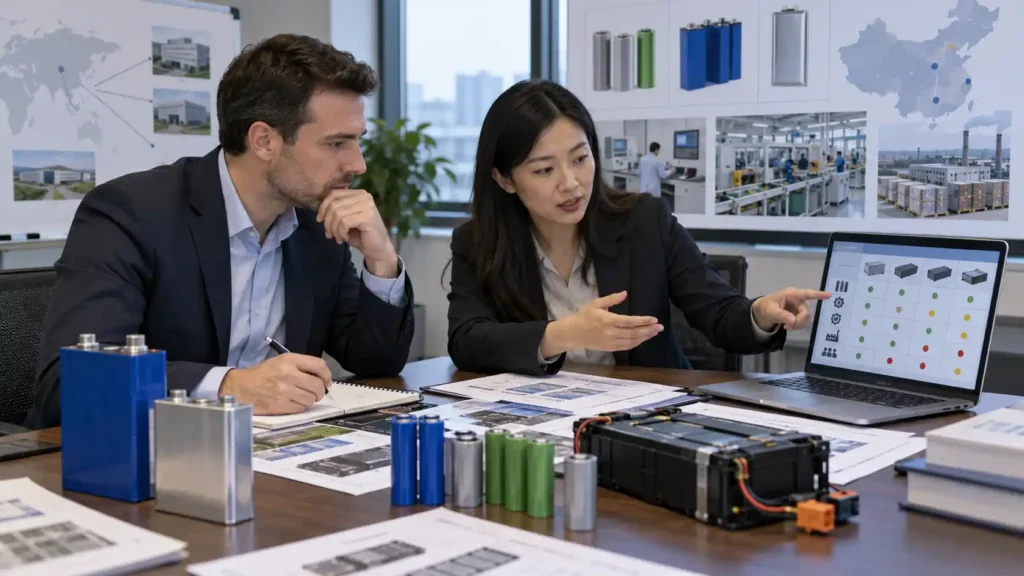
A China Top 10 list should only be the beginning of supplier qualification.
The right manufacturer depends on the project specification, annual volume, target market and how much engineering support the buyer requires.
Match the Supplier to the Application
Do not begin by asking:
Who is the biggest manufacturer?
Begin with:
Who has already solved battery problems similar to mine?
A drone battery, medical pack, 51.2V energy-storage module and electric bicycle battery require different engineering priorities.
Application experience can therefore matter more than total factory size.
Confirm Whether You Need a Cell Supplier or a Pack Manufacturer
This distinction is especially important when sourcing batteries from China.
A battery cell supplier helps the buyer select and source the underlying 18650, 21700, prismatic LFP or NMC cell.
A custom battery pack manufacturer takes those cells and develops the electrical, mechanical and protection system around the application.
Some suppliers perform both roles, while others specialize heavily in one side.
OEM buyers should clarify this before requesting quotations.
Verify Cell Source and BOM Traceability
The approved battery should identify the key cell and component requirements.
Important questions include:
- Who manufactures the cell?
- What cell model is proposed?
- Can lot or batch information be traced?
- Can the supplier substitute another cell without customer approval?
- How are connectors, busbars, BMS components and other critical parts controlled?
- What happens if the original cell reaches end of life?
For long-term OEM projects, change control can be just as important as the initial quotation.
Evaluate Cell Matching and Incoming Inspection
Cells with the same nominal voltage and capacity are not automatically identical.
Capacity, open-circuit voltage, internal resistance and batch consistency can affect the behavior of a multi-cell battery pack.
Ask the supplier:
- what incoming inspections are performed;
- whether cells are graded before assembly;
- how cell batches are recorded;
- how capacity and resistance consistency are controlled;
- whether aging tests are performed on finished packs.
This is especially important for large series-connected LiFePO4 packs.
Check the Prototype-to-Production Process
A prototype can be assembled carefully by an experienced engineer and still fail to represent mass-production quality.
Before approving the sample, determine:
- which production processes will change;
- whether welding becomes automated;
- how production inspections are defined;
- which BOM version becomes the production baseline;
- how engineering changes are approved.
The objective is not only to build one good battery.
It is to manufacture the same validated battery repeatedly.
Verify Compliance Before Finalizing the Design
Lithium battery compliance should be discussed before tooling or mass production.
UN 38.3 is particularly important for international transport. Buyers should also determine whether their target application requires standards such as IEC 62133, IEC 62619, UL 1973 or other market-specific requirements.
Review MOQ, NRE, Tooling and Production Volume
China offers manufacturing options ranging from prototype-oriented suppliers to very large-scale factories.
That does not mean every factory is commercially suitable for every project.
Before sending an RFQ, define:
- prototype quantity;
- first commercial order;
- annual forecast;
- tooling requirements;
- expected production life;
- target price range.
This allows suppliers to recommend a realistic engineering and manufacturing route.
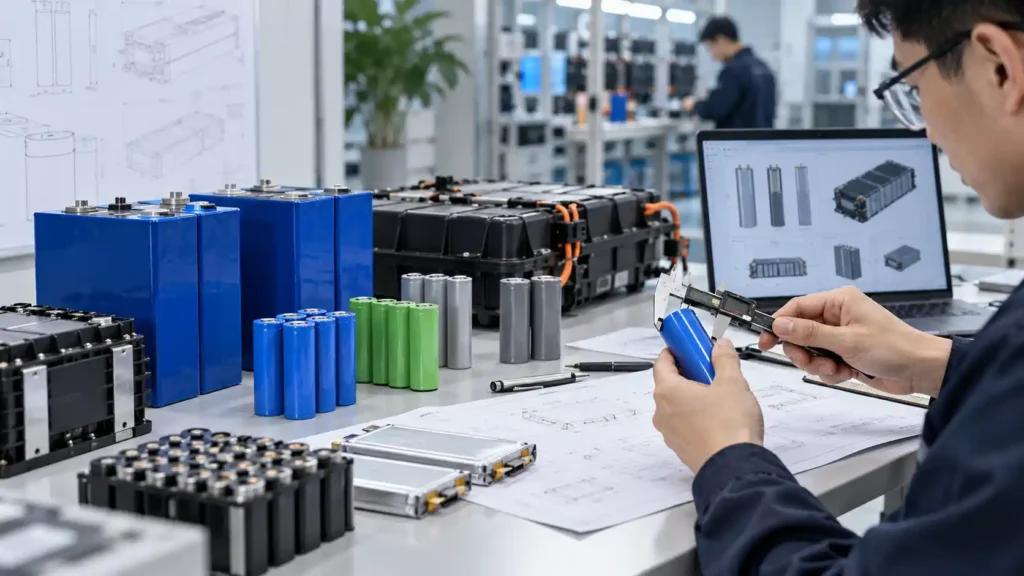
Battery Chemistry and Cell Format for OEM Projects
Supplier selection becomes easier once the underlying battery architecture has been defined.
Prismatic LiFePO4 Cells
Large prismatic LiFePO4 cells are especially relevant to residential ESS, commercial storage, solar battery systems and other high-capacity stationary applications.
Typical OEM decisions include:
- Ah capacity;
- physical cell dimensions;
- series count;
- continuous charge/discharge requirements;
- cycle-life expectations;
- terminal structure;
- enclosure compression;
- batch consistency.
A buyer designing a 51.2V battery system may use sixteen 3.2V cells in series, but the final energy capacity depends on the chosen Ah rating.
18650 and 21700 Cells
Cylindrical lithium-ion cells are commonly used where the pack requires modular mechanical design or flexible series-parallel configuration.
21700 cells generally offer more capacity per individual cell than 18650 cells, which can reduce the total cell count for a given energy target.
However, OEM engineers still need to evaluate:
- continuous current;
- thermal management;
- welding and busbar design;
- pack dimensions;
- cell availability;
- cost.
The current Battery Cells & Components product catalog includes prismatic LiFePO4, 18650, 21700 and NMC/NCM cell options.
NMC Cells
NMC cells remain useful when higher energy density and lower weight are major engineering priorities.
Compared with large-format LFP cells, NMC platforms are often evaluated for applications where compact packaging or weight has greater importance.
The chemistry decision should therefore follow the application rather than a generic claim that one technology is always better.
What to Include in a Custom Battery RFQ
A detailed RFQ helps different custom battery manufacturers in China quote against the same technical target.
| RFQ Requirement | Information to Provide |
|---|---|
| Application | Equipment type and operating duty |
| Chemistry | LiFePO4, NMC, Li-ion or open to recommendation |
| Nominal voltage | Required battery/system voltage |
| Capacity | Ah and Wh target |
| Continuous current | Normal operating load |
| Peak current | Maximum current and duration |
| Dimensions | Maximum L × W × H |
| Weight | Maximum permitted battery mass |
| Charging | Charger voltage and charging current |
| Temperature | Charging and discharge environment |
| Mechanical design | Enclosure, mounting and connector requirements |
| Cycle target | Expected service life |
| Compliance | Destination market and required standards |
| Prototype quantity | Engineering samples |
| Initial order | First production quantity |
| Annual forecast | Expected yearly requirement |
| Documentation | Drawings, test reports, traceability |
| Change control | Rules governing BOM and cell substitutions |
A useful RFQ should make different quotations technically comparable.
A lower-priced quotation is not necessarily less expensive if the supplier is using a different cell, reducing testing or assuming a simpler enclosure.
From Supplier Shortlist to Sample Validation
Once the battery specification is sufficiently clear, reduce the market to a small number of suitable suppliers.
Send the same RFQ to each company.
Then compare more than price.
Look at:
- the engineering questions they ask;
- the proposed cell;
- BMS and protection strategy;
- mechanical solution;
- sample timeline;
- compliance responsibility;
- production plan;
- documentation.
A supplier that immediately quotes without clarifying an incomplete specification may deserve more scrutiny than one that challenges unclear requirements.
After the engineering review, produce samples and test them in the actual equipment whenever possible.
Validation may include:
- capacity;
- load behavior;
- peak current;
- charging;
- operating temperature;
- mechanical fit;
- vibration;
- communication with the equipment where applicable;
- protection behavior.
Once the sample is approved, freeze the production specification and establish a formal process for future changes.
FAQs
What is the difference between a battery manufacturer and a battery supplier in China?
A manufacturer generally owns or directly operates production processes for battery cells, battery packs or both. A battery supplier may instead focus on product sourcing, supplier coordination, exporting and helping buyers select among multiple manufacturing platforms.
For B2B buyers, either model can be useful depending on whether the priority is direct production, multi-product sourcing or supply-chain flexibility.
How do I find a reliable custom battery manufacturer in China?
Begin with a detailed specification and shortlist suppliers with relevant application experience.
Then verify factory capabilities, cell sources, test procedures, quality systems, compliance documentation, sample performance and production-change controls before committing to a large order.
What information does a Chinese battery manufacturer need for an OEM quotation?
At minimum, prepare application, voltage, capacity, continuous current, peak current, dimensions, charging requirements, operating temperature, required certifications, prototype quantity and annual forecast.
Providing drawings and actual load information usually improves the quality of the quotation.
Can I specify the exact battery cells used in my custom pack?
Yes.
OEM buyers can specify an exact cell model or define minimum chemistry, capacity, current and mechanical requirements.
If the cell model is critical to product approval, any later substitution should require buyer approval.
What is the typical MOQ for a custom lithium battery pack in China?
There is no single industry-wide MOQ.
Some suppliers support small prototype or pilot batches, while highly automated manufacturers may require much larger production commitments. MOQ also depends on enclosure tooling, BMS development, cell availability and certification requirements.
Do custom lithium batteries from China need UN 38.3?
Lithium batteries intended for international transport generally need applicable UN 38.3 testing and documentation.
The buyer should confirm that the test documentation corresponds to the actual battery model being shipped rather than an unrelated cell or pack.
Conclusion
China offers a broad range of custom battery sourcing options—from large engineering-driven pack manufacturers to specialized high-rate battery factories, LiFePO4 system suppliers and B2B sourcing partners.
The best supplier is therefore not necessarily the largest company on the list.
A stronger sourcing process is:
Define the application → choose the chemistry and cell format → prepare a detailed RFQ → shortlist relevant suppliers → verify cells and production controls → validate samples → confirm compliance → freeze the production specification → scale manufacturing.
For buyers sourcing lithium battery cells, custom packs or energy-storage products from China, the objective should be to find the supplier whose technical capabilities and commercial model best match the project—not simply the company offering the lowest initial quotation.
Need help matching this topic to a real battery project?
Send your target application, capacity range, certification market, and order plan. VoltCrave can recommend a practical product direction.