China has a large number of outdoor portable power station suppliers, but for a B2B buyer, finding a suitable long-term manufacturing partner involves far more than comparing product images and prices.
Importers, distributors, private-label brands, solar companies, and energy-storage businesses need to determine who actually manufactures the product, how the battery and electrical system are designed, whether the required compliance documents match the target market, and whether the supplier can maintain consistent production quality.
If you are still at the stage of identifying possible suppliers, first compare portable power station manufacturers in China.
This article focuses on the next stage: evaluating an outdoor portable power station factory in China after potential suppliers have already been shortlisted.
Start by Identifying the Supplier Model
Before conducting factory due diligence, clarify what type of cooperation you actually need.
Terms such as manufacturer, OEM, ODM, white label, and trading company are often mixed together during sourcing, but they do not represent the same level of engineering or manufacturing involvement.
| Supplier Model | What the Buyer Usually Receives | Customization Level | Best Fit |
|---|---|---|---|
| Brand distributor | Existing branded products | Low | Retailers and distributors |
| White-label supplier | Existing platform with buyer branding | Low to moderate | New private-label brands |
| OEM manufacturer | Production based on agreed specifications | Moderate | Importers and established brands |
| ODM manufacturer | Existing platform with deeper customization | Moderate to high | Product-line development |
| Manufacturing partner | Engineering, production, testing and supply support | Project dependent | Strategic B2B cooperation |
| Trading company | Products sourced from external factories | Usually limited | Buyers prioritizing sourcing convenience |
No single model is automatically better.
A buyer sourcing an existing 1 kWh product with custom branding may not need extensive engineering involvement. By contrast, a company developing a differentiated high-power platform should pay much closer attention to BMS design, inverter architecture, thermal management, product validation, and compliance.
The first question should therefore be:
Are you purchasing an existing product, modifying an existing platform, or developing a longer-term product line?
How to Evaluate an Outdoor Portable Power Station Factory
Factory verification should cover commercial, technical, production, quality, and compliance factors.
The goal is not simply to confirm that a factory exists. The real purpose is to determine whether its capabilities match the portable power station project you intend to place.
Verify the Company Behind the Quotation
Begin with the legal company information and the relationship between the entity issuing the quotation and the facility producing the product.
Review whether the company names shown on quotations, contracts, payment information, certification documents, and shipping paperwork are consistent.
You should also determine whether the supplier operates its own production facility, works with an affiliated manufacturer, or purchases finished goods from another factory.
A trading company is not automatically unsuitable.
The concern arises when a supplier presents itself as a manufacturer but cannot clearly identify who is responsible for engineering, production, quality control, and after-sales support.
Examine the Production Process, Not Just the Building
Factory size alone does not demonstrate manufacturing quality.
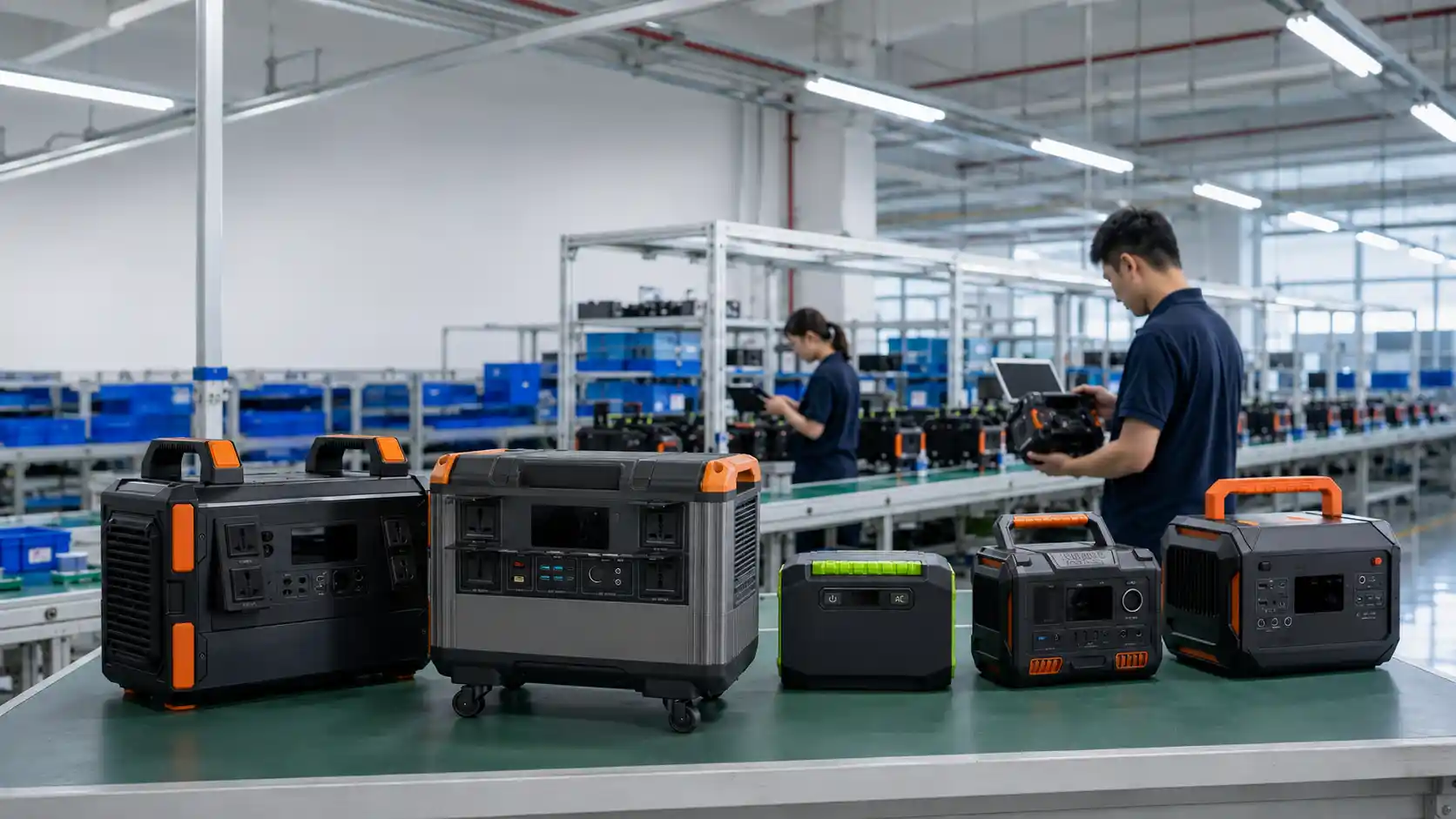
Portable power station production involves several systems working together:
- Battery pack
- BMS
- Inverter
- Charging system
- Wiring
- Thermal management
- Enclosure
- Firmware
- Final assembly and testing
A more useful factory assessment asks how each of these areas is controlled.
For example:
How are battery packs assembled?
How are incoming cells or battery modules checked?
How are BMS parameters configured?
How are inverter boards tested?
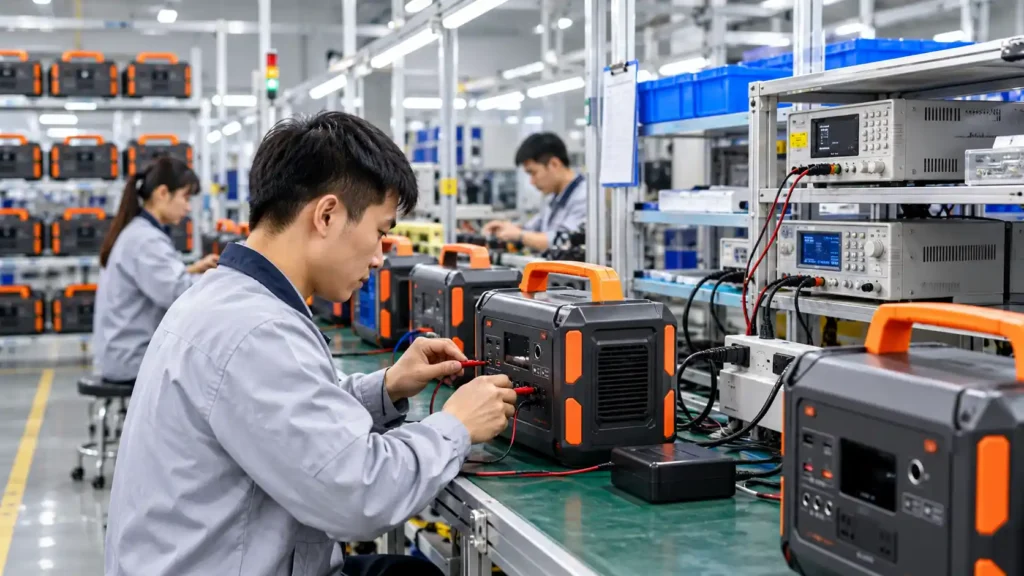
Which electrical tests are carried out before shipment?
How are defective units identified?
How is an approved sample converted into repeatable mass production?
For buyers assessing VoltCrave Power, its advanced manufacturing capabilities provide additional context on the production structure.
Match Engineering Capability to the Project
Not every project requires advanced customization.
A simple white-label order may involve little more than logo, label, manual, and packaging changes.
OEM or ODM projects can be much more demanding.
Changes to AC output, battery configuration, solar input, charging logic, firmware, communication functions, or enclosure design can affect multiple systems at the same time.
A technically capable manufacturer should explain not only what can be changed, but also:
- Which changes are simple
- Which require engineering validation
- Which may affect product safety
- Which may require new testing
- Which could affect existing compliance documentation
Be cautious if every technical request receives exactly the same answer:
“No problem.”
A credible manufacturer should also be able to explain constraints and development risks.
Review Quality Control Throughout Production
Final inspection alone is not enough to describe a complete quality system.
A stronger process manages quality from incoming materials through production and finished-product testing.
Depending on the factory and product, this may include:
- Incoming material inspection
- Battery-pack testing
- BMS verification
- Inverter testing
- Charge and discharge checks
- AC/DC output verification
- USB and communication testing
- Display and control checks
- Protection-function testing
- Aging or burn-in testing
- Final functional inspection
Instead of asking only:
“Do you test every unit?”
ask:
“What is tested, under what conditions, how are the results recorded, and how is a failed unit handled?”
For private-label customers, this is important because quality problems eventually become their own warranty and brand issues.
Evaluating LiFePO4 Battery and Cell Sourcing
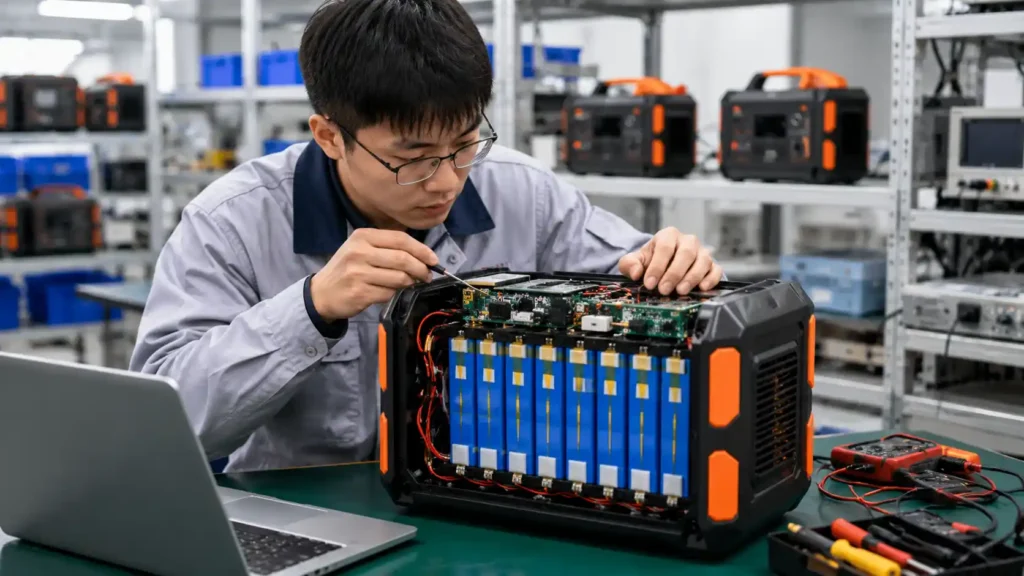
Battery quality is one of the most important elements of an outdoor portable power station.
LiFePO4 is widely used in current products because it can offer strong cycle-life characteristics and good thermal stability compared with several other lithium-ion chemistries.
However, LiFePO4 is not risk-free.
Cell quality, pack structure, BMS protection, charging logic, thermal design, and production consistency still matter.
A statement such as:
“We use LiFePO4 cells.”
does not provide enough information for a B2B purchasing decision.
Buyers should also confirm:
- Battery chemistry
- Nominal system configuration
- Rated capacity
- Cycle-life test conditions
- Cell consistency controls
- Battery batch identification
- Pack assembly process
If the supplier claims to use cells from a specific cell manufacturer, request appropriate supporting documentation rather than relying only on a sales statement.
For larger OEM projects, traceability can become especially important because it helps connect product failures with specific production batches.
Do Not Evaluate the Battery Without the BMS and Inverter
Portable power station performance is determined by an entire electrical system rather than battery capacity alone.
The battery cells, BMS, inverter, charging system, firmware, thermal design, and output architecture must work together.
Depending on system design, BMS functions can include:
- Cell and pack voltage monitoring
- Current monitoring
- Temperature monitoring
- Overcharge protection
- Over-discharge protection
- Over-current protection
- Short-circuit protection
- Charge and discharge management
The inverter affects rated AC power, surge handling, efficiency, waveform quality, and load compatibility.
For that reason, two products with similar advertised Wh ratings can perform very differently in real applications.
Verify Certification Documents at the Model Level
Portable power station compliance is often oversimplified.
There is no single certification package that automatically applies to every portable power station sold in every country.
Applicable requirements depend on factors such as:
- Target market
- Battery configuration
- Electrical design
- Charger configuration
- Wireless functions
- Transportation requirements
- Retailer requirements
- Local regulations
Depending on product and destination, documentation may involve CE-related conformity requirements, EMC, electrical safety, FCC requirements, UN 38.3 transport testing, RoHS, battery regulations, or North American safety standards.
The most important principle is:
Verify the documents against the exact product you intend to purchase.
Check details such as:
- Applicant or manufacturer name
- Model number
- Product description
- Referenced standard
- Report or certificate number
- Laboratory information
- Product configuration
Also confirm whether requested OEM modifications could change the applicability of existing documents.
VoltCrave Power provides an overview of available certifications and compliance documentation.
For any actual project, the final compliance requirements should still be confirmed against the exact configuration and intended market.
Define Outdoor Portable Power Station Specifications Properly
A quotation request based only on power and capacity is usually incomplete.
For example:
“Please quote a 1000Wh 1200W portable power station.”
This leaves too many important variables undefined.
A professional B2B RFQ should cover the full product architecture.
| Specification Area | What Buyers Should Define |
|---|---|
| Battery capacity | Nominal Wh and system configuration |
| Battery chemistry | Required chemistry |
| Rated AC output | Continuous output |
| Surge performance | Temporary or peak-load requirement |
| AC standard | Target voltage and frequency |
| Waveform | Required AC waveform |
| AC charging | Input and charging requirements |
| Solar input | Voltage, current and power range |
| Vehicle charging | Required input |
| USB outputs | USB-A / USB-C and protocols |
| DC outputs | Voltage, current and connector |
| UPS/EPS | Required only when relevant |
| Operating conditions | Expected temperature/environment |
| Dimensions and weight | Portability requirements |
| Enclosure | Required environmental protection |
| Branding | Logo, color, manual and packaging |
| Target market | Country or region |
Buyers preparing specifications can compare available configurations in the VoltCrave Power Portable & Outdoor power station range.
Solar Input Needs More Than a Wattage Number
Solar compatibility is often under-specified in outdoor power station sourcing.
The photovoltaic input should be reviewed as a complete electrical range, including:
- Supported voltage
- Maximum current
- Maximum power
- Connector configuration
- MPPT architecture where applicable
A solar panel does not become compatible simply because its rated wattage is below the maximum solar input of the power station.
Voltage and current must also remain within the supported range.
This matters especially when a distributor combines the power station with third-party solar modules.
The solar panel and power station should therefore be treated as one electrical system.
Outdoor Use Does Not Mean Unlimited Temperature or Water Exposure
An outdoor portable power station may be used in both hot and cold environments, but charging and discharging do not necessarily share the same temperature limits.
Lithium battery charging can require a narrower permitted temperature range than discharge.
For cold-weather applications, confirm:
- Charging temperature range
- Discharging temperature range
- Low-temperature charging protection
- Thermal monitoring strategy
Do not assume that an outdoor product can charge normally under all environmental conditions.
The same principle applies to water and dust resistance.
A rugged-looking enclosure is not automatically waterproof.
If environmental protection is important, request the tested rating for the exact model rather than relying only on descriptions such as:
outdoor
rugged
weather resistant
Understand the Difference Between White Label, OEM, and ODM
These terms should be clarified before discussing MOQ, tooling, development cost, or lead time.
White Label
White-label sourcing generally uses an existing product platform.
Typical changes may include:
- Logo
- Packaging
- Labels
- Manual
- Selected cosmetic options
This approach is often suitable for companies that want faster market entry and do not need major technical differentiation.
OEM
OEM projects involve manufacturing against agreed product requirements.
An existing platform may still be used, but the buyer may request certain configuration or commercial changes.
The scope should always be defined clearly because different suppliers can use “OEM” differently.
ODM
ODM usually involves deeper use of the manufacturer’s engineering resources.
Possible changes may involve:
- Electrical architecture
- Enclosure design
- Interfaces
- Firmware
- Battery configuration
- Product functions
- Charging system
- Communication features
As customization increases, so does the need for engineering validation and potentially additional compliance work.
The sourcing model should match the commercial objective.
Do not redesign a mature platform unnecessarily when branding and packaging changes are enough.
At the same time, do not expect simple logo customization to create a genuinely differentiated product.
Use the Sample as a Technical Check
A sample should not be treated only as something to approve visually.
It is the first opportunity to check whether the product actually matches the agreed specification.
Sample evaluation can cover:
- Electrical performance
- Charging behavior
- AC output
- USB/DC interfaces
- Solar charging
- User interface
- Enclosure quality
- Thermal behavior
- Accessories
- Packaging
- Documentation
Whenever possible, use equipment that reflects the intended application.
A camping power station designed to run refrigerators should not be tested only with phones and laptops.
A unit intended for backup power should be tested with representative AC loads.
Any discrepancy discovered during sample testing should be documented before production begins.
Consider Pilot Production for Customized Products
A single engineering sample does not necessarily reveal mass-production variation.
Pilot production can help confirm:
- Component consistency
- Assembly process
- Firmware version
- Packaging
- Labels
- Accessories
- QC standards
- Production repeatability
For deeper OEM and ODM projects, establish a clear approval point before the order enters full production.
Late changes can result in rework, delays, cost increases, and compliance risk.
Plan Pre-Shipment QC Before Production Is Finished
The final inspection approach should reflect both the product risk and the commercial agreement.
Depending on the project, inspection may rely on internal factory records, buyer inspection, or third-party inspection.
The scope should be agreed before the goods are completed.
Typical checks may include:
- Quantity
- Packaging
- Labeling
- Appearance
- Accessories
- Model configuration
- Basic functionality
- Agreed product-specific tests
The objective is not to repeat every engineering test on every finished unit.
It is to obtain reasonable evidence that mass production remains consistent with the approved product.
Common Procurement Errors
Selecting the Lowest Quotation
The lowest initial price can become expensive if the supplier creates unstable quality, documentation problems, production delays, repeated revisions, or high warranty costs.
Price should only be compared after the product specifications and project scope are aligned.
Comparing Products That Are Not Equivalent
Two products described as “1000Wh portable power stations” may still differ in battery chemistry, output power, charging architecture, PV input, components, ports, accessories, certification scope, and warranty.
If the specifications differ, the quotations are not directly comparable.
Accepting General Certification Statements
Claims such as:
“CE certified”
or
“UL available”
are not enough on their own.
Request the applicable documentation for the exact configuration and market.
Ignoring PV Compatibility
Maximum solar wattage alone does not determine whether a solar panel can be used.
Voltage and current limits also matter.
Requesting Excessive Customization Too Early
New brands sometimes request major electrical, enclosure, firmware, and functional changes before confirming market demand.
A mature existing platform can reduce technical and commercial risk.
Deeper ODM development becomes more reasonable when product differentiation and expected volume justify the investment.
Leaving Warranty Responsibility Vague
The statement:
“Warranty available”
does not explain what happens after overseas customers experience a failure.
Clarify:
- Warranty period
- Diagnosis process
- Replacement procedure
- Spare-parts support
- Technical responsibility
- Defective-unit handling
- Commercial responsibility
These details matter after the product reaches the market.
What to Include in an RFQ
A useful quotation request should clearly define the product, application, and market.
Before asking for a final quotation, specify:
- Intended application
- Battery capacity
- AC output
- Voltage and frequency
- Battery chemistry
- AC charging
- Solar input
- USB/DC ports
- Target market
- Required certifications
- Customization requirements
- Estimated quantity
- Packaging
- Documentation
- Expected schedule
For customized projects, separate:
fixed requirements
from
preferred requirements.
This allows the factory to determine whether an existing platform can meet the project instead of assuming that a new product must be developed.
Look Beyond the First Product
Supplier selection matters more when portable power stations are intended to become a long-term business category.
A buyer may begin with one model and later expand into:
- Compact portable power stations
- Higher-output systems
- Solar panels and accessories
- Residential backup products
- Battery systems
- Other energy-storage solutions
In that situation, engineering communication, manufacturing capability, documentation support, product continuity, and portfolio breadth become more important.
This is one reason some B2B buyers prefer developing longer-term relationships with energy-storage manufacturers instead of sourcing every model independently.
Working With VoltCrave Power
VoltCrave Power focuses on B2B battery and energy-storage products, including portable and outdoor power solutions.
The appropriate cooperation model depends on the target application, electrical requirements, market, certification needs, customization depth, and commercial strategy.
For straightforward private-label projects, an existing mature platform may provide the most efficient route to market.
For projects involving deeper customization, engineering feasibility and validation should be established before production begins.
Customization should not be pursued simply for the sake of being different.
The objective is to create a product configuration that matches the target market while remaining technically and commercially manageable.
FAQs
How do I find a reliable outdoor portable power station factory in China?
Verify the company and manufacturing relationship first. Then review production processes, battery and BMS capability, quality-control procedures, model-specific compliance documents, sample performance, and after-sales support.
Do not select a supplier based only on price or website appearance.
Is LiFePO4 better for outdoor portable power stations?
LiFePO4 is widely used because it can provide strong cycle-life characteristics and good thermal stability.
Battery selection should still consider weight, capacity, application, cost, pack design, BMS strategy, and overall product requirements.
What certifications should a portable power station factory provide?
There is no universal list that applies to every product and every country.
The necessary documentation depends on product configuration, target market, electrical design, battery system, transportation requirements, and sales channel.
Always verify the documentation against the specific model you intend to purchase.
What is the difference between OEM and white label?
White-label projects usually use an existing platform with branding and packaging changes.
OEM projects may involve buyer-specific configuration or product requirements.
Because suppliers may use these terms differently, the scope should always be defined clearly.
Should I order a sample before placing a bulk order?
Yes.
A sample helps verify charging behavior, electrical performance, interfaces, enclosure quality, packaging, documentation, and intended application compatibility before mass production.
How should I compare two portable power station quotations?
Normalize the specifications before comparing price.
Battery chemistry, capacity, AC output, charging, PV input, ports, accessories, certification scope, customization, warranty, and commercial terms should be comparable.
Can a portable power station charge below freezing?
Not necessarily.
Charging can have a narrower permitted temperature range than discharge.
For cold-climate applications, confirm the exact charging range and low-temperature protection strategy.
What information should I provide for an OEM inquiry?
Provide the application, battery capacity, rated output, AC voltage and frequency, battery chemistry, charging requirements, solar input, required ports, target market, customization scope, estimated quantity, packaging, compliance requirements, and desired schedule.
Conclusion
Choosing an outdoor portable power station factory in China should be treated as a supplier-evaluation process rather than a simple search for a product and price.
Once a shortlist has been created, verify who actually manufactures the unit, how the battery, BMS, and inverter are designed, whether the compliance documentation matches the exact model, and how samples, pilot production, QC, and warranty support are handled.
For outdoor and LiFePO4 portable power station projects, these factors are more useful than factory size, marketing claims, or the lowest initial quotation.
The best supplier is not simply the company willing to quote the requested specification.
It is the manufacturer whose product architecture, engineering capability, production process, documentation, quality system, and long-term support fit the business you intend to build.
Buyers who have already defined their project requirements can contact VoltCrave Power for B2B sourcing and project evaluation.
Need help matching this topic to a real battery project?
Send your target application, capacity range, certification market, and order plan. VoltCrave can recommend a practical product direction.