Why AC Coupling vs DC Coupling Determines Your Solar Storage ROI
When a solar installer on DIY Solar Forum reported that a single battery alert shut down their entire 18 kW system — “no solar input accepted, no AC output to the house, just nothing” — they exposed a reality that most product catalogs conveniently omit: the architecture you choose for your energy storage system matters as much as the cells inside it.
For distributors, installers, project developers, and OEM procurement teams specifying a solar energy storage system residential project, the ac coupling vs dc coupling decision quietly determines round-trip efficiency, retrofit costs, blackout resilience, and long-term ROI. Yet most buyers discover the implications only after installation — when efficiency losses, communication failures, or backup power shortfalls surface in the field.
This guide breaks down both architectures through the lens of real-world pain points documented across DIY Solar Forum, Enphase support communities, EnergySage, and field reports from installers worldwide. Whether you are sourcing a hybrid solar inverter for a new development or evaluating battery storage for solar power systems in retrofit markets, the analysis below will help you make an architecture decision that holds up over 15+ years of service.
AC Coupling vs DC Coupling: Fundamental Differences Explained
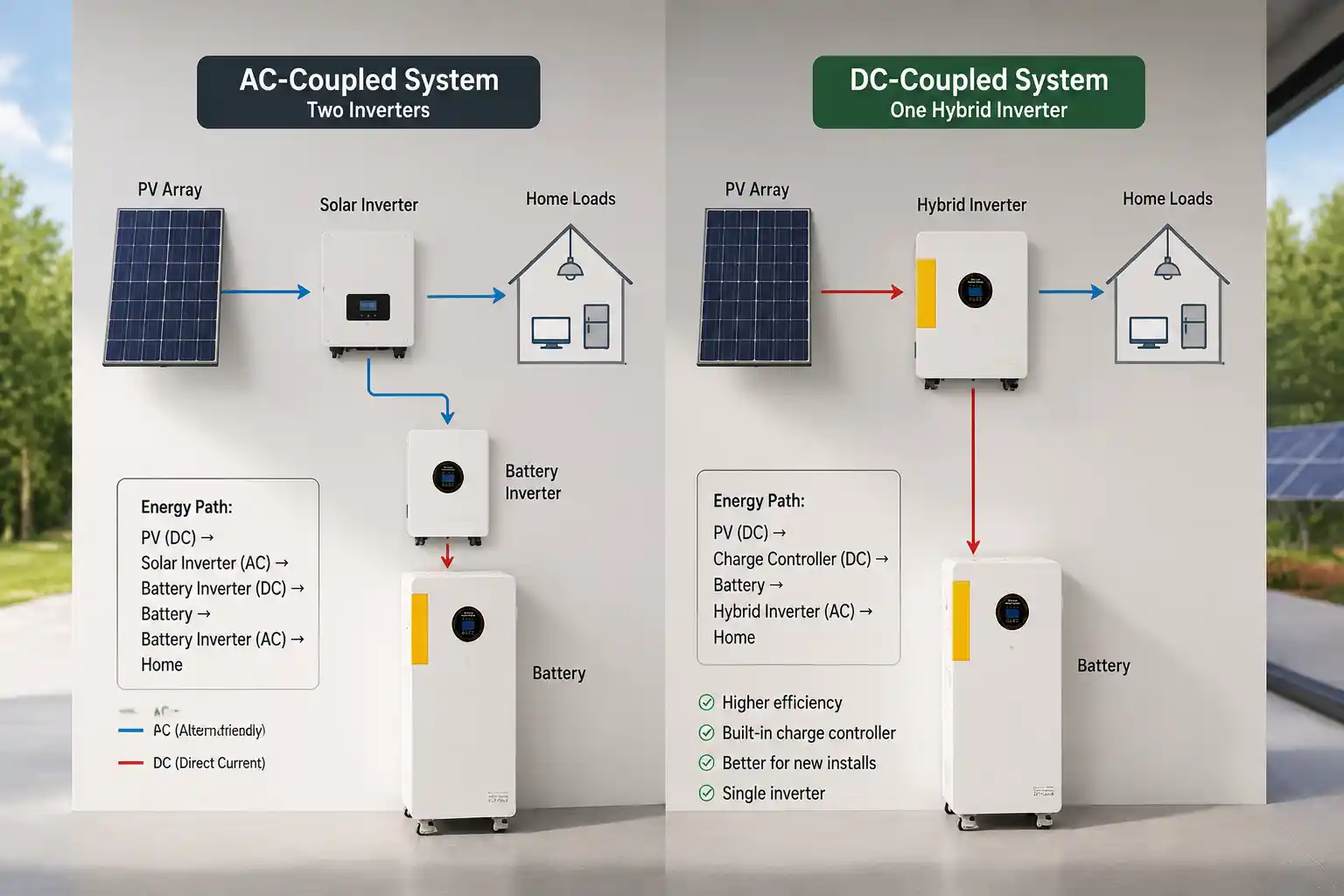
Every solar-plus-storage installation has three electrical domains: the PV array (DC), the battery pack (DC), and the home loads plus the grid (AC). The term “coupled” describes where the battery connects — on the AC bus or the DC bus. That single architectural fork changes how many times energy gets converted, and every conversion costs 2–5% in round-trip losses.
How AC-Coupled Battery Storage Works
In an AC-coupled system, solar panels feed a standard grid-tied inverter that converts DC to AC. That AC powers the home or flows to a separate battery inverter, which converts it back to DC for storage. When the home needs power at night, the battery inverter converts DC back to AC. The energy path is: PV (DC) → Solar Inverter (AC) → Battery Inverter (DC) → Battery → Battery Inverter (AC) → Home.
This architecture requires two separate inverters but offers a critical advantage for retrofit projects: the existing solar inverter stays untouched. For the 60–70% of battery additions that involve existing solar arrays, AC coupling is the default starting point because it preserves the original inverter, warranty, and wiring.
How DC-Coupled Battery Storage Works
In a DC-coupled system, solar panels and the battery share the same DC bus, managed by a single hybrid solar inverter. Solar DC flows directly into the battery with no AC conversion during charging. When the home needs power, the hybrid solar inverter converts DC to AC in a single step. The energy path is: PV (DC) → Charge Controller (DC) → Battery → Hybrid Inverter (AC) → Home.
With only one conversion stage instead of three, DC-coupled systems achieve 94–97% round-trip efficiency compared to 85–92% for AC-coupled systems. For new installations where no legacy inverter needs protection, this architecture delivers more usable energy from the same panels and battery — a critical advantage when designing a solar energy storage system residential project for maximum self-consumption.
Side-by-Side Comparison
| Factor | AC-Coupled System | DC-Coupled System |
|---|---|---|
| Round-trip efficiency | 85–92% | 94–97% |
| Inverters required | 2 (solar + battery) | 1 (hybrid solar inverter) |
| Best for | Retrofit existing solar | New solar + storage installs |
| Retrofit cost range | 10,000–18,000 | 14,000–22,000 |
| Blackout solar charging | No (anti-islanding shuts solar) | Yes (grid-forming / Black Start) |
| Single point of failure | No (two independent inverters) | Yes (hybrid failure stops all) |
| Brand flexibility | High (mix-and-match) | Low (battery must match inverter) |
| Solar clipping recovery | No | Yes (battery absorbs excess DC) |
| Monitoring | Two apps / two systems | One unified platform |
| Future expansion | Easier (add more AC batteries) | Limited by hybrid inverter specs |
6 Hidden Risks Most Buyers Overlook
Competitor blogs typically stop at “retrofit uses AC, new builds use DC.” But installers and procurement teams who have lived with these systems know the real risks run deeper. The following six issues are drawn from forum discussions, field reports, and government inspection data — not marketing brochures.
The 5–12% Efficiency Tax of AC Coupling
The efficiency gap between ac coupling vs dc coupling is not theoretical. Engineering analysis from Heaven Designs quantified the impact on a 500 kWh BESS cycling once daily: a 5% efficiency differential translates to 9,125 kWh lost annually — roughly $22,000 over a 25-year service life. On a residential 10 kWh daily cycle, the gap is smaller in absolute terms (about 110 kWh per year) but still meaningful for off-grid systems where every watt-hour counts.
The root cause is conversion count. AC-coupled systems convert electricity three times (DC→AC→DC→AC), losing 2–5% at each stage. DC-coupled systems convert once (DC→AC). However, as SolarQuotes founder Finn Peacock argues, the wasted energy is often surplus solar worth only 2–10 cents per kWh in feed-in tariffs — meaning the financial impact is modest for grid-tied systems that export excess solar. The efficiency penalty matters most in off-grid setups, daily-cycling commercial systems, and battery storage for solar power systems operating under high time-of-use rate differentials.
Single Point of Failure in DC-Coupled Hybrid Inverters
A DIY Solar Forum user running an 18 kW hybrid solar inverter reported: “Twice now, I’ve had a battery fault out and it shuts down the whole system — no solar input accepted, no AC output to the house, just nothing. Why does the whole system have to fail with one battery alert? It seems like an Achilles heel.”
This is the fundamental trade-off of DC coupling. A hybrid solar inverter manages MPPT tracking, battery charging, grid synchronization, and backup switching in one box. If it fails, everything stops — solar production, battery discharge, and home power. AC-coupled systems, with two independent inverters, provide natural redundancy: if the battery inverter fails, the solar inverter still powers the home during daylight.
For B2B buyers specifying battery storage for solar power systems in regions with long replacement lead times (parts of Africa, Southeast Asia, remote areas), this risk warrants explicit mitigation: spare inverters, extended warranty contracts, or hybrid architectures that combine both coupling methods.
Silent BMS Communication Failures
Technical analysis from Enronix revealed a failure mode that most system owners never detect until damage is done: when BMS-to-inverter communication (CAN bus or RS485) breaks, the system does not shut down — it degrades silently. The inverter switches to voltage-based battery management, losing real-time state-of-charge, temperature, and current-limit data. The battery gets slowly overcharged or overdischarged for months.
“The first sign most owners notice is that their autonomy has halved. By then, months of cycle damage has already happened,” the Enronix report stated.
This risk is amplified when mixing battery and inverter brands. The U.S. Department of Energy found that improper component matching accounts for nearly 30% of all solar storage system failures, and NREL research shows mismatched components typically suffer 20–40% lower round-trip efficiency. For a solar energy storage system residential installation, this means a 10 kWh battery paired with an incompatible inverter may deliver only 6–7 kWh of usable energy per cycle.
Blackout Backup That Fails When You Need It Most
An Enphase support forum user with 7 kW of solar and 20 kWh of battery backup reported: “Our entire home lost power for 5–10 seconds and our battery array did not kick in despite being at 100%. Super scary that a software update might have killed my entire system.”
This is not an isolated incident. AC-coupled systems face a structural limitation during blackouts: anti-islanding safety regulations require the solar inverter to shut down when the grid fails, which means solar cannot charge the battery during an outage. The battery provides backup power from its stored charge, but once depleted, there is no solar recharge path.
DC-coupled systems with grid-forming hybrid solar inverters can perform a “Black Start” — the inverter creates its own microgrid, allowing solar panels to charge the battery even with the grid down. A Queensland family documented 7 days of off-grid operation using this capability, with their system black-starting every morning and running the household entirely on solar plus storage. This difference is a decisive factor when evaluating ac coupling vs dc coupling for blackout-prone regions.
Inverter-Battery Compatibility Nightmares
When specifying battery storage for solar power systems, buyers frequently assume that any AC-coupled battery works with any solar inverter. In practice, firmware mismatches, unsupported communication protocols, and voltage range incompatibilities cause failures that are expensive to diagnose and fix.
Solar Secure identified eight common pairing errors, including assuming all AC-coupled batteries are identical, ignoring voltage requirements, and mixing brands without integration protocols. The company noted: “You cannot assume a battery from Brand A will work seamlessly with an inverter from Brand B, unless both support common integration protocols like SunSpec, Modbus, or CAN bus.”
For DC-coupled systems, the constraint is tighter: the battery typically must come from the same manufacturer as the hybrid solar inverter, or from a verified compatibility list. This limits procurement flexibility but ensures communication reliability — a worthwhile trade-off for most solar energy storage system residential projects.
Solar Clipping Energy Waste
Solar clipping occurs when panel output exceeds inverter capacity, and the excess DC energy is discarded. DC-coupled systems can capture this wasted energy: the battery absorbs excess DC power before it reaches the inverter, storing it for later use. SurgePV reported that systems with a 1.5:1 DC-to-AC ratio can recover up to 90% of clipped energy through DC coupling.
For buyers with oversized solar arrays or high DC-to-AC ratios, this benefit alone can justify the DC-coupled architecture. AC-coupled systems have no mechanism to recover clipped energy because the clipping happens at the solar inverter, upstream of the battery. In the ac coupling vs dc coupling debate, clipping recovery is one of the most overlooked advantages of DC coupling.
The Retrofit Decision: AC vs DC Coupling for Existing Solar
The retrofit decision is the most common and most contested question in solar energy storage system residential projects. With 60–70% of battery additions involving existing solar arrays, getting this decision wrong carries significant financial consequences.
When AC Coupling Wins
AC coupling is the default choice for retrofits when:
- The existing solar inverter is under 5 years old and still under warranty
- The system uses microinverters (Enphase, Hoymiles), which are inherently AC-coupled
- The installation must minimize disruption to the existing solar wiring
- The local utility requires only a simple grid notification rather than a full re-application
In these scenarios, AC coupling preserves the existing inverter investment, avoids warranty complications, and typically costs 4,000–6,000 less than a DC-coupled retrofit. The efficiency penalty is real but, for grid-tied systems with surplus daytime solar, the financial impact may be modest.
When DC Coupling Wins
DC coupling becomes the better choice for retrofits when:
- The existing inverter is over 8 years old, out of warranty, or approaching end of life
- The system is being fully repowered (new panels + new inverter + battery)
- The DC-to-AC ratio exceeds 1.3:1, making solar clipping recovery valuable
- The installation is in a blackout-prone region where Black Start capability is critical
- The project is off-grid or operates primarily on stored solar energy
In these cases, the cost of replacing the inverter with a hybrid solar inverter is offset by efficiency gains, clipping recovery, and backup power capability. The combined value often exceeds the 4,000–6,000 premium within the first 3–5 years for daily-cycling battery storage for solar power systems.
The Real Cost Calculation
| Cost Factor | AC-Coupled Retrofit | DC-Coupled Retrofit |
|---|---|---|
| Typical installation cost | 10,000–18,000 | 14,000–22,000 |
| Inverter replacement needed | No | Yes (hybrid solar inverter) |
| Grid re-application required | Usually no (simple notification) | Often yes (full re-application) |
| Annual efficiency savings | Baseline | 30–60 (grid-tied residential) |
| Payback on inverter upgrade | — | 70–200 years (grid-tied only) |
| Black Start capability | No | Yes |
| Solar clipping recovery | No | Up to 90% of clipped energy |
| 25-year efficiency value | Baseline | $22,000+ (daily-cycling commercial) |
The table above reveals an uncomfortable truth: for grid-tied retrofits, the efficiency savings from DC coupling rarely justify the inverter replacement cost alone. PowerLutions calculated that DC coupling’s efficiency advantage saves only 30–60 per year for a typical residential system, while replacing the inverter costs 4,000–6,000. The decision should be driven by blackout resilience, clipping recovery, or inverter age — not efficiency alone.
How to Evaluate a Hybrid Solar Inverter for DC-Coupled Systems
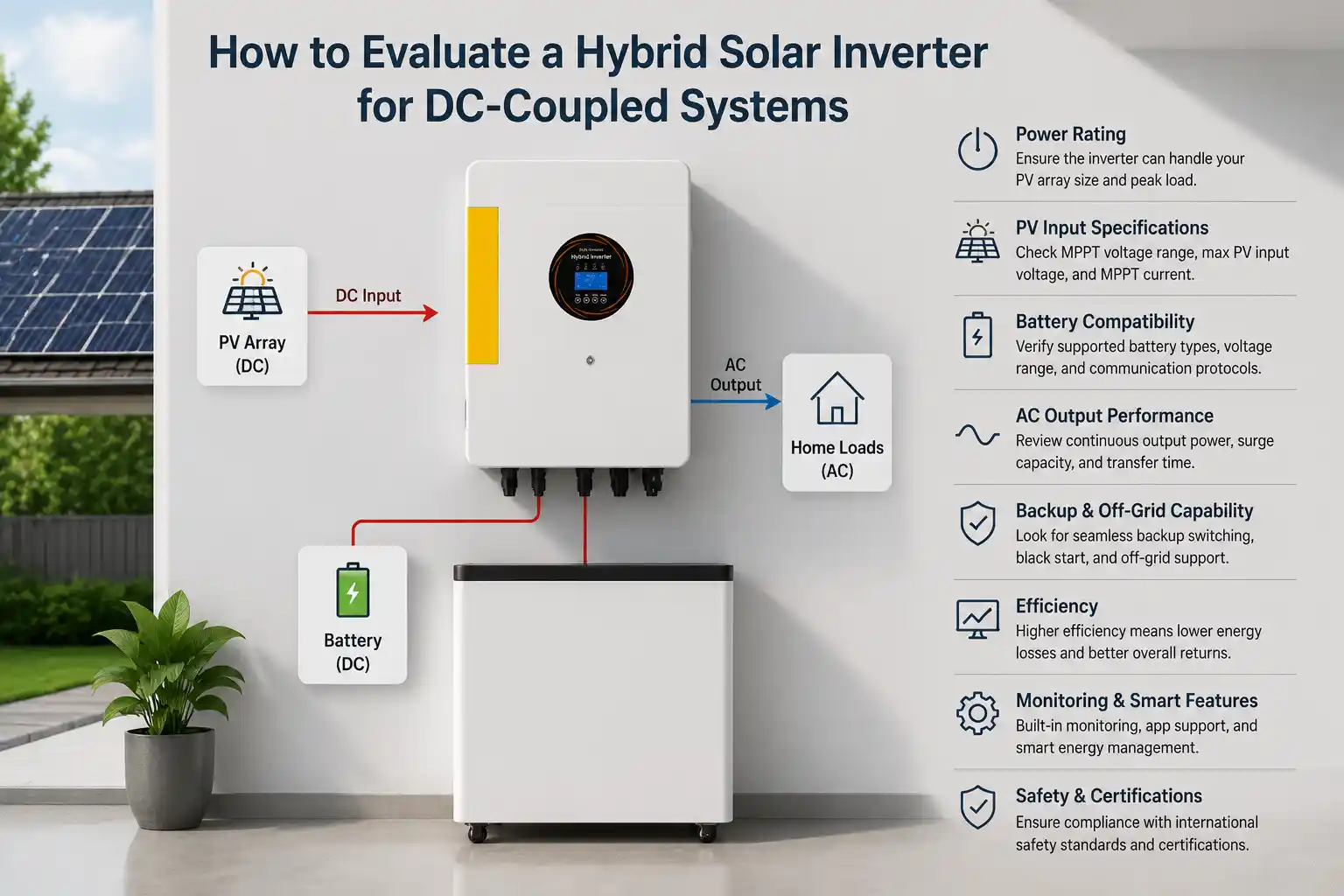
For new installations and inverter-replacement retrofits, the hybrid solar inverter is the single most critical component. It determines efficiency, backup capability, communication compatibility, and future expansion limits for any solar energy storage system residential project.
Key Specifications to Verify
Procurement teams should verify the following before committing to a hybrid solar inverter:
- MPPT channels and input voltage range — More channels allow better shading management; wider voltage ranges accommodate various panel configurations
- Grid-forming / Black Start capability — Essential for backup power during extended outages
- Battery communication protocols — Must match the battery BMS (CAN bus, RS485, SunSpec, Modbus)
- UPS transfer time — Under 20 ms for seamless backup; longer gaps may require a secondary UPS
- DC-to-AC ratio support — Higher ratios (1.3:1 or above) enable solar clipping recovery
- Certification coverage — UL 1741 (US), IEC 62109 (EU and global), G98/G99 (UK), AS/NZS 4777 (Australia)
- Monitoring platform — Single-app unified monitoring versus fragmented multi-app systems
Red Flags vs Green Flags
| Factor | Red Flag | Green Flag |
|---|---|---|
| BMS communication | “Compatible with most batteries” (vague) | Published compatibility list with firmware versions |
| Backup power | “Backup ready” (no specs) | Under 20 ms transfer time, documented Black Start |
| Efficiency | Only peak efficiency advertised | Full load curve across 10–100% load range |
| Warranty | 5 years standard, exclusions buried | 10+ years, explicit degradation curve |
| Certifications | “Meets international standards” | Specific UL, IEC, CE certificate numbers listed |
| Technical support | Email only, no response SLA | 120+ engineers, multilingual, defined response time |
| Firmware updates | “Contact dealer” | OTA updates, public changelog |
Total Cost of Ownership: What Buyers Actually Pay
The sticker price of battery storage for solar power systems rarely reflects the true cost over a 15-year service life. Hidden costs can add 20–40% to the initial investment, and the ac coupling vs dc coupling choice influences every line item.
| Cost Category | AC-Coupled System | DC-Coupled System |
|---|---|---|
| Initial hardware | 10K–18K (2 inverters + battery) | 8K–15K (1 hybrid inverter + battery) |
| Installation labor | 15–20% of project cost | 10–15% of project cost |
| Grid application fees | 0–500 (simple notification) | 500–2,000 (full re-application) |
| Annual maintenance | 200–400 (2 systems to maintain) | 100–200 (1 system) |
| Inverter replacement (year 10–12) | 1,500–3,000 (one inverter) | 2,500–5,000 (hybrid inverter) |
| Efficiency loss over 10 years | 10,950–21,900 kWh | 3,650–7,300 kWh |
| Monitoring software | Often 2 separate apps | Single unified platform |
For B2B buyers managing multiple installations, the labor and maintenance differences compound across a portfolio. A distributor handling 100 retrofit projects per year could save 50,000–100,000 in labor costs alone by standardizing on AC-coupled retrofits — even before accounting for the lower grid application burden. For new-build solar energy storage system residential developments, DC coupling’s lower hardware count and unified monitoring reduce long-term operational complexity.
How Voltcrave Power Addresses These Challenges
Voltcrave Power approaches the ac coupling vs dc coupling challenge from the perspective of a manufacturer that supplies both architectures across 30+ countries. Founded in 2011 with three production bases in Dongguan, Hunan, and Thailand, the company has accumulated 14+ years of field data from residential, commercial, and off-grid installations.
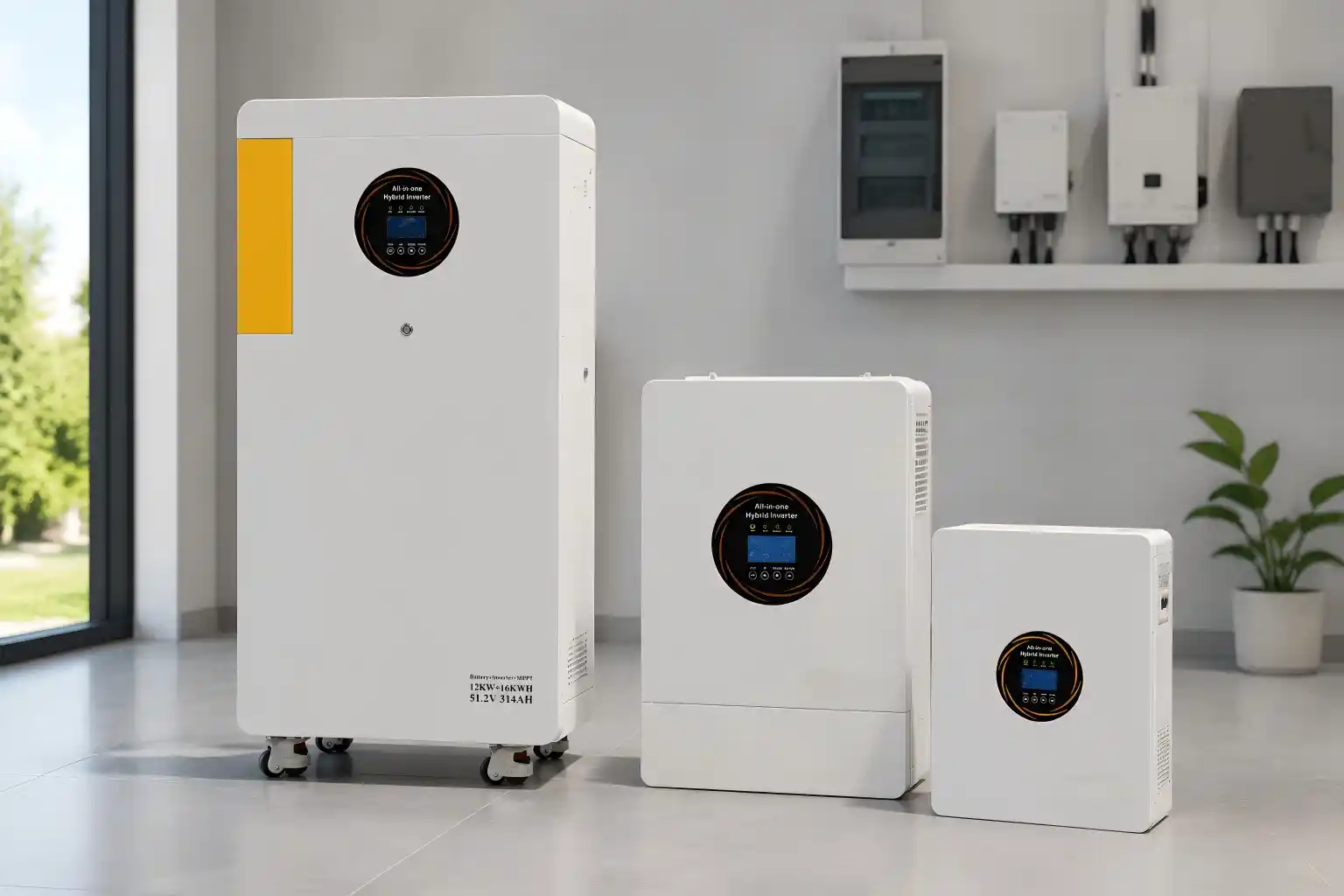
DC-coupled solutions. The Voltcrave Power All-in-One series integrates a 6 kW hybrid solar inverter with LiFePO4 battery storage in a single unit. This architecture delivers DC-coupled efficiency (94–97% round-trip) with under 20 ms UPS transfer time for blackout resilience. The integrated design eliminates cross-brand communication failures by keeping the inverter and BMS within one validated system — directly addressing the silent BMS failure risk documented in field reports.
BMS engineering. Every Voltcrave Power battery employs an automotive-grade 8-layer BMS with sub-100 µs fault response. The system maintains active communication with the hybrid solar inverter across CAN bus and RS485 protocols, with automatic fallback protection if communication is interrupted. This engineering approach prevents the silent degradation mode that Enronix identified as a leading cause of premature battery failure in battery storage for solar power systems.
Certification coverage. Voltcrave Power products carry UL1973, UL9540A, CE, UN38.3, IEC 62619, and TUV certifications — pre-certified for EU, North American, and Asia-Pacific markets. An ISO/IEC 17025-accredited in-house laboratory validates 8,000+ cycle life and thermal performance from -40°C to +85°C before production, ensuring that every solar energy storage system residential unit meets international compliance standards.
Procurement flexibility. Stock products are available from 10–20 units MOQ, making them accessible for distributors validating new markets. OEM-branded and custom-designed systems start at 300–500 units MOQ, with a 6-stage process covering concept, engineering (DFM), prototyping, certification, mass production, and global delivery. The 120+ R&D engineering team provides system integration support, inverter compatibility verification, and certification assistance in English, Mandarin, and Spanish.
Quality control. The 8-stage production process — from raw material inspection through cell sorting, BMS integration, and full charge-discharge cycle verification — is designed to address the 60%+ installation failure rate documented by the Australian Clean Energy Regulator. Every pack is built to order with full traceability in ISO 9001-certified workshops, giving distributors and OEM buyers confidence that ac coupling vs dc coupling architecture decisions are supported by validated hardware.
FAQs
What is the main difference between AC coupling and DC coupling for solar battery storage?
AC coupling connects the battery to the system on the AC side using a separate battery inverter, while DC coupling shares a single hybrid solar inverter between the solar panels and the battery. AC coupling requires three energy conversions (DC to AC to DC to AC) versus one for DC coupling (DC to AC), resulting in a 5–12% efficiency difference that compounds over the system’s 15+ year service life.
Which coupling architecture is better for retrofitting an existing solar system?
For 60–70% of retrofits, AC coupling is the default choice because it preserves the existing solar inverter, warranty, and wiring. DC coupling for retrofits typically requires replacing the inverter with a hybrid solar inverter, adding 4,000–6,000 to the project cost. DC coupling becomes justified when the existing inverter is near end of life, when Black Start capability is required, or when solar clipping recovery adds significant value.
Can a hybrid solar inverter charge the battery from the grid during off-peak hours?
Yes. Most modern hybrid solar inverters support grid charging with programmable time-of-use schedules. The battery charges from the grid when electricity rates are low and discharges during peak hours, reducing electricity bills by 40–60% in markets with significant time-of-use rate differentials. This capability is available in both AC-coupled and DC-coupled architectures.
Does DC coupling provide better backup power during a blackout than AC coupling?
Yes, in most cases. DC-coupled systems with grid-forming hybrid solar inverters can perform a Black Start — charging the battery from solar panels even during a grid outage. AC-coupled systems cannot do this because anti-islanding regulations force the solar inverter to shut down when the grid fails. A Queensland family documented 7 consecutive days of off-grid operation using DC-coupled Black Start capability after a storm knocked out grid power.
What certifications should I verify when sourcing battery storage for solar power systems for the EU market?
For EU distribution, verify CE (EMC and LVD directives), IEC 62619 (battery safety), IEC 62109-1 and -2 (inverter safety), and UN38.3 (transport safety). Additional national certifications may include VDE (Germany), JET (Japan for APAC diversification), and RoHS compliance. Voltcrave Power products carry all of these certifications with test reports available for distributor verification.
What MOQ should I expect when sourcing solar energy storage system residential products?
For stock products from manufacturers like Voltcrave Power, the MOQ typically starts at 10–20 units — sufficient for pilot projects and market validation. OEM-branded and custom-designed systems require 300–500 units MOQ to justify tooling, certification, and production line setup. Lead times range from 4–8 weeks for stock products to 6–9 months for full OEM customization with proprietary firmware and enclosure design.
How do I verify that a battery and inverter from different brands will work together?
Request the manufacturer’s published compatibility list with specific firmware versions, not generic claims. Test the communication protocol (CAN bus, RS485, SunSpec, or Modbus) between the battery BMS and the inverter before committing to volume. The U.S. DOE reports that improper component matching causes nearly 30% of solar storage system failures, and NREL found 20–40% efficiency degradation in mismatched systems.
What is solar clipping and how does DC coupling recover clipped energy?
Solar clipping occurs when solar panel output exceeds the inverter’s maximum AC output rating, causing the excess DC energy to be discarded. DC-coupled systems can route this excess DC energy directly into the battery before it reaches the inverter, recovering up to 90% of clipped energy in systems with a 1.5:1 DC-to-AC ratio. AC-coupled systems cannot recover clipped energy because clipping occurs at the solar inverter, upstream of the battery.
What is the typical payback period for a residential solar battery storage system?
Payback periods range from 6–15 years depending on local electricity rates, time-of-use differentials, solar generation profiles, and system architecture. AC-coupled retrofits generally have shorter payback periods due to lower upfront costs, while DC-coupled new builds deliver better long-term value through higher efficiency and Black Start capability. In markets with high feed-in tariffs, the efficiency penalty of AC coupling may be financially immaterial since the wasted energy is surplus solar worth only 2–10 cents per kWh.
How does Voltcrave Power support distributors and OEM buyers with system design?
Voltcrave Power provides 120+ R&D engineers for system integration support, including inverter compatibility verification, wiring diagrams, certification assistance, and custom firmware development. The company offers FOB, CIF, and DDP shipping to 30+ countries with strategic warehousing in Asia, Europe, and North America. Technical support is available in English, Mandarin, and Spanish, with defined response times for distributor and OEM accounts.
Ready to Choose the Right Coupling Architecture for Your Next Project?
The ac coupling vs dc coupling decision is not about which architecture is universally better — it is about matching the architecture to your project context. For retrofits with healthy existing inverters, AC coupling delivers lower cost and faster deployment. For new builds, off-grid systems, and blackout-prone regions, DC coupling delivers superior efficiency, Black Start capability, and solar clipping recovery.
The risks documented across forums and field reports — silent BMS failures, single-point-of-failure shutdowns, blackout backup shortfalls, and compatibility nightmares — are not theoretical. They are happening to real installations today. The difference between a successful project and a costly failure comes down to three things: choosing the right architecture for the application, sourcing from a manufacturer with validated BMS engineering, and verifying certifications before committing to volume.
Voltcrave Power offers both AC-coupled and DC-coupled solutions across four residential series — Wall-Mount (3–5 kWh), Stackable (5–30 kWh), All-in-One (5–10 kWh with integrated 6 kW hybrid solar inverter), and High-Voltage (10–30 kWh). With 14+ years of manufacturing experience, 8,000+ validated cycle life, automotive-grade 8-layer BMS, and global certification coverage, the company supports distributors, installers, and OEM buyers through every stage of project development.
Contact the Voltcrave Power engineering team to discuss your project requirements, request datasheets and compatibility documentation, or schedule a factory audit. Stock products are available from 10–20 units MOQ; OEM and custom solutions start at 300–500 units MOQ with full 6-stage customization support.
Need help matching this topic to a real battery project?
Send your target application, capacity range, certification market, and order plan. VoltCrave can recommend a practical product direction.