Why Thermal Management Deserves Its Own Buying Decision
Battery buyers often focus on cell chemistry, kWh, PCS power, and price. Thermal management is sometimes treated as a secondary detail. That is risky.
Temperature affects:
- Battery cycle life
- Calendar aging
- Charging and discharging limits
- Cell balancing
- Safety performance
- System availability
- Warranty compliance
- Fire risk management
- Maintenance cost
VoltCrave Power’s position as a lithium battery and energy storage manufacturer means thermal design should be discussed as part of system reliability, not as a hidden accessory.
What Air-Cooled BESS Means
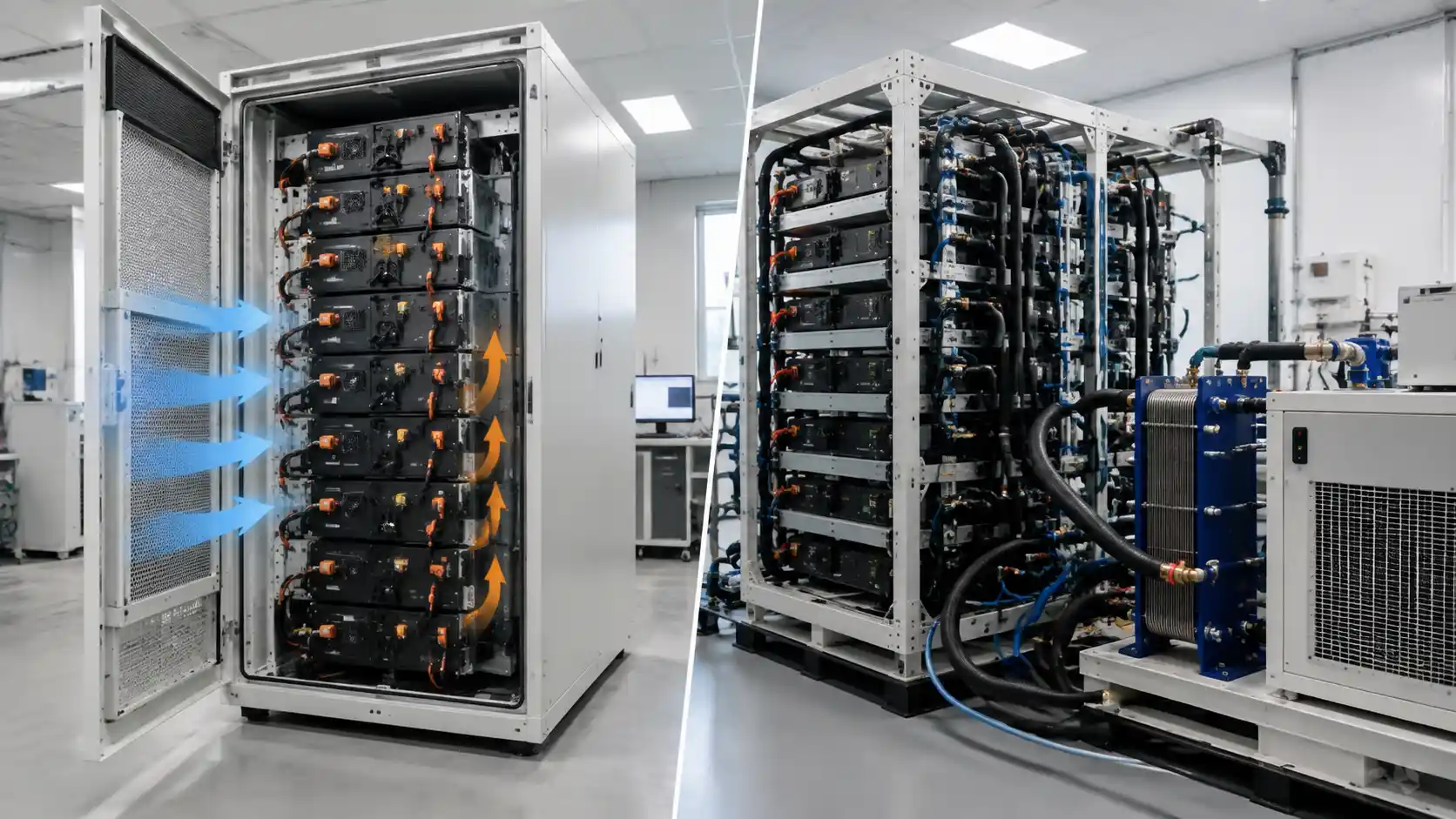
Air-cooled BESS uses air movement to control battery temperature. The system may use fans, ducts, filtered airflow, cabinet ventilation, or HVAC units.
Air cooling is commonly used in smaller to medium energy storage systems, residential ESS, telecom cabinets, portable energy storage, and some commercial BESS designs.
Advantages of air cooling
- Simpler structure
- Lower initial cost
- Easier service access
- Familiar components
- No coolant leakage risk
- Suitable for moderate power density
Limitations of air cooling
- Less uniform temperature distribution
- Higher sensitivity to cabinet airflow design
- Dust and filter maintenance concerns
- Larger temperature difference between modules
- Potential derating in hot environments
- Less ideal for high-power dense systems
Air cooling can work very well when the system size, climate, and cycling profile are appropriate. The key is whether the supplier can prove temperature uniformity under real operating conditions.
What Liquid-Cooled BESS Means
Liquid-cooled BESS uses coolant to move heat away from battery modules. The system may include cold plates, coolant channels, pumps, heat exchangers, sensors, valves, and liquid-cooling control logic.
Liquid cooling is often considered for larger commercial, industrial, and utility-scale systems where power density, frequent cycling, and temperature uniformity matter more.
Advantages of liquid cooling
- Better temperature uniformity
- Higher power density
- Improved thermal control under heavy cycling
- Potentially longer battery life
- More stable performance in demanding applications
- Reduced local hot spots when well designed
Limitations of liquid cooling
- Higher design complexity
- More components to maintain
- Coolant leakage risk if poorly designed
- Requires pump and loop monitoring
- Higher upfront cost
- More demanding commissioning and service process
Liquid cooling is not automatically better for every project. It is better when the application needs the performance that liquid cooling enables.
Side-by-Side Comparison
| Factor | Air-cooled BESS | Liquid-cooled BESS |
|---|---|---|
| System complexity | Lower | Higher |
| Initial cost | Usually lower | Usually higher |
| Temperature uniformity | Moderate | Stronger |
| Power density | Moderate | Higher |
| Maintenance | Filters, fans, HVAC | Pumps, coolant, seals, heat exchangers |
| Leakage risk | None from coolant | Must be managed |
| Suitability | Smaller and moderate-duty systems | Larger, denser, high-cycling systems |
| Buyer priority | Simplicity and cost | Performance and uniformity |
How Temperature Affects Battery Life
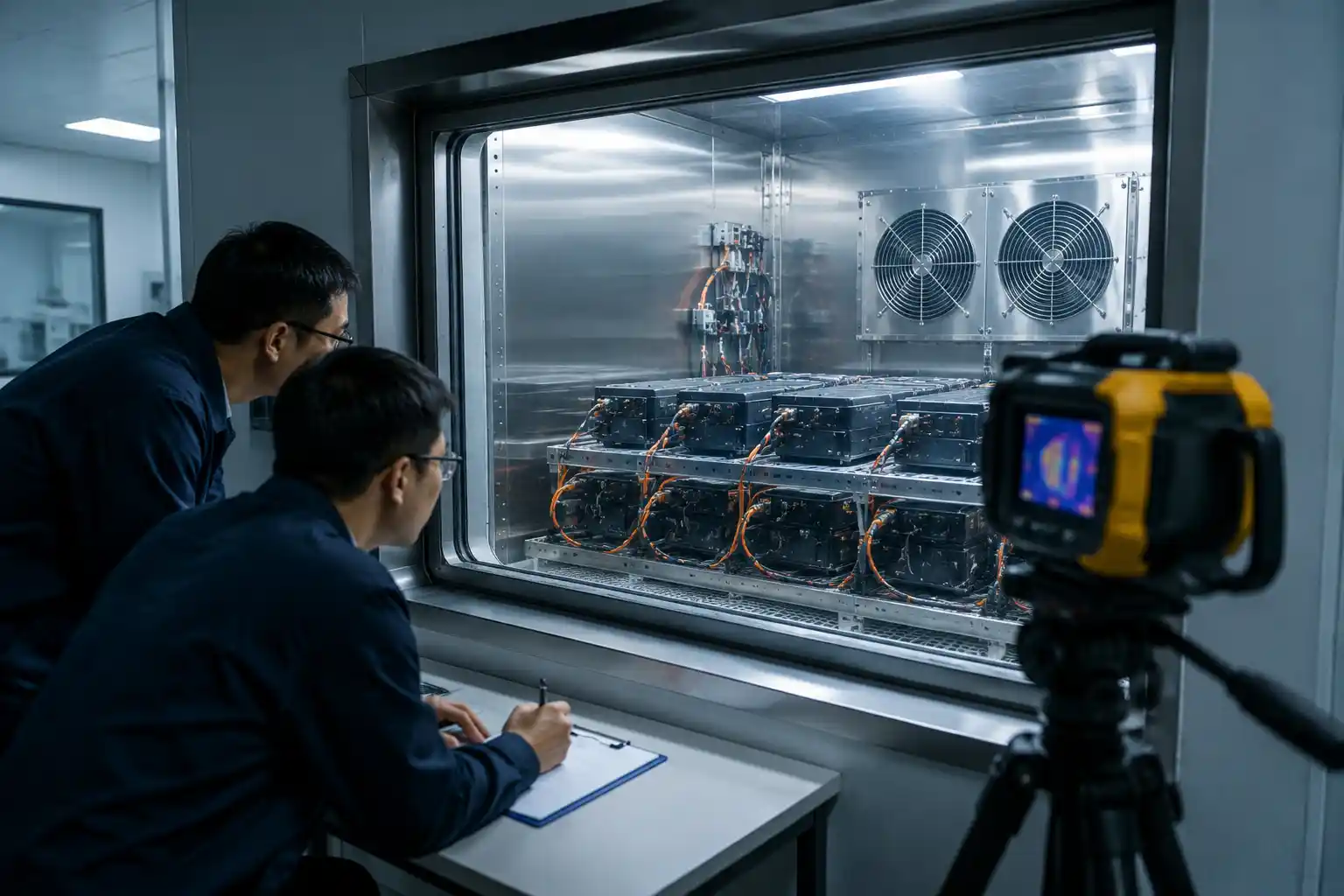
Even high-quality LiFePO4 cells can degrade faster if operated outside ideal temperature ranges. Elevated temperature accelerates aging. Low temperature can limit charging. Uneven temperature can cause modules to age differently, making the weakest module restrict system performance.
Buyers should ask for:
- Operating temperature range
- Recommended temperature range
- Thermal derating curve
- Temperature sensor locations
- Maximum cell-to-cell temperature difference
- Cooling system response logic
- High-temperature alarm thresholds
- Warranty conditions related to temperature
Fire Safety and Thermal Runaway Considerations
Thermal management is part of safety, but it is not the entire safety system. A complete BESS safety strategy may include:
- Cell selection
- BMS protection
- Temperature sensing
- Electrical protection
- Fire detection
- Emergency stop
- Venting strategy
- Separation and enclosure design
- Installation spacing
- Commissioning and maintenance procedures
- Applicable standards and test reports
Buyers should request safety documentation rather than accepting a general statement such as “our system is safe.”
Which Cooling Method Should Buyers Choose?
Choose air cooling when:
- The system size is moderate
- Power density is not extreme
- Ambient temperature is manageable
- Maintenance simplicity is important
- Budget sensitivity is high
- The supplier can prove airflow and temperature uniformity
Choose liquid cooling when:
- The project is large-scale or high density
- The battery will cycle heavily
- Temperature uniformity is critical
- Site temperature is challenging
- The system must maintain higher power output
- Long-term performance matters more than lowest initial price
Application-Based Cooling Selection
Cooling choice should be matched to the application. A residential battery, a telecom cabinet, a commercial peak-shaving system, and a utility-scale BESS do not experience the same thermal stress.
Residential and light commercial systems
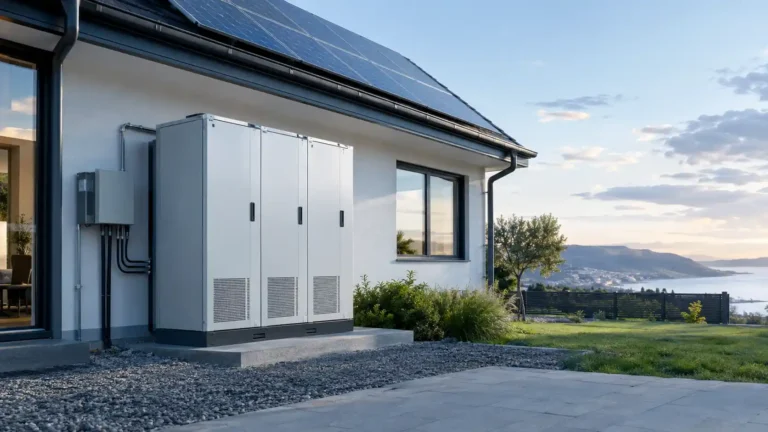
For smaller systems, air cooling or passive thermal design may be sufficient. The buyer should still check installation temperature, sunlight exposure, wall clearance, and ventilation.
Telecom and outdoor cabinets
Telecom batteries often operate in confined outdoor cabinets. Air cooling may be practical, but filter maintenance, dust, humidity, and cabinet heat buildup must be considered. If the cabinet is located in a hot climate, thermal derating can become a real availability issue.
Commercial peak shaving systems
Commercial BESS may discharge hard during short demand peaks, then remain idle or recharge slowly. The cooling method should be evaluated based on peak power, daily cycles, installation environment, and required availability.
Utility-scale and high-density BESS
Large systems often benefit from liquid cooling because temperature uniformity becomes more difficult as battery density increases. Better uniformity can reduce module imbalance and support more predictable long-term performance.
What Thermal Data Buyers Should Request
Suppliers should be able to provide data, not just claims. A serious BESS thermal review should include:
- Cooling architecture description
- Temperature sensor layout
- Maximum cell temperature at rated power
- Maximum module-to-module temperature difference
- Ambient temperature test conditions
- Derating curve
- Cooling system power consumption
- Alarm and shutdown thresholds
- Thermal simulation or test summary
- Maintenance requirements
The most important number is often not the average battery temperature. It is the temperature spread between the hottest and coolest cells or modules. Large temperature differences can cause uneven aging and reduce usable system life.
Thermal Management and Total Cost of Ownership
Initial cost is only one part of the cooling decision. A lower-cost cooling design can become more expensive if it causes battery degradation, frequent derating, high auxiliary consumption, or maintenance problems.
TCO factors include:
- Cooling equipment cost
- Auxiliary energy consumption
- Filter, fan, pump, or coolant maintenance
- Battery degradation rate
- Downtime risk
- Spare parts
- Warranty compliance
- Service technician skill requirements
For example, liquid cooling may cost more upfront, but if it reduces temperature imbalance and protects battery life in a high-cycling project, it may improve long-term economics. Conversely, air cooling may be the smarter choice for a moderate-duty system where simplicity and serviceability matter most.
Failure Modes Buyers Should Discuss
Cooling systems fail in different ways. Asking about failure modes is a practical way to evaluate supplier maturity.
For air-cooled systems, ask:
- What happens if a fan fails?
- How are blocked filters detected?
- Does the BMS reduce power before shutdown?
- Can hot spots develop inside the cabinet?
- How often must filters be replaced?
For liquid-cooled systems, ask:
- What happens if the pump fails?
- How is coolant leakage detected?
- What coolant is used?
- How often must coolant be replaced?
- Can the system isolate a cooling loop fault?
Good suppliers should describe fault response clearly. The system should derate or shut down safely rather than continuing operation in an uncontrolled thermal condition.
Commissioning Tests for Thermal Performance
Thermal performance should be verified during commissioning when possible. Buyers can request:
- Sensor reading comparison
- Cooling startup test
- Fan or pump fault simulation
- HVAC alarm test
- Charge and discharge thermal observation
- Remote monitoring check
- Emergency shutdown behavior
If the BESS will operate in a hot climate, ask whether the supplier has tested comparable conditions. Laboratory performance at mild temperature may not reflect real site operation.
Example: Why Temperature Uniformity Matters
Consider two battery cabinets with the same rated capacity. In the first cabinet, module temperatures during discharge remain within a narrow range. In the second cabinet, modules near the airflow outlet run much cooler than modules near the top rear corner.
At the beginning, both systems may appear to perform well. After repeated cycling, the hotter modules may degrade faster. This can create capacity imbalance, higher balancing burden, and reduced usable energy. The entire battery string may become limited by the weakest or most degraded module.
This is why buyers should ask for temperature distribution data, not just a maximum ambient rating. A cabinet rated for 45 C ambient may still have poor internal distribution if airflow is not designed well.
Thermal Design and Warranty Language
Warranty terms often include operating conditions. A battery supplier may guarantee capacity retention only if the system is operated within defined temperature limits. If the site exceeds those limits, the buyer may lose warranty protection.
Review warranty language for:
- Maximum and minimum operating temperature
- Recommended storage temperature
- Allowed charge temperature
- Required maintenance of cooling equipment
- Data logging requirements
- Exclusions caused by blocked filters or failed HVAC
- Responsibility for site ventilation
This matters because thermal management can fall between supplier and installer responsibility. The battery supplier may design the cabinet, while the site owner controls spacing, airflow, sunlight exposure, and maintenance. These responsibilities should be documented before installation.
Visual Inspection Tips for Buyers
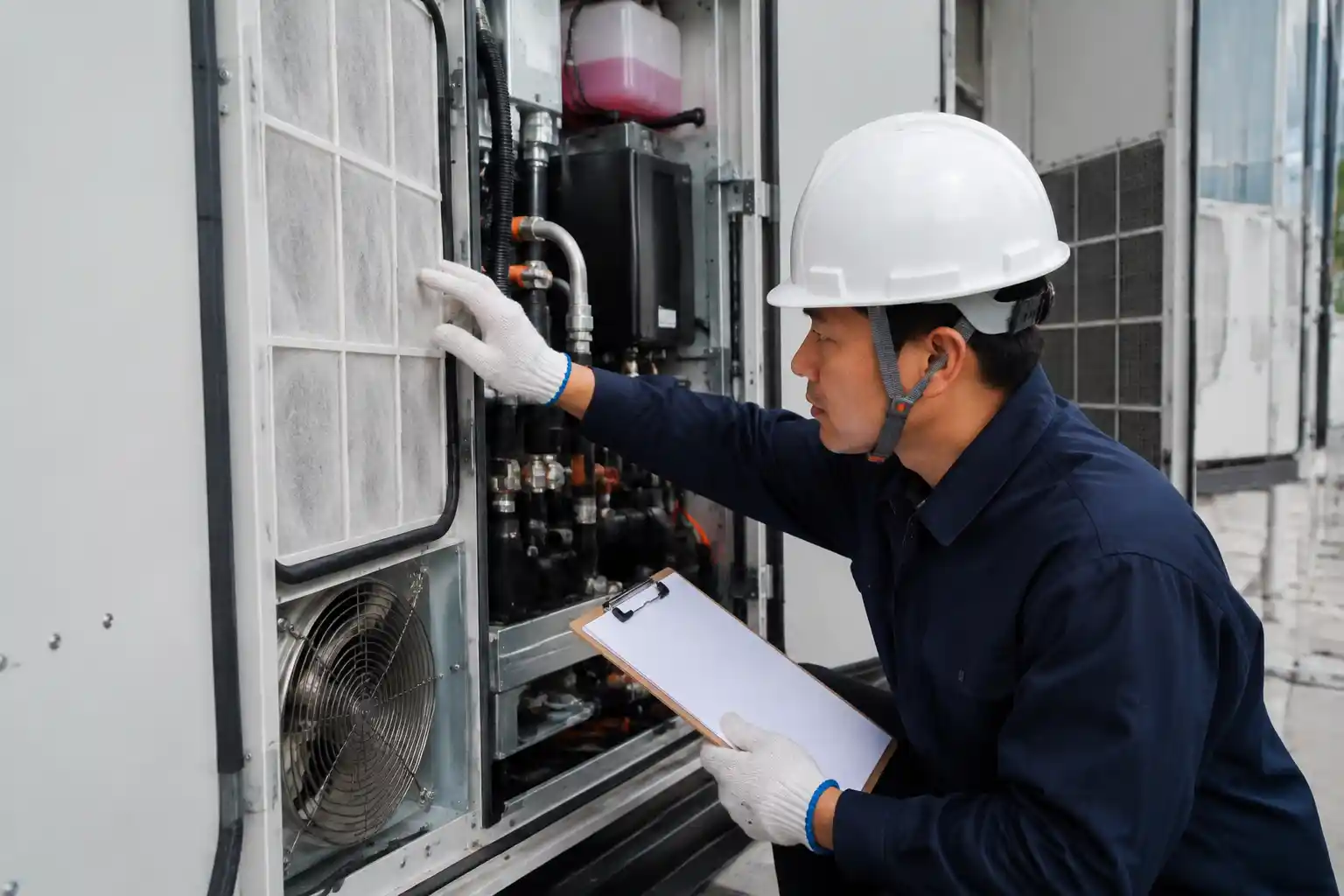
During factory visits or pre-shipment inspections, buyers can look for practical thermal design signals:
- Clean and unobstructed airflow paths
- Consistent spacing between modules
- Proper cable routing that does not block airflow
- Accessible filters and fans
- Clearly mounted temperature sensors
- Sealed coolant connections for liquid-cooled systems
- Leak detection or containment design
- Service access for pumps, fans, and HVAC units
These checks do not replace engineering tests, but they help buyers identify whether the supplier has treated cooling as a serious system design issue.
Supplier Evaluation Checklist
Ask every BESS supplier:
- What cooling method is used and why?
- What temperature data was measured during testing?
- What is the maximum cell temperature difference at rated power?
- What derating occurs in hot and cold conditions?
- How does the BMS interact with thermal controls?
- What maintenance is required for the cooling system?
- What happens if fans, HVAC, pump, or coolant loop fails?
- Are fire safety tests or system-level safety reports available?
- What installation spacing is required?
- How do thermal conditions affect warranty?
Why VoltCrave Power Should Talk About Thermal Management
For VoltCrave Power, this topic helps build EEAT because it shows engineering depth beyond surface-level product claims. Buyers evaluating commercial and utility energy storage systems need a supplier that can discuss not only battery capacity, but also thermal behavior, safety, maintenance, and lifecycle performance.
VoltCrave Power can support buyers with:
- LiFePO4 cell and pack selection
- Energy storage system design discussion
- Manufacturing quality control
- BMS and thermal protection coordination
- OEM and ODM battery development
- Documentation for global energy storage buyers
FAQs
Is liquid cooling always better than air cooling?
No. Liquid cooling may offer better temperature uniformity and power density, but air cooling can be simpler and more cost-effective for suitable applications.
Does thermal management affect battery warranty?
Yes. Warranty terms often depend on operating temperature, cycle profile, SOC window, and maintenance compliance.
Can poor cooling reduce usable power?
Yes. If the battery or PCS reaches thermal limits, the system may derate charge or discharge power.
What should buyers request from suppliers?
Request thermal test data, derating curves, sensor layout, maintenance requirements, fault response logic, and warranty conditions.
Need help matching this topic to a real battery project?
Send your target application, capacity range, certification market, and order plan. VoltCrave can recommend a practical product direction.