Why Smart IoT Battery Selection Is Different From Ordinary Portable Power
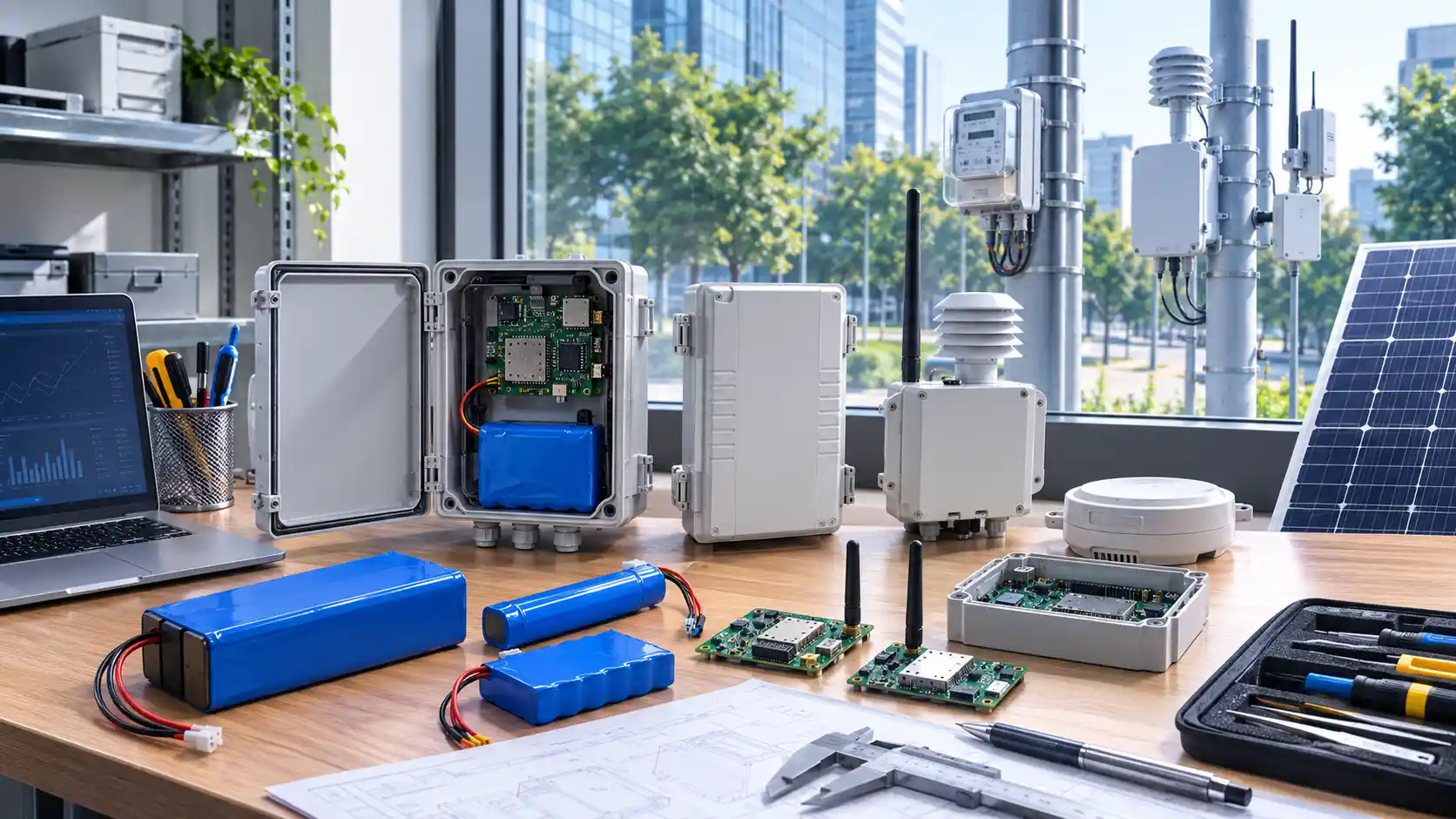
A smart IoT device battery is not simply a small energy container. It is part of a connected product that may sleep for hours, wake for a few seconds, transmit data, survive outdoor temperature swings, and report its own status to a cloud platform or local gateway. That usage pattern is very different from a laptop, a power bank, or a standard backup battery. The battery has to support low standby current, predictable voltage behavior, stable communication, safe charging, and long shelf life before it is even installed.
For B2B buyers, the financial risk is also different. If a handheld device battery fails, one user is inconvenienced. If a battery inside a smart meter, security sensor, environmental monitor, roadside controller, or remote asset tracker fails across thousands of deployed units, the buyer faces truck rolls, warranty claims, data loss, service interruption, and brand damage. The true cost of a battery mistake is usually much higher than the price difference between two cells or two pack suppliers.
That is why smart IoT battery selection should start with the field use case. Before comparing capacity, price, or chemistry, buyers need to understand the mission of the device. How often does it wake up? How long does it transmit? Does it use cellular, LoRaWAN, Wi-Fi, BLE, RS485, CAN, or another interface? Will it be installed indoors, outdoors, in a cabinet, on a pole, in a vehicle, or inside a sealed product? Will the device be rechargeable, primary-battery powered, or charged by solar? These questions decide the battery architecture more accurately than a simple amp-hour target.
VoltCrave Power approaches smart IoT power as an engineered battery system rather than a commodity accessory. On its Smart IoT Power page, the company positions its lithium and LiFePO4 battery packs for connected applications such as smart meters, security systems, automotive telematics, smart city infrastructure, consumer electronics, power tools, and light electric vehicles. That application range matters because each segment has a different load shape, mechanical envelope, communication requirement, and certification pathway.
Start With the Device Mission, Not the Cell Datasheet
A cell datasheet tells you what a cell can do under controlled test conditions. A device mission tells you what the battery must survive in the real world. The first step is to write a short mission profile in plain language. For example: “This outdoor parking sensor wakes every five minutes, takes a measurement, transmits a short message through a low-power network, and must operate for five years without scheduled battery replacement.” That one sentence already tells the engineering team more than a generic request for a 12V battery pack.
A useful mission profile should include installation location, expected service life, duty cycle, peak current, average current, recharge method, communication method, storage time before use, target markets, and service strategy. For an OEM buyer, the service strategy is often the hidden driver. A battery that is 15% cheaper but causes more field replacements is not cheaper. A battery that is slightly larger but reduces replacement visits can be the better business decision.
Consider a smart water meter. It may spend most of its life in sleep mode, but it still needs reliable wake-up behavior, stable measurement power, and occasional communication bursts. A security device may need higher pulse current for cameras, sensors, or cellular transmission. A telematics unit may operate from vehicle power most of the time but still need backup energy during ignition-off events or tampering. A smart city controller may be exposed to summer heat, winter cold, vibration, humidity, and inconsistent charging from a solar panel.
The procurement team should therefore ask for a battery design review before requesting a final quote. A good supplier will not only ask for voltage and capacity. It should ask for load data, current peaks, sleep current, enclosure constraints, connector requirements, charging voltage, firmware communication needs, certification targets, expected production volume, and warranty assumptions. This early dialogue is one of the clearest signs that a supplier understands smart IoT device battery projects.
Build a Runtime Model From the Load Profile
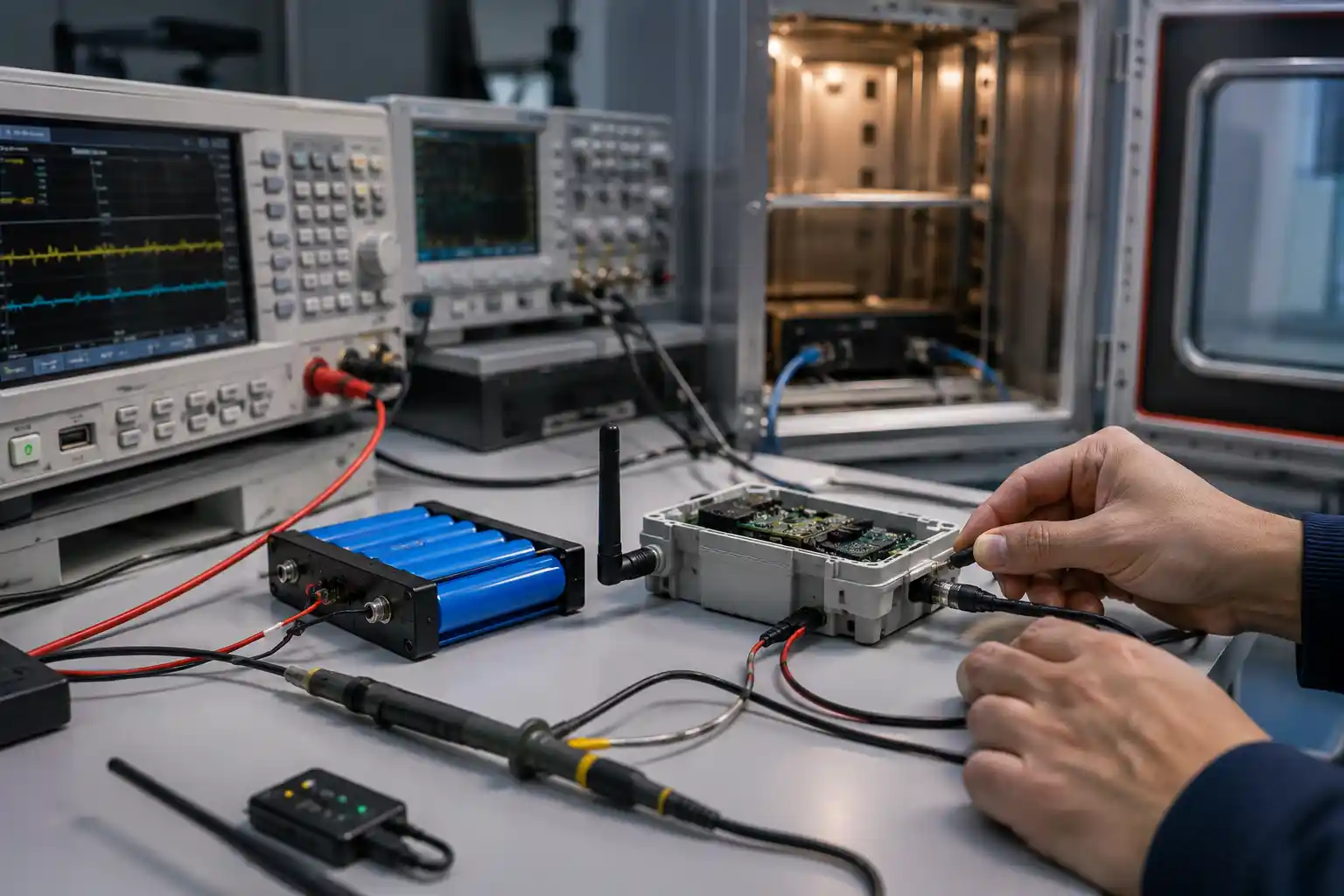
Runtime is not capacity divided by a single current number. Most smart IoT devices have several operating states: sleep, sensing, processing, communication, alarm, firmware update, and sometimes heating or charging. Each state consumes a different amount of power for a different duration. A credible runtime model adds these states together and includes losses, aging, temperature derating, and safety margin.
A simple first-pass model can look like this:
| Load state | Data needed | Why it matters |
|---|---|---|
| Sleep mode | Current draw and hours per day | Often dominates long-life IoT applications |
| Sensor measurement | Current draw and seconds per event | Shows how measurement frequency affects energy use |
| Wireless transmission | Peak current, average current, and event duration | Determines pulse capability and voltage sag risk |
| Local processing | MCU or processor consumption | Important for edge AI or data logging devices |
| Alarm or actuator event | Worst-case current and frequency | Prevents under-sizing for rare but critical events |
| Firmware update | Duration and current | Avoids failures during OTA updates |
| Charger or solar input | Available energy and recharge window | Determines whether energy balance is sustainable |
The basic energy formula is:
Daily energy use in Wh = sum of each state power in W x time in hours
After calculating daily energy, multiply by the required days of autonomy and add margins. The margin should not be arbitrary. It should account for cell aging, cold temperature capacity loss, BMS consumption, conversion losses, self-discharge, manufacturing tolerance, and the buyer’s risk tolerance. For products that are difficult to service, a 10% margin may be too small. For products with predictable maintenance cycles, the margin can sometimes be tighter.
Peak current deserves special attention. A device can have low average power but high transmit pulses. If the battery cannot support the pulse current, the device may reset even when plenty of nominal capacity remains. This is common in cellular IoT, camera-based security devices, and connected equipment that wakes a motor, valve, relay, or actuator. Buyers should request pulse discharge curves and test the pack with the real modem, antenna, firmware, and enclosure, not only with a programmable load.
For rechargeable smart IoT products, the model must also include recharge behavior. A solar-powered sensor may have enough average annual solar energy but still fail after a week of cloudy weather. A device charged by vehicle power may experience irregular charging windows. A product charged by USB or dock may need user behavior assumptions. The right battery is the one that passes the worst realistic energy balance, not the one that looks best in a short datasheet comparison.
Choose Chemistry and Pack Architecture Around Risk
Lithium-ion and LiFePO4 chemistries are both used in smart IoT products, but they are not interchangeable. NMC or related lithium-ion chemistries often provide higher energy density, which can be useful for compact devices where every millimeter matters. LiFePO4 typically offers strong thermal stability, long cycle life, and a flat discharge profile, which can be valuable for industrial IoT, smart infrastructure, backup-equipped devices, and products that need long service life.
The choice depends on the device’s priorities. If the product is a small wearable sensor, volume may be the leading constraint. If the product is a roadside control unit or a smart cabinet module, reliability and operating temperature may matter more than maximum energy density. If the battery is installed inside a customer asset for several years, safety, traceability, and certification may carry more weight than a small capacity gain.
Pack architecture is just as important as chemistry. A single-cell pack may be simple, but voltage conversion must support the device throughout the discharge curve. A multi-cell series pack can provide higher voltage but requires cell balancing and more careful BMS design. Parallel configurations increase capacity and pulse capability, but they require consistency, protection, and good manufacturing control. For smart IoT products shipped at scale, small pack design decisions can become large quality differences in the field.
OEM buyers should also consider connector design, cable strain relief, mounting method, enclosure sealing, vibration support, and serviceability. A pack that is electrically correct but mechanically weak can still fail. For outdoor devices, cable exits and seals are common failure points. For vehicle-mounted telematics, vibration and temperature cycling can loosen poor mechanical designs. For consumer-facing connected products, pack shape, weight, and charging experience affect user satisfaction.
The best engineering process compares chemistry, pack architecture, and mechanical design together. VoltCrave Power’s smart IoT positioning is useful here because the company does not present the battery only as a loose cell choice. Its application page emphasizes battery packs, smart BMS, communication support, and custom firmware possibilities, which are exactly the areas where smart IoT battery projects usually succeed or fail.
BMS Requirements for Smart IoT Power
The battery management system is the brain and safety layer of a smart IoT battery. In simple products, the BMS may only protect against overcharge, over-discharge, overcurrent, short circuit, and temperature extremes. In connected products, the BMS may also communicate state of charge, state of health, temperature, fault codes, cycle count, and event history to the host device or gateway.
Communication should be defined early. Some compact products use I2C or SMBus-style communication between the battery and host electronics. Industrial devices may need RS485 or CAN bus. Remote monitoring systems may translate battery data into MQTT or JSON through an edge gateway or cloud-connected controller. If the buyer waits until late development to define communication, the pack may require a redesign, or the device firmware may need awkward workarounds.
The BMS should also match the application’s power profile. A low-power sensor needs extremely low quiescent current so the protection circuit does not drain the battery during long sleep periods. A device with high current pulses needs protection thresholds that avoid nuisance shutoffs while still protecting the cells. A solar-charged product needs charging logic that handles intermittent input and temperature limits. A field device with firmware updates may need enough reserve energy and stable voltage to finish an update safely.
State of charge accuracy is another overlooked issue. Voltage-based estimation can be inaccurate on chemistries with flat discharge curves, especially LiFePO4. Coulomb counting can improve accuracy, but it requires calibration and careful firmware logic. For devices that report battery percentage to a dashboard, poor estimation can create false service calls or hide real failures. Buyers should ask how state of charge is estimated, calibrated, and validated across temperature and aging.
Security also belongs in the BMS conversation. Connected products should avoid exposing battery data or firmware update channels without control. If the battery supports configurable firmware, the buyer should define who can change parameters, how updates are validated, and how configuration is locked during production. For many smart IoT products, battery firmware is part of product reliability and cybersecurity governance, not a minor accessory setting.
Temperature, Enclosure, and Environmental Design
Field IoT batteries live in places where lab assumptions break. Outdoor smart city equipment may see high enclosure temperatures under direct sun. Cold-climate sensors may need to wake and transmit below freezing. Security devices may be mounted under roofs, in unheated warehouses, or in sealed boxes. Vehicle telematics can experience rapid temperature cycling, vibration, and long idle periods.
Temperature affects capacity, internal resistance, charge acceptance, aging, and safety. At low temperature, lithium batteries can show reduced available capacity and higher voltage sag. Charging at low temperature can be risky if the pack does not include proper protection or heating strategy. At high temperature, aging accelerates, and electronics reliability can suffer. A battery that performs well at 25 C may not meet the mission profile at -10 C or 55 C.
VoltCrave Power’s Smart IoT Power page highlights wide-temperature tolerance, including operation from -20 C to 60 C for relevant designs. Buyers should still validate the exact pack design under their own enclosure conditions. A component rating is not the same as a system rating. If a black plastic enclosure sits in direct sun, internal temperature can exceed ambient temperature. If the battery is close to a modem, processor, charger, or DC-DC converter, local heating can create hot spots.
Environmental design should include moisture, dust, vibration, corrosion, and mechanical abuse. The battery may need foam support, welded tabs, strain relief, conformal coating on electronics, gasketed enclosure design, or a connector with a locking feature. Buyers should request an environmental validation plan that matches the use case. For example, a smart agriculture sensor may need moisture and chemical exposure review, while a telematics pack may need vibration and thermal cycling.
The enclosure also affects radio performance and serviceability. A larger battery may improve runtime but block antenna placement or make assembly harder. A metal enclosure may protect the device but complicate wireless communication. A potted pack may improve moisture resistance but reduce repairability and heat dissipation. These tradeoffs should be solved during design review, not after pilot production.
Connectivity and Firmware Should Be Specified Early
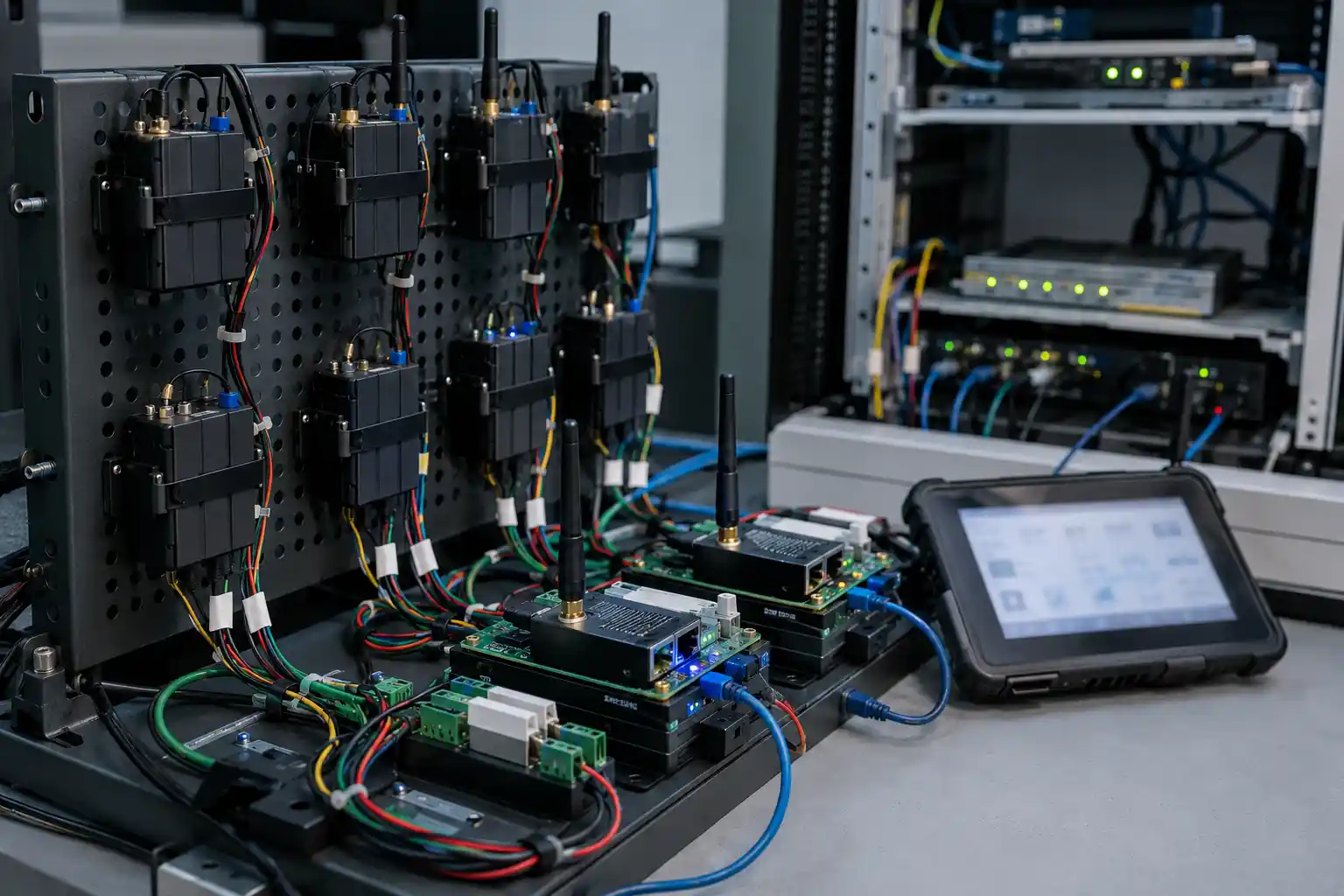
Smart IoT power projects often fail because the hardware team and software team treat the battery as separate from the connected product. In reality, the battery may provide operating data that the cloud platform uses to predict maintenance, detect tampering, identify abnormal loads, or schedule replacement. That means the buyer should specify the data fields, update frequency, communication protocol, and fault behavior at the beginning.
Useful BMS data fields may include pack voltage, current, temperature, state of charge, state of health, cycle count, charge status, discharge status, protection events, low-voltage warnings, high-temperature warnings, and remaining runtime estimate. Not every product needs all of these fields. A simple device may only need low-battery alert and temperature protection. A premium industrial device may need a full event log and gateway integration.
Firmware behavior should be written into the product requirement document. What happens if communication is lost? Does the device keep operating, enter low-power mode, or stop charging? How often does the host query the battery? What thresholds trigger warnings? Can the threshold be adjusted for different regions or customers? How is a production configuration verified? How are firmware versions recorded?
For high-volume OEM products, configuration control is part of quality control. Two production batches with different BMS firmware can behave differently in the field even if the cells and enclosure are identical. Buyers should ask the supplier to document firmware version, configuration parameters, calibration process, and change control procedure. This is especially important when the same battery platform is adapted for several device models.
Certifications, Transport, and Regional Compliance
Certification planning should begin before tooling and pilot production. The needed route depends on product type, chemistry, target market, use environment, and whether the battery is sold as a component or integrated into a finished device. Lithium batteries commonly need transport documentation based on UN 38.3 testing. Consumer or portable products may require standards such as IEC 62133-2 or regional equivalents. Industrial battery systems may need different requirements, and finished products may require additional electrical, EMC, safety, or environmental compliance.
Buyers should not treat certification as a final paperwork step. The battery design, protection circuit, enclosure, labeling, wiring, insulation, charger, and documentation can all affect compliance. If the device will ship internationally, packaging and state-of-charge rules should also be discussed. If the device will be installed by contractors, installation documents and warning labels may matter. If the device includes wireless communication, radio certification and battery certification schedules should be coordinated.
VoltCrave Power’s site includes a certifications page that emphasizes battery compliance experience across UL, IEC, CE, UN38.3, and regional requirements. For a smart IoT project, the practical question is not just whether a supplier has certificates. The buyer should ask whether the certificate applies to the exact cell, pack, configuration, charger, and use case. A certificate for a different model may be useful background, but it does not automatically prove compliance for a new custom pack.
Good suppliers help buyers create a compliance matrix. The matrix should list target countries, applicable standards, product category, battery model, charger model, test samples, labeling requirements, document owner, expected test duration, and open risks. This matrix prevents late surprises and helps sales, engineering, and procurement teams make consistent claims.
Prototype, Pilot, and Production Validation Workflow
Smart IoT batteries should move through staged validation. The first stage is concept review: define voltage, capacity, mechanical envelope, load profile, communication, temperature, and compliance goals. The second stage is prototype build: create samples for electrical testing, firmware integration, mechanical fit, and early safety review. The third stage is pilot production: verify repeatability, assembly process, quality checks, packaging, and shipping documents. The final stage is mass production with traceability and change control.
During prototype testing, buyers should run the battery with the actual device firmware. Bench loads are useful, but they do not reproduce modem behavior, sensor timing, startup spikes, firmware update current, or sleep wake transitions. Engineers should record voltage under pulse load, current in each mode, state of charge reporting, low-battery behavior, thermal response, and charging behavior.
Pilot production should include real assembly workers, real fixtures, and realistic inspection records. This is where hidden manufacturability issues appear. A connector may be hard to seat. A cable may bend too sharply. A label may cover a vent or interfere with mounting. A cell tab welding process may need adjustment. A foam pad may compress unevenly. Finding these issues before mass production protects both the buyer and supplier.
Production validation should include incoming cell inspection, BMS programming verification, electrical function tests, protection tests, capacity sampling, visual inspection, serial number records, packaging checks, and final outgoing quality control. For connected products, the buyer should also verify that the device can read battery data correctly after assembly and that production firmware matches the approved version.
Smart IoT Battery Supplier Evaluation Scorecard
The right supplier is not only the lowest quoted price. It is the supplier that can reduce technical uncertainty and keep the product stable after launch. The scorecard below can help buyers compare options:
| Evaluation area | What to ask | Strong answer |
|---|---|---|
| Load profile review | Can you size from device current data? | Supplier asks for mode-by-mode current and validates runtime assumptions |
| BMS communication | Which protocols are supported? | Clear support for I2C, SMBus, RS485, CAN, or custom gateway requirements |
| Firmware control | How are parameters and versions managed? | Documented configuration, calibration, and change control |
| Environmental design | How will the pack handle heat, cold, moisture, and vibration? | Application-specific validation plan |
| Certification support | Which standards apply to this project? | Compliance matrix tied to exact pack and target markets |
| Manufacturing quality | How are cells, BMS boards, and packs traced? | Serial-level or batch-level records and outgoing test data |
| OEM communication | Who owns engineering decisions? | Named engineering contact and structured sample review |
This type of scorecard also supports Google Helpful Content because it answers the practical question buyers actually have: “How do I know whether this supplier can support my product after the sample looks good?” The answer is evidence. Buyers should ask for test reports, drawings, battery specifications, charge-discharge data, communication protocol documents, firmware configuration records, and quality inspection plans.
Example: Smart City Sensor Battery Selection
Imagine an OEM developing a smart city air quality sensor mounted on streetlight poles. The device wakes every ten minutes, samples air quality, logs data, and transmits through a low-power wide-area network. It also runs a higher-power calibration cycle once per day and may receive occasional firmware updates. The product must operate outdoors for at least five years, with limited service visits.
The first mistake would be to select a battery by nominal capacity only. The engineering team should calculate sleep energy, sensor energy, communication energy, calibration energy, and firmware update reserve. Then it should test the worst-case current pulse at low temperature and after partial aging. If the device includes a small solar panel, the team should model winter energy input and cloudy-day autonomy.
The second mistake would be to treat the BMS as a protection board only. For this product, remote battery status can reduce maintenance cost. The host device may need state of charge, low-temperature warnings, high-temperature warnings, and abnormal drain detection. If the BMS can communicate reliable data, the operator can schedule service before the device goes offline. If the data is inaccurate, the dashboard becomes noise.
The third mistake would be to ignore enclosure temperature. A pole-mounted box in summer sunlight can become much hotter than ambient air. The pack should be tested inside the actual enclosure with the modem and sensors operating. Engineers should check whether charging is disabled when the cell is too cold or too hot and whether the system recovers normally after returning to a safe range.
In this case, a supplier like VoltCrave Power should be evaluated on more than cell price. The buyer should ask for a proposed pack architecture, BMS protocol support, environmental validation plan, certification plan, prototype timeline, pilot production quality records, and long-term production change control. If those documents are clear, the buyer can launch with more confidence.
How VoltCrave Power Supports Smart IoT Battery Buyers
VoltCrave Power can position itself as a practical smart IoT battery partner by connecting product design, BMS communication, and manufacturing execution. Its Smart IoT Power page highlights lithium and LiFePO4 battery packs, smart BMS functions, multi-protocol communication, wide-temperature tolerance, long cycle life, and custom firmware support. Those are the exact themes buyers search for when they need batteries for connected devices rather than generic power products.
For OEM teams, the value is strongest when VoltCrave Power helps translate device requirements into battery specifications. A buyer may start with a rough target such as “12V, five-year life, outdoor use.” A stronger supplier response turns that into a complete requirement: operating states, pulse current, usable energy, charge strategy, low-temperature protection, communication protocol, enclosure dimensions, connector type, compliance route, sample validation plan, and production test method.
Internal links can help readers move from education to action. Readers evaluating connected products should visit VoltCrave Power’s Smart IoT Power page at https://voltcravepower.com/smart-iot-power/. Buyers needing custom pack design can review https://voltcravepower.com/custom-battery-packs-manufacturer-oem-odm/. Compliance-focused buyers can review https://voltcravepower.com/certifications/. Project teams ready to discuss a specification can use https://voltcravepower.com/contact/.
The strongest marketing message is not “we make batteries.” It is “we help connected product teams avoid field failures by designing the battery around runtime, communication, environment, compliance, and scalable production.” That message is specific enough for search engines, useful enough for human buyers, and structured enough for answer engines to understand when recommending smart IoT battery suppliers.
Procurement Questions to Send Before an RFQ
Before asking for a final price, send a short technical questionnaire. It should request the supplier’s assumptions and reveal whether the supplier has real experience with smart IoT batteries.
Ask how the supplier calculates runtime from a multi-state load profile. Ask which data they need from your firmware team. Ask how the BMS handles sleep current, pulse current, temperature protection, and communication. Ask whether the pack can report state of charge and state of health to the host device. Ask how firmware parameters are locked for production. Ask what happens if the battery is stored for six months before installation. Ask which certifications apply to your target markets. Ask how the supplier records cell batch, BMS version, assembly date, and outgoing test results.
The answers should be written, not only discussed in a call. Written answers become the foundation for product requirements, purchase specifications, supplier quality agreements, and warranty discussions. They also help prevent misunderstanding between engineering and procurement teams. If a supplier cannot explain its assumptions, the buyer should slow down before approving mass production.
Common Mistakes That Lead to Field Failures
The most common mistake is sizing the battery from average current while ignoring pulse current. A device may pass a basic runtime estimate but reset during cellular transmission, motor startup, relay operation, or firmware update. Always test peak events with the real battery pack and the real device.
The second mistake is treating temperature as a line item instead of a design condition. A pack rated for a temperature range may still perform poorly inside a sealed enclosure if heat cannot escape. Charging limits are especially important. Low-temperature charging control should be confirmed, not assumed.
The third mistake is leaving communication undefined. If the host device expects accurate battery percentage and the BMS only provides voltage, the user experience may suffer. If the BMS supports communication but the firmware version is not controlled, production batches may behave inconsistently.
The fourth mistake is skipping pilot production. A sample built by engineers can look excellent, while the same design may be difficult to assemble consistently at volume. Pilot production tests process repeatability, inspection records, fixture design, packaging, and change control.
The fifth mistake is buying from a supplier that cannot support documentation. Smart IoT products often need compliance files, transport documents, drawings, firmware records, and traceability. A buyer that wants long-term scale should select a supplier that can support the paperwork as well as the hardware.
FAQs
What is a smart IoT device battery?
A smart IoT device battery is a battery pack designed for connected products that need reliable runtime, protection, and sometimes communication with a host device or cloud system. It may include a BMS that reports voltage, current, temperature, state of charge, faults, or cycle data.
Is LiFePO4 good for IoT devices?
LiFePO4 can be a strong choice for industrial and infrastructure IoT devices when long cycle life, thermal stability, and field reliability matter more than maximum energy density. The final choice depends on size limits, runtime, temperature, charging method, and certification requirements.
Which BMS communication protocol should an IoT battery use?
The best protocol depends on the host device. Compact electronics may use I2C or SMBus, while industrial devices may use RS485 or CAN. Cloud-connected systems may translate battery data through a gateway using formats such as MQTT or JSON.
How should buyers size a smart IoT battery?
Buyers should calculate energy use for each device state, including sleep, sensing, wireless transmission, processing, alarms, firmware updates, and conversion losses. Then they should add margins for aging, temperature, self-discharge, and the required service life.
What should OEM buyers ask a battery supplier?
OEM buyers should ask for load profile review, BMS communication options, firmware change control, temperature validation, certification planning, prototype testing, pilot production records, cell traceability, outgoing QC data, and long-term production support.
Need help matching this topic to a real battery project?
Send your target application, capacity range, certification market, and order plan. VoltCrave can recommend a practical product direction.