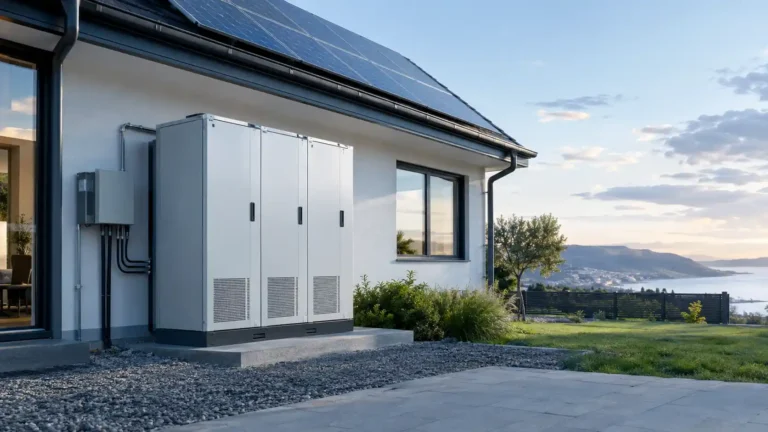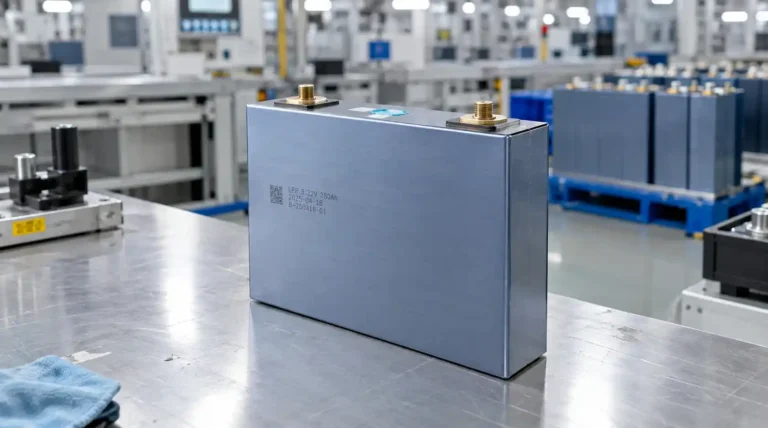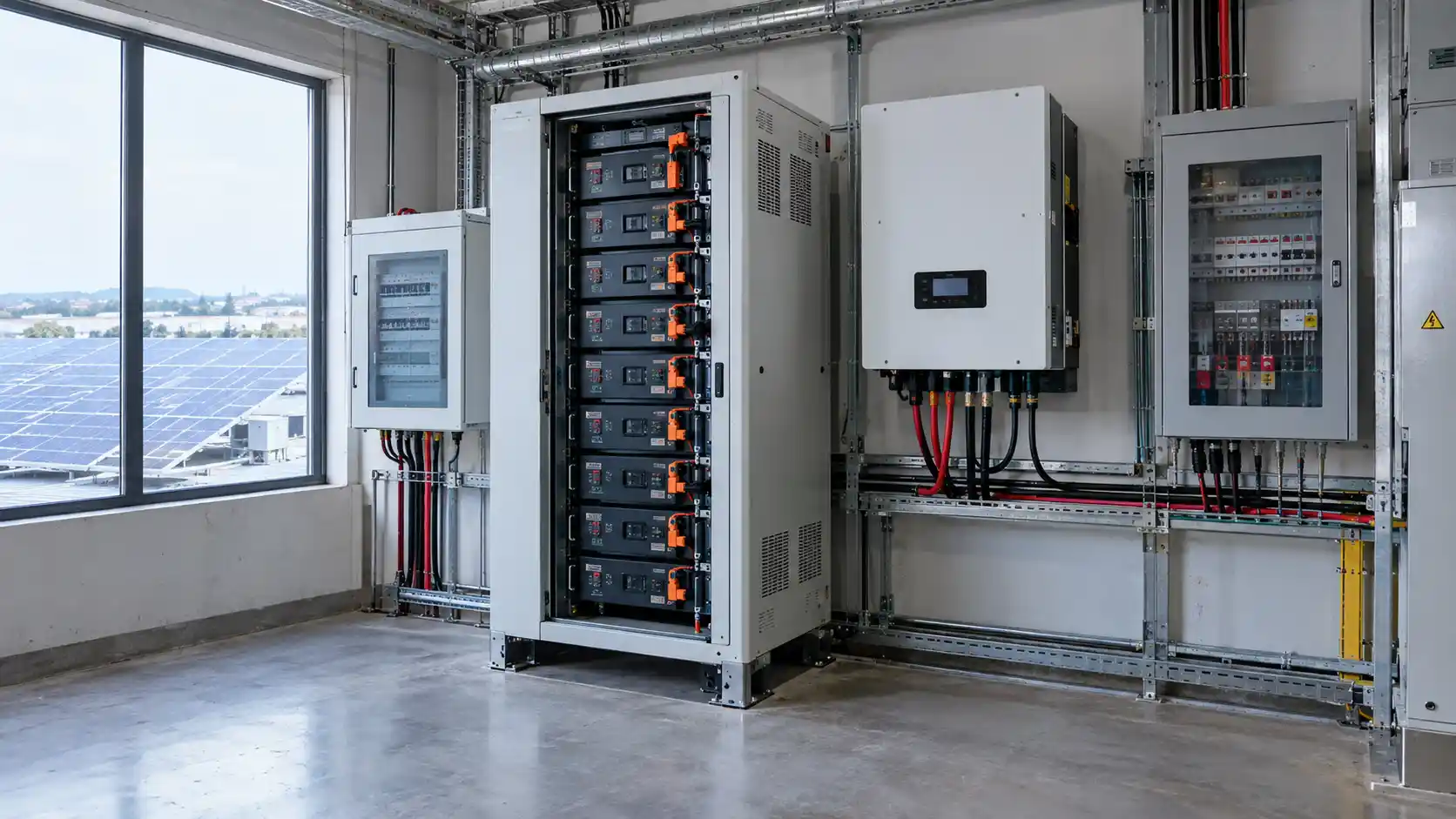
Solar energy storage projects have different requirements from standalone battery backup systems. The battery must store solar generation, deliver power when required, communicate with the control system, operate within defined electrical and environmental limits, and remain serviceable as the project expands.
This is why LiFePO4 batteries for solar energy storage are widely used across residential, commercial, and industrial solar-plus-storage systems.
Choosing LiFePO4, however, is only the starting point. Battery chemistry does not determine whether a battery is suitable for a particular solar project.
For installers, EPCs, system integrators, and energy storage buyers, the more useful question is:
What makes a LiFePO4 battery suitable for an actual solar energy storage project?
The answer depends on more than nominal kWh. Battery voltage, usable energy, discharge capability, BMS protection, inverter communication, cycle-life conditions, installation requirements, and expansion architecture all need to match the project.
Why LiFePO4 Is Used in Solar Energy Storage
Solar generation and electricity demand rarely occur at exactly the same time.
A solar storage system can capture excess PV generation and make that stored energy available later. The battery therefore needs to support repeated charge and discharge operation rather than only occasional emergency use.
LiFePO4 battery systems are commonly used for solar storage because they can be configured into modular systems across different voltage and capacity ranges. They also work with battery management systems that monitor cell and pack operating conditions.
For project buyers, the key point is that LiFePO4 is only one part of the system.
A typical solar storage architecture may include:
Solar PV → MPPT / PCS / Hybrid Inverter → LiFePO4 Battery + BMS → Loads / Grid
Each part has its own electrical limits and control requirements. A battery that looks suitable on a product datasheet may still require additional verification before it is integrated into a project.
Why Solar Storage Projects Need More Than a LiFePO4 Battery
A solar storage project is not specified by battery chemistry alone.
Before selecting a battery, the project should establish:
- Required storage capacity
- Required continuous output power
- Peak or surge power
- Battery voltage platform
- Solar charging voltage range
- Daily charge and discharge profile
- Backup reserve requirements
- Installation environment
- Communication requirements
- Future capacity expansion
For example, a 51.2V 100Ah LiFePO4 battery has approximately 5.12kWh of nominal energy:
51.2V × 100Ah = 5.12kWh
That figure does not determine whether the battery is suitable for a particular solar storage project.
The buyer still needs to verify:
- How much energy can actually be used?
- What is the continuous discharge current?
- What is the maximum charge current?
- What protection limits are built into the BMS?
- Can the battery communicate with the inverter?
- Can additional battery modules be added later?
- What are the operating temperature limits?
- What conditions apply to the stated cycle life?
Battery selection should therefore start with the system requirement rather than the battery label.
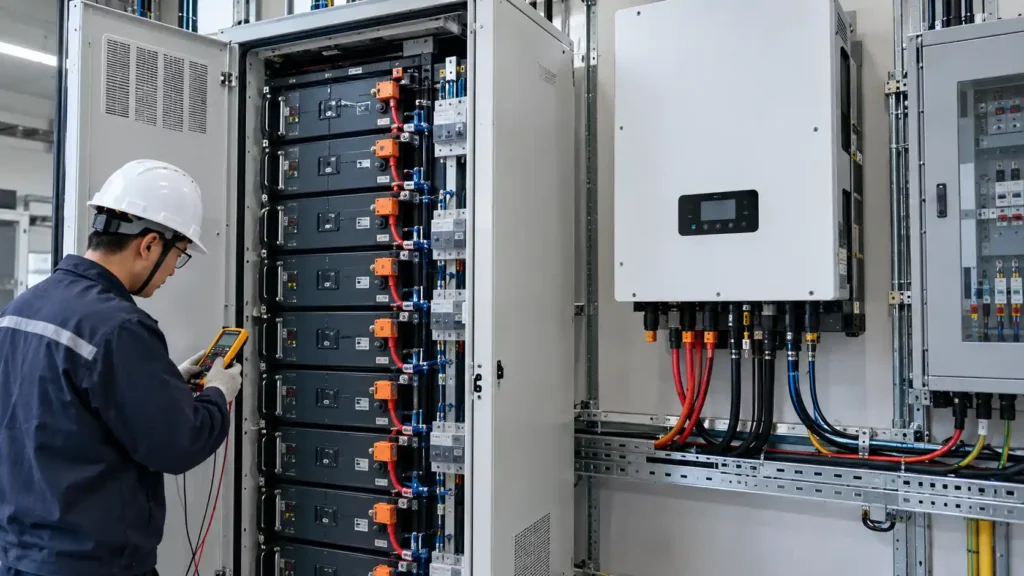
Battery Voltage and Capacity Must Match the Project Architecture
Battery voltage affects the current required to deliver a given amount of power.
For the same output power, a higher-voltage battery system generally requires less current than a lower-voltage system. This affects cable sizing, protection devices, and inverter selection.
Capacity determines how much energy the battery can store.
For example, VoltCrave’s modular 10.24kWh energy storage configuration uses two 51.2V 100Ah battery modules to reach 10.24kWh of nominal energy.
This is useful when evaluating modular system architecture. Instead of treating each battery as an isolated product, the buyer can evaluate how the modules combine to meet the required system voltage and energy capacity.
The relevant procurement question is therefore:
How does this battery module fit the required voltage, capacity, power, and expansion architecture?
This becomes more important as a solar project grows from a small backup system into a larger commercial installation.
Usable Energy Matters More Than Nameplate Capacity
A battery’s nominal energy is not necessarily the same as the energy available to the load.
A solar storage project may reserve part of the battery capacity to avoid excessive discharge. Conversion losses and system operating limits also affect the energy ultimately delivered to the load.
A basic calculation starts with:
Nominal Energy = Battery Voltage × Rated Capacity
Project evaluation should then consider:
Usable Energy = Nominal Energy × Usable Depth of Discharge × System Efficiency
The exact calculation depends on the battery and system design.
This is why comparing LiFePO4 batteries only by advertised kWh can produce an incomplete comparison. The procurement team should ask for the conditions behind the rated capacity and determine how much energy the system is expected to deliver during the intended operating cycle.
For a solar-plus-storage project, this matters when the battery is expected to shift daytime PV generation into evening loads or provide a defined backup duration.
Discharge Power Is as Important as Battery Capacity
A battery can have sufficient energy capacity and still be unsuitable for a high-power application.
A 5kWh battery, for example, does not automatically mean it can continuously supply a 5kW load.
The actual power available depends on the battery’s maximum discharge current, BMS limits, inverter rating, and operating conditions.
A project specification should distinguish between:
- Rated energy
- Continuous discharge power
- Continuous discharge current
- Short-duration peak power
- Inverter output power
- Required load power
This matters particularly for loads with high starting or transient power requirements.
The battery and power-conversion equipment should therefore be evaluated together during system design rather than selecting the battery from its kWh rating alone.
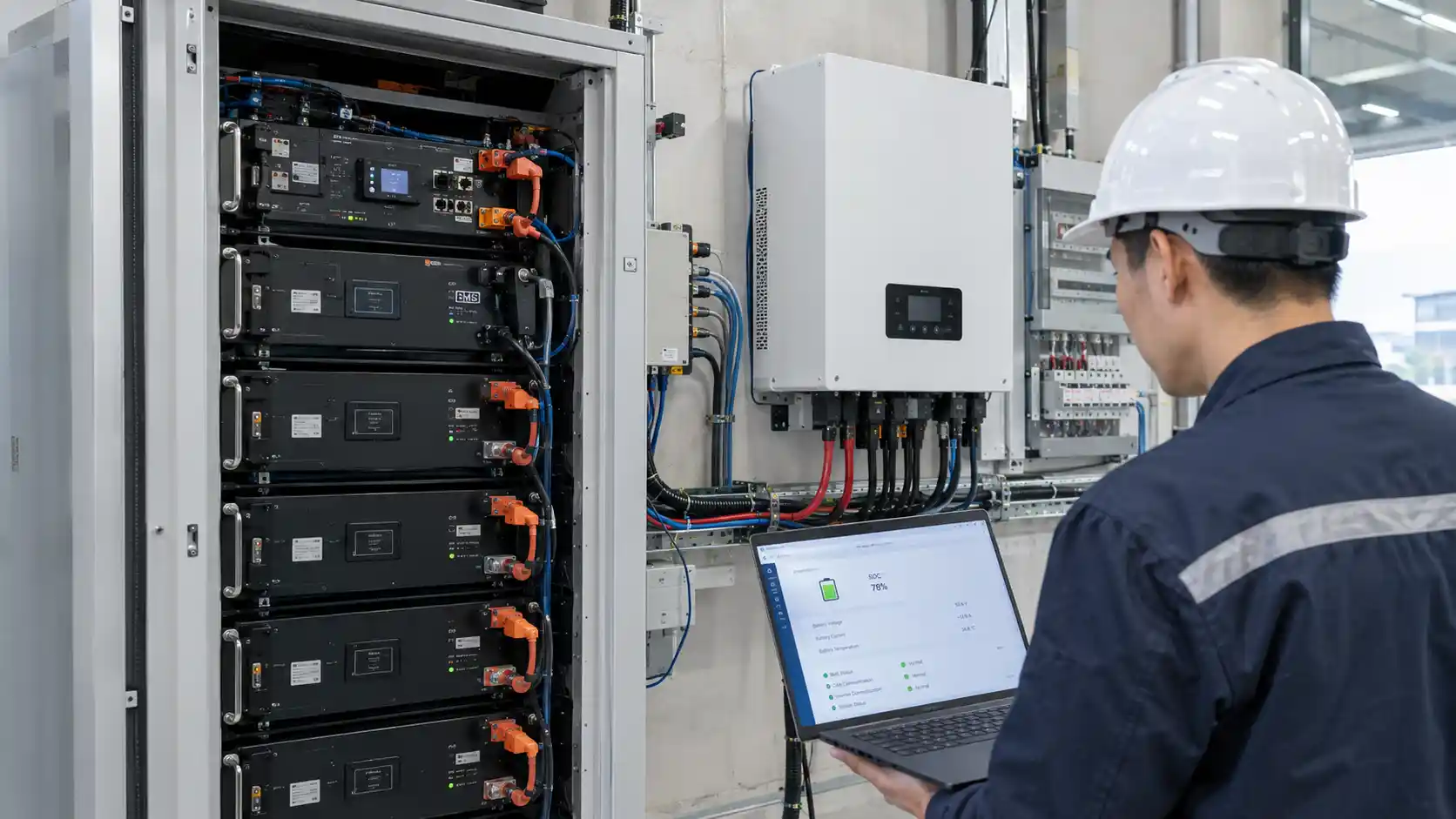
BMS and Inverter Communication Should Be Verified Before Ordering
BMS communication can become a practical integration issue after installation.
Solar storage discussions frequently involve questions about LiFePO4 batteries, MPPT chargers, inverter settings, and communication between the battery and inverter. These issues illustrate why a buyer should confirm the communication architecture before ordering rather than assuming that a battery with a BMS will automatically work with the intended inverter.
The procurement questions include:
- What protections does the BMS provide?
- Does the battery support CAN or RS485?
- What communication protocol is used?
- Is the inverter compatible with that protocol?
- What charging and discharging limits are communicated?
- How is SOC reported?
- What happens if communication is lost?
- Are the required communication parameters documented?
A BMS can provide the required battery protections while still requiring specific integration settings between the battery and inverter.
VoltCrave energy storage configurations include communication interfaces such as RS232, RS485, and CAN on applicable products, allowing communication requirements to be considered during system integration.
Cycle Life Should Be Evaluated With Its Test Conditions
“6,000 cycles” or another cycle-life figure is not enough information for project procurement.
When a supplier states a cycle-life figure, the buyer should ask:
- At what depth of discharge?
- At what charge and discharge rate?
- At what temperature?
- What is the end-of-life capacity threshold?
- Is the figure based on cells or the finished battery system?
- How does the warranty define acceptable degradation?
For example, a VoltCrave 10.24kWh energy storage configuration specifies 6,000+ cycles at 80% DoD.
The 80% DoD condition is important because cycle-life figures should be interpreted together with the test conditions. A buyer comparing different suppliers should request the same information from each supplier rather than comparing headline cycle counts alone.
Temperature and Installation Conditions Affect Battery Selection
Battery specifications should be checked against the actual installation environment.
Relevant parameters can include:
- Operating temperature
- Charging temperature
- Discharging temperature
- Indoor or outdoor installation
- Enclosure protection
- Ventilation or cooling requirements
- Installation clearance
- Mounting method
- Cable and terminal arrangement
The required conditions depend on the battery architecture and project environment.
An outdoor commercial storage installation, for example, may have different environmental requirements from an indoor residential battery installation.
The supplier datasheet should therefore be reviewed against the project site’s actual conditions before the purchase order is finalized.
Expansion Architecture Matters When Solar Capacity May Grow
Solar projects do not always remain at their original capacity.
A customer may initially install a smaller PV and battery system and later add:
- More PV capacity
- Additional battery modules
- More inverter capacity
- Additional backup loads
- EV charging
- Commercial loads
A modular LiFePO4 architecture can simplify future expansion when the battery, BMS, inverter, and system controls support the intended configuration.
VoltCrave’s product range includes stackable energy storage configurations built around 51.2V battery modules, allowing different energy capacities to be assembled from modular units.
Before ordering, verify:
- Maximum number of parallel modules
- Supported battery combinations
- BMS communication requirements
- Inverter limits
- Protection requirements
- Installation space
- Whether additional modules must be identical
Expansion should be considered during the initial system design. Adding modules later can create compatibility or configuration problems if the original battery and inverter architecture was not designed for expansion.
What Changes When the Project Becomes Commercial or Industrial?
The technical requirements become more structured as storage capacity and site power increase.
A small residential system may focus mainly on backup runtime and solar self-consumption. A commercial or industrial project may also require:
- Load-profile analysis
- Peak-demand management
- PV self-consumption
- Power conversion equipment
- EMS control
- Grid integration
- Thermal management
- Fire protection
- Monitoring
- Commissioning
- Long-term service support
VoltCrave’s commercial and industrial energy storage systems cover larger configurations and integrate battery modules with BMS, PCS, EMS, thermal management, and fire protection according to the project configuration.
The distinction is important because a larger solar storage project is an integrated energy system rather than simply a collection of battery modules.
Real Project Scale Matters When Evaluating a Battery Supplier
A product datasheet shows what a battery is designed to do. Project documentation provides additional information about the types of system configurations a supplier has delivered.
VoltCrave’s project portfolio includes solar and energy storage installations at different scales, including:
- 5kW / 5.12kWh solar system installation
- 10kW / 10kWh hybrid solar systems
- 13.2kW / 15kWh hybrid solar systems
- 24kW / 40kWh rooftop solar storage
- 150kW / 450kWh commercial hybrid solar storage
- 300kWh and 1,000kWh-class commercial energy storage projects
These projects involve different system sizes and application requirements.
For a buyer, project documentation can be useful when evaluating whether a supplier has experience with the type of system being specified.
You can review the documented VoltCrave Power project case portfolio when assessing relevant project experience.
What Should a LiFePO4 Battery Supplier Provide Before an RFQ?
Before requesting a final quotation, a solar storage buyer should have enough technical information to compare suppliers on the same basis.
| Parameter | What to verify |
|---|---|
| Battery chemistry | LiFePO4 / LFP configuration |
| Nominal voltage | System voltage compatibility |
| Rated capacity | Ah and kWh |
| Usable energy | DoD and operating limits |
| Continuous discharge | Current and power |
| Peak discharge | Duration and conditions |
| Maximum charge current | Solar charging compatibility |
| BMS | Protection and monitoring functions |
| Communication | CAN / RS485 / supported protocol |
| Cycle life | DoD, temperature, rate, and EOL conditions |
| Operating temperature | Charging and discharging limits |
| Dimensions | Mechanical installation |
| Weight | Handling and structural requirements |
| Expansion | Parallel/module limits |
| Inverter compatibility | Approved or tested combinations |
| Warranty | Conditions and degradation terms |
| Certifications | Required market and project certifications |
| Documentation | Datasheet, communication protocol, installation manual |
This information gives the procurement team a consistent basis for comparing battery quotations.
How VoltCrave Power Supports LiFePO4 Solar Energy Storage Projects
Solar storage projects may require more than a standard battery catalog.
Depending on the application, the supplier may need to provide:
- Battery cells
- Custom battery packs
- BMS integration
- Hybrid inverters
- Stackable ESS
- Commercial and industrial ESS
- OEM/ODM customization
- System integration
- Project-specific configuration
VoltCrave Power has operated since 2011 and provides battery cells, custom battery packs, solar systems, inverters, and energy storage products for international OEM/ODM customers.
Its product portfolio covers residential, commercial, industrial, solar inverter, battery cell, and portable energy storage applications.
The VoltCrave Power product portfolio can be reviewed when comparing available battery and energy storage configurations.
Final Checklist: Is a LiFePO4 Battery Ready for Your Solar Storage Project?
Before approving a LiFePO4 battery for a solar energy storage project, verify the following.
Battery specification
- Is the voltage correct for the system?
- Is the nominal capacity sufficient?
- Is usable energy clearly defined?
- Is the continuous discharge power sufficient?
System integration
- Is the battery compatible with the inverter or PCS?
- Is BMS communication supported where required?
- Are CAN or RS485 protocols documented?
- Are charge and discharge limits clearly defined?
Performance
- Are cycle-life conditions disclosed?
- Is the DoD condition specified?
- Are operating temperature limits suitable?
- Is the warranty tied to measurable conditions?
Installation
- Do the dimensions fit the planned location?
- Are terminals and communication ports accessible?
- Is the enclosure appropriate for the installation environment?
- Are protection and cooling requirements understood?
Expansion
- Can additional battery modules be added?
- What is the maximum parallel configuration?
- Does expansion require identical modules?
- Can the inverter and BMS support the planned future capacity?
Supplier qualification
- Can the supplier provide complete technical documentation?
- Can the supplier support system integration?
- Does the supplier have experience with relevant project scales?
- Can the supplier provide OEM/ODM customization when required?
FAQs
Are LiFePO4 batteries good for solar energy storage?
Yes. LiFePO4 batteries are widely used in solar energy storage because they support repeated charge and discharge operation and can be integrated with BMS and power-conversion systems.
However, chemistry alone does not determine whether a battery is suitable for a solar project. Voltage, usable energy, discharge capability, BMS protection, inverter compatibility, communication, operating conditions, and expansion requirements also need to be evaluated.
How long do LiFePO4 batteries last in solar energy storage systems?
Service life depends on factors such as depth of discharge, charge and discharge rate, temperature, battery management, and the end-of-life definition used for the cycle-life test.
For example, a VoltCrave 10.24kWh energy storage configuration specifies 6,000+ cycles at 80% DoD. When comparing suppliers, buyers should check the conditions behind the stated cycle-life figure rather than comparing cycle counts alone.
Can LiFePO4 batteries work with any solar inverter?
No. Compatibility depends on the battery voltage range, charge and discharge current limits, BMS communication, communication protocol, SOC reporting, supported battery profiles, and inverter settings.
Before ordering, the battery and inverter should be checked as a complete system. CAN or RS485 support alone does not guarantee compatibility if the communication protocol or required parameters do not match.
What size LiFePO4 battery is needed for a solar energy storage project?
The required battery size depends on the project’s energy demand, load profile, backup duration, PV generation, usable DoD, discharge power, inverter capacity, and charging requirements.
As a basic reference, a 51.2V 100Ah battery has approximately 5.12kWh of nominal energy. The actual project requirement should then be calculated using usable energy and the required discharge power rather than nominal capacity alone.
Conclusion
LiFePO4 batteries are widely used for solar energy storage because they can be configured for repeated charge and discharge operation and integrated into modular battery systems.
For project procurement, however, the chemistry is only the starting point.
A project-ready LiFePO4 battery should be evaluated through:
Energy capacity → usable energy → discharge power → BMS → communication → inverter/PCS integration → cycle-life conditions → installation → expansion → supplier support
For smaller systems, these checks help prevent compatibility problems. For larger solar-plus-storage projects, they become part of the engineering and procurement process.
The appropriate LiFePO4 battery is the configuration whose electrical characteristics, protection system, communication, operating conditions, expansion capability, documentation, and supplier support match the requirements of the solar energy storage project.
Need help matching this topic to a real battery project?
Send your target application, capacity range, certification market, and order plan. VoltCrave can recommend a practical product direction.