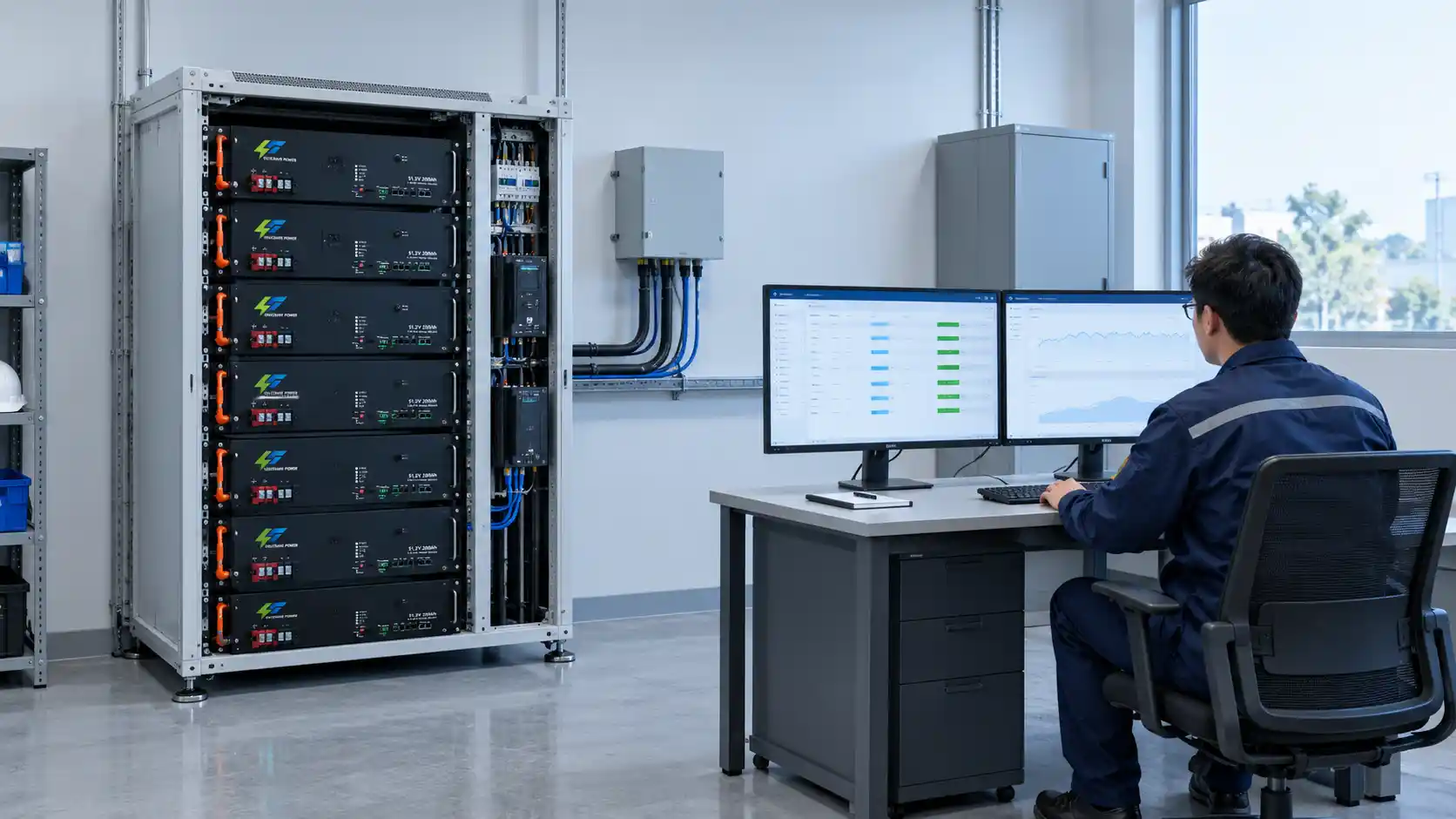
What are battery SOC and SOH?
Battery SOC (State of Charge) indicates the battery’s current charge level. Battery SOH (State of Health) describes the battery’s condition compared with a defined reference condition, usually when the battery was new.
They answer different questions:
| Parameter | SOC | SOH |
|---|---|---|
| Full name | State of Charge | State of Health |
| What it shows | Current charge level | Battery condition |
| Common display range | 0–100% | 0–100% |
| Example | 75% SOC means the battery is estimated to have about 75% of its usable reference charge remaining | 85% SOH indicates that the battery’s health or capacity has declined relative to its reference condition |
| Changes mainly with | Charging and discharging | Aging and operating history |
| Main purpose | Estimate remaining energy | Assess battery degradation |
*The exact SOH calculation and display range depend on the BMS algorithm and its reference definition.
A battery can show 100% SOC while having less than 100% SOH. An older battery may still reach its defined full-charge point even though its usable capacity is lower than when it was new.
What does battery SOC mean?
Battery SOC represents the estimated amount of charge currently available relative to a defined battery capacity.
For example, a battery showing 75% SOC is estimated to have about 75% of its reference charge available. This does not mean that the battery voltage is 75% of its maximum voltage. SOC is an estimated state, not a direct voltage measurement.
A BMS may use several inputs to estimate SOC, including:
- Battery current
- Pack voltage
- Cell voltage
- Temperature
- Configured battery capacity
- Charging and discharging history
- Previous SOC data
- Calibration or synchronization points
This is why battery SOC can sometimes differ from what a user expects based only on voltage.
For lithium battery systems, SOC estimation affects how the system reports remaining energy and manages charging and discharging. The accuracy of the displayed value depends on the measurements, settings, and estimation method used by the BMS.
What does battery SOH mean?
Battery SOH (State of Health) describes the battery’s condition relative to a defined reference state.
One common capacity-based approach is:
SOH ≈ Current Available Capacity ÷ Reference Capacity × 100%
For example, if a battery had a reference capacity of 100 Ah and its measured usable capacity had declined to about 85 Ah, a capacity-based calculation could indicate approximately 85% SOH.
Actual BMS calculations can vary. Some systems consider capacity degradation, internal resistance, operating history, or other battery characteristics. For that reason, buyers should check how the supplier defines and calculates SOH before comparing the percentage between different battery systems.
A lower SOH does not automatically mean that a battery has failed. It indicates that the battery has moved away from its reference condition. Usable capacity, cell behavior, temperature, and operating history provide additional context.
Battery SOC vs SOH: What is the difference?
The distinction is straightforward:
SOC describes the battery’s current charge state. SOH describes its condition relative to a reference state.
Consider an older battery with 85% SOH and 100% SOC. The 100% SOC means the battery has reached its current defined full-charge state. The 85% SOH indicates that its capacity or other health-related characteristics have declined compared with the reference condition.
| Battery condition | SOC | SOH |
|---|---|---|
| New battery, fully charged | 100% | Around 100% |
| Older battery, fully charged | 100% | May be below 100% |
| Partially charged battery | Below 100% | Depends on battery condition |
| Battery aging over time | Changes during operation | Generally declines |
SOC can move up and down every day. SOH normally changes much more slowly as the battery ages.
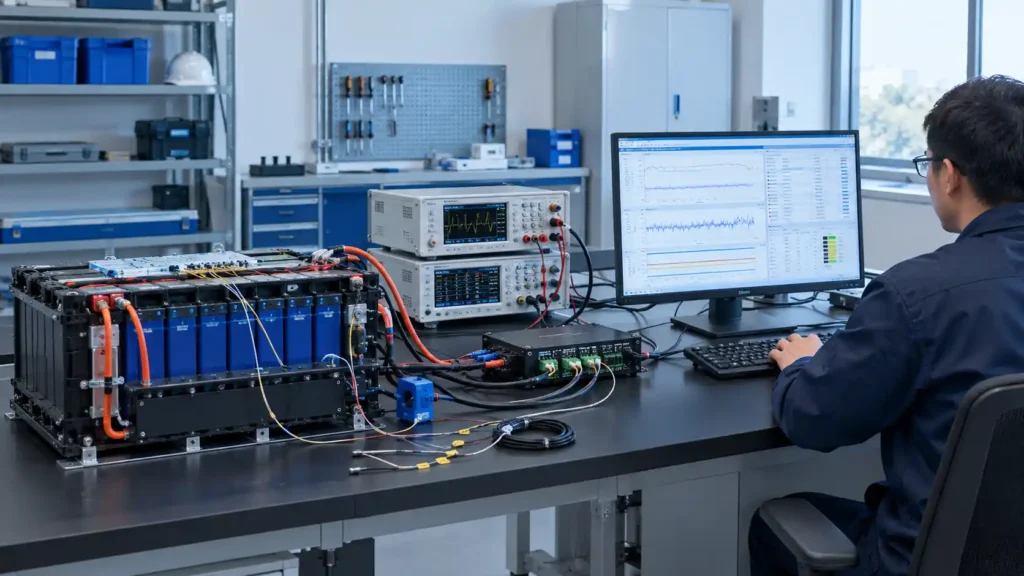
How does a BMS estimate battery SOC?
A BMS generally combines battery measurements and estimation methods rather than relying on a single reading.
Coulomb counting
Coulomb counting tracks the current flowing into and out of the battery over time.
In simplified form:
SOC change ≈ Accumulated charge or discharge ÷ Reference capacity
If the system knows the starting SOC and accurately measures current, it can estimate how much charge has entered or left the battery.
The calculation can accumulate errors over time. Current sensor accuracy, configured capacity, charging efficiency, temperature, and calibration all affect the result.
This is why a BMS may use defined charging conditions or other reference points to correct the SOC estimate.
Voltage-based estimation
Battery voltage can also be used as part of SOC estimation, but state of charge vs voltage is not a fixed one-to-one relationship.
Voltage changes with:
- Charging or discharging current
- Temperature
- Battery chemistry
- Recent operating conditions
- Voltage recovery after charging or discharging
- Cell imbalance
For LiFePO4 batteries, the relatively flat voltage curve across part of the operating range makes voltage alone a limited way to estimate exact SOC.
A BMS therefore benefits from combining voltage with current, temperature, historical data, and other measurements.
Why can battery SOC readings be inaccurate?
SOC is an estimate, so the displayed percentage can differ from the usable energy available under a particular operating condition.
SOC suddenly jumps
A BMS may show a sudden change, such as SOC moving from a low value to a much higher value.
Possible causes include:
- SOC recalibration
- Incorrect configured capacity
- Current measurement error
- Loss of accumulated SOC information
- Communication or synchronization issues
- A BMS reaching a defined full-charge condition
The percentage should be checked together with charging current, voltage, cell data, and BMS settings rather than viewed on its own.
SOC does not match battery voltage
A displayed SOC may appear inconsistent with pack voltage because voltage changes with load, charging current, temperature, battery chemistry, and recovery after charging or discharging.
The BMS SOC value may also be based on coulomb counting and historical data. For LiFePO4 systems, the flat voltage curve over part of the operating range makes this difference particularly noticeable.
BMS SOC and inverter SOC are different
An energy storage system can display one SOC value through the BMS and another through the inverter or system dashboard.
The two systems may use different:
- Battery capacity settings
- SOC estimation methods
- Calibration points
- Communication parameters
- Usable-capacity definitions
- Synchronization conditions
When the readings differ, checking these settings is more useful than assuming that one percentage is automatically wrong.

How should LiFePO4 battery SOC be monitored?
For a LiFePO4 energy storage system, SOC should be evaluated using multiple battery parameters rather than pack voltage alone.
Useful data includes:
- BMS SOC
- Pack voltage
- Individual cell voltage
- Charge and discharge current
- Battery temperature
- Cell voltage difference
- Charging and discharging history
- Configured battery capacity
- BMS alarms and protection status
The relationship between these values often provides more information than any single reading.
For example, if SOC suddenly changes while pack voltage, current, and cell voltage remain stable, the BMS estimation or calibration settings may need to be checked.
For a practical example of an energy storage battery using BMS and communication interfaces, see the [51.2V LiFePO4 Battery Storage System]. 51.2V LiFePO4 Battery Storage System
How does battery SOH change over time?
Battery SOH generally changes as the battery ages and its electrochemical characteristics change.
Factors that can affect battery health include:
- Charge and discharge cycles
- Operating temperature
- Time spent at high or low SOC
- Charging and discharging conditions
- Available capacity
- Internal resistance
- Cell imbalance
- Long-term operating history
The rate of SOH change is not necessarily constant.
A BMS may also recalculate SOH as new battery data becomes available. A change in the displayed SOH can therefore reflect both actual battery aging and changes in the estimation process.
For procurement, it is useful to understand how the supplier defines SOH instead of comparing the percentage alone.
How should buyers evaluate SOC and SOH in an energy storage system?
When evaluating a battery for a residential or energy storage application, buyers should check how SOC and SOH are calculated, communicated, and used by the system.
Key questions include:
- How is SOC calculated?
Check whether the BMS uses current measurement, voltage, temperature, historical data, or a combination of these inputs. - How is battery capacity configured?
An incorrect capacity setting can affect the displayed SOC. - How is SOC calibrated?
Ask what conditions are used to synchronize or correct the SOC estimate. - How is SOH defined?
Determine whether SOH is based mainly on capacity, internal resistance, operating history, or another BMS algorithm. - Can the system provide cell-level data?
Cell voltage and temperature data can help identify imbalance or abnormal operating conditions. - How does the battery communicate with the inverter?
Communication interfaces and configuration can affect the SOC data received and displayed by the inverter. - What capacity does the SOC percentage represent?
Confirm whether the percentage is based on nominal capacity, usable capacity, or another reference.
These checks are more useful for procurement than simply asking whether a battery has an SOC or SOH display. A [10kW Solar Battery Storage System] is one example of a battery system where BMS protection and communication interfaces are part of the system specification. 10kW Solar Battery Storage System
Key takeaways for energy storage buyers
- SOC shows the battery’s current charge state, while SOH describes its condition relative to a reference state.
- A battery can display 100% SOC while its SOH is below 100%.
- Battery voltage should not be treated as a direct replacement for SOC, particularly for LiFePO4 batteries.
- BMS SOC and inverter SOC can differ because of different settings, estimation methods, calibration, or communication conditions.
- SOH should be interpreted according to the BMS definition and considered together with usable capacity and battery operating data.
- VoltCrave Power supports battery and energy storage applications where BMS monitoring, battery data, and system integration need to be considered together.
FAQs
What is battery SOC?
Battery SOC, or State of Charge, is an estimate of the battery’s current charge level, usually displayed as a percentage.
What is battery SOH?
Battery SOH, or State of Health, indicates the battery’s condition compared with a defined reference condition. It is commonly related to capacity retention, but the exact calculation depends on the BMS.
What is the difference between SOC and SOH?
SOC describes current charge, while SOH describes battery condition relative to a reference state. SOC can change from day to day, while SOH normally changes more gradually as the battery ages.
Can a battery have 100% SOC but less than 100% SOH?
Yes. A battery can reach its current defined full-charge point while having less usable capacity than it had when new. For example, a battery could display 100% SOC while its SOH is 85%.
Why does battery SOC sometimes jump?
SOC can change suddenly because of recalibration, capacity settings, current measurement errors, synchronization conditions, communication problems, or changes in the BMS estimation state.
Why does battery SOC not always match voltage?
Voltage is affected by current, temperature, battery chemistry, and recent operating conditions. SOC is an estimated value that may also use coulomb counting and historical data, so the two readings do not always correspond directly.
Why can BMS SOC and inverter SOC be different?
The BMS and inverter may use different capacity settings, estimation methods, calibration points, usable-capacity definitions, or communication configurations. These settings should be checked before concluding that one reading is incorrect.
Does lower SOH mean the battery has failed?
No. A lower SOH indicates that the battery has moved away from its reference condition. Its practical significance depends on remaining usable capacity, cell behavior, operating conditions, and the health criteria used by the BMS.
Need help matching this topic to a real battery project?
Send your target application, capacity range, certification market, and order plan. VoltCrave can recommend a practical product direction.