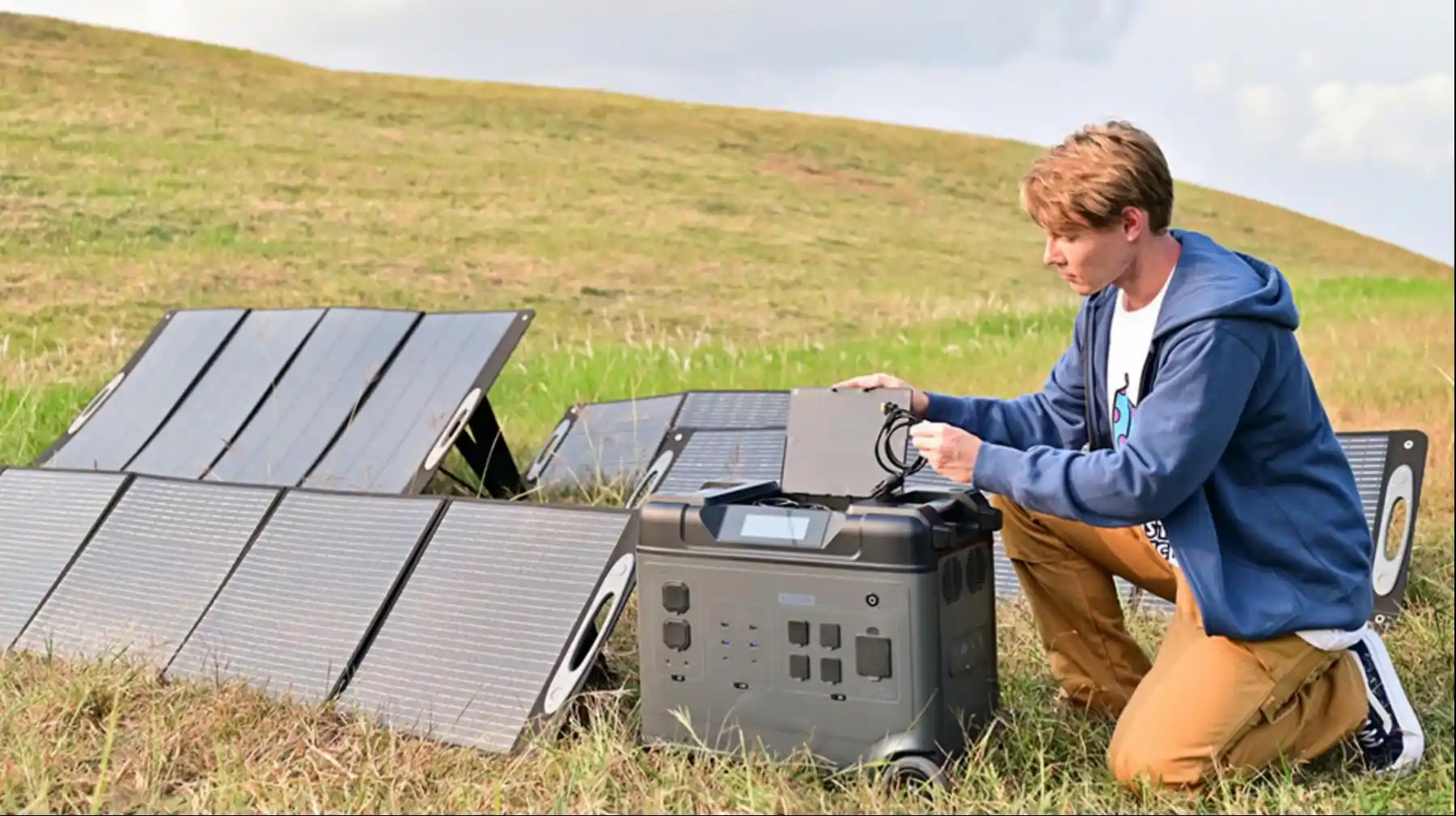
Choosing the right solar panel for portable power station applications is not simply a matter of selecting the highest wattage available. A panel can have enough rated power and still be unsuitable because its voltage, current, connector, physical size, or operating conditions do not match the power station.
For distributors, outdoor power brands, OEM buyers, and project purchasers, the more important question is whether the solar panel and portable power station form a compatible, repeatable product combination.
This article explains the key specifications to check before sourcing a panel, including wattage, voltage, Voc, current, connectors, panel format, portability, and realistic solar output.
The 8 Numbers You Must Check Before Buying
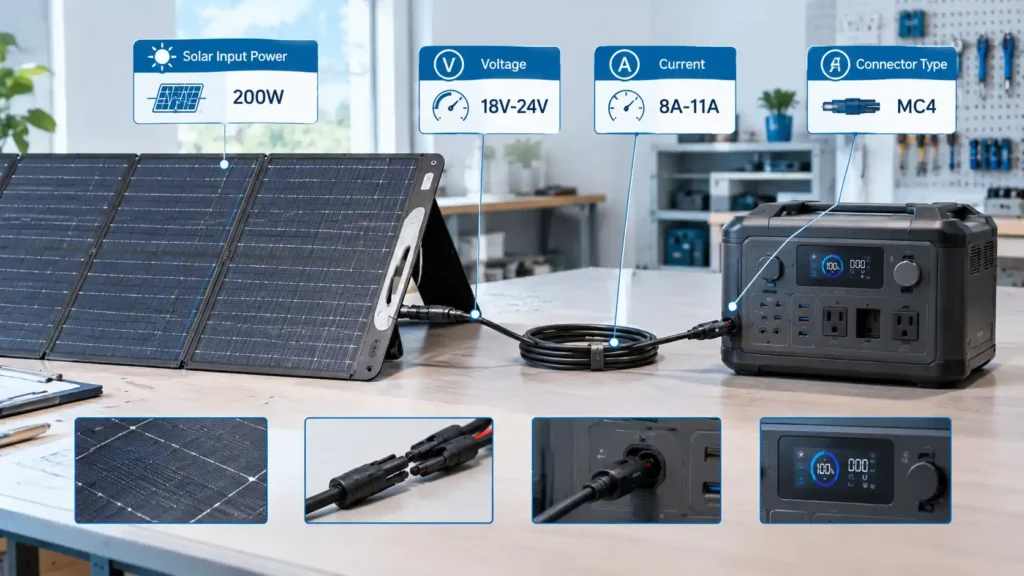
Before comparing different solar panels, collect the electrical specifications of both the panel and the portable power station.
4 Numbers to Check on the Portable Power Station
Start with the portable power station because its solar input limits determine which panels can actually be used.
Check:
- Maximum solar input power
- Solar input voltage range
- Maximum solar input current
- Solar connector type
For example, a power station may accept a particular maximum solar input wattage but also impose separate voltage and current limits. A panel that exceeds either electrical limit may not be an appropriate match even if its rated wattage appears reasonable.
The manufacturer’s specification sheet should therefore be treated as the starting point for panel selection.
4 Numbers to Check on the Solar Panel
For the solar panel, check:
- Rated power
- Open-circuit voltage (Voc)
- Maximum-power voltage (Vmp)
- Operating current, usually shown as Imp
These specifications tell you much more about compatibility than the wattage printed on the front of the panel.
For procurement teams, it is useful to place the power station and panel specifications side by side before requesting samples or volume quotations.
Simple Matching Worksheet
A basic procurement worksheet can include:
| Item | Portable Power Station | Solar Panel |
|---|---|---|
| Rated / maximum solar power | Check specification | Rated W |
| Voltage | Solar input range | Voc / Vmp |
| Current | Maximum input current | Imp / Isc |
| Connector | Input connector | Output connector |
| Format | — | Foldable / flexible / rigid |
| Weight | Product requirement | Panel weight |
| Dimensions | Product requirement | Panel dimensions |
This simple comparison can eliminate many compatibility problems before purchasing.
How to Match Solar Panel Wattage to a Portable Power Station
The most visible specification is usually wattage, but it should not be the only selection criterion.
A solar panel for portable power station applications should normally be selected according to the power station’s maximum solar input rather than simply choosing the largest panel available.
For example, 100W, 200W, and 400W panels can serve very different portable power configurations.
100W Portable Solar Panels
A 100W portable solar panel can be suitable for smaller portable power stations where portability and lower charging requirements are more important than maximum solar input.
This type of panel can also be useful when:
- The power station has a relatively low solar input limit
- The product needs to remain lightweight
- The system is designed for occasional outdoor use
- Buyers prioritize easy transportation
The key is not whether 100W is universally sufficient. The correct choice depends on the input specification of the power station.
200W Portable Solar Panels
A 200W panel provides a useful middle ground between portability and solar generation.
For example, VoltCrave Power currently lists the PV200 200W Portable Solar Panel Foldable Monocrystalline, which is positioned for portable power stations and outdoor energy applications.
For distributors, a 200W configuration can be easier to package and position as part of a portable power kit than a much larger panel.
400W Portable Solar Panels
A 400W portable solar panel can make sense when the portable power station supports a higher solar input and the buyer wants more charging capacity.
VoltCrave Power also lists a PV400 400W Portable Solar Panel Foldable Monocrystalline for larger portable power stations and higher-output portable charging applications.
However, a 400W panel should not automatically be treated as a better choice. If the power station cannot accept the panel’s electrical characteristics, the additional rated wattage may provide little practical benefit.
Why Higher Wattage Is Not Always Better
A common sourcing mistake is to compare panels only by rated wattage.
The correct sequence is:
Power station input limits → panel voltage → panel current → connector → physical format → rated wattage
This prevents a high-wattage panel from being selected simply because its headline specification looks attractive.
How to Check Solar Input Voltage and Voc
Voltage is one of the most important compatibility checks.
The portable power station normally specifies a solar input voltage range. The solar panel provides voltage characteristics such as Voc and Vmp.
Voc vs Vmp
Voc means open-circuit voltage. It represents the panel voltage when no load is connected.
Vmp means voltage at maximum power. It represents the voltage at which the panel produces its rated maximum power under specified test conditions.
For compatibility screening, Voc deserves particular attention because the panel’s open-circuit voltage must remain within the power station’s permitted solar input limits.
A panel may have a suitable wattage but still be unsuitable if its voltage is outside the acceptable range.
Why Cold Weather Matters
Solar panel voltage can change with temperature. In colder conditions, Voc can rise.
This means buyers should not evaluate voltage only under typical warm-weather conditions. The expected operating environment should also be considered when checking the maximum allowable solar input voltage.
For detailed charging-safety considerations, including solar Voc and temperature-related charging issues, see the dedicated Portable Power Station Charging Precautions article.
The purpose here is compatibility selection rather than repeating a complete charging-safety procedure.
How to Match Solar Panel Current to the Power Station
Current is another specification that is frequently overlooked.
A portable power station may specify a maximum solar input current. The solar panel may specify Imp and Isc.
Isc vs Imp
Isc is short-circuit current.
Imp is current at maximum power.
These values describe different operating conditions and should not be treated as interchangeable.
When selecting a solar panel, compare its current characteristics with the maximum solar input current of the power station.
What Happens When Panel Current Is Too High?
The result depends on the power station’s design and control system, so buyers should not assume that an oversized current specification will always be harmless.
The safer procurement approach is to stay within the manufacturer’s stated electrical limits.
This is especially important when creating a standard product bundle for distributors. A configuration that works with one portable power station model should not automatically be applied to another model.
Series and Parallel Configurations
Series and parallel configurations can change the voltage and current characteristics of a solar array.
However, this article is focused on selecting a compatible solar panel for portable power station rather than providing a complete series/parallel sizing tutorial.
For a single portable power station, buyers should first determine whether the manufacturer specifies a single-panel input configuration or supports multiple-panel configurations.
If multiple panels are considered, the combined voltage and current must remain within the power station’s specified limits.
How to Check Connector Compatibility
Electrical specifications are not the only compatibility issue.
The connector between the solar panel and portable power station must also be checked.
Before purchasing, confirm:
- Connector type
- Connector gender
- Polarity
- Cable length
- Cable gauge
- Adapter requirements
A panel with correct wattage, voltage, and current can still create an installation problem if the connector configuration does not match.
For B2B sourcing, it is better to define the complete cable and connector configuration in the quotation rather than leaving accessories unspecified.
This is particularly important when a solar panel is sold as part of a portable solar panel kit.
Foldable vs Semi-Flexible vs Rigid Solar Panels
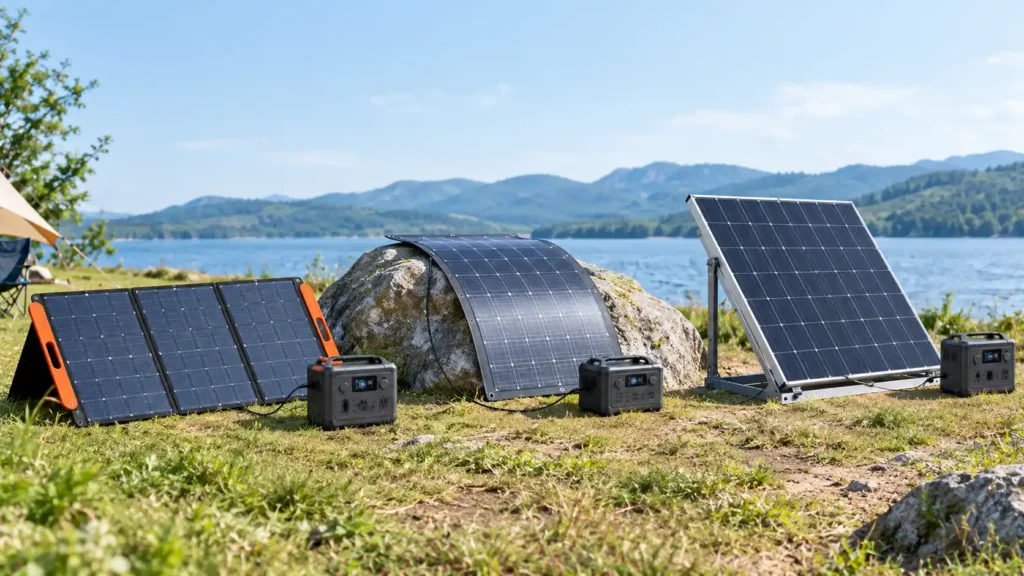
The best panel format depends on the application.
Foldable Solar Panels
Foldable panels are often suitable for portable power stations because they can be transported and stored more easily.
Typical advantages include:
- Compact storage
- Easier transportation
- Convenient outdoor deployment
- Suitable for portable power kits
- Easier packaging for mobile applications
For camping, field work, emergency power, and mobile energy products, foldable panels can provide a practical balance between output and portability.
Semi-Flexible Solar Panels
Flexible and semi-flexible solar panels can be useful when weight, mounting surface, or curved installation requirements are important.
However, they should not be selected simply because they are lighter. The electrical specifications, physical protection, mounting method, and expected application still need to match the portable power system.
Rigid Solar Panels
Rigid panels can provide a more conventional solution where portability is less important.
They may be suitable for applications where the panel remains deployed for longer periods and transportation frequency is lower.
The decision should therefore be based on the complete use case rather than panel type alone.
Panel Size, Weight and Portability: The Trade-Offs
Rated wattage is only one part of portable solar panel selection.
A higher-output panel can also mean:
- Larger dimensions
- Higher weight
- More complicated transportation
- More storage space
- Higher packaging requirements
For a portable power station product line, this creates a practical trade-off between energy collection and mobility.
For example, a distributor targeting outdoor users may prefer a foldable configuration because the panel can be packed together with the power station and accessories.
A project buyer supplying temporary field equipment may instead prioritize higher output and less frequent transportation.
Therefore, panel dimensions and weight should be included in the product specification review, especially when developing a standardized portable solar panel kit.
How Much Solar Power Does Your Portable Power Station Actually Need?
The required panel size depends on the power station, the intended usage, and the desired recharge window.
A larger battery does not automatically mean that the largest available solar panel is required.
Consider these factors:
Battery capacity: A larger battery may require more solar energy to recharge within the desired timeframe.
Solar input limit: The power station may limit how much solar power it can accept.
Sunlight conditions: Rated panel output is measured under specified test conditions and actual output varies in real environments.
Usage during charging: If equipment is running while the power station is receiving solar input, part of the available solar power may be consumed immediately.
Portability requirements: A larger panel may provide more potential output but can increase weight and package size.
The practical goal is to match the panel to the system rather than maximize the panel rating.
For example, the BP1002 from VoltCrave Power is a 1000W portable power station with 1120Wh energy capacity and MPPT solar charging support. Its charging system supports solar panels as one of its charging sources.
BP1002 1000W 1120Wh MPPT Portable Power Station
The appropriate panel configuration should still be confirmed against the actual solar input specifications of the selected power station.
Portable Solar Panel Kits vs Bare Panels
For B2B buyers, there is an important difference between sourcing a bare panel and sourcing a complete portable solar panel kit.
A complete kit may include:
- Solar panel
- Connection cable
- Adapter
- Connector set
- Carrying or storage solution
- Packaging
- User documentation
For distributors, complete kits can simplify product presentation and reduce compatibility questions from downstream customers.
However, a bare panel may be preferable when the buyer already has standardized cables, connectors, or accessories.
The correct sourcing model depends on the buyer’s existing product ecosystem.
Common Solar Panel Matching Mistakes
Choosing by Wattage Alone
A 400W panel is not automatically compatible with a 400W-rated or 500W-rated power station.
Voltage, current, connector, and system limits must also be checked.
Ignoring Voc
Using only Vmp when checking compatibility can overlook the importance of open-circuit voltage.
Voc should be reviewed against the power station’s maximum permitted solar input voltage.
Ignoring Current Limits
Panel current should be compared with the power station’s maximum solar input current.
Assuming Every Connector Is Interchangeable
A physical connector that appears similar does not necessarily mean the electrical configuration is identical.
Selecting a Panel That Is Too Large for the Application
Higher output can come with increased weight, dimensions, transportation requirements, and packaging costs.
Treating Rated Output as Real-World Output
Solar panel rated power is measured under defined test conditions. Actual field output varies according to sunlight, temperature, orientation, shading, and other conditions.
B2B Note: Sourcing Solar Panels and Portable Power Stations Together
For distributors and OEM buyers, panel selection should be treated as part of the complete product configuration rather than an isolated accessory purchase.
A procurement specification can include:
| Procurement Item | Information to Confirm |
|---|---|
| Portable power station | Model and rated capacity |
| Solar input | Maximum power |
| Solar voltage | Input voltage range |
| Solar current | Maximum input current |
| Solar panel | Rated wattage |
| Panel voltage | Voc / Vmp |
| Panel current | Imp / Isc |
| Connector | Type and polarity |
| Panel format | Foldable / flexible / rigid |
| Cable | Length and connector configuration |
| Packaging | Individual or kit packaging |
| Quantity | Sample and production quantity |
| Market | Target country / region |
This approach reduces the risk of ordering panels that later require adapters, different cables, or configuration changes.
VoltCrave Power’s solar accessory range currently includes portable and fixed solar panels as well as portable power stations, providing a route for buyers evaluating the panel and power-station combination together.
Solar Panels and Hybrid Inverters | Solar Accessories & Energy Storage Products
For OEM and ODM projects, requirements such as product configuration, packaging, dimensions, and electrical specifications can also be discussed as part of the development process.
OEM & ODM Energy Storage Solutions
FAQs
What size solar panel do I need for a portable power station?
The correct panel size depends on the portable power station’s maximum solar input power, voltage range, current limit, and connector configuration. A higher-wattage panel is not automatically the correct choice.
Can I use a 200W solar panel with a portable power station?
Yes, if the power station’s solar input voltage, current, connector, and maximum solar input power are compatible with the panel.
Is a 400W portable solar panel better than a 200W panel?
The two configurations serve different requirements. A 400W panel can provide higher rated solar output where the power station supports it, while a 200W panel may offer a better balance of output, size, weight, and portability for smaller systems.
What solar panel voltage does a portable power station need?
There is no universal voltage. The panel’s Voc and Vmp should be checked against the specific solar input voltage range of the portable power station.
Can I use a foldable solar panel with a portable power station?
Yes. Foldable solar panels are commonly considered for portable applications because they can reduce storage and transportation requirements. Electrical compatibility still needs to be confirmed.
Do I need a solar panel kit or just a panel?
For distributors and OEM buyers, a complete kit can simplify compatibility and packaging. A bare panel may be more appropriate when the buyer already has standardized cables and connectors.
Can VoltCrave Power help match solar panels with portable power stations?
Yes. Buyers can provide the portable power station model, solar input voltage and current limits, target charging requirements, connector preference, and target market. VoltCrave Power can then evaluate the appropriate panel configuration and accessory requirements.
Final Checklist for Choosing a Solar Panel
Before approving a solar panel for portable power station applications, confirm these points:
- Solar input power limit checked
- Panel wattage checked
- Solar input voltage range checked
- Panel Voc checked
- Panel Vmp checked
- Maximum solar input current checked
- Panel Imp / Isc checked
- Connector compatibility confirmed
- Polarity confirmed
- Cable configuration confirmed
- Panel dimensions checked
- Panel weight checked
- Foldable, flexible, or rigid format selected
- Expected operating environment considered
- Packaging requirements confirmed
- Sample compatibility tested before volume purchasing
The right solar panel is therefore not simply the one with the highest wattage. It is the one whose electrical specifications, connector, physical format, portability, and application requirements match the portable power station as a complete system.
For distributors, OEM buyers, and energy-product businesses, evaluating the panel and power station together can also reduce accessory mismatches and simplify the final product configuration.
VoltCrave Power can support specification matching for portable power stations and compatible solar panel configurations based on the required power, voltage, current, connector, panel format, and accessory requirements.
Need help matching this topic to a real battery project?
Send your target application, capacity range, certification market, and order plan. VoltCrave can recommend a practical product direction.