A lithium e-bike battery cannot be selected by voltage alone. The pack has to fit the controller, the frame, the charger, and the target market at the same time, and a mismatch in any one of them usually shows up later as a warranty claim. Get it wrong and the range does not materialize, the BMS trips under load, the enclosure does not fit the frame, or the shipment stops at customs.
This guide covers how to choose a lithium e-bike battery from a buyer’s position, whether you are a bike brand sourcing packs for a new model, a dealer or repair shop replacing stock, or an OEM building your own line. It explains why lithium dominates the category, what the main pack types are, which specifications decide fit, and what to check before you place an order.
Why lithium is the default chemistry for e-bike batteries
Every e-bike battery on the market today that is worth considering uses lithium chemistry. Lead-acid packs still exist in low-cost scooters and some utility vehicles, but they have been pushed out of serious e-bike design for three practical reasons.
Energy density and weight
Energy density is the amount of usable energy stored per kilogram of battery. Lithium cells store roughly three to four times more energy per kilogram than lead-acid. On a bicycle that ratio matters more than on almost any other vehicle, because weight decides whether the bike is pleasant to ride and whether it can be lifted onto a rack. A lithium pack that delivers the same range at a fraction of the weight changes the whole design of the bike.
Cycle life
Cycle life is how many full charge and discharge cycles a battery delivers before its capacity drops to a defined percentage, commonly 80 percent of original. The e-bike packs in current production typically rate between 800 and 1,000 cycles, and higher-grade configurations push beyond that. Over the multi-year life of a bicycle, that difference determines whether the customer replaces the battery once or not at all.
No memory effect
Lithium cells do not suffer the memory effect that older nickel chemistries did, where partial discharges reduced usable capacity over time. Riders can top up after a short commute without degrading the pack, which matches how e-bikes are actually used. Combined with a low self-discharge rate, this makes lithium the only chemistry that fits the real-world charging habits of e-bike owners.
The main types of lithium e-bike battery packs
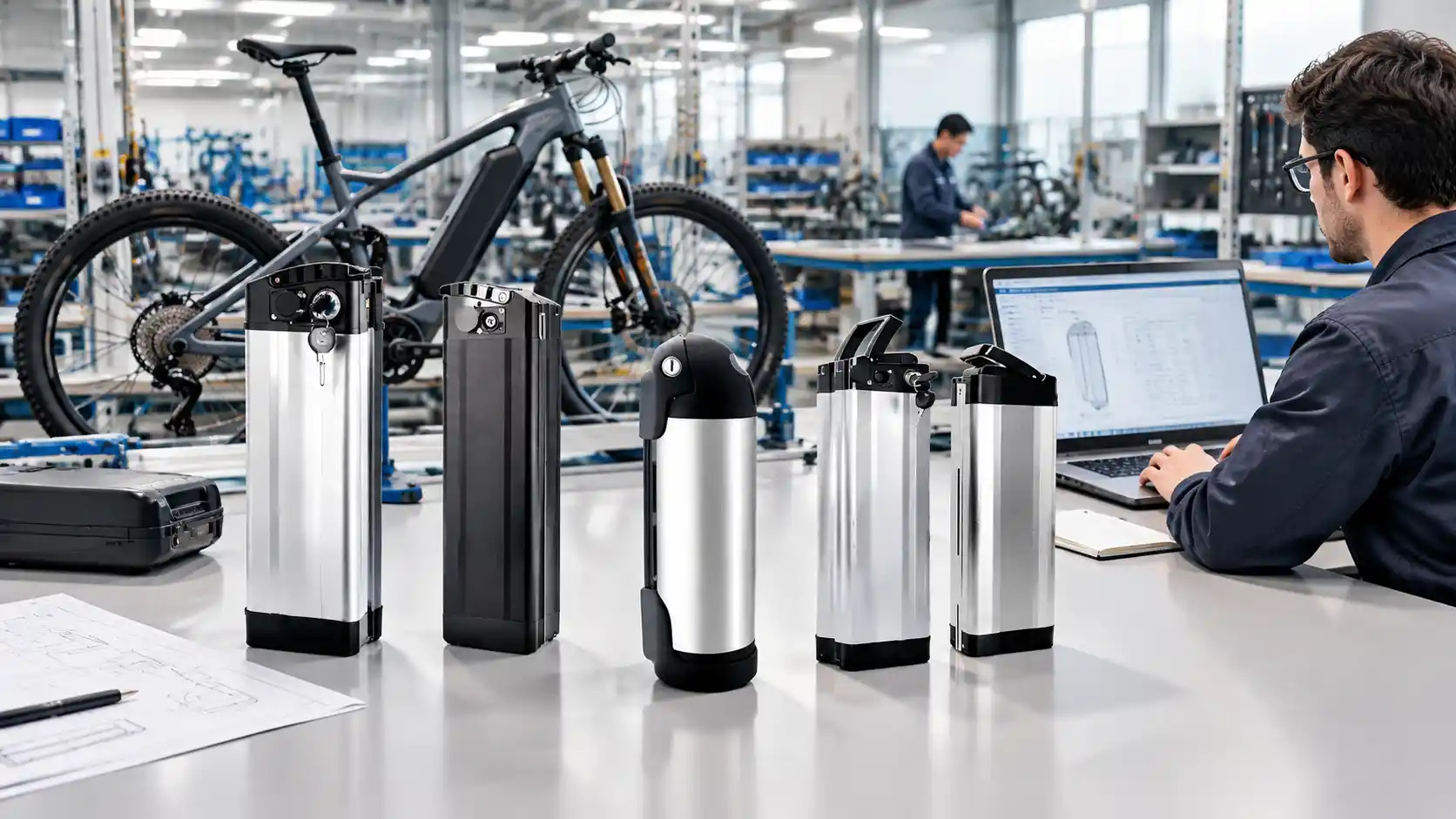
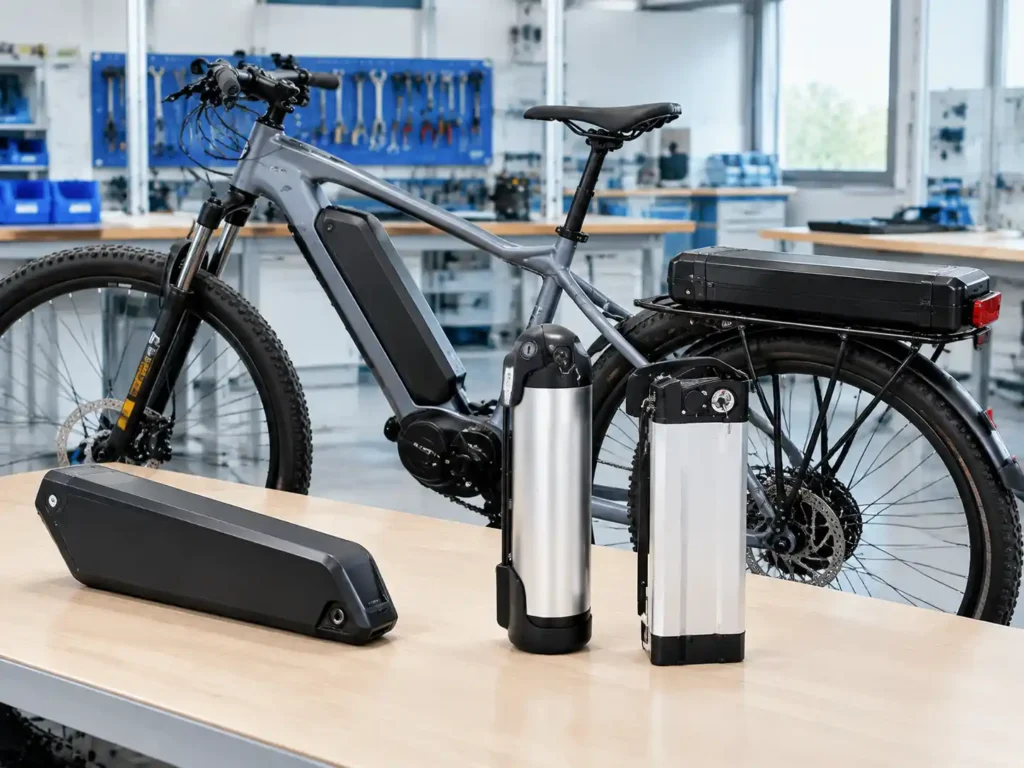
Lithium e-bike batteries come in several physical formats, and the format usually matters more to a buyer than the chemistry inside it, because the format decides what will physically fit the bike. The four common formats are downtube, water bottle, silver fish, and rear rack.
Downtube packs mount along the lower frame tube, keep the center of gravity low, and offer generous volume for higher-capacity builds. Water bottle packs are compact and mount where a bottle cage would go, which suits lighter assist bikes and frames with limited space. Silver fish packs slide into a dedicated rear or frame mount and are widely used in the aftermarket and replacement segment. Rear rack packs put the mass over the back wheel and suit cargo and utility builds with long range demands.
A pack built as a downtube unit and a pack built as a silver fish unit can share the same cells, the same BMS rating, and the same voltage, yet be completely incompatible on the bike. This is why the format decision comes before the specification decision.
18650 and 21700 cylindrical cells
Most e-bike packs are built from cylindrical cells in the 18650 or 21700 format. The numbers describe physical size: an 18650 is 18mm in diameter and 65mm long, and a 21700 is 21mm by 70mm. The larger 21700 cell holds more energy per cell, so a pack of the same capacity needs fewer of them, which simplifies the internal wiring. The 18650 remains the most widely available format with the deepest supply base. Neither format is inherently better. The choice depends on the capacity target, the space envelope, and cell availability at the time of design.
NCM and LiFePO4 chemistry differences
Two lithium chemistries dominate e-bike applications, and the difference between them shapes the whole product.
NCM (nickel cobalt manganese) is the mainstream e-bike chemistry. It offers higher energy density, which means more range from a lighter pack, and it performs better in cold weather. Most performance and commuter e-bikes use NCM packs, including downtube units built from 18650 cells.
LiFePO4 (lithium iron phosphate) trades some energy density for a more stable chemistry with better thermal and safety characteristics, and it generally offers longer cycle life. It is more common where the battery is large, stationary, or where safety and longevity outweigh the weight penalty.
The rule is straightforward. If weight and range define the bike, NCM is usually the right fit. If safety margin and cycle life over many years matter more than the last few kilograms, LiFePO4 is the better answer. Cell sourcing and pack assembly are covered in more detail under battery cells and components.
Downtube packs
A downtube lithium e-bike battery is the default format for modern commuter and performance bikes. It sits in the main triangle of the frame, keeps weight low and centered, and gives the designer room for a higher-capacity pack. Because the enclosure follows the frame tube, downtube packs are usually model-specific and harder to retrofit. They suit a bike brand building a defined product line rather than a dealer sourcing a universal replacement.
One example is an 18650 NCM downtube lithium-ion e-bike battery, which pairs NCM chemistry with a 48V nominal voltage, a 20Ah capacity, a 40A BMS, and motor compatibility up to 1500W. That combination fits a mid-to-high-end commuter or conversion build.
Water bottle packs
A water bottle lithium e-bike battery fits into the standard bottle cage mount, which makes it the most flexible format for frames that were not designed around a battery. It suits lighter-assist builds, city bikes, and conversions where the buyer wants to keep the bike looking as close to a normal bicycle as possible. The trade-off is capacity. The bottle form factor limits how much energy you can fit, so water bottle packs usually serve shorter-range and lighter-duty applications.
One configuration is a 24V/36V/48V water bottle e-bike battery, with a selectable nominal voltage and a capacity range from 8Ah to 18Ah, rated for 1000 cycles. That spread lets one platform serve several bike models without redesigning the pack.
Silver fish packs
A silver fish lithium e-bike battery slides into a dedicated mount and is one of the most common formats in the replacement and aftermarket channel, because it is widely compatible and easy to source. It is often positioned on a rear rack or in a frame-mounted cradle, and dealers and repair shops stock it because it fits many bikes.
Silver fish packs are also the format most often built to order. Buyers usually specify capacity, discharge grade, and BMS rating rather than ordering a fixed model. A 36V 30Ah OEM silver fish lithium e-bike battery pack shows the option range: voltage options from 36V to 60V, capacity options from 10.4Ah to 28Ah, and selectable discharge grades of 1C, 2C, and 3C. A related pack, the 36V/48V/52V silver fish lithium e-bike battery pack, covers the same capacity and BMS options at a 3C discharge grade. Both are offered with OEM and ODM customization.
Rear rack packs
A rear rack lithium e-bike battery carries the pack over the back wheel. The format frees the frame triangle entirely and allows a large, high-capacity pack, which makes it the natural choice for cargo bikes, utility bikes, and long-range touring builds. The cost is weight distribution: mass over the rear axle affects handling, so rack packs suit bikes where carrying capacity and range are the priority over agility.
Comparing the formats
| Format | Mount position | Capacity room | Mounting drilling | Best for |
|---|---|---|---|---|
| Downtube | Lower frame tube | High | Model-specific | Commuter and performance bikes |
| Water bottle | Bottle cage mount | Low to medium | Flexible, low drilling | Light assist and conversions |
| Silver fish | Rear or frame cradle | Medium to high | Flexible, replaceable | Replacement and aftermarket |
| Rear rack | Over rear wheel | High | Flexible, by design | Cargo, utility, long range |
The specifications that decide fit and performance
Once the format is settled, the specification decides whether the pack works with the rest of the bike. These are the parameters that come up in every sourcing conversation, and any one of them can make a pack unusable.
Nominal voltage (24V, 36V, 48V, 52V)
Nominal voltage is the average voltage the pack delivers during discharge, and it is the most important compatibility figure. The pack voltage has to match the controller and motor. A 36V pack on a 48V system will not run. A 52V pack on a controller rated only for 48V can damage the electronics.
Common e-bike voltages are 24V for light assist, 36V and 48V for the mainstream, and 52V for higher-performance builds. Many supplier platforms offer selectable voltage so one pack design can serve several bike models, but the buyer still has to confirm the controller and motor are rated for the voltage selected.
Ah and Wh are not the same thing
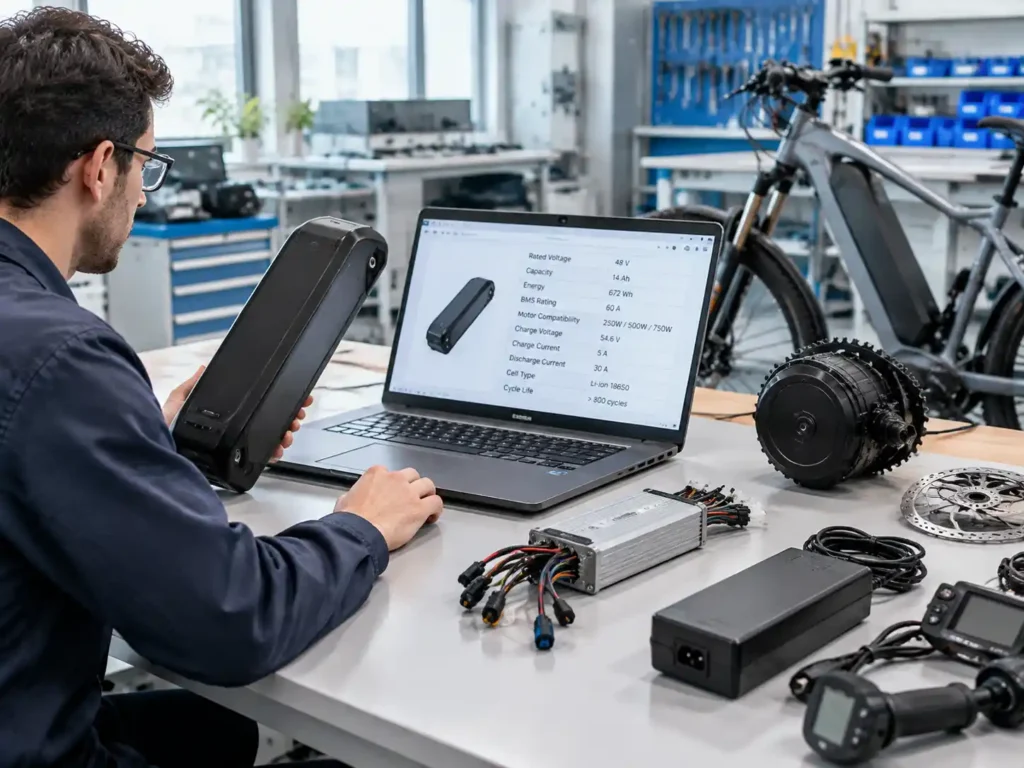
Amp-hours (Ah) describe how much charge a pack holds. Watt-hours (Wh) describe how much energy it stores, and Wh is the number that tells you range. Wh equals nominal voltage multiplied by Ah. A 48V 20Ah pack and a 36V 20Ah pack therefore share an Ah rating but store different amounts of energy.
Comparing packs on Ah alone leads to mistakes, because a lower-Ah pack at higher voltage can carry more energy than a higher-Ah pack at lower voltage. Convert to Wh before comparing range.
BMS current and controller matching
The battery management system, or BMS, protects the pack from overcharge, over-discharge, over-current, and short circuit. Its continuous discharge rating determines how much current the pack can deliver, and that rating has to meet or exceed what the controller and motor draw at peak.
A pack with a 20A BMS on a controller that pulls 30A under load will trip or overheat. This is a common cause of battery cut-out complaints on hills, and it is a specification mismatch, not a defective pack. When comparing options, check the BMS discharge rating against the controller’s peak current rather than its nominal current.
Motor power compatibility
Motor power, measured in watts, sets the current demand the pack has to supply at the chosen voltage. Higher-wattage motors need higher current capability, which means a pack with a higher BMS rating. Some supplier platforms express this as a motor compatibility range, such as 250W to 5000W depending on configuration, so the buyer can match the pack to the build instead of picking a fixed model. The motor rating, controller current, and BMS rating all have to line up.
Charger and charge voltage
The charger has to match both the pack voltage and the chemistry’s charge profile. A 48V pack charged to 54.6V needs a charger that tops out at that voltage, and the charge current has to stay within the pack’s rating, commonly 2A, 3A, or 5A depending on the configuration. A mismatched charger is a safety issue rather than a performance one. Fast charging is possible, but it should be specified deliberately because it affects cell heating and long-term life.
How to match a battery to your e-bike platform
Matching is where the specification meets the actual bike. Start from the platform and work outward, not from a battery catalogue.
Decide by bike type
A commuter bike prioritizes a low, centered downtube pack with enough capacity for a daily round trip. A light assist or city bike often suits a compact water bottle pack that keeps the bike looking conventional. A cargo or utility bike usually needs a high-capacity rear rack pack, where range and carrying capacity outweigh handling. Start with how the bike is used and the format narrows itself.
Decide by controller current
The controller defines the current ceiling the pack has to support. Read the controller’s continuous and peak current ratings, then select a BMS that exceeds them with margin. This step alone rules out many unsuitable packs before any other comparison.
Decide by range target
Convert the range requirement into watt-hours. If a rider needs a 40-kilometer round trip at a defined assist level, estimate the Wh that trip consumes, then add margin for hills, cold weather, battery aging, and assist use. Ah figures alone will not tell you whether a pack meets the target. Wh will.
Decide by installation space
The frame envelope is the hard constraint. Measure the available length, diameter, and clearance of the intended mount before selecting a pack. Downtube packs are usually model-specific, while bottle, silver fish, and rack formats are more forgiving. Confirming the mechanical envelope early avoids the most expensive kind of late-stage redesign.
LiFePO4 vs NCM: which fits which application
The chemistry choice comes down to how the bike will be used and what the buyer values most. Neither chemistry is better across the board. They optimize for different priorities.
Safety and thermal stability
LiFePO4 has a more stable chemistry with a higher thermal runaway threshold, which gives it a larger safety margin. NCM delivers higher energy density but is less thermally forgiving, so a well-designed NCM pack depends on a robust BMS and sound pack construction. For large stationary packs or high-safety applications, LiFePO4 is often specified for this reason. In e-bike applications, both chemistries operate safely when the pack design and BMS are correct.
Cost structure
LiFePO4 generally has a lower cost per kilowatt-hour at the cell level and a longer cycle life, which lowers cost per cycle over the life of the product. NCM cells cost more per unit of energy but deliver more energy per kilogram, which reduces the weight penalty for a given range. The cheaper chemistry is not always the cheaper product once weight, range, and battery count are accounted for.
Cold weather behavior
NCM performs better in cold conditions, retaining more usable capacity and delivering stronger current at low temperatures. LiFePO4 loses more usable capacity in the cold, which matters for seasonal markets. For e-bikes used year-round in cold climates, NCM is often the more practical choice. Charging below freezing is a separate constraint that applies to both chemistries and has to be handled by the BMS.
How to decide
Use NCM when the bike needs the best range-to-weight ratio and reliable cold-weather performance, which covers most commuter and performance e-bikes. Use LiFePO4 when safety margin and cycle life matter more than the weight penalty, which suits larger packs and high-utilization applications. For most e-bike platforms, NCM is the default and LiFePO4 is the deliberate alternative for specific use cases.
What to check before sourcing lithium e-bike battery packs
Between choosing a specification and signing with a supplier sits a set of checks that separate a reliable source from a risky one. Skipping them is a common way buyers end up with packs that pass a sample test and fail in the field.
Certifications
Lithium e-bike batteries and the bikes they power fall under a range of compliance requirements depending on the target market. UN 38.3 covers the transport testing every lithium battery shipment needs. UL 2271 addresses the battery pack, and UL 2849 addresses the electrical system of the e-bike. IEC standards apply in many international markets. Confirm which certifications a supplier can produce and that the certificates match the pack being purchased rather than a different model.
Cycle life data
Cycle life claims should come with test conditions. A figure of 800 to 1,000 cycles means little unless it states the depth of discharge, the temperature, and the capacity retention threshold used. Ask for the test method behind any cycle life number, and compare packs on the same basis.
Warranty terms
Warranty length signals confidence, but only if the terms are clear. Check what the warranty covers, how it is claimed, who pays return freight, and whether coverage applies to the pack or to the cells. A one-year warranty and a twelve-month warranty can behave very differently if the terms are not comparable.
OEM and ODM capability
If you are building your own brand or a model-specific bike, the supplier needs to support customization rather than only selling a fixed catalogue item. Look for documented OEM and ODM capability, the ability to adjust voltage, capacity, discharge grade, BMS rating, enclosure, and connectors, and a willingness to work from a specification rather than pushing a stock model. This often decides whether a supplier can serve a real program or only fill a one-off order.
Where VoltCrave Power fits
VoltCrave Power supplies lithium e-bike battery systems for OEM, ODM, and aftermarket buyers, across the formats and configuration options this guide covers.
Product coverage
The e-bike range covers the four common formats: downtube packs, water bottle packs, silver fish packs, and rack and multi-position configurations. Voltage options span 24V, 36V, 48V, and 52V, and capacity, discharge grade, BMS rating, and cell capacity can all be selected to match the platform rather than fixed in advance. A buyer can source a single pack family across multiple bike models instead of managing incompatible one-off parts.
Customization
VoltCrave Power accepts OEM and ODM projects, adjusting voltage, capacity, discharge grade, BMS rating, enclosure, connectors, and cell options to a defined specification. Sizing is customizable where the standard enclosure does not suit the frame, and charger options of 2A, 3A, or 5A are available depending on the configuration. The OEM and ODM battery development process covers how a custom pack moves from requirement to production.
Quality system
Packs move through incoming, in-process, final, and outgoing quality control, with cell-level validation before assembly. This matters for e-bike buyers because a pack that passes a sample test but drifts in production becomes a warranty problem. The battery manufacturing and pack assembly process stands behind the specifications on each data sheet.
If you are specifying an e-bike battery program, the next step is to define the voltage, Wh target, controller current, and mount format, then send those requirements for a quote and a matching sample.
FAQs
What voltage lithium e-bike battery do I need?
Match the battery voltage to your controller and motor. 24V suits light assist, 36V and 48V are the mainstream, and 52V suits higher-performance builds. A pack voltage that does not match the controller will not run the bike, and a pack voltage above the controller’s rating can damage it.
How do I calculate the range of a lithium e-bike battery?
Convert the pack to watt-hours by multiplying nominal voltage by amp-hours, then compare that against the Wh your trip consumes at your chosen assist level. Wh, not Ah, determines range. Add margin for hills, cold, and battery aging.
What is the difference between NCM and LiFePO4 e-bike batteries?
NCM offers higher energy density, lower weight for a given range, and better cold-weather performance, and it is the mainstream e-bike chemistry. LiFePO4 offers a more stable chemistry and longer cycle life but weighs more for the same energy. Most e-bikes use NCM, while LiFePO4 suits high-safety, high-cycle applications.
How long does a lithium e-bike battery last?
The e-bike packs in current production typically rate between 800 and 1,000 cycles to 80 percent capacity, and some configurations exceed this. Calendar life and how the pack is charged and stored also affect how long it lasts, so cycle rating alone is not the whole picture.
What size BMS does my e-bike battery need?
The BMS continuous discharge rating should exceed the controller’s peak current with margin. A BMS rated below what the controller draws under load will trip or overheat, which is a common cause of batteries cutting out on hills.
Can I use a different charger with my e-bike battery?
Only if it matches both the pack voltage and the charge current the pack is rated for. A 48V pack charged to 54.6V needs a charger with the same top voltage, and the charge current has to stay within the pack’s rating. A mismatched charger is a safety risk rather than a performance issue.
Final checklist
Before committing to a lithium e-bike battery, confirm the following.
- The pack format fits the frame and the intended mount position.
- The nominal voltage matches the controller and motor rating.
- The BMS discharge rating exceeds the controller’s peak current.
- The Wh, not just the Ah, meets the range target with margin.
- The chemistry suits the application, with NCM for range and weight and LiFePO4 for safety and cycle life.
- The charger matches the pack voltage and charge current.
- Certifications cover the target market and match the exact pack being purchased.
- Cycle life data comes with test conditions you can compare.
- Warranty terms are clear on coverage, claims, and freight.
- The supplier supports the customization your program needs.
Those ten points decide whether the battery becomes a component you can plan around or a recurring warranty item.
Need help matching this topic to a real battery project?
Send your target application, capacity range, certification market, and order plan. VoltCrave can recommend a practical product direction.