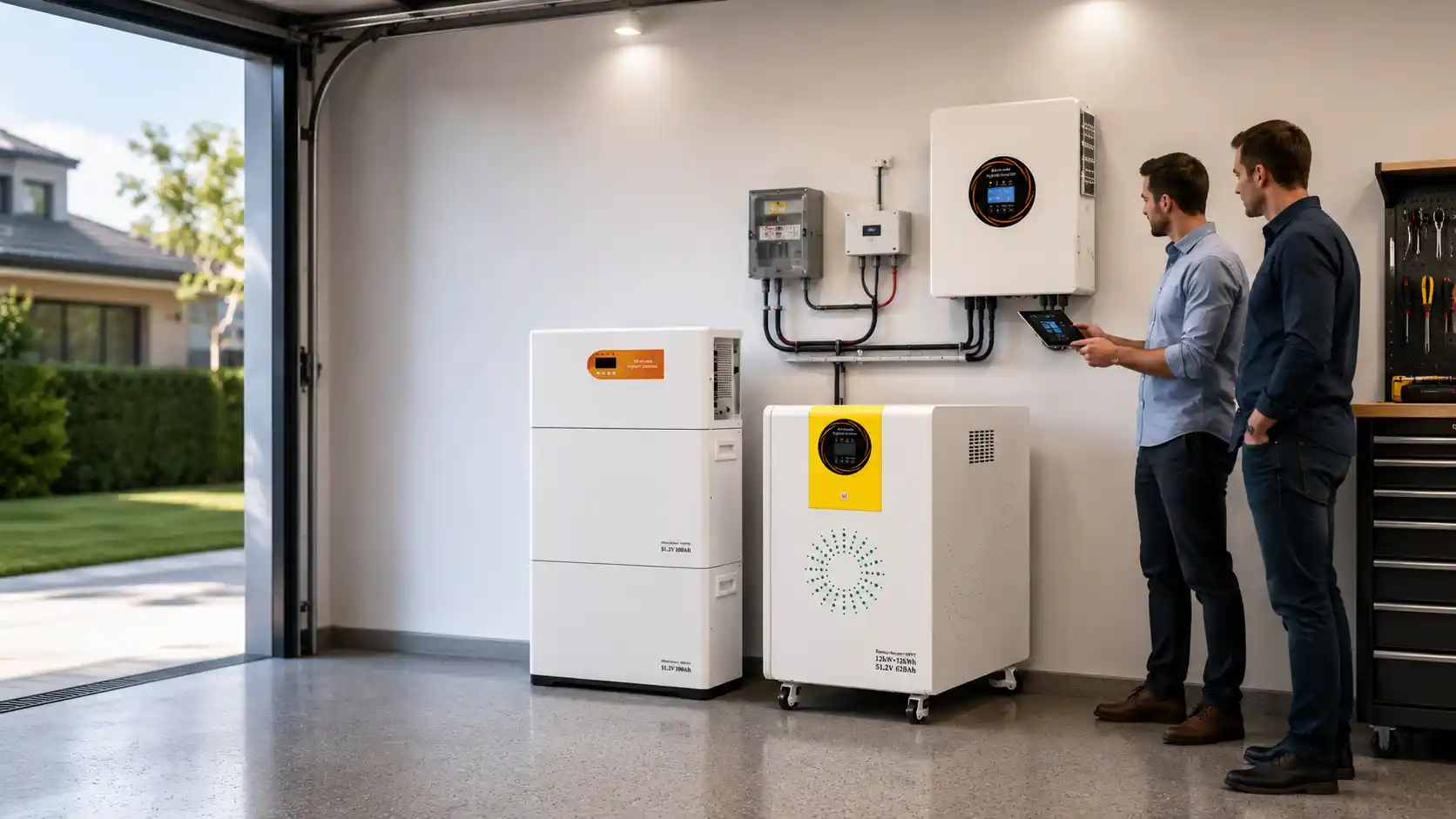
Finding a home battery storage manufacturer is relatively easy. Determining whether that company can support a reliable residential energy storage business is much more difficult.
For distributors, solar installers, private-label brands, importers, and energy-storage companies, supplier evaluation should go beyond battery capacity, product appearance, and quotation price. A residential battery must operate as part of a larger system involving the BMS, inverter, communication protocols, safety protection, installation requirements, monitoring, and after-sales support.
The right supplier therefore depends not only on the product itself, but also on engineering capability, manufacturing consistency, documentation, system compatibility, customization scope, and the ability to support repeat orders.
If you are still building an initial shortlist rather than evaluating specific suppliers, first compare leading home battery manufacturers.
Once several candidates have been shortlisted, the following framework can help determine which supplier is better suited to long-term B2B cooperation.
What Type of Home Battery Supplier Are You Evaluating?
Before comparing factories or requesting quotations, determine what type of supplier you actually need.
The residential energy storage market contains several different business models, and they should not be evaluated using exactly the same criteria.
| Supplier Type | Typical Business Model | Main Advantage | Best Fit |
|---|---|---|---|
| Established residential energy brand | Own-brand battery ecosystem | Mature product and market presence | Installers and branded distribution |
| OEM manufacturer | Existing platforms manufactured for third parties | Private-label flexibility | Distributors and importers |
| ODM manufacturer | Manufacturer provides deeper engineering support | Product differentiation | Established private-label brands |
| ESS system integrator | Battery, inverter and control-system integration | Complete-system support | Solar and energy companies |
| Trading supplier | Sources products from multiple manufacturers | Broad sourcing access | Buyers prioritizing product variety |
None of these models is automatically better.
A solar installer may value a mature integrated ecosystem with simple commissioning and monitoring.
A distributor building its own brand may care more about product continuity, labeling, documentation, inverter compatibility, and OEM support.
An established energy-storage brand may require deeper ODM development involving BMS communication, enclosure changes, software, electrical architecture, or market-specific system integration.
The first question should therefore be:
Are you distributing an existing system, private-labeling an existing platform, or developing your own residential ESS product line?
That answer determines how the manufacturer should be evaluated.
How to Evaluate a Home Battery Storage Manufacturer
A professional supplier assessment should cover technical, manufacturing, commercial, and after-sales factors.
No single specification can tell you whether a manufacturer is suitable.
Engineering Capability
Residential ESS engineering extends beyond assembling battery cells into a cabinet.
Depending on the product architecture, engineering may involve:
- Battery-pack design
- BMS development
- Electrical protection
- Thermal management
- High- or low-voltage architecture
- Inverter communication
- Firmware
- Monitoring
- Mechanical design
- Parallel operation
- Backup functionality
- System commissioning
The level of engineering support required depends on the project.
A buyer selecting an existing product platform may only need technical documentation and compatibility support.
A deeper ODM project may require coordinated changes across several subsystems.
When evaluating engineering capability, ask whether the supplier can explain the consequences of a requested change.
For example, changing battery voltage or BMS communication may affect inverter compatibility. Changing the enclosure may affect thermal performance or existing compliance documentation.
A technically credible manufacturer should not respond to every request with:
“Yes, no problem.”
It should also be able to explain limitations, risks, required validation, and whether the requested modification is commercially reasonable.
Manufacturing Capability
A large factory does not automatically mean strong production control.
The more important question is whether the manufacturer can repeatedly build the same approved product with consistent components, assembly processes, firmware, inspection criteria, and documentation.
For residential batteries, buyers should understand how the manufacturer controls stages such as:
- Incoming materials
- Cell or module inspection
- Battery-pack assembly
- BMS installation
- Wiring
- Structural assembly
- Firmware configuration
- Functional testing
- Final inspection
- Packaging
Production traceability becomes increasingly important as order volume grows.
If a field issue appears later, the supplier should ideally be able to identify the relevant product batch, component version, firmware version, and production records.
Buyers evaluating VoltCrave Power’s production background can review its advanced battery and energy storage manufacturing capabilities.
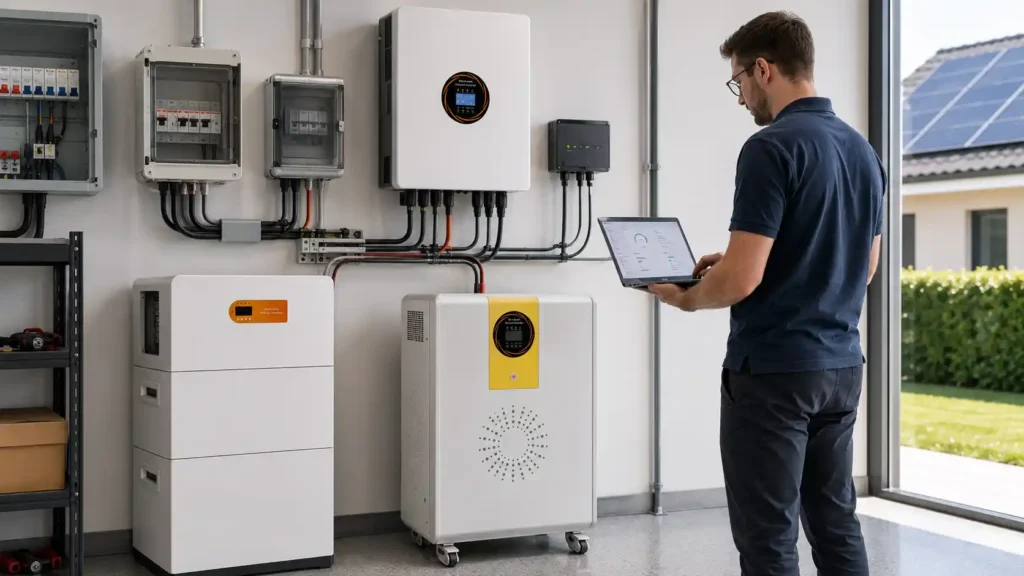
Battery and BMS Capability
Battery chemistry is important, but chemistry alone does not determine residential ESS quality.
LiFePO4 is widely used in residential energy storage because of its thermal-stability characteristics and cycle-life potential. Actual operational lifespan, however, depends on factors such as cell quality, depth of discharge, operating temperature, current, pack design, BMS strategy, and the manufacturer’s test conditions.
Therefore, avoid treating statements such as:
“LiFePO4 battery”
or
“long cycle life”
as sufficient product evaluation.
Instead, review the complete battery architecture.
Important questions include:
- What battery chemistry does the exact model use?
- How is the pack configured?
- How is cell consistency controlled?
- How does the BMS monitor voltage and temperature?
- What charge and discharge protections are implemented?
- How is current limited?
- How is battery balancing handled?
- How are fault conditions communicated?
- How are firmware versions controlled?
For high-voltage residential batteries, module communication and system-level BMS architecture become even more important.
The battery should therefore be evaluated as an engineered system rather than a group of cells.
Inverter Compatibility
For many B2B residential ESS projects, inverter compatibility is one of the most important supplier-selection criteria.
A battery and inverter may both work well independently but still fail to operate correctly together if voltage ranges, current limits, communication protocols, firmware, or operating logic are not compatible.
Buyers should verify:
- Supported inverter brands or platforms
- CAN or RS485 communication where applicable
- Battery voltage range
- Charging and discharging current limits
- Firmware requirements
- Communication protocol version
- Parallel configuration requirements
- Approved compatibility lists
Do not assume that an inverter is compatible simply because both products use the same communication interface.
A CAN connection does not mean two products automatically understand the same protocol.
For distributors operating across multiple markets, compatibility breadth can directly influence how easily a battery platform can be added to an existing inverter portfolio.
Quality Control
Quality control should be evaluated as a process rather than a marketing statement.
A supplier saying:
“Every battery is tested.”
does not explain what was tested or how the result was recorded.
A more useful assessment considers quality control across the entire production process.
Depending on the product, this may include:
- Incoming component inspection
- Battery-module checks
- BMS verification
- Electrical connection inspection
- Charge and discharge testing
- Communication testing
- Protection-function testing
- Display and interface checks
- Aging or functional testing
- Final inspection
Buyers should ask:
What are the acceptance criteria?
How are failures recorded?
What happens to a failed unit?
Can production records be traced to a batch?
The purpose is not to demand unnecessary testing.
It is to determine whether the supplier has a repeatable quality system capable of supporting commercial-scale shipments.
Certification Support
Residential energy storage products can face different regulatory and certification requirements depending on the country, product architecture, inverter configuration, battery system, and installation environment.
A supplier should understand the difference between:
having general certification experience
and
having applicable documentation for the exact model being supplied.
This distinction is critical.
Certification should therefore be evaluated at the model and configuration level.
We cover the specific document-verification process later in this article.
After-Sales Support
Residential energy storage has a much longer customer relationship than many ordinary consumer products.
A distributor may still need technical support years after the first shipment.
Supplier evaluation should therefore include:
- Warranty process
- Failure diagnosis
- Replacement-part availability
- BMS or firmware support
- Remote technical assistance
- Documentation updates
- Spare units or parts strategy
- Product-version management
- Discontinued-model support
After-sales capability becomes particularly important for installers and distributors because the end customer usually contacts the local seller first.
A poorly defined manufacturer warranty process can therefore become the distributor’s own operational problem.
What Global Distributors Should Expect From a Home Energy Storage Supplier
Global distributors have different priorities from individual homeowners.
They are not buying one battery.
They are building a product category that must remain supportable across multiple shipments, installers, end users, and possibly several years.
A professional home energy storage supplier should therefore support more than product delivery.
Stable Product Platforms
Frequent unannounced product changes create problems for distributors.
If the BMS, inverter protocol, connector, enclosure, firmware, or internal configuration changes between production batches, existing technical documentation and installation procedures may become outdated.
Distributors should understand how product revisions are managed and communicated.
Consistent Documentation
B2B buyers may require documents covering:
- Product datasheets
- Installation manuals
- User manuals
- Wiring diagrams
- Communication information
- Packaging specifications
- Warranty terms
- Compliance documentation
- Troubleshooting procedures
These materials need to remain consistent with the product being delivered.
Inverter Ecosystem Support
Many distributors already sell one or more inverter brands.
A battery manufacturer that supports a practical range of inverter platforms can therefore be easier to integrate into an existing sales channel.
However, the number of compatible inverter brands should not be treated as the only metric.
Compatibility must also remain stable across firmware and product generations.
Market-Specific Configuration
Residential ESS requirements vary between markets.
Differences may involve:
- Electrical architecture
- Nominal voltage
- Inverter selection
- Grid environment
- Installation practice
- Backup expectations
- Communication
- Labels
- Packaging
- Documentation
- Compliance
A supplier should understand that “the same battery for every country” is not always the best strategy.
Product Continuity
A distributor investing in product training, inventory, installer relationships, and marketing needs reasonable confidence that the product platform will remain available.
Product continuity is therefore a commercial consideration as well as a manufacturing one.
Warranty and Technical Response
When a system fails in the field, the distributor needs a practical process for diagnosis and resolution.
That may involve log analysis, BMS information, firmware support, replacement modules, spare parts, or complete product replacement depending on the issue.
The exact process varies by supplier, but it should be understood before large-scale distribution begins.
Certification Documents Buyers Should Verify
Certification claims should never be evaluated only from a sales brochure.
The required documentation depends on the exact residential ESS configuration and the market where the system will be installed.
Depending on the product and region, documentation may involve:
- Battery safety
- ESS safety
- Electrical safety
- EMC
- Transportation requirements
- Environmental compliance
- Regional grid or installation requirements
- Inverter-related compliance
The correct document set should be determined for the specific product and market.
When checking a report or certificate, review details such as:
Model number
Does it match the product being quoted?
Manufacturer or applicant
Does the company name correspond to the supplier or relevant manufacturing entity?
Product description
Does the tested product architecture match the offered system?
Referenced standard
Is it relevant to the target market and product type?
Report or certificate number
Can it be traced to supporting documentation?
Product variants
Are additional capacities or configurations actually covered?
OEM modification can also affect compliance.
A change that appears commercially minor—such as an enclosure, internal component, inverter, BMS, or electrical configuration—may require further review.
VoltCrave Power provides an overview of available residential energy storage certification and compliance documentation.
The final certification plan should still be confirmed against the exact model and target market.
Battery Technology and System Compatibility
Residential ESS procurement increasingly involves system-level decisions.
The battery cannot be evaluated separately from:
- Inverter
- BMS
- PV system
- Backup architecture
- Monitoring platform
- Load requirements
- Installation environment
Low-Voltage vs High-Voltage Batteries
Low-voltage and high-voltage systems use different architectures and are not interchangeable.
Low-voltage batteries are common in many residential applications and can offer straightforward modularity.
High-voltage systems can be attractive where the inverter architecture and system design benefit from higher DC voltage.
The correct choice depends on inverter platform, system capacity, installation requirements, and target market.
Neither architecture should be described as universally better.
Wall-Mounted vs Stackable Batteries
Wall-mounted batteries can suit installations where floor space is limited and a clean residential appearance is important.
Stackable systems can provide convenient modular capacity expansion.
The choice should reflect installation practice rather than visual preference alone.
Battery-Only vs All-in-One ESS
Battery-only platforms allow buyers or installers to combine the battery with compatible external inverters.
All-in-one systems can simplify product selection by integrating more of the energy-storage architecture.
The best option depends on whether the buyer values:
platform flexibility
or
system integration.
Communication Compatibility
Communication should be treated as a technical requirement, not a connector requirement.
Two devices using CAN or RS485 are not automatically compatible.
Protocol, firmware, addressing, operating logic, and supported commands must match.
This is one of the areas where a technically capable supplier can provide significant value to a distributor or system integrator.
OEM vs ODM vs Private Label
These cooperation models should be clarified before discussing customization.
Private Label
Private-label projects typically begin with an existing product platform.
Possible changes may include:
- Branding
- Labels
- Packaging
- Manuals
- Selected exterior options
This is often the lowest-risk route for a distributor entering a new residential ESS market.
OEM
OEM cooperation generally involves production according to agreed buyer requirements.
Depending on the manufacturer, this can include selected changes to product configuration, appearance, communication, documentation, or accessories.
The term OEM is used differently across the industry, so the actual customization scope should always be defined clearly.
ODM
ODM development typically involves deeper engineering participation from the manufacturer.
Possible changes may include:
- BMS logic
- Communication protocol
- Battery configuration
- Enclosure design
- Electrical architecture
- Firmware
- Interfaces
- Integrated inverter configuration
- System functions
Deeper customization should only be pursued when there is a clear commercial reason.
Every technical change creates additional validation and product-management requirements.
For many new distributors, a proven existing platform with limited customization can offer a faster and lower-risk route to market.
Buyers looking at available product architectures can explore VoltCrave Power’s residential ESS product line.
MOQ Should Be Evaluated by Project Scope
MOQ should not be treated as one fixed number for every home battery project.
MOQ varies by product platform, customization depth, and project requirements. Buyers should confirm the current MOQ for the specific model and cooperation type.
A standard product with packaging customization and a deeply engineered ODM project should not be expected to follow identical commercial requirements.
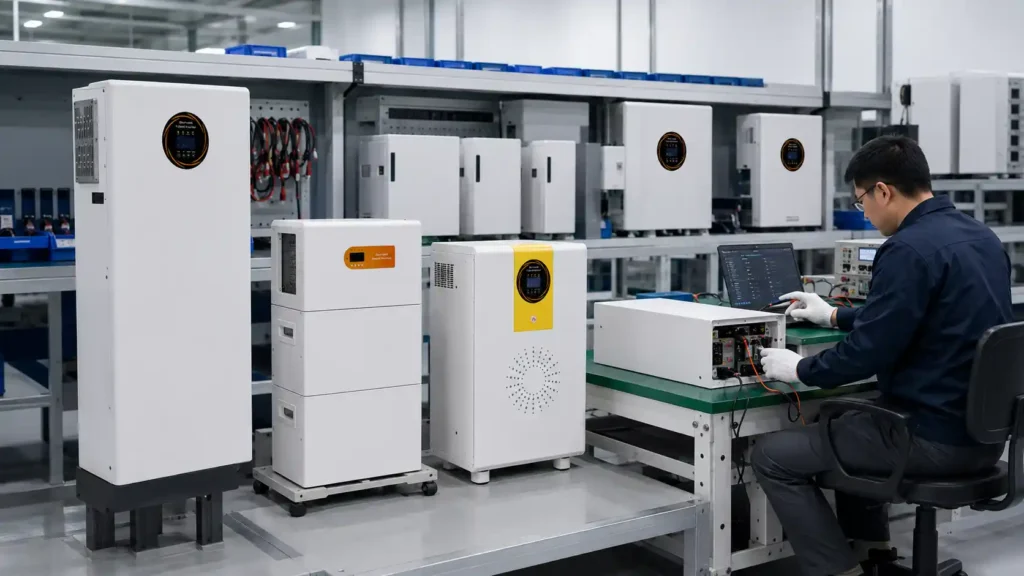
Sample and Pilot Order Evaluation
A sample is one of the most important stages between supplier selection and mass production.
However, the purpose of the sample should be broader than checking appearance.
For a residential battery, sample evaluation can include:
- Product dimensions
- Installation method
- Battery capacity
- Charging and discharging behavior
- BMS functions
- Inverter communication
- Monitoring
- Connectors
- Cabling
- User interface
- Documentation
- Packaging
- Thermal behavior
- Backup operation where applicable
The sample should be tested with the actual or intended inverter platform whenever possible.
A battery that operates correctly in a laboratory demonstration but cannot communicate reliably with the inverter used by local installers is not yet a commercially ready solution.
Why a Pilot Order Can Be Useful
A single sample does not always reveal manufacturing variability.
For customized projects, pilot production can help confirm that:
- Approved components are used consistently
- Firmware matches the approved version
- Labels are correct
- Packaging is repeatable
- Communication remains stable
- QC criteria are implemented
- Production documents match the product
The purpose of pilot production is not to add unnecessary complexity.
It is to identify production-scale problems before they become large shipment problems.
Common Supplier Selection Mistakes
Mistake 1: Choosing the Lowest Quotation
A lower initial price can become expensive if the supplier later creates warranty claims, technical delays, certification issues, compatibility problems, or inconsistent production.
Price comparison is meaningful only when the products and cooperation scope are genuinely comparable.
Mistake 2: Comparing Different Product Architectures as if They Were Equal
Two “10 kWh home batteries” may have completely different:
- Voltage architecture
- Battery chemistry
- Inverter compatibility
- BMS functions
- Installation method
- Enclosure design
- Communication
- Certification scope
- Expandability
Capacity alone does not make two systems equivalent.
Mistake 3: Evaluating Only the Battery Cell
Cell quality matters, but residential ESS reliability also depends on BMS design, electrical protection, pack construction, thermal management, firmware, communication, and integration.
The battery should be assessed as a complete product.
Mistake 4: Ignoring Inverter Compatibility Until After Purchase
Compatibility should be confirmed during product selection.
Trying to solve protocol or firmware problems after batteries arrive in the destination market creates unnecessary risk.
Mistake 5: Accepting Generic Certification Statements
Statements such as:
“We have CE.”
or
“The product is certified.”
are not enough.
Verify documents for the specific product and intended market.
Mistake 6: Over-Customizing the First Project
A completely redesigned enclosure, new BMS logic, new inverter integration, new firmware, and new electrical architecture may look attractive on paper.
But every change adds engineering, validation, production, and compliance risk.
Customization should be proportional to the commercial opportunity.
Mistake 7: Ignoring After-Sales Operations
A battery warranty is useful only if there is a realistic process behind it.
Before ordering, understand how technical failures will be diagnosed, how replacement components will be handled, and who is responsible for customer-facing support.
Home Battery Manufacturer Evaluation Checklist
Before selecting a supplier, B2B buyers can use the following checklist as a final screening framework.
| Evaluation Area | Questions to Confirm |
|---|---|
| Supplier model | Brand, OEM, ODM, manufacturer, integrator, or trader? |
| Product architecture | LV, HV, wall-mounted, stacked, battery-only, or all-in-one? |
| Battery chemistry | What chemistry and exact pack configuration are used? |
| BMS | What protection, communication, and monitoring functions are supported? |
| Inverter compatibility | Which inverter platforms and protocol versions are validated? |
| Engineering | Can the supplier explain modification feasibility and limitations? |
| Manufacturing | How are incoming materials, assembly, and final testing controlled? |
| Traceability | Can finished units be linked to production and component batches? |
| Certification | Does documentation match the exact model and target market? |
| OEM/ODM | What customization is actually supported? |
| Documentation | Are datasheets, manuals, wiring information, and technical files available? |
| Sample testing | Can the buyer validate the battery with the intended inverter? |
| Pilot production | Is a pre-production stage appropriate for the project? |
| Product continuity | How are revisions and discontinued models managed? |
| After-sales | How are diagnosis, warranty, replacement, and technical support handled? |
| MOQ | Is the requirement appropriate for the selected product and customization scope? |
A strong supplier does not necessarily need to provide the most complex answer in every category.
The important point is that the answers should be clear, consistent, technically credible, and appropriate for the buyer’s actual project.
FAQs
How do I choose a home battery storage manufacturer?
Start by defining the product architecture and business model you need. Then compare engineering capability, battery and BMS design, inverter compatibility, manufacturing control, certification support, OEM/ODM scope, product continuity, and after-sales service.
What should global distributors look for in a home energy storage supplier?
Distributors should pay particular attention to stable product platforms, technical documentation, inverter compatibility, regional compliance support, product continuity, warranty processes, and repeat-order consistency.
Is LiFePO4 suitable for residential energy storage?
LiFePO4 is widely used in residential ESS because of its thermal-stability characteristics and cycle-life potential. Actual performance still depends on cell quality, BMS design, thermal conditions, depth of discharge, charging strategy, and complete battery-pack engineering.
How important is inverter compatibility?
It is critical when the battery and inverter are supplied separately. Voltage, current, communication protocols, firmware, and operating logic must be compatible. A shared CAN or RS485 interface alone does not guarantee compatibility.
What is the difference between an OEM and ODM home battery manufacturer?
OEM cooperation generally involves manufacturing to agreed buyer requirements, often using an existing platform. ODM projects usually involve deeper manufacturer-led engineering and product customization. The exact scope should always be defined because suppliers may use these terms differently.
Should I test a home battery sample before placing a bulk order?
Yes. Sample evaluation can help verify electrical performance, BMS functions, inverter communication, installation, monitoring, documentation, packaging, and real application compatibility before mass production.
Do all products from one battery manufacturer have the same certifications?
No. Compliance documentation should be reviewed at the exact model and configuration level. A manufacturer having certification experience does not mean every product automatically carries the same documentation.
What MOQ should I expect for a residential battery project?
MOQ depends on the product platform, customization depth, packaging, engineering requirements, and cooperation model. Buyers should confirm the current MOQ for the specific product and project rather than relying on a universal number.
Conclusion
Evaluating a home battery storage manufacturer requires more than comparing battery capacity and quotations.
For global B2B buyers, the more important questions are whether the manufacturer can provide a technically suitable battery platform, maintain consistent production, support the required inverter ecosystem, provide appropriate compliance documentation, and continue supporting the product after it reaches the market.
Engineering, BMS architecture, system compatibility, manufacturing control, documentation, OEM capability, and after-sales support should therefore be evaluated together.
A distributor seeking a private-label battery has different requirements from an installer choosing an established integrated ecosystem. An experienced energy-storage company developing a customized residential platform will have different requirements again.
The objective is not to find a manufacturer that claims to be suitable for every project.
It is to identify the supplier whose technical capabilities, manufacturing model, product architecture, and commercial support match the residential ESS business you intend to build.
Once your technical and commercial requirements are defined, you can contact VoltCrave Power for residential ESS project evaluation and B2B sourcing support.
Need help matching this topic to a real battery project?
Send your target application, capacity range, certification market, and order plan. VoltCrave can recommend a practical product direction.