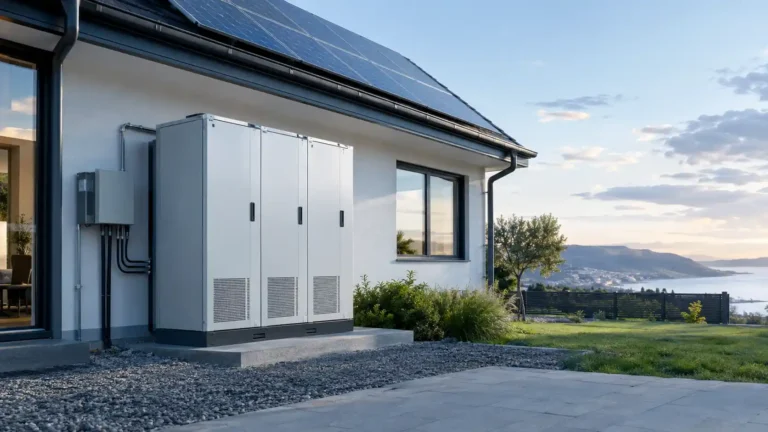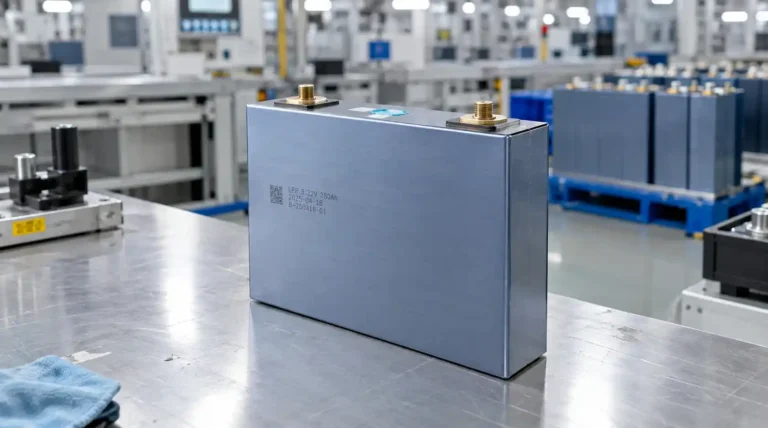
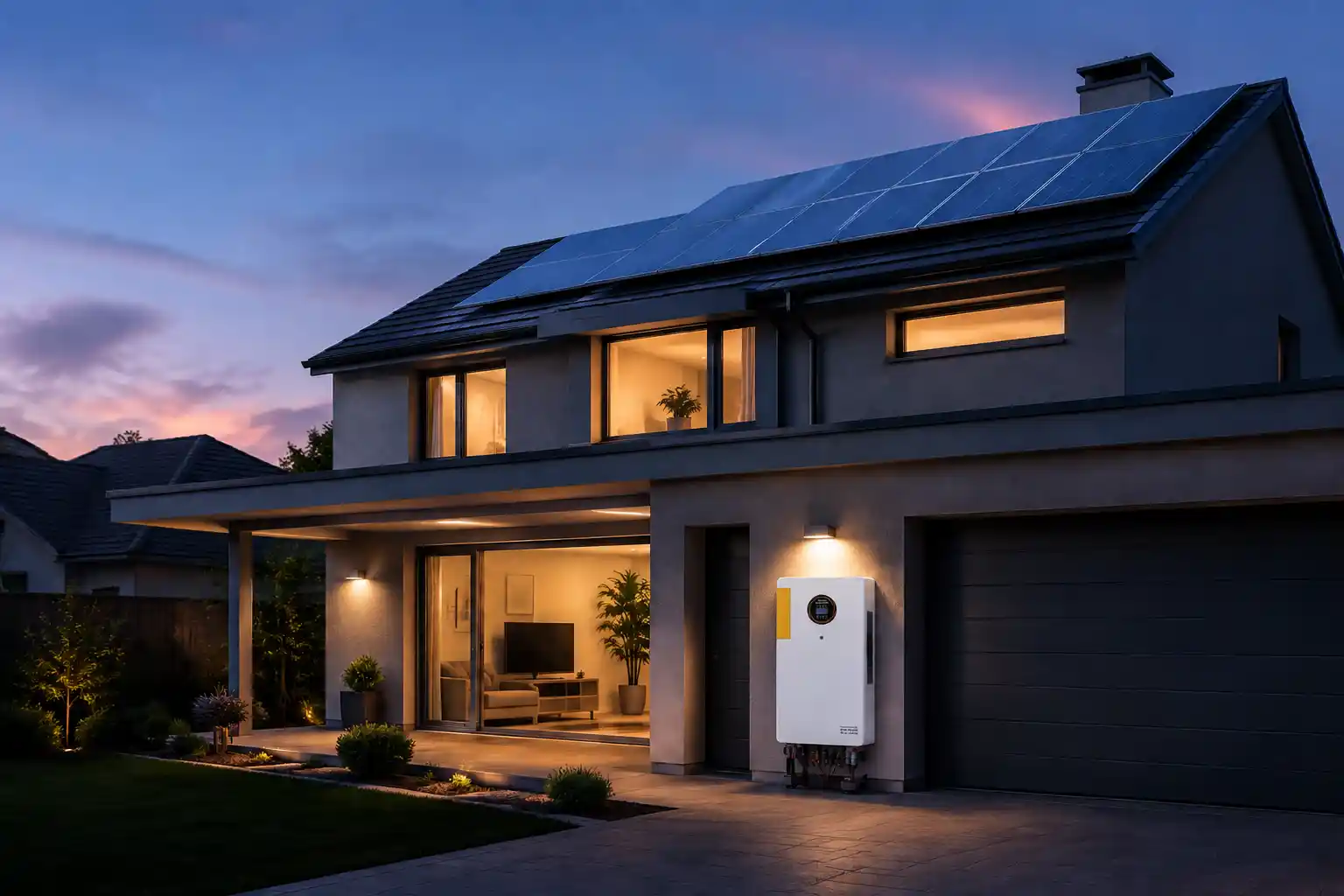
There’s no single answer to “how long will a solar battery power a house.” A 10kWh battery can keep a fridge, Wi-Fi and a few lights running for close to a day — or drain in under three hours if it’s also carrying a central air conditioner. The real answer depends on four things: how much usable energy the battery actually holds, how much power your home is drawing, how the inverter handles that load, and whether solar panels can keep feeding the battery while the grid is down.
This guide walks through the math, gives worked examples for common battery sizes, and covers the parts most runtime articles skip — like why “10kWh” on a spec sheet rarely means 10kWh of usable energy, and why having solar panels doesn’t automatically mean they’ll charge your battery during an outage.
Quick answer: Under a light “essentials” load (fridge, Wi-Fi, lighting, phone charging — roughly 400W average), a 10kWh battery typically delivers around 20–22 hours of backup. Add a central air conditioner or electric water heater, and that same battery may last only 2–4 hours. Capacity alone doesn’t determine runtime — load does.
How Long Can a Solar Battery Power a House?
The table below gives rough runtime ranges across common battery sizes, assuming a fairly steady average load rather than one big appliance cycling on and off. Treat these as a starting point for sizing conversations, not a guarantee for any specific home.
| Battery Size (rated) | Typical Use Case | Illustrative Average Load | Approx. Runtime* |
|---|---|---|---|
| 5 kWh | Wi-Fi, lighting, phone charging | ~0.25 kW | ~15–18 hours |
| 10 kWh | Fridge + essentials | ~0.4 kW | ~20–22 hours |
| 15 kWh | Essentials + home office | ~0.75 kW | ~16–17 hours |
| 20 kWh | Essentials + partial home | ~1 kW | ~16–17 hours |
| 30 kWh | Larger partial-home backup | ~2 kW | ~12–13 hours |
Illustrative estimates only. They assume roughly 90% usable depth of discharge and typical conversion losses, and a steady average load rather than appliance cycling. Actual runtime depends on your battery’s stated usable capacity, your home’s real load profile, and your inverter’s rated output.
What Actually Determines Battery Runtime
Usable capacity isn’t the number on the label
A “10kWh” battery doesn’t give you 10kWh to work with. Two things eat into that number before it reaches your appliances:
- Depth of discharge (DoD): most LiFePO4 systems are rated to discharge to around 90% before the BMS cuts off, to protect cell life. That alone brings 10kWh down to 9kWh.
- Conversion losses: DC-to-AC inversion and cabling typically lose another 5–10%. Applied to that 9kWh, you’re realistically working with around 8.5kWh of usable energy.
Some manufacturers already publish “usable capacity” instead of raw rated capacity — in that case you don’t need to apply DoD again. Always check which figure is on the spec sheet before you run the math.
Average household load
This is the variable most sizing guides skate past. A fridge might be rated at 150W, but it’s not drawing 150W continuously — it cycles on and off, averaging maybe a third of that over a day. What matters for runtime isn’t any single appliance’s rating; it’s the blended average draw of everything running at once.
Inverter output and surge capacity
Your battery might hold plenty of energy, but the inverter has a ceiling on how much power it can deliver at any instant — and appliances with motors or compressors (AC units, well pumps, fridges) draw a brief surge, sometimes 2–3x their running wattage, when they start up. An inverter sized to the battery’s total energy but not to that surge will trip before the battery is anywhere near empty.
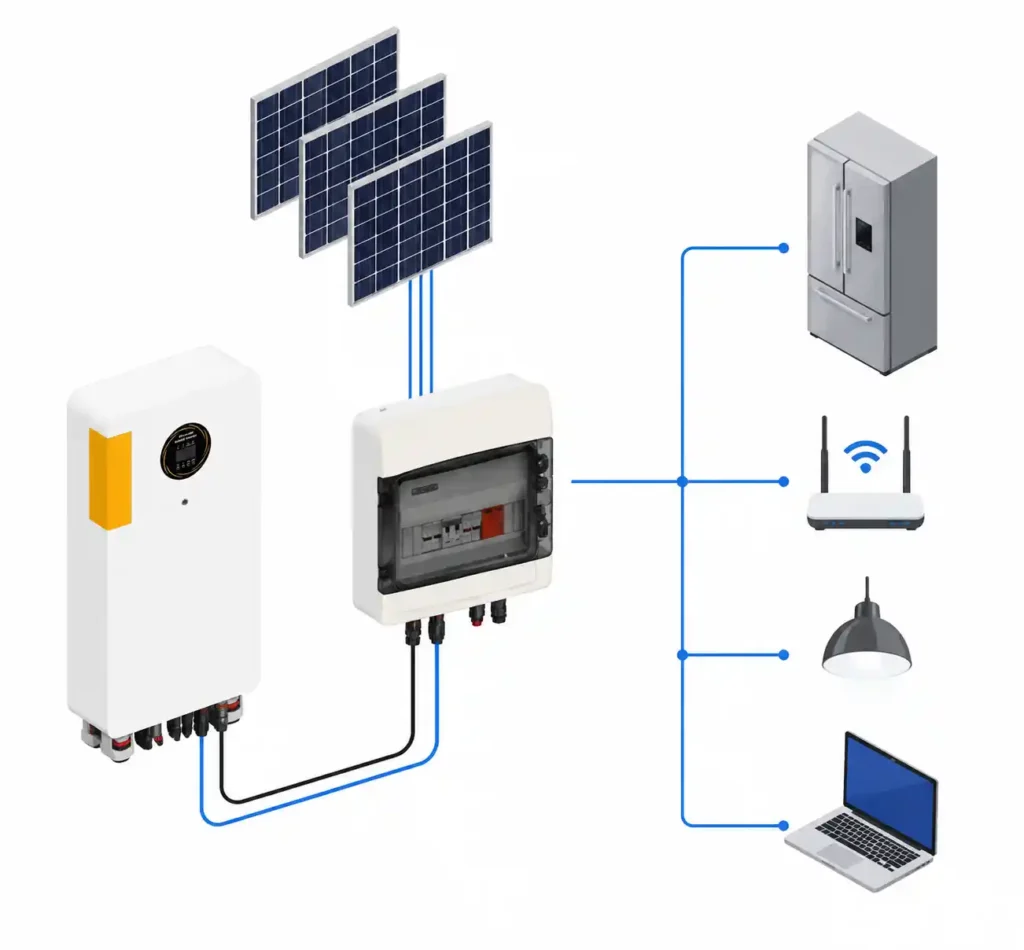
Solar recharge
If panels can keep feeding the battery during daylight, an outage that would otherwise drain the battery in a day can be stretched out indefinitely — but only if the system is built to allow it. More on that below, because it’s the part people get wrong most often.
How to Calculate Your Own Runtime
The formula is straightforward once you’re using the right starting number:
Runtime ≈ Usable Battery Energy ÷ Average Load
If you’re starting from the battery’s rated (not usable) capacity, expand it to:
Runtime ≈ (Rated Capacity × Usable DoD × Conversion Efficiency) ÷ Average Load
Worked example — a 10kWh battery at 90% DoD and 95% conversion efficiency, running a 400W average essentials load:
10 kWh × 0.90 × 0.95 = 8.55 kWh usable 8.55 kWh ÷ 0.4 kW = ~21.4 hours
Change the load and the answer changes fast — that’s the whole point of running the numbers yourself rather than relying on a single headline figure.
Example: A 10kWh Battery During an Outage
Same battery, three different load profiles:
Scenario A — Essentials only
Fridge, Wi-Fi router, eight LED bulbs, phone charging, a small TV. Average load around 0.4kW. Runtime: ~21 hours.
Scenario B — Essentials plus a home office
Add a laptop, monitor, and modem running continuously. Average load climbs to around 1kW. Runtime: ~8.5 hours.
Scenario C — Essentials plus air conditioning
A single room AC unit or a mini-split pushes average load to roughly 2.5–3kW once you factor in cycling. Runtime: ~3 hours.
These are illustrative, not universal — actual power draw varies by appliance, climate, and how efficiently a home is insulated. The takeaway that holds regardless: adding one high-draw appliance can cut runtime by 80% or more.
How Long Can a 20kWh Battery Power a House?
Using the same math (20kWh × 0.90 × 0.95 = 17.1kWh usable):
- Essentials only (~0.5kW average): roughly 34 hours
- Essentials + office + partial lighting load (~1.5kW): roughly 11 hours
- Essentials + central AC (~2.75kW): roughly 6 hours
A 20kWh system gives meaningfully more runway than 10kWh, but it doesn’t turn AC into an all-day backup load on its own — that generally needs both more capacity and a load-management strategy (see below).
Can a Solar Battery Run Central AC?
Usually, but not indefinitely, and not without planning for the surge. A 3-ton central AC unit typically runs somewhere in the 3,000–4,000W range once compressor cycling is factored in, with a startup surge that can briefly spike two to three times higher. Two things need to line up:
- The inverter’s continuous and surge output need to cover that startup spike, not just the running load.
- The battery needs enough usable capacity to sustain that draw for however long you actually need AC to run — which, at 3kW+, adds up fast even on a large battery.
Many residential backup systems handle this by putting AC on a separate, load-managed circuit rather than the always-on backup panel, so it only draws from the battery when there’s headroom.
Essential Loads vs. Whole-Home Backup
“Essential loads” (fridge, lighting, Wi-Fi, medical equipment, some outlets) is the more common backup target because it stretches a smaller battery much further. Whole-home backup — including AC, electric water heating, and other high-draw circuits — usually calls for 20–30kWh or more, but that range isn’t fixed. A small, well-insulated home with a heat pump may get by on less; a larger home with central AC and an electric water heater can draw down a 30kWh system in a matter of hours. The right number always comes back to the home’s actual load profile, not a rule of thumb.
Solar Battery Runtime by Appliance
These are illustrative running loads, not fixed industry figures — actual draw varies by appliance model, age, and efficiency rating.
| Appliance | Illustrative Running Load | Example Energy Use (1 hour) |
|---|---|---|
| LED lighting (per bulb) | ~9–12 W | ~0.01 kWh |
| Wi-Fi router | ~10–20 W | ~0.015 kWh |
| Efficient refrigerator | ~100–200 W (cycling) | ~0.15 kWh |
| Laptop + monitor | ~80–150 W | ~0.1 kWh |
| Microwave (in use) | ~1,000–1,300 W | ~0.2 kWh for 10 min use |
| Well pump | ~1,000–2,000 W | varies by run time |
| Central AC (3-ton, cycling) | ~3,000–4,000 W | ~3.5 kWh |
| Electric water heater element | ~3,500–4,500 W | ~4 kWh |
What determines battery size isn’t wattage alone — it’s wattage multiplied by how long the appliance actually runs. A microwave at 1,200W for ten minutes uses about 0.2kWh; the same load for five hours would use 6kWh. Size for energy use, not just peak draw.
What Happens to Runtime in Cold or Hot Weather?
LiFePO4 batteries lose some usable capacity and discharge rate in cold conditions, and most have a built-in low-temperature cutoff that limits charging below freezing unless the system has heating elements. High heat doesn’t cut runtime on a given day as much, but it accelerates long-term capacity fade if the battery regularly operates outside its rated temperature range. If backup power in extreme climates matters to you, check the battery’s operating temperature range and whether it includes active thermal management before relying on the runtime numbers above.
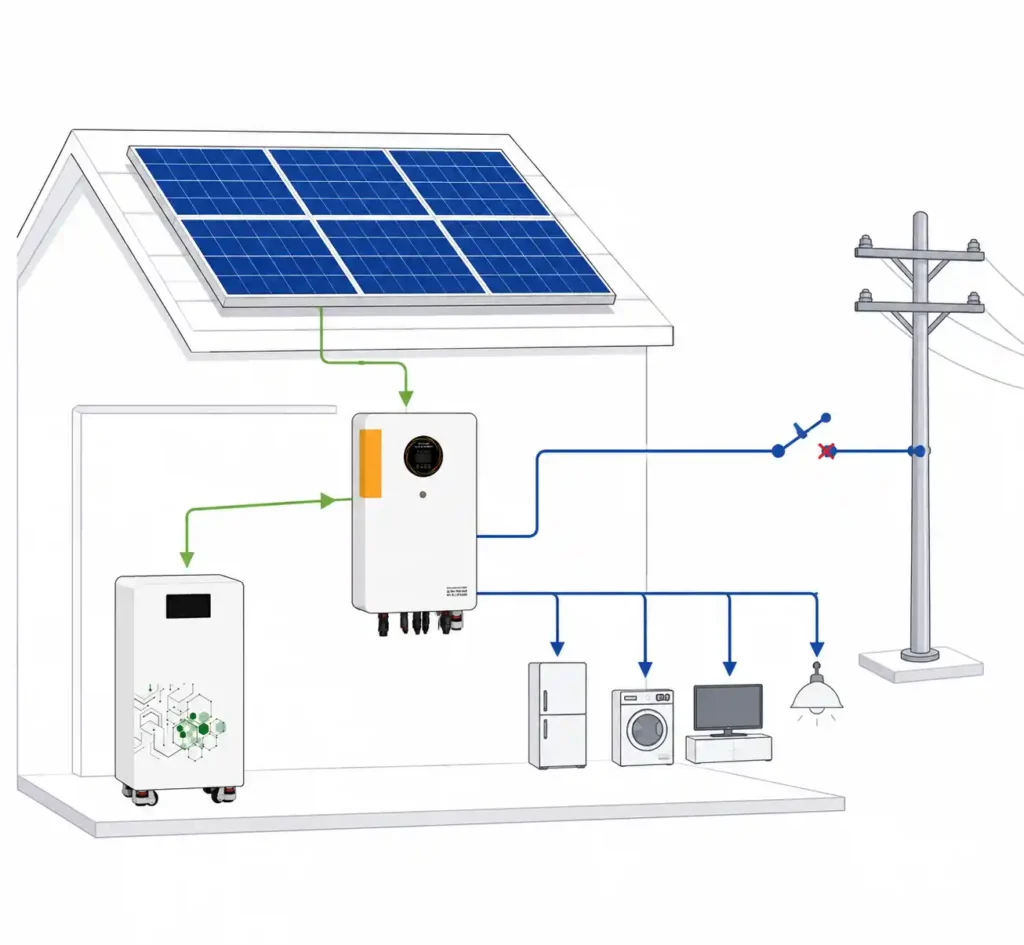
Can solar panels recharge a battery during a power outage? Only if the system is built for it. Having solar panels does not automatically mean they’ll charge your battery when the grid goes down. Standard grid-tied inverters shut off during an outage for safety (to prevent backfeeding power to utility lines linemen may be working on) — panels included. To keep charging the battery through an outage, the system needs a hybrid inverter with islanding capability, transfer equipment that disconnects from the grid, and backup-specific configuration. If your system wasn’t installed with that in mind, assume the battery is running on stored charge alone once the sun goes down and won’t recharge until the grid comes back.
Runtime vs. Cycle Life
Runtime tells you how long the battery lasts on a single charge. Cycle life tells you how many charge-discharge cycles it can handle before capacity degrades below a usable threshold — a separate question, and one worth not conflating with “years of service.”
Take a battery rated for 6,000 cycles at a given DoD. At one full cycle per day, that works out mathematically to roughly 16 years. But that figure assumes ideal, consistent conditions — cycle-life ratings are always tied to specific test conditions (DoD, charge/discharge rate, temperature, and the capacity threshold used to define “end of life”). Real-world service life is also shaped by calendar aging, ambient temperature, and how the manufacturer defines end-of-life capacity — typically 70–80% of original. Read cycle-life numbers alongside the warranty terms, not as a standalone promise.
How Many kWh of Storage Does a House Actually Need?
There’s no universal number — it depends entirely on what you want backed up and for how long. As a rough starting point:
| Backup Goal | Typical Range* |
|---|---|
| Essentials for 12–24 hours | 5–10 kWh |
| Essentials + partial comfort loads for a day | 10–15 kWh |
| Extended multi-day essentials backup | 15–20 kWh |
| Whole-home backup including AC or electric heat | 20–30 kWh or more |
These ranges depend heavily on the home’s size, climate, insulation, and which specific circuits are on the backup panel. A proper sizing conversation should start from a real load profile, not a table like this one.
How to Extend Battery Runtime During an Outage
- Put only true essentials — fridge, medical devices, some lighting and outlets — on the backup circuit; leave AC, water heating, and dryers off it or on a load-managed circuit.
- Stagger high-draw appliances instead of running them at the same time.
- If the system supports solar recharging during an outage, prioritize daytime use of larger loads when panels are actively contributing.
- Keep the battery within its rated temperature range where possible — extreme cold or heat both work against usable capacity.
Choosing a Residential Battery System
Once you know the backup duration and loads you’re sizing for, the platform choice mostly comes down to how much flexibility you want. VoltCrave Power‘s All-in-One residential systems pair LiFePO4 storage with an integrated 6kW hybrid inverter across several capacity points, which suits essentials-to-partial-home backup without a lot of installation complexity. For larger or evolving loads, the stackable high-voltage platform can be configured across a wide capacity range by adding battery modules, which is a better fit for whole-home backup or homes planning future expansion. Both platforms use an automotive-grade BMS for cell balancing and fault protection. You can compare specific configurations on the product pages or talk to the team through the contact page about sizing for a specific home.
FAQ
How long will a 10kWh solar battery run a house?
Around 20–22 hours for essential loads (fridge, lighting, Wi-Fi, phone charging) under a light average load. Add air conditioning or electric water heating, and the same battery may last only 2–4 hours, since runtime is driven by load as much as capacity.
How long will a 20kWh battery power a house?
Roughly 30+ hours for essentials alone, dropping to somewhere around 6–11 hours once moderate or high-draw appliances are added. The exact number depends on which circuits are backed up.
Can a solar battery run overnight without sun?
Yes — battery runtime doesn’t depend on solar input unless the battery itself is depleted. A charged battery will discharge based on load alone; solar recharging only becomes relevant once you need the outage to extend past what the stored charge can cover.
Do solar panels keep charging the battery during a power outage?
Only with a system specifically configured for it — a hybrid inverter with islanding capability and the right backup wiring. Standard grid-tied solar shuts off during outages regardless of how much sun is available.
How many solar batteries do I need to power my house?
It depends on your target backup duration and which loads you want covered — start from a real load profile rather than a fixed number, then size capacity from there.
Need help matching this topic to a real battery project?
Send your target application, capacity range, certification market, and order plan. VoltCrave can recommend a practical product direction.