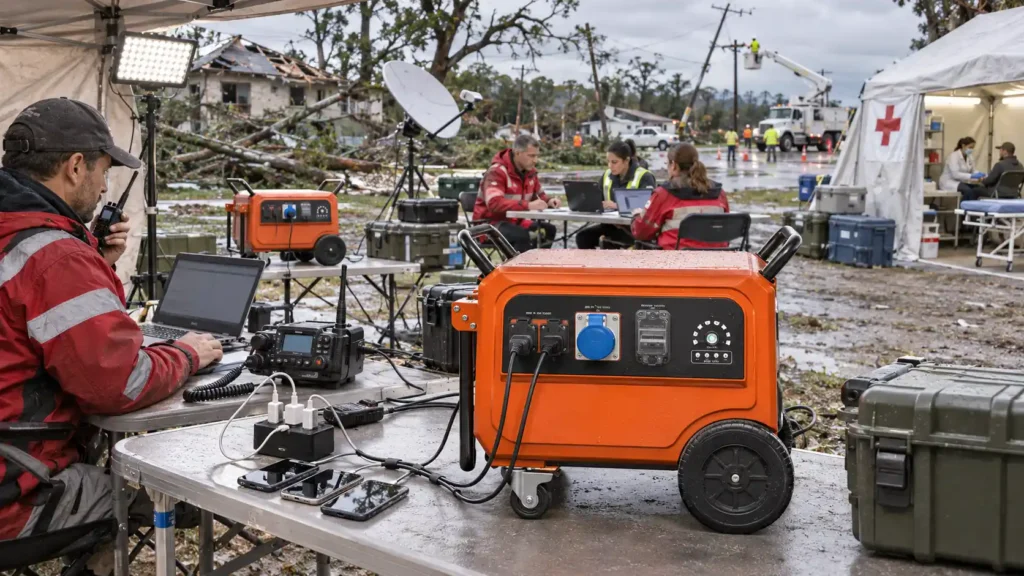
When a hurricane, flood or earthquake takes down the grid, relief teams need more than extra equipment. They need power at the exact points where work happens: the command post, the field clinic, the communications node and the repair site.
On 28 October 2025, Hurricane Melissa left about 77% of Jamaica Public Service customers without electricity, and about 72% (490,380 customers) were still offline two days later, according to government figures reported by The Gleaner and Our Today. That is the planning problem behind any disaster relief power supply: the grid is gone, fuel and road access are uncertain, and teams on the ground still have to communicate, coordinate and keep essential equipment running.
This guide explains how to plan emergency power for disaster relief operations by response phase, how to match portable power station classes to relief tasks, how batteries and fuel-based generators divide the work, and what bulk buyers should verify before ordering. It is written for disaster relief equipment distributors, emergency response suppliers, government procurement teams, utility and telecom field-service contractors, and private-label power station brands. Home backup, construction-site power and permanent hybrid system design are covered in separate articles and are not repeated here.
Why Is Reliable Power Critical in Disaster Relief Operations?
Reliable power is critical because communication, coordination, lighting, medical support and water services all slow down or stop without electricity, and the grid and fuel supply chains that normally provide it are usually among the first systems damaged.
How outages disrupt emergency response services
Power loss rarely stays a power problem. During Hurricane Melissa, Jamaica’s telecommunications minister reported that 26% of Digicel mobile customers were offline because of power failures, and officials reported that one hospital lost power and 75 patients had to be relocated. Once public networks and facilities fail, response organisations depend on whatever temporary power they brought with them.
Why fuel supply and grid access become major constraints
Generators solve many problems but add a logistics chain. Fuel has to be bought, transported, stored and handled safely, often over damaged roads, and every additional generator needs refuelling and maintenance. Where roads are blocked or fuel is rationed, a site that depends on continuous refuelling can lose power even though the equipment is working. Grid reconnection is rarely a near-term option for field sites, so planners should assume each deployment must carry or generate its own energy for days.
Which critical operations need power immediately
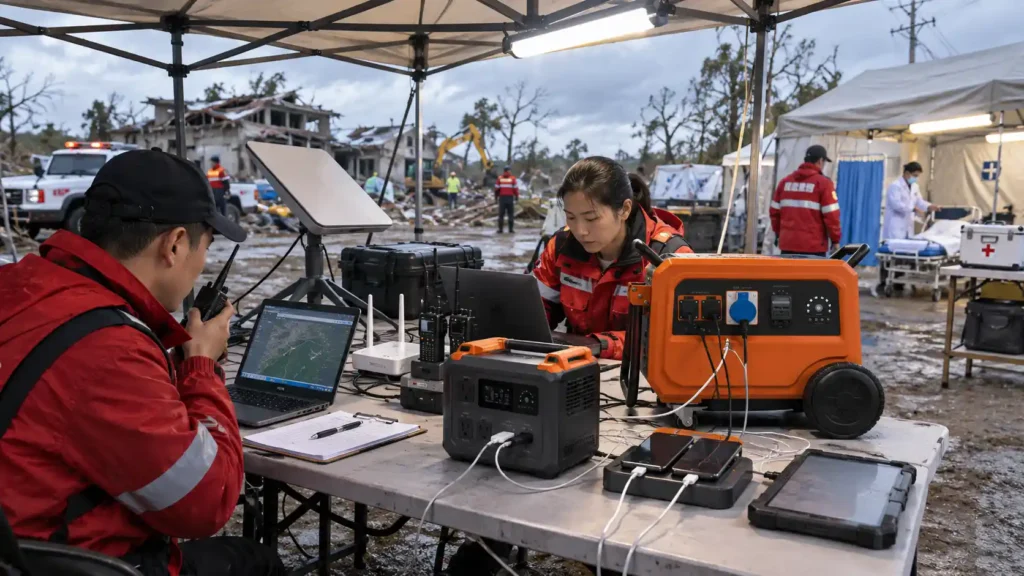
- Communications and command: radios, satellite terminals, routers, laptops and tablets for coordination and logging.
- Temporary medical support: lighting, small diagnostic and monitoring devices, and device charging. Every medical device must be checked against its own power requirements and clinical guidance before it is connected to a portable power station.
- Scene and shelter lighting: LED work lights for search, triage, registration and overnight operations.
- Water and basic services: small pumps, purification equipment and phone-charging points for affected people.
How Should Emergency Power Be Allocated Across Disaster Response Phases?
Allocate power by phase: stockpile and test equipment before the event (Phase 0), protect communications, command and medical-support loads in the first 72 hours (Phase 1), expand to shelters and operating bases during stabilisation (Phase 2), and move toward longer-duration, rechargeable, solar-capable systems for reconstruction (Phase 3). This four-phase model is a planning framework used in this article, not a formal standard, so adjust the time windows to your own response doctrine.
For each phase, answer the same four questions: which tasks need power, which loads get priority, what type of power source fits, and what spares and recharging resources must already be in place.
Phase 0: Pre-disaster preparedness and power reserves
- Key tasks: inventory checks, charge-state checks, pre-positioning kits in regional depots.
- Priority loads: communications kits, lighting, command laptops.
- Power source: compact and mid-size units, stored and maintained according to the manufacturer’s guidance.
- Spares and replenishment: charging cables, solar panels, labelled kits, and a rotation schedule so stock is never found empty on deployment day.
Phase 1: Critical power for the first 72 hours
- Key tasks: search-and-rescue coordination, triage, emergency communications, initial assessment.
- Priority loads: radios and satellite terminals, lighting, device charging, small medical devices that have been verified.
- Power source: fuel-free portable units that one or two people can move quickly. Speed of deployment matters more than maximum capacity.
- Spares and replenishment: a second unit for each critical node, plus a way to top up from vehicles or generators.
Phase 2: Power deployment during recovery operations
- Key tasks: field clinics, shelters, assessment teams, utility and telecom restoration crews.
- Priority loads: communications racks, mobile workstations, shelter lighting, restoration tools that have been load-checked.
- Power source: mid-size and large units, solar charging where possible, and generators for heavy continuous loads. Cold-chain and pump loads need their own verified load profile.
- Spares and replenishment: regional depots that can swap depleted units for charged ones.
Phase 3: Long-term power for reconstruction and field work
- Key tasks: temporary offices, equipment depots, workshops, community facilities, repair crews.
- Priority loads: office and IT equipment, tools, lighting, recharging stations for smaller units.
- Power source: large-capacity units with solar arrays, scheduled swapping, and generator support where load justifies it.
- Spares and replenishment: spare parts, maintenance routines and a replenishment agreement with the supplier.
Worked example: sizing power for a temporary command post
Consider a relief command post with four load groups.
| Load | Power | Daily run time | Daily energy |
|---|---|---|---|
| Communications equipment | 100 W | 12 h | 1,200 Wh |
| LED lighting | 60 W | 8 h | 480 Wh |
| Computers and tablets | 150 W | 8 h | 1,200 Wh |
| Other essential equipment | 100 W | 6 h | 600 Wh |
| Total | 410 W if all run at once | 3,480 Wh |
Daily energy is the sum of power multiplied by hours of use: E_daily = Σ (P × t). For this site, E_daily = 3,480 Wh.
To find the battery capacity needed, divide by the efficiency and the share of capacity you plan to use. Assuming 90% combined inverter and distribution efficiency and 80% planned use of rated capacity:
Battery capacity = 3,480 Wh ÷ (0.90 × 0.80) ≈ 4,833 Wh
The 90% and 80% figures are illustration assumptions. They are not measured VoltCrave efficiency values or guaranteed depth of discharge.
Three lessons follow from this one example:
- Power and energy are different questions. The 410 W simultaneous load sits within the 600 W rating of a compact unit such as the BP060B, but its 336 Wh capacity covers only about 7% of the 4,833 Wh requirement. At the same assumptions it would carry the full load for roughly 35 minutes.
- Capacity must match the day, not the box. A single 2,048 Wh unit covers about 42% of the requirement, and two (4,096 Wh) still fall short. Three would cover it with margin (6,144 Wh), and one 5,120 Wh unit covers it in a single box.
- Recharging decides day two. As an illustration, a 1,000 W solar array under about four peak sun hours and 75% system yield delivers roughly 3,000 Wh per day, while the site draws about 3,867 Wh per day from the battery (3,480 ÷ 0.90). One array does not close the gap, so plan more panels, a vehicle or generator top-up, or rotating spare units.
What Types of Portable Power Stations Does Disaster Relief Need?
Match the power station class to the mission, not to a product name: compact units for communications and lighting, mid-size units for mobile teams and carefully profiled field equipment, and large industrial units for command posts and recovery sites that justify the transport effort.
Compact units for communications and shelter support
Compact units in the 300–600 W range suit radios, LED lighting, phones, tablets and routers. One person can carry them and set them up in minutes. The VoltCrave BP060B is rated at 600 W with 336 Wh of LiFePO4 capacity, which fits low-power, short-duration loads. It should not be described as a general power source for medical equipment.
Mid-size units for medical and field-service equipment
Mid-size units in the 1–3.2 kW range serve mobile response teams, communications racks and equipment whose loads have been measured. The VoltCrave P2001 Pro is rated at 3,200 W with 6,400 W peak output and 2,048 Wh of capacity. It accepts up to 1,000 W of MPPT solar input and 1,800 W of AC charging, and its product data lists more than 4,000 cycles to 80% remaining capacity. Product data cites about one hour of AC charging to 80%, which depends on actual charging conditions. For any medical equipment, confirm start-up current and power-quality requirements before connecting.
Large industrial units for command and recovery sites
Large units fit command posts, temporary workstations and recovery sites where one system can serve many loads.
- BP500A: 5,000 W rated and 10,000 W peak, 5,120 Wh, up to 6,000 W of PV input (125–450 V), IP54, about 65 kg.
- BP1500A: 13,500 W rated and 27,000 W peak, 16,076 Wh, 380 V AC output, PV input of 125–430 V at 3,600 W × 3, IP54, about 220 kg.
Weight is a deployment constraint. A 65 kg unit needs wheels or two-person handling, and a 220 kg unit needs lifting equipment and a vehicle suited to loading it. Plan handling and transport before planning the load.
| Relief application | Reference power range | Representative model |
|---|---|---|
| Communications and lighting | 300–600 W | BP060B |
| Mobile response teams | 1–3.2 kW | P2001 Pro |
| Recovery site operations | 3.6–5 kW | BP500A |
| Large emergency sites | 10–13.5 kW | BP1500A |
These power bands are screening references, not fixed standards. Start-up loads, simultaneous loads, target runtime and recharging conditions decide the final choice. You can browse the full range on our portable power station solutions page.
How Do Battery Power Systems Support Relief Work When Fuel and Grid Supply Are Limited?
Battery systems are best used for loads close to people and electronics, such as communications, lighting, IT, small medical equipment and mobile workstations, while diesel generators remain better suited to sustained, heavy infrastructure loads. Most relief operations use both.
Reducing fuel dependence for critical loads
Running a generator around the clock to support a few hundred watts of critical load ties up fuel, creates noise and requires someone to keep refuelling it. Moving those small, constant loads to batteries frees fuel for the loads that truly need it. Battery units also produce no exhaust at the point of use, which matters near shelters, clinics and enclosed tents. For permanent installations that combine battery banks with standby generators, see our guide to battery–generator hybrid backup systems.
Using solar charging to restore power in remote areas
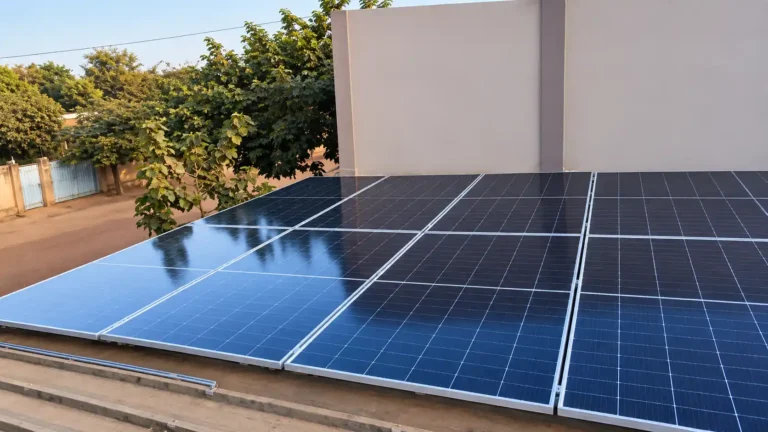
Solar input lets a site recharge without a fuel delivery. Check that the panel strings you can actually obtain fit the unit’s input window, for example the 125–450 V PV range on the BP500A, and remember that panels add transport, setup and security needs. Solar extends runtime but rarely supports a heavy daily load alone, as the command post example shows.
Placing power closer to response teams
Several smaller units spread across a site keep radios, lighting and workstations running if one unit fails or has to be moved. The trade-off is more units to track, charge and maintain, so label them, record charge status and assign an owner for each.
What Should Buyers Consider When Procuring Disaster Relief Power Systems?
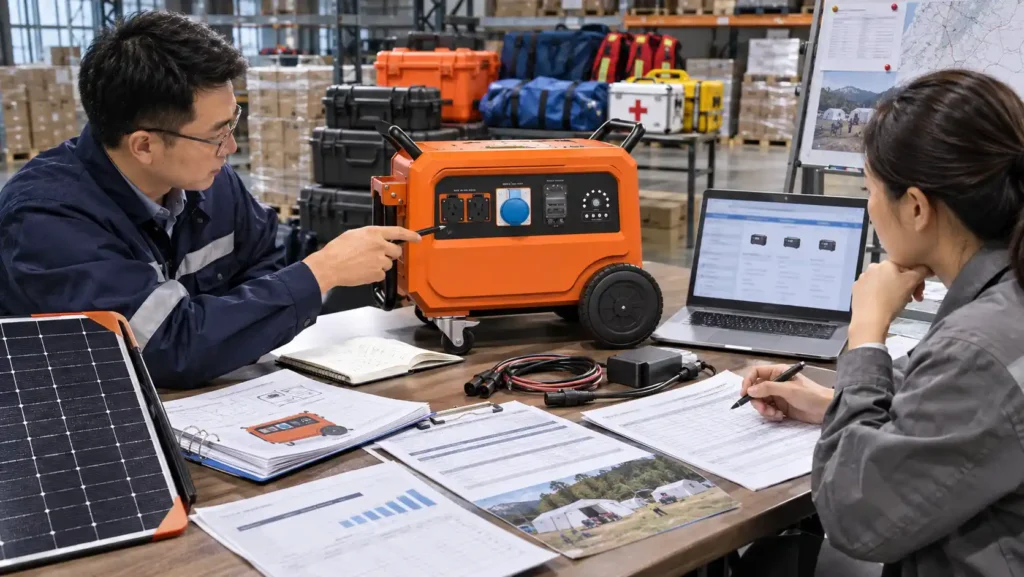
Before a bulk order, verify five things: rated power and capacity against profiled loads, solar and AC charging flexibility, enclosure and temperature ratings, certification documents matched to model and destination market, and the supplier’s capacity for volume production, sample validation and spare parts.
Match rated power and battery capacity to critical loads
Kilowatts decide whether equipment can start and run together. Kilowatt-hours decide how long it runs. Ask for continuous rating, peak rating and how long peak output is sustained, then compare them with your measured loads, as in the command post example.
Check solar input and charging flexibility
Ask for the PV voltage window, maximum solar input power, AC charging power and whether the unit can charge from a vehicle or generator. Flexible charging matters when the only energy source on site changes from day to day.
Assess outdoor protection and temperature limits
An IP54 rating means protection against dust ingress and splashing water. It does not mean the unit can be immersed or left exposed to heavy rain jets, so plan shelter or covers in flood-prone deployments. Ask for charging and discharging temperature ranges separately, because charging limits are often narrower than discharging limits.
Audit certifications and product documentation
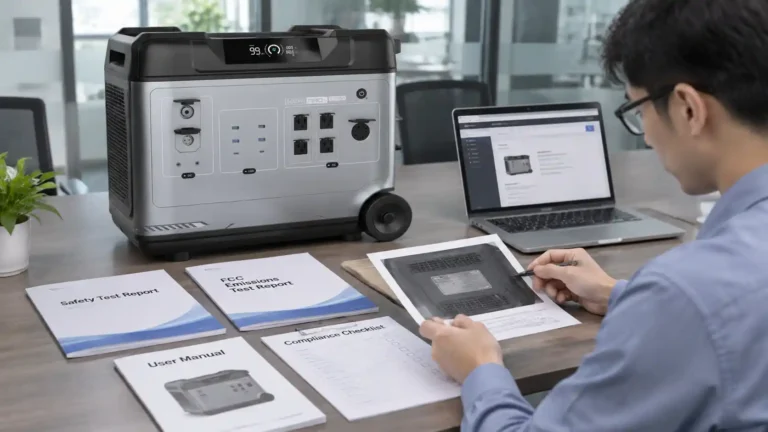
Certification availability varies by model, chemistry and target market, so ask for documents that name your exact model number. Lithium batteries are regulated goods in transport, so request the UN38.3 test summary and confirm shipping classification for large units with your freight forwarder before committing to a delivery plan.
Evaluate OEM/ODM and bulk supply capability
Ask about production capacity, batch inspection and spare-part support. VoltCrave describes its quality control process as incoming, in-process, final and outgoing inspection on every batch, and publishes standard lead times of 25–35 days for existing models. Before committing to volume, use sample evaluation to test a unit against your own load profile, charging sources and environment.
| Buyer question | What to request |
|---|---|
| Do kW and kWh meet the mission? | Measured load list and runtime calculation |
| Can it handle start-up loads? | Peak output rating and duration |
| Does solar input match available panels? | PV voltage window and maximum input power |
| Is the enclosure suitable for the site? | IP rating and its scope |
| Does charging work in the deployment climate? | Charge and discharge temperature ranges |
| Do certificates match the model and market? | Documents naming the exact model |
| Can the supplier deliver and support volume? | Lead times, sample policy and spare-part plan |
How Should Organizations Build a Reliable Emergency Power Inventory?
Plan inventory by deployment point first, then add spares, charging accessories and a replenishment mechanism, instead of choosing a total unit count at the start.
Planning quantities for each deployment location
Start with the number of sites and the daily energy each one needs. Divide each site’s battery requirement by the capacity of the unit class you plan to deploy, round up, then add redundancy for the most critical nodes. A command post needing about 4.8 kWh per day is one large unit or three mid-size units, and a regional plan multiplies that by the number of posts.
Preparing spare units, charging accessories and replacements
Spare units matter less than the small items that stop a deployment: charging cables, vehicle charging leads, solar panels and connectors, extension leads, covers, and carts or lifting aids for heavy units. Keep them in labelled kits that travel with each unit, and set a routine to check charge status and rotate stock.
Working with manufacturers on customized emergency power solutions
OEM and ODM programmes can match local plug types, colours, labelling, firmware settings and packaging to your operating region. VoltCrave lists a standard OEM minimum order of 100 units per model and 300–500 units for ODM projects with new tooling. See our OEM and ODM portable power station manufacturing page for the process, and agree a replenishment schedule before the first order ships.
FAQs
What power source is best for disaster relief operations?
No single source is best. Battery power stations suit communications, lighting, IT and mobile teams, diesel generators suit heavy continuous loads, and solar extends battery runtime where fuel is scarce. Most relief operations combine them by load type and response phase.
How many portable power stations does an emergency shelter need?
It depends on the shelter’s load budget, not a fixed ratio. Add up each device’s watts multiplied by daily hours, divide by 0.72 (the 90% efficiency and 80% usable capacity assumptions used above), then divide by the unit capacity and add redundancy. The command post example works out to about 4.8 kWh per day.
Can portable power stations support disaster relief teams?
Yes, for communications, lighting, IT, charging and many field tools, provided the unit’s continuous rating, peak rating and capacity match the measured load. Heavy loads such as large pumps or air conditioning need to be sized separately, and medical equipment needs verification against its own requirements.
How are emergency power stations recharged during long outages?
Common sources are solar panels, vehicle or generator AC, and grid power where it has returned. Compare the daily recharge energy available with the daily draw, and add more panels, a top-up source or rotating spare units if recharge falls short.
What should buyers check before purchasing disaster relief power systems?
Check rated power and capacity against measured loads, peak output, solar and AC charging inputs, IP rating, charge and discharge temperature ranges, model-specific certification documents and transport classification, and the supplier’s ability to deliver volume, samples and spare parts.
Can portable power station manufacturers provide customized emergency power solutions?
Yes. OEM and ODM programmes can customize plugs, enclosure, labelling, firmware and packaging, and a supplier can support certification and replenishment planning. VoltCrave lists a minimum order of 100 units per OEM model and 300–500 units for ODM projects with new tooling.
Conclusion: Plan Emergency Power for Faster, More Reliable Disaster Response
Effective disaster relief power planning rests on four principles: allocate power by response phase, give critical loads priority, secure a way to recharge, and prepare procurement and inventory before the event. Build the plan from measured loads, not product names, and treat weight, transport and recharging as part of the design.
If you are planning bulk procurement, distribution or a custom emergency power programme, contact the VoltCrave Power engineering team with your load profile, deployment regions and target quantities.
Need help matching this topic to a real battery project?
Send your target application, capacity range, certification market, and order plan. VoltCrave can recommend a practical product direction.