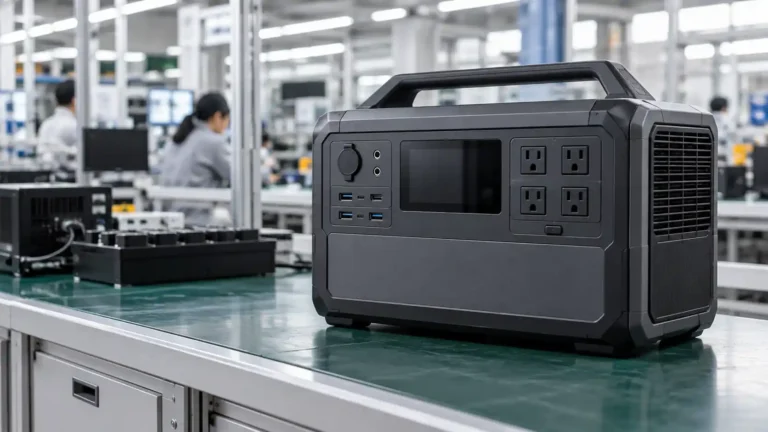
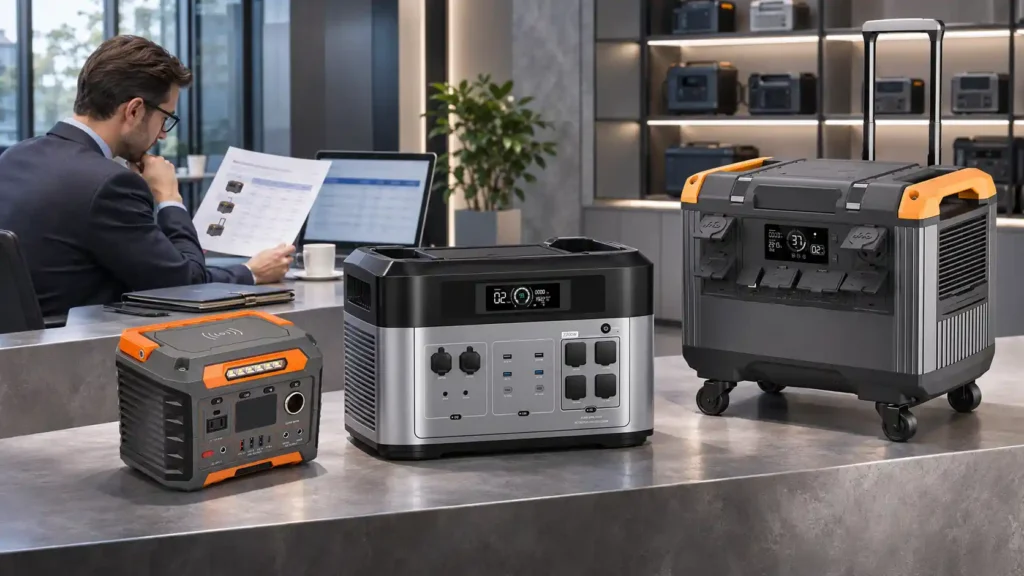
A portable power station’s wholesale price is set mainly by seven factors: battery capacity and chemistry, inverter output, charging hardware, built-in functions, customization, order terms, and the scope of certification and warranty. That is why quotes for “a 1000W unit” can differ widely between suppliers, and why no single portable power station wholesale price exists for the category. VoltCrave Power’s portable power station range alone covers 40+ models, from 200W camping units to 13,500W industrial power stations.
The examples below come from VoltCrave’s product pages. There is no price list here, because price depends on model, quantity, destination and customization. The article ends with a checklist for requesting quotes that can be compared line by line.
The seven cost drivers at a glance
- Battery capacity and cell chemistry: the Wh you buy and the cells that supply it.
- Inverter output, surge rating and waveform: how much power the station can deliver, and how cleanly.
- Charging hardware: AC input power and the solar MPPT window.
- Built-in functions and form factor: expansion, backup switching, ports and weight.
- Customization: plug standard, housing color, logo, packaging and manual.
- Order terms: quantity, lead time, Incoterms and freight weight.
- Certification, testing and warranty: the documents and guarantees that come with the price.
Why quotes are hard to compare
A wholesale quote is tied to a specific model, quantity, shipping term and customization scope, and changing any one of them changes the unit price. Comparing quotes means converting each one to the same basis first. The seven drivers below are the inputs to that conversion.
1. Battery capacity and cell chemistry
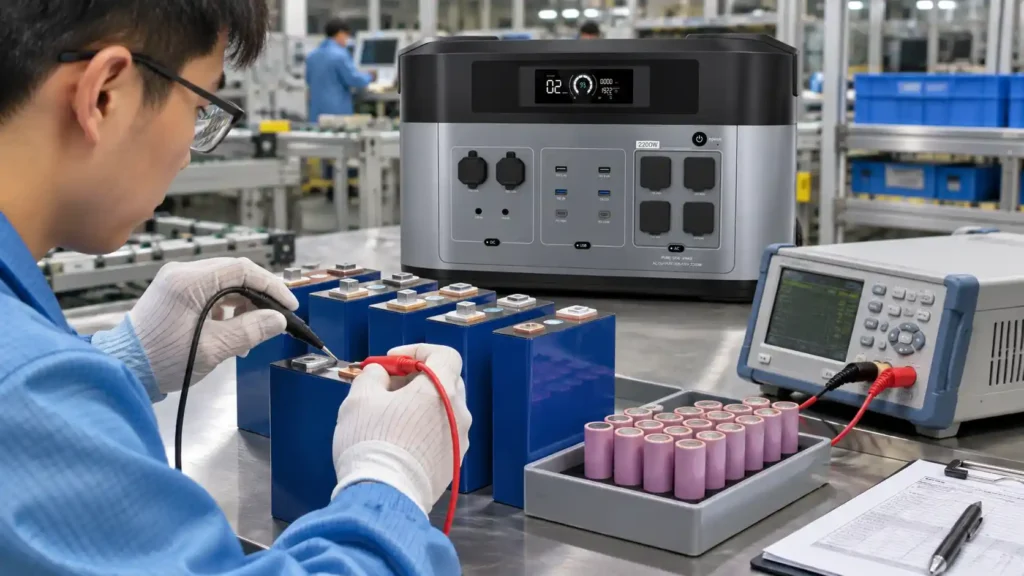
Capacity, measured in watt-hours (Wh), sets how much cell material goes into a power station, so it is the first figure to normalize. VoltCrave’s own portable models show how wide the range is:
- The A3B 300W model has a 288Wh lithium-ion battery.
- The BP1002 stores 1120Wh.
- The BP2000 uses a 2048Wh LiFePO4 battery rated for 3500+ cycles to 80% of original capacity.
- The 3000W LiFePO4 model holds 2688Wh.
Chemistry changes both cell cost and cycle life. On its portable category page, VoltCrave lists prismatic LiFePO4 cells from CATL, BYD and EVE, and NCM cylindrical cells from Samsung, LG and Panasonic for energy-dense designs. Two models with the same Wh can therefore carry different cell costs.
On a quote, divide the unit price by Wh to get price per Wh. If the supplier states a cycle rating, divide the price by Wh multiplied by cycles to get price per cycle-Wh. If the quote leaves out the cell brand or the cycle rating, ask for both before comparing. Our guides to Ah vs kWh and lithium battery cycle life explain how to read these figures.
2. Inverter output, surge rating and waveform
The inverter determines what the station can run. A higher continuous rating needs a larger power stage and more thermal capacity, and surge capacity adds margin for motor and compressor start-up.
The BP2000 is specified at 2200W rated output with 4000W surge and a pure sine wave inverter. The 3000W model lists 3000W continuous output through four AC pure sine wave outlets. The BP1002 is rated at 1000W with three AC outlets, and the A3B at 300W.
Rated power and surge power are different figures, so a quote that gives only one wattage cannot be compared with one that states continuous output, surge output and waveform type. Ask for all three.
3. Charging hardware
Recharge speed and the available charging sources are built into the price, and the specifications differ widely:
- The BP2000 accepts up to 1800W AC input and up to 1000W of MPPT solar input. With both connected, the maximum combined input is 2800W, and the product page cites roughly 1.5 hours for 0 to 80% on AC under suitable conditions.
- The 3000W model accepts 1600W AC input and 650W of MPPT solar input (12V to 80V), with a 1200W solar configuration listed as an option.
- The A3B recharges from a DC 15V / 3A input and supports solar input of 13V to 26V at up to 3A.
The optional 1200W solar configuration shows why to ask whether a feature is standard or an add-on. If your customers will pair the station with larger panels, price that version.
4. Built-in functions and form factor
Each extra function adds components, firmware work or enclosure complexity:
- Expansion. The BP2000 can be expanded from 2048Wh up to 16kWh by adding up to seven B2000 battery units. Ask whether expansion batteries are quoted separately; the B2000 expansion battery is listed as its own product.
- Backup switching. The BP2000 lists EPS switching in under 10ms and compatibility with a dual-power automatic transfer switch. The 3000W model lists a UPS function with 10ms switching time.
- Convenience features. The A3B adds 5W wireless charging and a 3W LED light to its USB, Type-C, DC and car-socket outputs.
- Size and weight. The A3B weighs about 3.2kg, the BP2000 about 23.6kg, and the 3000W model about 35kg with an integrated wheel and handle.
Weight also feeds freight cost per unit, covered under driver 6.
5. Customization
Moving from a standard catalog configuration to a market-specific one changes the quote. The VoltCrave product pages list these options:
- The BP1002 page lists plug configuration, AC output standard and housing color.
- The A3B page adds logo, packaging, user manual and market-specific configuration.
Plug and AC output changes typically affect the hardware, while logo, packaging and manual changes affect printing and packaging. On the portable category page, VoltCrave states that standard OEM orders start at 100 units per model, that ODM projects with new tooling start at 300 to 500 units, and that new OEM/ODM projects add 4 to 8 weeks for sampling and tooling. Customization can therefore raise MOQ and lead time as well as unit price.
List every customization item in the request and ask for each as a separate quote line, so that each supplier prices the same scope. Branding and labeling requirements are covered on the OEM/ODM service page.
6. Order terms: quantity, lead time, Incoterms and freight
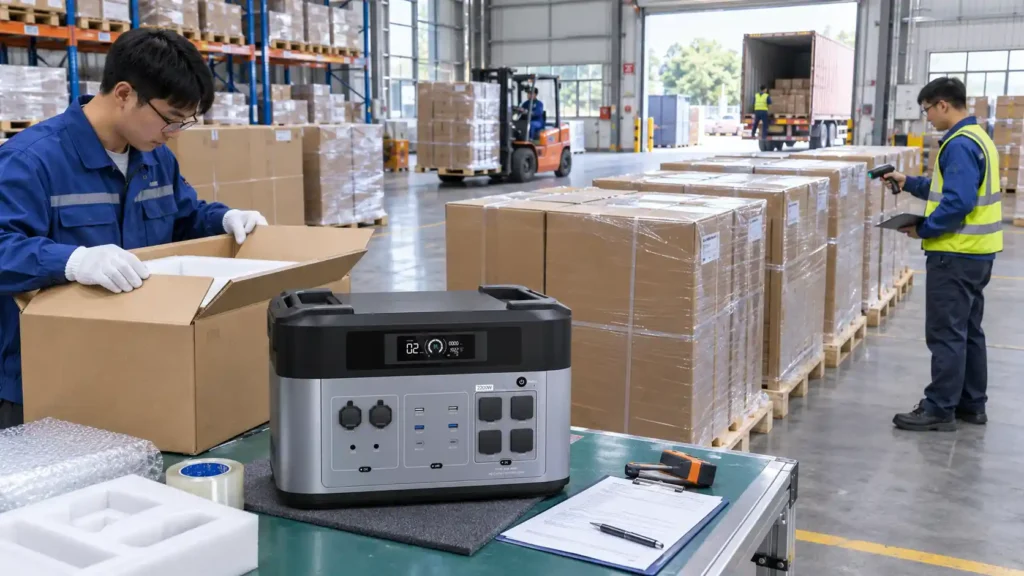
The same model has a different price depending on how you buy it.
Quantity. MOQ is set per model. The BP1002 page lists 500 units with delivery in 30 working days, while the category page gives 100 units as the starting point for standard OEM orders. VoltCrave’s FAQ also mentions annual pricing agreements with volume-based incentives for long-term partners. Confirm the MOQ for your exact model before comparing quantity tiers.
Samples. The category page states that sample orders of 1 to 5 units are available and that sample fees are credited against the first production order, so a sample is not a pure extra cost if the project proceeds.
Incoterms. VoltCrave’s FAQ lists EXW Dongguan, FOB Shenzhen or Guangzhou, CIF to the destination port, and DDP for select EU countries. A DDP price and an EXW price are not comparable, so ask every supplier to quote the same Incoterm for the same destination.
Freight weight. Freight cost per unit rises with weight: a 35kg station costs more to ship than a 3.2kg one. The FAQ also notes that air freight for lithium batteries costs significantly more than sea freight and is typically recommended only for samples and urgent orders.
7. Certification, testing and warranty
Certifications, factory testing and warranty terms are part of what the price covers, and they vary by model and target market.
- The BP2000 lists CE, FCC, PSE, UN38.3, EMC, LVD, RoHS and MSDS. VoltCrave states that certification availability varies by model and target market, and that buyers should confirm the applicable documents for the chosen model.
- The UL 1642 document on product pages is a lithium cell component document. VoltCrave states that it is not a certification of a complete energy-storage system, so it should not be read as one.
- The BP1002 page describes a production process that includes cell testing, PCBA testing, battery-pack aging, product aging, final testing and OQC inspection, and lists a warranty of 1 to 3 years.
- For OEM projects with enough order volume, VoltCrave’s FAQ says it can manage additional certification work for models that do not already carry a given listing.
A quote that leaves out the certificates your market requires will need those costs added later. The energy storage battery certification guide covers what each market requires.
Three models side by side
The table uses specifications from VoltCrave’s product pages.
| Model | Battery | Capacity | Rated AC output | Solar input | Weight |
|---|---|---|---|---|---|
| A3B 300W | Lithium-ion, 3.7V | 288Wh | 300W | 13V to 26V, 3A max | About 3.2kg |
| BP2000 | LiFePO4 | 2048Wh | 2200W (4000W surge) | MPPT, up to 1000W | About 23.6kg |
| 3000W LiFePO4 (T30) | LiFePO4 | 2688Wh | 3000W | MPPT, 650W (1200W optional) | About 35kg |
The 288Wh and 2688Wh stations sit in the same category but store more than nine times as much energy apart, so any price comparison has to start from Wh, chemistry and output rating.
How to request quotes you can compare
Send every supplier the same request:
- Model or target specification, including Wh and rated and surge output.
- Battery chemistry, cell brand and cycle rating.
- Solar and AC input requirements, including any optional configurations.
- Every customization item: plug, AC standard, color, logo, packaging, manual.
- Target quantity, plus any tier quantities you want priced.
- Incoterm and destination port or country.
- Required certifications and target market.
- Warranty length and expected after-sales terms.
With identical inputs, quotes can be compared on price per Wh, price per cycle and landed cost.
FAQs
Is there a standard wholesale price per Wh for portable power stations? No. Price per Wh varies with chemistry, inverter size, charging hardware, features, customization and order terms. Calculate it from each quote rather than relying on a market average, and make sure every quote uses the same Incoterm.
Do larger orders always lower the unit price? Quantity tiers are common, but the effect depends on the model, and MOQ is set per model. Confirm the MOQ and ask for tier pricing at the quantities you are actually considering.
Are samples an extra cost? Sample orders of 1 to 5 units are available, and VoltCrave states that sample fees are credited against the first production order.
Are test reports and shipping documents charged separately? According to VoltCrave’s FAQ, the UN38.3 test report and summary are provided with every shipment at no additional charge, and standard documentation includes a factory test report, certificate of conformance, batch traceability report and packing list. Confirm the exact document set for your model when you request the quote.
Request a quote
Send the checklist above with your target capacity range, market and order quantity. You can browse the full portable power station range, request a sample to evaluate a model before committing to volume, or contact VoltCrave Power with your requirements.
Need help matching this topic to a real battery project?
Send your target application, capacity range, certification market, and order plan. VoltCrave can recommend a practical product direction.