A LiFePO4 home backup battery stores electricity for use when solar production is low or the grid is unavailable. For homeowners, the main benefits are backup power, higher solar self-consumption, greater flexibility with time-of-use electricity rates, quieter operation than fuel generators, and better control over household energy use.
When paired with rooftop solar, a LiFePO4 battery can store excess daytime solar generation and make that energy available later in the evening or during a grid outage. The actual value depends on the home’s electricity consumption, utility rates, solar export compensation, backup requirements, and system configuration.
For solar installers, distributors, EPC contractors, and private-label energy brands, residential battery storage also creates a way to offer more than solar panels alone: a complete energy storage solution that addresses both energy use and power resilience.
Why Are Homeowners Adding Battery Storage to Solar in 2026?
Solar panels can generate substantial electricity during the day, but household demand does not always follow the same schedule.
A home may produce its most solar energy around midday while using more electricity in the evening, when solar production is falling or has already stopped. At the same time, some homeowners face time-of-use electricity rates, reduced compensation for exported solar power, or concerns about grid outages.
This creates a simple problem:
Solar generation and household electricity demand do not always occur at the same time.
A home battery provides a way to shift stored electricity from one period to another.
Instead of using solar electricity only when it is being generated, a homeowner can use a residential battery system to:
- power household loads during the evening;
- retain excess solar generation for later use;
- provide backup power during a grid outage;
- reduce dependence on grid electricity during expensive periods;
- increase the amount of rooftop solar consumed on-site.
For homeowners, this makes battery storage more than an additional piece of hardware. It can change how the home’s solar energy is used throughout the day.
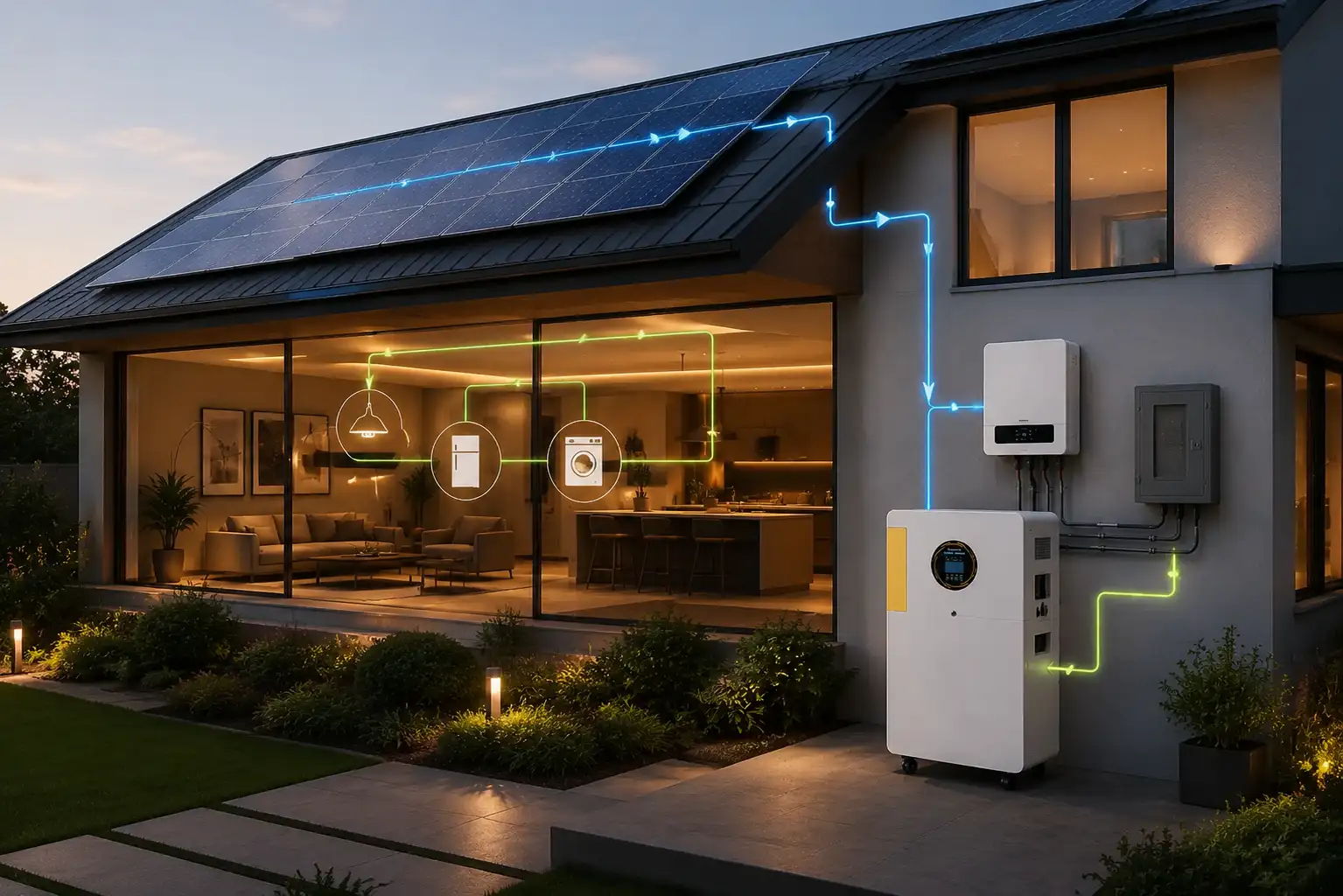
5 Key Benefits of LiFePO4 Home Energy Storage
The benefits of residential LiFePO4 battery storage can be grouped into five practical areas: backup power, solar self-consumption, electricity-rate flexibility, generator alternatives, and future household electrification.
1. Backup Power During Grid Outages
One of the clearest reasons homeowners install battery storage is to keep essential electrical loads operating during a power outage.
Solar panels by themselves generally cannot continue supplying a grid-connected home during an outage unless the system has the appropriate backup architecture. A properly configured battery and inverter system can provide stored energy to selected household loads when the grid is unavailable.
Depending on system capacity and installation design, these may include:
- refrigerators and freezers;
- Wi-Fi routers and networking equipment;
- lighting;
- security systems;
- sump pumps;
- home office equipment;
- selected medical or other critical devices.
The important point is that backup power is determined by the complete system, not simply by the battery’s capacity label.
Battery capacity, inverter output, load requirements, backup configuration, and installation design all affect what a home can actually operate during an outage.
For homeowners, the value is therefore not simply “having a battery.” It is having a residential energy storage system designed around the loads that matter most.
2. Higher Solar Self-Consumption
Another major benefit of residential battery storage is the ability to use more of the solar energy generated by the home.
Without storage, a typical rooftop solar system may produce its highest output during the middle of the day. If household electricity demand is lower at that time, some of the excess electricity may be exported to the grid.
Later, when the household needs more electricity, solar production may be much lower.
A battery changes this timing.
Without battery storage:
Solar generation → Home loads → Excess solar → Grid
With battery storage:
Solar generation → Home loads → Battery charging → Evening/night loads
This allows homeowners to shift some solar energy from periods of high production to periods of higher household demand.
The financial value of this function depends heavily on local electricity tariffs and solar export compensation. Where exported solar receives relatively low compensation compared with the retail electricity price, increasing self-consumption can become an important reason to add battery storage.
3. More Flexibility With Time-of-Use Electricity Rates
Some electricity markets charge different rates depending on the time of day.
For example, electricity may cost less during off-peak periods and more during evening demand periods.
A residential battery can provide energy-shifting flexibility in these situations.
When conditions and system controls allow it, the battery may:
- charge from solar during the day;
- store the energy;
- discharge during higher-cost periods;
- reduce the amount of electricity purchased from the grid during those periods.
However, battery savings are not automatic.
The economics depend on:
- the local electricity tariff;
- peak and off-peak rate differences;
- solar export compensation;
- battery efficiency;
- system operating strategy;
- installation cost;
- local regulations and programs.
For this reason, residential battery storage should not be presented as guaranteed savings for every homeowner. Its financial value depends on the local energy market.
4. A Quieter Alternative to Fuel Generators
Traditional fuel generators remain useful for certain backup applications, particularly where long-duration backup is required.
However, homeowners may not want the noise, fuel storage, exhaust, engine maintenance, or manual operation associated with conventional generators.
A LiFePO4 home battery system provides a different type of backup solution.
A properly configured battery system can provide:
- quiet operation;
- automatic backup switching, depending on system design;
- no on-site fuel combustion;
- integration with rooftop solar;
- repeated charging and discharging.
For shorter or recurring outages, the combination of solar + battery storage can provide a convenient alternative to relying entirely on a fuel generator.
That does not mean batteries replace generators in every application. Long-duration outages and high continuous loads may require a different backup strategy.
The right choice depends on the homeowner’s actual requirements.
5. Support for Future Home Electrification
Household electricity demand is changing as more appliances and transportation systems become electric.
Examples include:
- electric vehicle charging;
- heat pumps;
- electric water heating;
- induction cooking;
- home offices and networking equipment;
- other high-power household appliances.
As electricity becomes a larger part of household energy use, energy storage can provide additional flexibility between solar generation, grid electricity, and household demand.
For homeowners, this means a residential battery can be considered not only as an outage product, but also as part of a longer-term home energy system.
For installers and distributors, this creates an opportunity to build residential ESS product lines that support different levels of household energy demand.
Why Is LiFePO4 Used for Residential Battery Storage?
LiFePO4, also known as lithium iron phosphate or LFP, is widely used in stationary energy storage applications because of its combination of cycle life, thermal stability, and suitability for repeated charge and discharge.
A home battery does not need to be the smallest or lightest possible battery. It needs to operate reliably through repeated daily cycles while meeting the requirements of a stationary energy system.
For homeowners, the main areas of interest are usually:
Safety and Thermal Stability
Battery safety depends on the complete system, including the cells, BMS, thermal management, enclosure, electrical design, inverter integration, and installation.
LiFePO4 chemistry provides a useful foundation for stationary energy storage, but chemistry alone does not determine the safety of a complete residential ESS.
Long Cycle Life
Residential batteries may be charged and discharged repeatedly, particularly when they are used for daily solar self-consumption.
Cycle life therefore matters when comparing long-term battery value.
Suitable for Daily Energy Storage
A solar battery may be used regularly rather than only during emergencies.
For a homeowner using solar during the day and battery energy in the evening, repeated cycling is part of normal operation.
Lower Maintenance Than Traditional Lead-Acid Systems
Compared with traditional lead-acid storage, LiFePO4 systems can offer deeper usable capacity and longer cycle life while requiring less routine maintenance.
For installers and distributors, this can also affect long-term warranty and after-sales considerations.
When Does Home Battery Storage Make Sense?
A LiFePO4 home backup battery can be particularly relevant when a homeowner has one or more of the following conditions:
- frequent or costly grid outages;
- high evening electricity rates;
- low compensation for exported solar energy;
- a strong preference for energy independence;
- a need for backup power for critical household loads;
- dissatisfaction with fuel generators;
- plans to add EV charging or other electric loads;
- a remote property where grid reliability is limited.
On the other hand, battery storage may have a weaker financial case when electricity is inexpensive, the grid is highly reliable, and solar export compensation is highly favorable.
In that situation, the primary reason for installing a battery may be backup power, energy independence, or personal preference rather than direct financial savings.
This distinction matters because the value proposition of residential storage is not identical for every homeowner.
What Should Homeowners Understand Before Installing a Battery?
Homeowners do not necessarily need to understand every battery specification, but several technical concepts affect the real-world performance of a residential ESS.
Battery Capacity: kWh
Battery capacity is normally expressed in kilowatt-hours (kWh).
It describes how much energy the battery can store.
However, nominal battery capacity should not automatically be treated as the exact amount of energy available to household loads.
Usable capacity depends on the system’s operating limits and other factors.
Power Output: kW
Power and energy are different.
- kWh describes stored energy.
- kW describes power delivered at a given time.
A battery may have substantial energy capacity but still require an appropriately sized inverter and system design to operate high-power appliances.
For example, running a refrigerator and Wi-Fi equipment is very different from simultaneously running air conditioning, electric cooking, a heat pump, and an EV charger.
Inverter Compatibility
Battery and inverter compatibility also matters.
The system needs to operate within the appropriate voltage, power, communication, and control requirements.
For detailed battery-inverter matching, this topic should be handled by your dedicated article:
How to Match a Battery and Inverter for Solar and Backup Power
That keeps the two articles focused on different search intents instead of turning this benefits article into another technical matching guide.
LiFePO4 Home Backup Battery Options for Residential Projects
Residential energy storage is not a one-size-fits-all product category.
Different homeowners have different backup requirements, daily electricity consumption, and solar system configurations.
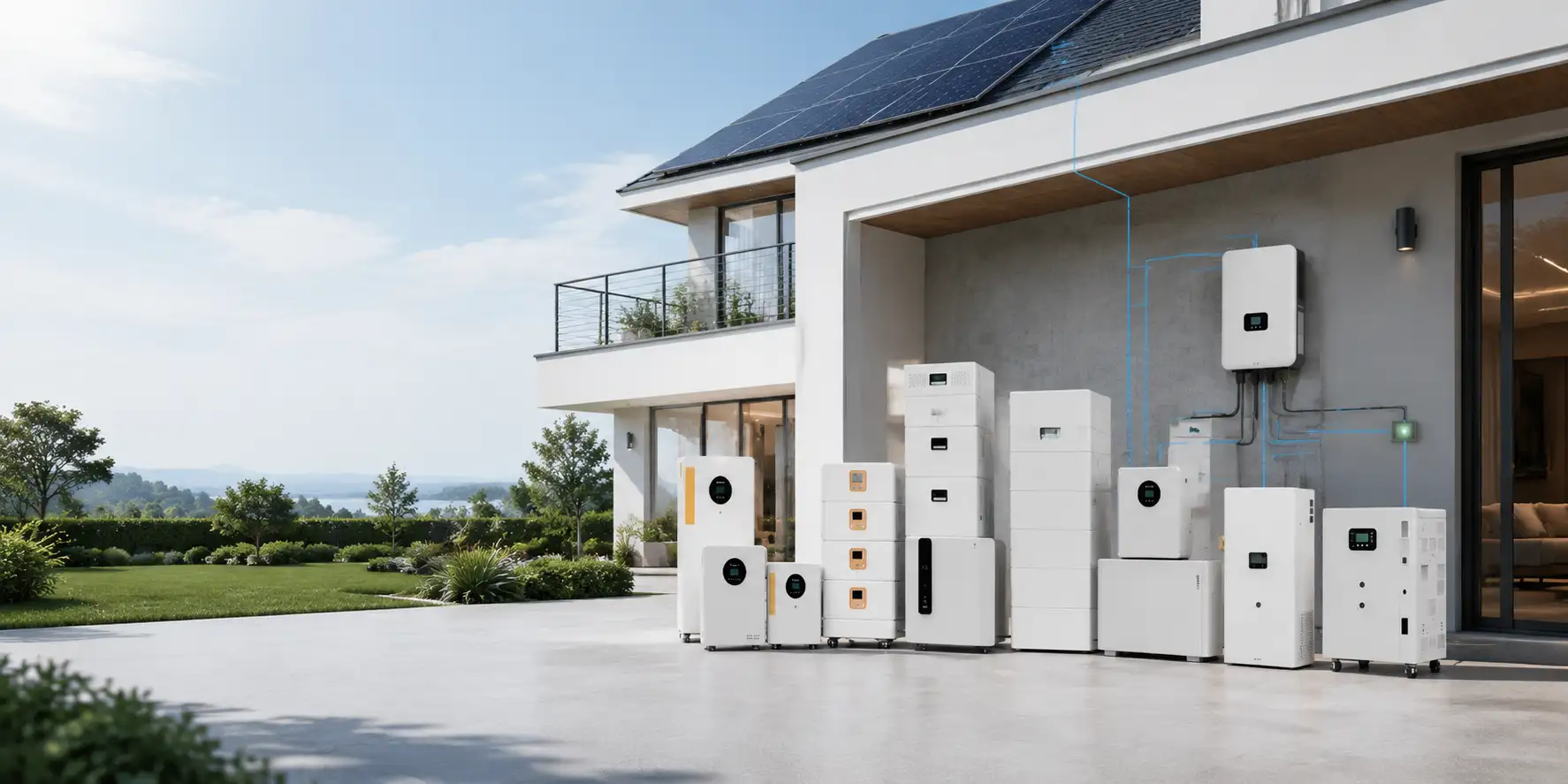
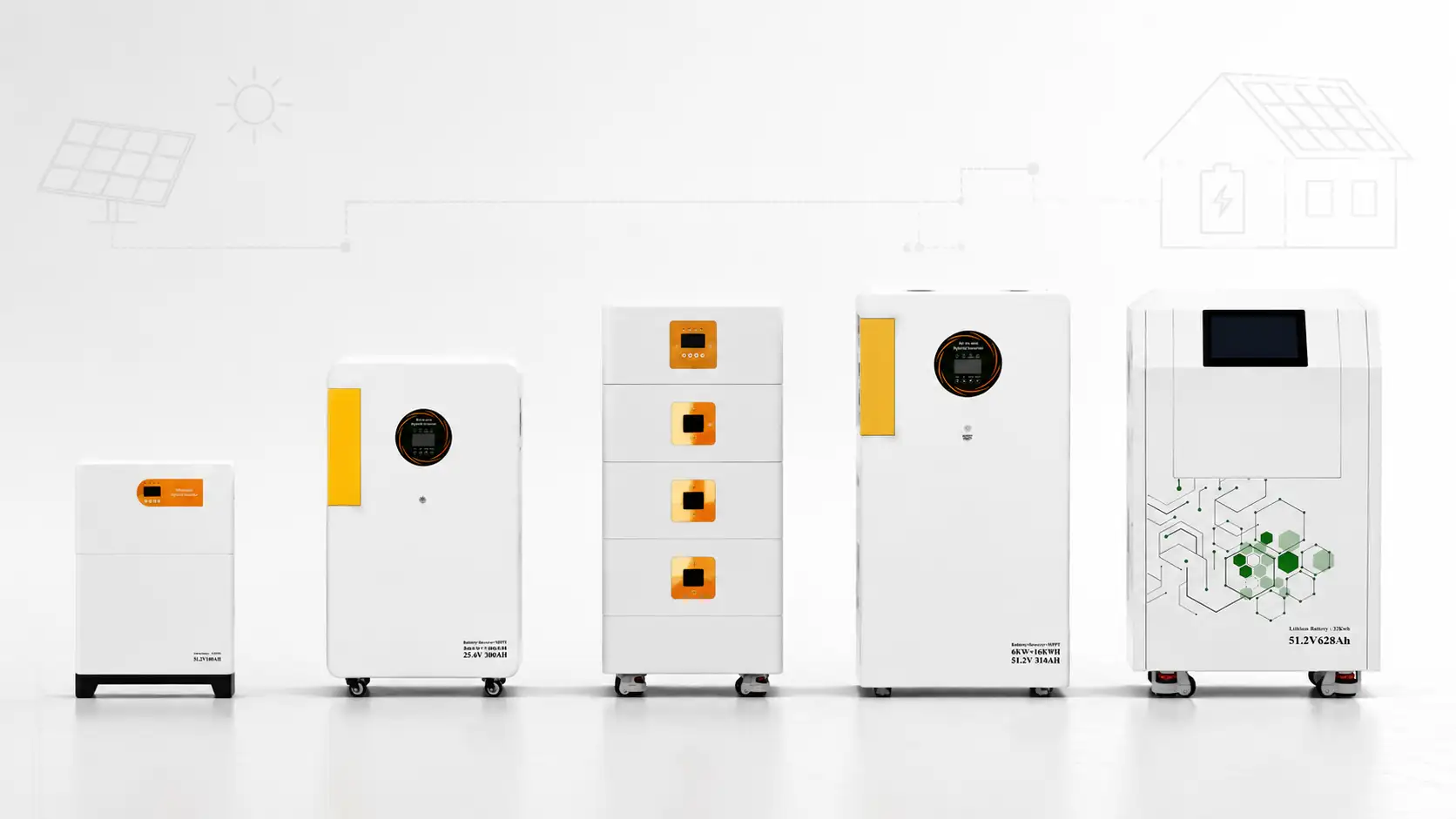
Voltcrave Power’s residential portfolio includes systems in several capacity ranges, including 5kWh, 7.68kWh, 10kWh, 10.24kWh, 16kWh, and 32kWh configurations.
| Residential storage range | Typical application |
|---|---|
| 5–7.68kWh | Essential-load backup and smaller residential projects |
| 10–10.24kWh | Mainstream solar-plus-storage applications |
| Around 16kWh | Larger homes and longer backup requirements |
| Around 32kWh | High-capacity residential, off-grid and whole-home applications |
These ranges should be treated as application examples rather than fixed rules. Actual system requirements depend on household loads, backup objectives, inverter output, solar generation, and local installation conditions.
Example Voltcrave Residential ESS Products
- 5KWh LiFePO4 Home Energy Storage System — compact all-in-one residential system.
- 7.68kWh Residential Energy Storage System — designed for smaller residential backup applications.
- 10.24kWh LiFePO4 All-in-One ESS — combines LiFePO4 storage with a 6kW hybrid inverter and MPPT.
- 10kWh All-in-One Residential ESS — a two-module 5.12kWh configuration with a 6kW hybrid inverter.
- 6KW 16KWh All-in-One Residential ESS — for higher-capacity residential applications.
- 51.2V 32kWh LiFePO4 Battery Storage System — high-capacity battery platform with RS485, RS232 and CAN communication.
- 12KW 32KWh All-in-One Solar Energy Storage System — integrated high-capacity residential/off-grid configuration.
Why All-in-One ESS Can Be Attractive for Installers
An all-in-one residential ESS combines multiple system components into a more integrated package.
For installers, this can simplify product presentation and reduce the number of separate components that need to be selected, installed, and commissioned.
It can also make the product easier for distributors to package as a complete residential solution.
However, all-in-one systems are not automatically suitable for every project.
Some integrators prefer separate battery and inverter components because they require greater system flexibility or use established inverter platforms.
The appropriate architecture depends on the project.
For B2B buyers, the more important question is whether the manufacturer can provide clear specifications, compatibility information, certification documentation, installation support, and after-sales assistance.
What Should B2B Buyers Look for in a Residential LiFePO4 Battery Manufacturer?
For solar installers, distributors, EPC contractors, and private-label brands, the battery itself is only part of the purchasing decision.
A residential energy storage supplier should also be evaluated on:
- product specifications;
- battery cell quality;
- BMS functions;
- inverter compatibility;
- certification documentation;
- transportation documentation;
- packaging;
- installation manuals;
- communication protocols;
- warranty terms;
- technical support;
- OEM/ODM capabilities;
- long-term supply stability.
This is particularly important for distributors because the product continues to create costs after the initial purchase if installation documents are incomplete, compatibility problems occur, or warranty support is slow.
For B2B buyers, therefore, the relevant question is not simply:
“How much does the battery cost?”
It is also:
“Can this supplier support a reliable residential battery product line in our market?”
Voltcrave Power’s residential ESS portfolio is positioned around wall-mounted, stackable, all-in-one, and higher-capacity LiFePO4 systems for international B2B customers.
Common Questions About LiFePO4 Home Backup Batteries
Are LiFePO4 batteries good for home backup?
LiFePO4 batteries are widely used for residential energy storage because they combine long cycle life and thermal stability with suitability for repeated charging and discharging. The performance and safety of a home backup system also depend on the BMS, inverter, installation, enclosure, and overall system design.
Can a LiFePO4 battery work with rooftop solar?
Yes. A LiFePO4 battery can be integrated with a residential solar system when the battery, inverter, and system architecture are compatible. The battery can store available solar energy and make it available later, including during periods when solar generation is lower.
Can a home battery work during a power outage?
Yes, if the residential system is designed for backup operation. The actual loads that can remain powered depend on battery capacity, inverter output, backup configuration, and the electrical loads selected by the installer.
Does a home battery increase solar self-consumption?
It can. A battery can store excess solar electricity generated during periods of high solar production and make that energy available later when household demand is higher.
Can a LiFePO4 home battery reduce electricity costs?
It can reduce grid electricity purchases in some situations, particularly where time-of-use rates or low solar export compensation create value for storing and using solar energy later. Actual savings depend on local electricity prices, tariffs, system efficiency, installation cost, and operating strategy.
Is a home battery better than a generator?
They solve backup-power needs differently. A battery can provide quiet, automated backup and can integrate with solar, while a fuel generator can provide longer-duration power when fuel is available. The appropriate solution depends on outage duration, required loads, fuel availability, and homeowner priorities.
Does every home need a battery?
No. The value of residential battery storage depends on the homeowner’s electricity rates, solar system, outage frequency, export compensation, backup requirements, and future electricity demand.
How much battery capacity does a home need?
There is no single capacity that fits every home. The appropriate capacity depends on the loads that need backup, desired backup duration, solar production, inverter power, and the homeowner’s energy-use pattern.
What should installers check before installing a LiFePO4 home battery?
Installers should verify battery and inverter compatibility, electrical specifications, communication requirements, certification, installation conditions, backup configuration, and the loads that the homeowner expects to operate.
Is LiFePO4 suitable for daily solar cycling?
LiFePO4 batteries are commonly used for applications involving repeated charging and discharging, including solar energy storage. Actual cycle life depends on the battery design, operating conditions, temperature, depth of discharge, and other system factors.
Final Takeaway
The main solar energy storage benefits for homeowners in 2026 are not limited to one financial calculation.
A LiFePO4 home backup battery can help homeowners:
- maintain essential power during grid outages;
- use more of their own rooftop solar;
- shift stored energy toward higher-cost periods;
- reduce dependence on fuel generators;
- prepare for increasing household electrification.
The value of the system depends on the homeowner’s specific electricity market, solar production, household loads, backup requirements, and installation design.
For solar installers, distributors, EPC contractors, and private-label energy brands, this creates an opportunity to offer residential energy storage as a broader solution rather than simply adding another battery SKU.
Voltcrave Power provides residential LiFePO4 energy storage systems across multiple capacity and form-factor options, including wall-mounted, stackable, all-in-one, and high-capacity systems for different residential applications.
For residential ESS product information, OEM/ODM cooperation, or B2B project support, visit Voltcrave Power’s Home & Residential ESS category or contact the team directly.
Need help matching this topic to a real battery project?
Send your target application, capacity range, certification market, and order plan. VoltCrave can recommend a practical product direction.