Battery connection configuration determines how a storage system reaches its required voltage, capacity, and power level. The two basic options are series and parallel connections. In larger energy storage systems, both can be combined to create a series-parallel configuration.
For system designers, installers, and battery buyers, the choice is not simply about adding more batteries. Voltage must match the inverter and other system components, while current, BMS compatibility, battery specifications, and expansion limits also need to be considered.
What are series and parallel battery connections?
A series connection links batteries end to end. The voltage of each battery adds together, while the amp-hour capacity remains the same.
A parallel connection links batteries positive-to-positive and negative-to-negative. The voltage remains the same, while the amp-hour capacity increases.
For example, two identical 51.2V 100Ah batteries connected in series provide:
- Nominal voltage: 102.4V
- Capacity: 100Ah
The same two batteries connected in parallel provide:
- Nominal voltage: 51.2V
- Capacity: 200Ah
The stored energy is approximately the same in both configurations when the same batteries are used. What changes is how that energy is arranged within the system.
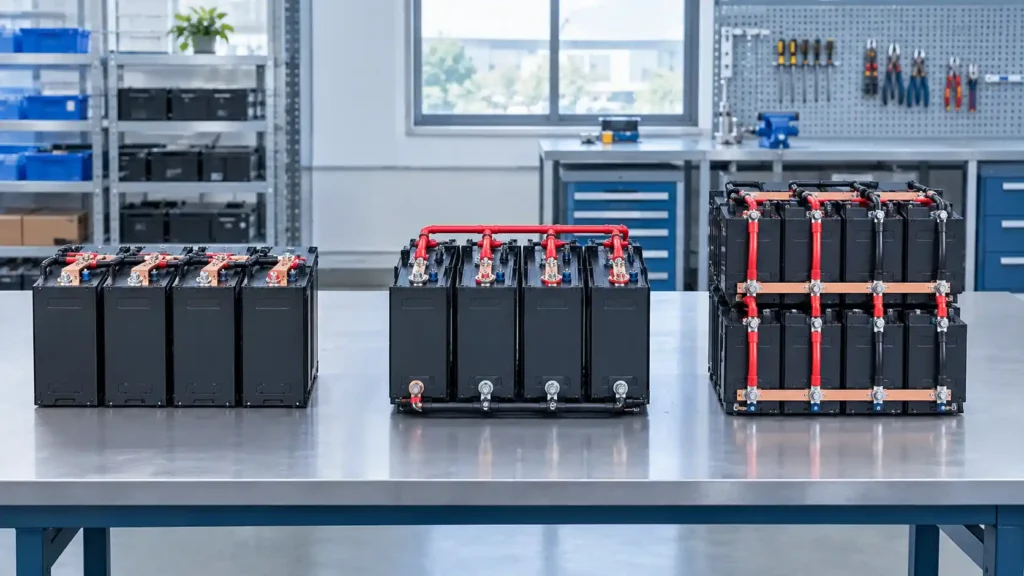
Batteries in series: how the connection works
Connecting batteries in series increases the system voltage.
If four identical 51.2V 100Ah batteries are connected in series, the resulting battery bank is approximately:
204.8V, 100Ah
The energy can be estimated as:
204.8V × 100Ah = 20.48kWh
Series connections are useful when the energy storage system requires a higher DC voltage than one battery can provide. This is common in systems designed around a specific high-voltage battery architecture.
The batteries used in a series string normally need to have compatible voltage, capacity, chemistry, and operating characteristics. Differences between batteries can become more significant as the string operates and charges.
For that reason, buyers should confirm the manufacturer’s approved series configuration rather than assuming that any batteries with the same nominal voltage can be connected in series.
Batteries in parallel: how the connection works
Connecting batteries in parallel keeps the system voltage unchanged while increasing available capacity.
For example, two identical 51.2V 100Ah batteries connected in parallel provide:
51.2V, 200Ah
The approximate stored energy is:
51.2V × 200Ah = 10.24kWh
Parallel battery configurations are useful when the system needs more stored energy at the same operating voltage. They can also increase the available current capacity when the batteries and BMS are designed for parallel operation.
However, adding batteries in parallel is not simply a matter of connecting positive and negative terminals. The batteries need to support parallel operation, and the system should account for current sharing, BMS communication, protection settings, cabling, and charging requirements.
Series vs parallel battery connections: key differences
| Configuration | Voltage | Capacity | Typical purpose |
|---|---|---|---|
| Series | Increases | Remains the same | Reach a higher system voltage |
| Parallel | Remains the same | Increases | Increase stored energy at the same voltage |
| Series-parallel | Increases | Increases | Build a larger battery bank with a specific voltage and capacity |
The correct configuration depends on the electrical requirements of the complete energy storage system.
A higher voltage configuration can reduce current for the same power level, but it also changes insulation, protection, inverter, BMS, and system design requirements. A parallel configuration can increase capacity and current capability, but the battery bank must be designed to distribute current correctly.
How series and parallel connections affect energy storage capacity
Battery capacity is normally expressed in amp-hours (Ah), while stored energy is expressed in watt-hours (Wh) or kilowatt-hours (kWh).
A simple calculation is:
Energy (Wh) = Voltage (V) × Capacity (Ah)
Consider four identical 51.2V 100Ah batteries.
If they are connected in series:
204.8V × 100Ah = 20.48kWh
If they are connected as two parallel strings, with two batteries in series in each string:
102.4V × 200Ah = 20.48kWh
This illustrates an important point: series and parallel connections change voltage and amp-hour capacity differently, but the total nominal energy can remain similar when the same number of identical batteries is used.
Actual usable energy can be lower than nominal energy because of operating limits, discharge settings, temperature, battery condition, and system efficiency.
For procurement, comparing batteries only by Ah can therefore be misleading. Voltage, usable capacity, continuous current, and system operating limits should be reviewed together.
Series vs parallel connections in energy storage systems
The required connection method depends on the architecture of the energy storage system.
Residential energy storage
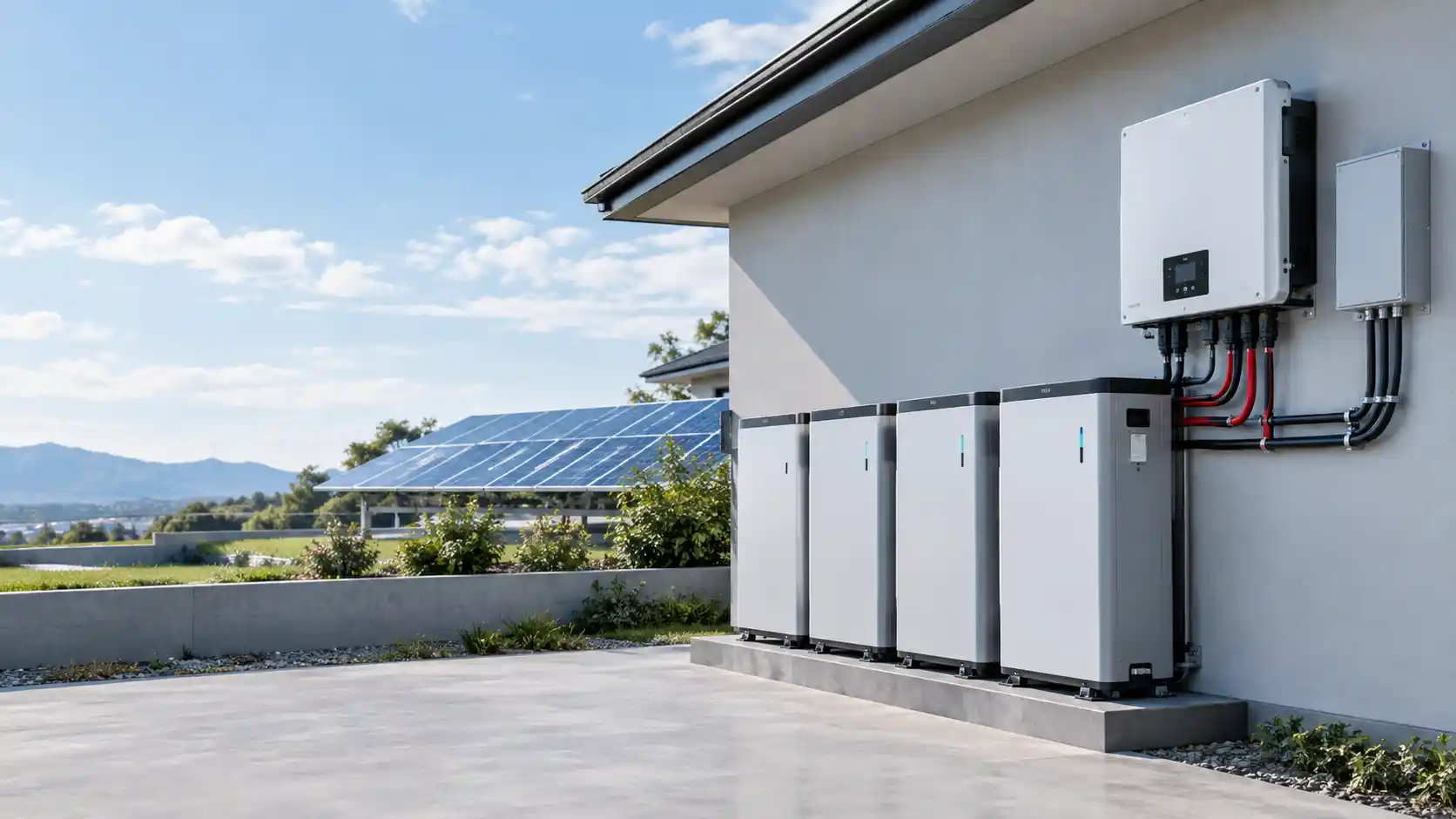
Residential systems often use a defined battery voltage platform to match the hybrid inverter or energy storage inverter. Depending on the product architecture, additional battery modules may be connected in parallel, series, or through a manufacturer-specific expansion method.
For example, a 51.2V LiFePO4 battery storage system may be configured according to the system’s specified voltage, capacity, current, and communication requirements.
The inverter’s battery voltage range should be checked before deciding how batteries will be connected. A battery bank with sufficient kWh capacity is not necessarily compatible with an inverter if its operating voltage or current limits fall outside the inverter’s requirements.
Off-grid solar energy storage
Off-grid systems need to balance battery capacity with inverter power and solar charging requirements.
A parallel configuration may be used when additional storage capacity is needed at the existing DC voltage. A series configuration may be required when the inverter or power conversion system operates at a higher battery voltage.
Solar charging current also matters. Increasing the battery bank capacity does not automatically mean that the existing charger or inverter can charge the larger bank at the required rate.
Commercial and industrial energy storage
Commercial and industrial systems generally have more demanding requirements for voltage, power, current, communication, protection, and expansion.
At this scale, battery connection topology should be treated as part of the complete system design rather than a standalone wiring decision. The inverter or PCS, BMS architecture, protection equipment, busbars, cables, and battery modules all need to work within their specified operating ranges.
For examples of different storage applications, see the VoltCrave Power project cases.
What is a series-parallel battery configuration?
A series-parallel configuration combines both connection methods.
For example, four identical 51.2V 100Ah batteries can be arranged as two batteries in series and two of those series strings in parallel.
Each series string provides:
102.4V, 100Ah
Two identical strings connected in parallel provide:
102.4V, 200Ah
The resulting nominal energy is:
102.4V × 200Ah = 20.48kWh
This approach allows system designers to reach a target voltage and capacity that cannot be achieved with a single series or parallel arrangement.
The configuration must follow the battery manufacturer’s approved architecture. The number of allowable modules, maximum parallel strings, communication method, protection requirements, and balancing strategy can vary between battery systems.
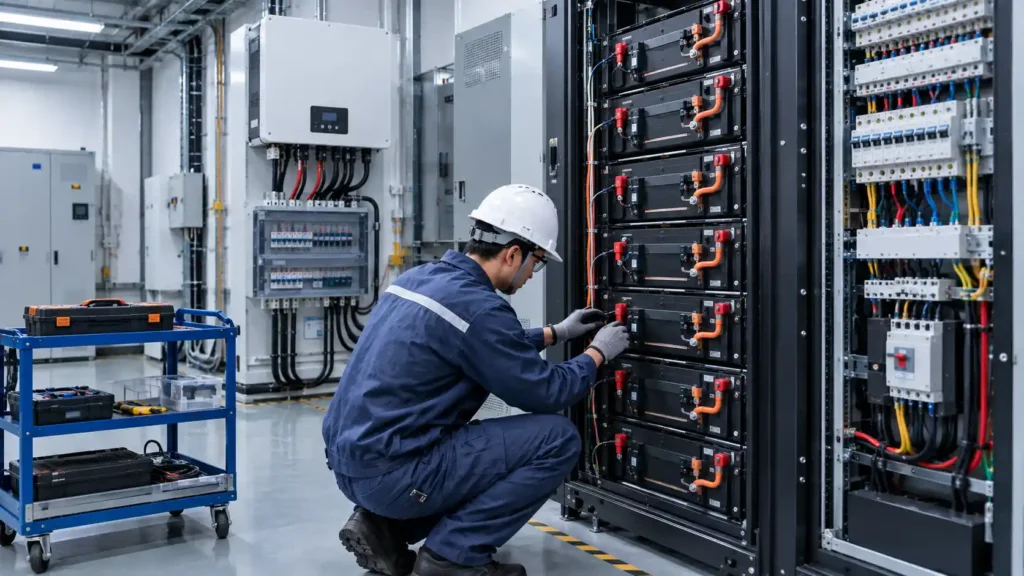
What to consider before connecting batteries in series or parallel
Battery compatibility
Batteries connected together should meet the manufacturer’s requirements for chemistry, nominal voltage, capacity, and operating characteristics.
Using mismatched batteries can create unequal current distribution or charging behavior. Differences in age, condition, internal resistance, or state of charge can also affect how the battery bank operates.
For procurement projects, confirm the approved battery combination before ordering additional modules.
BMS compatibility
The BMS controls and protects the battery within defined voltage, current, and temperature limits.
When multiple batteries are connected, the BMS architecture becomes part of the system design. Buyers should confirm whether the batteries communicate with each other, whether a master BMS is required, and how the battery bank communicates with the inverter.
Do not assume that two batteries with the same nominal voltage can communicate correctly simply because their electrical specifications appear similar.
Inverter compatibility
The inverter must support the battery bank’s voltage and current range.
For a complete system, check:
- Battery nominal and operating voltage
- Maximum continuous charge current
- Maximum continuous discharge current
- Peak or surge requirements
- BMS communication protocol
- Number of supported battery modules or strings
- Approved series or parallel configuration
Manufacturer-approved expansion
Battery expansion should follow the manufacturer’s specified configuration.
A system may have a maximum number of parallel modules or a defined series configuration. Cable sizing, protection devices, communication wiring, and BMS settings may also change as the battery bank grows.
For buyers, the practical question is not simply how many batteries can physically be connected. It is how many the complete system is designed and approved to support.
How to choose between series and parallel battery connections
Start with the required system voltage.
If the inverter or power conversion system requires a higher DC voltage, a series configuration may be necessary. If the operating voltage is already fixed but more stored energy is required, a parallel configuration may be appropriate.
For larger systems, a series-parallel arrangement can provide both the required voltage and capacity.
Before finalizing the configuration, confirm these points with the battery supplier:
- Required battery voltage range
- Target energy capacity in kWh
- Continuous and peak current requirements
- Maximum number of series-connected batteries
- Maximum number of parallel-connected batteries or strings
- BMS communication requirements
- Inverter or PCS compatibility
- Cable, protection, and installation requirements
The VoltCrave Power product range can be reviewed alongside the system requirements to identify the appropriate battery architecture.
FAQ
Does connecting batteries in series increase capacity?
No. A series connection increases voltage while the amp-hour capacity remains the same. The total stored energy increases because the system voltage increases.
Does connecting batteries in parallel increase voltage?
No. A parallel connection keeps the nominal voltage the same while increasing amp-hour capacity and, where supported, the available current.
Can batteries be connected in series and parallel at the same time?
Yes. A series-parallel configuration uses both connection methods to achieve a specific voltage and capacity. The arrangement must be supported by the battery manufacturer and compatible with the inverter and BMS.
Can different batteries be connected in series or parallel?
Not necessarily. Batteries should only be combined when the manufacturer specifies that the combination is supported. Differences in voltage, capacity, chemistry, age, BMS behavior, or operating limits can affect system performance and safety.
How many batteries can be connected together?
There is no universal number. The maximum depends on the battery design, BMS, inverter or PCS, approved series and parallel configuration, protection system, and installation requirements. Check the manufacturer’s specifications before expanding the battery bank.
Need help matching this topic to a real battery project?
Send your target application, capacity range, certification market, and order plan. VoltCrave can recommend a practical product direction.