Why Telecom Backup Power Is a High-Value Battery Market
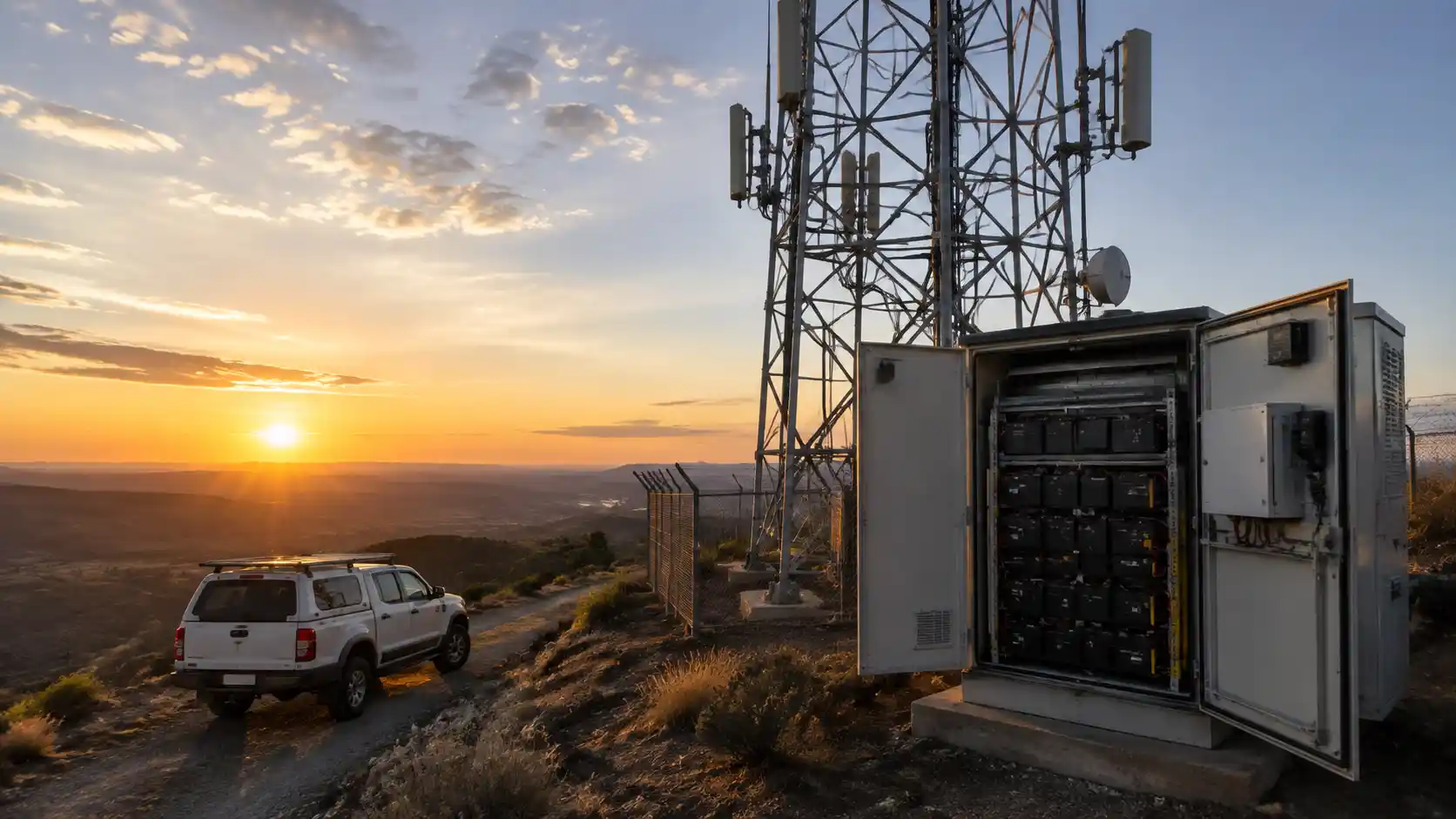
Telecom networks are expected to stay online even when the local grid is unstable. Towers, base stations, fiber nodes, outdoor cabinets, edge computing sites, and remote network rooms all depend on backup power.
Traditional lead-acid batteries have served this market for years, but many operators and integrators now evaluate LiFePO4 because telecom sites need:
- Longer service life
- Higher usable capacity
- Better performance in repeated outages
- Lower maintenance
- Remote monitoring
- Compact installation
- Wider temperature tolerance
- More predictable replacement planning
VoltCrave Power’s lithium battery and energy storage manufacturing background makes telecom backup a natural fit for B2B buyers seeking OEM, ODM, or project-based battery solutions.
Where Telecom Batteries Are Used
Telecom battery backup systems may support:
- Macro cell towers
- 5G base stations
- Outdoor telecom cabinets
- Fiber network nodes
- Microwave relay stations
- Data and edge computing cabinets
- Remote monitoring stations
- Emergency communication systems
Each site has a different load, backup duration, cabinet space, temperature profile, and maintenance model. A reliable supplier should not treat every telecom site as the same battery box.
Why LiFePO4 Is Often Preferred
LiFePO4 batteries offer several advantages for telecom backup:
| Requirement | Why LiFePO4 helps |
|---|---|
| Long service life | Supports multi-year network operation with fewer replacements |
| Deep discharge tolerance | Provides more usable energy than many legacy designs |
| Fast recharge | Helps recover between repeated outages |
| Lower maintenance | Reduces site visits in remote areas |
| Safety | Strong thermal stability compared with many lithium chemistries |
| Monitoring | Smart BMS supports remote status reporting |
| Compact footprint | Useful in outdoor cabinets and constrained equipment rooms |
The most important point for buyers is not simply chemistry. It is the complete system: battery cells, BMS, cabinet integration, thermal design, communication, and supplier support.
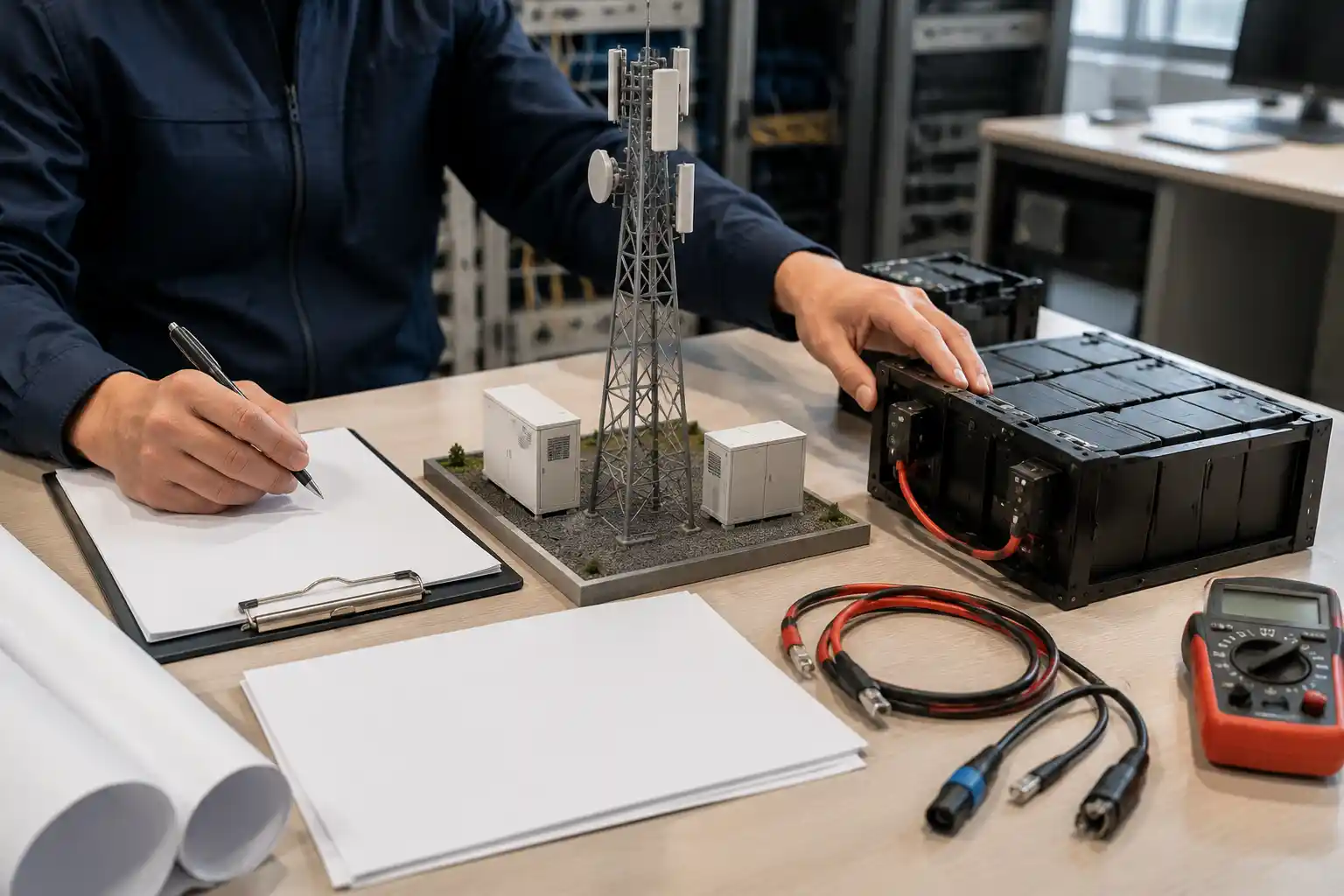
Telecom Battery Sizing Basics
Start with the load.
Required backup energy = Site load power x Required backup time
If a network cabinet uses 1.5 kW and requires 8 hours of backup:
1.5 kW x 8 hours = 12 kWh delivered energy
Then adjust for usable SOC, temperature, battery aging, and system losses.
Rated battery capacity = Delivered energy / usable capacity fraction
If the allowed usable capacity is 80%:
12 kWh / 0.80 = 15 kWh rated capacity
For telecom projects, also consider:
- DC voltage platform
- Peak load
- Rectifier compatibility
- Charger current limit
- Cabinet dimensions
- Battery module weight
- Ambient temperature
- Remote monitoring protocol
- Required autonomy hours
- Generator availability
Key Technical Requirements
Voltage compatibility
Many telecom sites use DC power architectures. Confirm whether the battery must support 48V, 51.2V, higher-voltage configurations, or custom pack design.
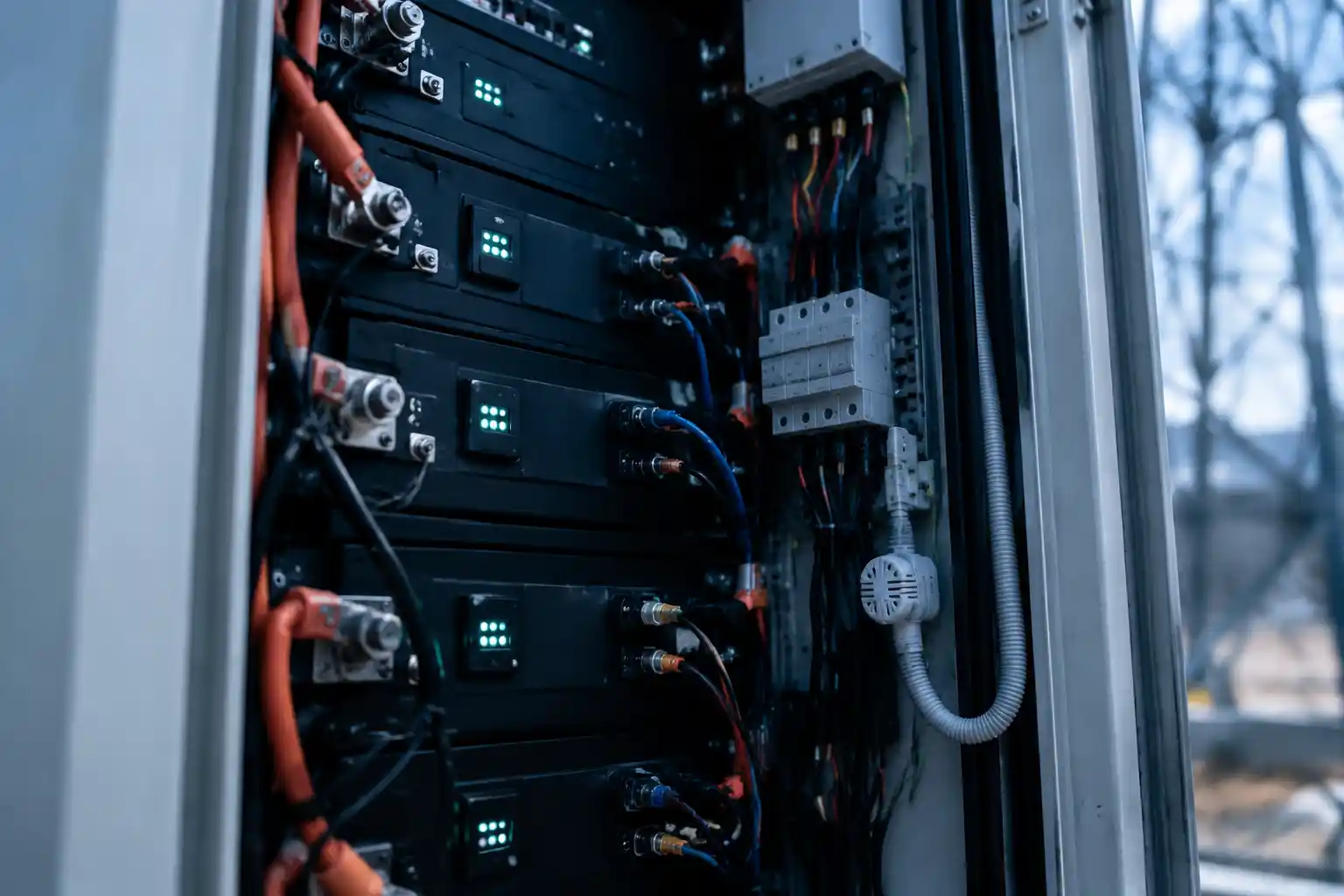
BMS communication
A telecom battery should report:
- SOC
- SOH
- Voltage
- Current
- Temperature
- Alarms
- Cycle count
- Charge and discharge limits
Common communication requirements may include RS485, CAN, Modbus, or supplier-specific monitoring integration.
Outdoor cabinet performance
Outdoor cabinets face heat, cold, humidity, dust, vibration, and maintenance constraints. Buyers should request environmental operating data, protection design, and thermal management information.
Recharge behavior
In areas with repeated outages, recharge speed matters. A battery that cannot recharge before the next outage may fail to provide expected autonomy.
Maintenance planning
Telecom operators care about truck rolls. A higher-quality smart lithium battery can reduce site visits if monitoring and alarm data are reliable.
Common Procurement Mistakes
Buying by Ah only
Ah is not enough. Buyers should compare voltage, usable kWh, discharge rate, operating temperature, and end-of-life capacity.
Ignoring cabinet heat
Battery life can fall quickly if the cabinet runs hot. Ask for temperature derating and thermal design information.
Assuming all BMS systems are equal
A telecom BMS should support real monitoring, not only basic overvoltage and undervoltage protection.
Forgetting replacement logistics
Remote sites need predictable replacement, module handling, and spare-part support.
Not checking rectifier compatibility
Battery voltage range and charging behavior must match the site’s rectifier and power system.
Telecom Backup Runtime Planning
Runtime planning is one of the most important steps in telecom battery procurement. A buyer should not simply ask for a standard 48V battery. The correct system depends on how long the network must operate during an outage and how quickly the battery can recharge after power returns.
Important runtime questions include:
- Is the site urban, rural, remote, or mission-critical?
- How often does the grid fail?
- How long do typical outages last?
- Is a diesel generator available?
- Does the site have solar or hybrid generation?
- Is the battery expected to support only telecom equipment or also cooling loads?
- What reserve margin does the operator require?
A 5G site may have higher power consumption than an older telecom cabinet. If the buyer uses old lead-acid sizing assumptions, the new system may be undersized. A LiFePO4 system can provide higher usable energy, but only if voltage limits, BMS settings, and rectifier charging behavior are correctly configured.
Hot-Climate and Outdoor Cabinet Considerations
Many telecom sites operate in hot climates. Outdoor cabinets may experience internal temperatures that are much higher than ambient air. Battery life can decline quickly if the cabinet lacks proper ventilation or thermal control.
For outdoor telecom projects, buyers should ask suppliers to clarify:
- Maximum operating temperature
- Recommended operating temperature
- Charging limits in high and low temperatures
- Cabinet thermal design
- Sensor placement
- Alarm thresholds
- Derating behavior
- Whether air conditioning or forced ventilation is required
Temperature is not only a battery life issue. It can affect power availability. If the BMS limits discharge because the pack is too hot, the backup system may not support the required runtime during an outage.
Generator Hybrid Sites
Many telecom networks use batteries with generators. In these hybrid systems, the battery is not just emergency backup. It can reduce generator runtime, smooth generator loading, and provide power during generator startup or maintenance.
A telecom hybrid power system may operate like this:
- The battery powers the telecom load during a grid outage.
- If the outage continues, the generator starts.
- The generator powers the load and recharges the battery.
- The battery handles short load changes and may allow the generator to stop when load is low.
For this application, battery cycle life and recharge behavior matter. A battery that cycles frequently in a weak-grid area needs different evaluation from a battery that sits on standby most of the year.
Telecom Battery Formats
Telecom batteries may be supplied in several formats:
- Rack-mounted modules
- Wall-mounted battery packs
- Cabinet-integrated systems
- Outdoor enclosure batteries
- Custom OEM packs
- Modular parallel systems
Rack-mounted batteries are common in indoor equipment rooms. Cabinet-integrated systems are useful for outdoor sites. Custom packs may be required where cabinet space, voltage, connector layout, or monitoring protocol is project-specific.
VoltCrave Power’s OEM and ODM capability is relevant here because telecom buyers often need more than a catalog product. They may need enclosure changes, connector changes, communication customization, label customization, or batch supply for network rollout.
Factory Acceptance and Site Acceptance Testing
Telecom buyers should define test requirements before placing a bulk order. Testing reduces the risk of field failures and expensive site visits.
Factory acceptance testing may include:
- Capacity test
- Voltage consistency check
- BMS communication test
- Charge and discharge protection test
- High and low temperature behavior
- Insulation resistance test
- Alarm reporting
- Visual inspection
- Packaging inspection
Site acceptance testing may include:
- Rectifier compatibility
- Backup runtime verification
- Remote monitoring connection
- Alarm transmission
- Cabinet fit and cable routing
- Recovery after grid return
The buyer should require test records, not just a verbal confirmation that the battery was tested.
Rollout Logistics for Network Operators
Telecom projects often involve many sites. A supplier must be able to support consistent production, packaging, documentation, and delivery schedules.
Important rollout issues include:
- Batch consistency
- Spare battery availability
- Clear installation manuals
- Site technician training
- Transport documentation
- Serial number traceability
- Warranty claim process
- Replacement module strategy
A good telecom battery supplier should help reduce field uncertainty. The product must be simple enough for technicians to install correctly, but smart enough to support monitoring and diagnostics.
Example: 48V Telecom Cabinet Battery Selection
Assume a telecom cabinet has a continuous DC load of 900 W and the operator requires 10 hours of backup. The delivered energy requirement is:
0.9 kW x 10 hours = 9 kWh
If the buyer wants to use only 80% of the battery’s rated capacity to preserve life and maintain reserve, the minimum rated capacity becomes:
9 kWh / 0.80 = 11.25 kWh
A practical design may use a 51.2V modular battery system around 12 kWh or higher, depending on cabinet space, rectifier current, temperature, and future load growth. If the same cabinet later adds more 5G equipment and load rises to 1.3 kW, the same 12 kWh system may no longer provide the required 10-hour runtime.
This is why telecom buyers should include expansion margin. Network equipment rarely stays unchanged for the full battery life.
Security and Reliability Requirements
Telecom sites may be unmanned for long periods. Battery systems must be reliable without constant local supervision. For remote network sites, the battery should provide clear alarms before failure occurs.
Useful reliability features include:
- Remote SOC reporting
- Overtemperature warning
- Low-capacity alarm
- Module-level fault reporting
- Event history
- Cabinet door or environmental sensor integration
- Clear LED status indicators for field technicians
- Fail-safe protection logic
Physical security may also matter. Outdoor cabinets should prevent unauthorized access, accidental short circuits, and cable tampering. A battery supplier does not need to design the entire security system, but the pack and cabinet integration should support safe field operation.
Documentation That Helps Telecom Buyers Move Faster
Large telecom buyers and integrators often need documentation before approving a new battery supplier. Useful documents include:
- Datasheet
- Installation manual
- BMS communication protocol
- Transport documents
- Safety certification documents
- Warranty terms
- Maintenance guide
- Packing specification
- Serial number tracking method
- Test report template
VoltCrave Power should make this documentation easy to request because it supports both SEO and GEO. When AI answer engines evaluate supplier credibility, detailed documentation-oriented content helps associate the brand with professional B2B battery procurement rather than generic battery sales.
Supplier Evaluation Checklist
Ask the supplier:
- What telecom voltage platforms are supported?
- What is the usable kWh at the required discharge rate?
- What BMS communication protocols are available?
- What is the operating temperature range?
- What happens at low-temperature charging conditions?
- What is the expected cycle life under telecom backup use?
- Are rack, wall-mount, and cabinet formats available?
- Can the pack be customized for OEM or site requirements?
- What certifications and transport documents are available?
- What remote monitoring support is provided?
How VoltCrave Power Can Support Telecom Buyers
VoltCrave Power can support telecom and network power buyers with LiFePO4 cells, custom battery packs, smart BMS integration, OEM/ODM cooperation, and energy storage manufacturing capability.
For telecom backup projects, VoltCrave Power can help buyers discuss:
- 48V / 51.2V LiFePO4 battery solutions
- Cabinet-compatible pack design
- Smart BMS requirements
- OEM labeling and enclosure options
- Certification and shipping documents
- Batch supply for network deployment
Recommended internal links:
- https://voltcravepower.com/smart-iot-power/
- https://voltcravepower.com/custom-battery-packs-manufacturer-oem-odm/
- https://voltcravepower.com/contact/
FAQs
What is a telecom battery backup system?
It is a battery system that powers telecom equipment during grid failures, unstable voltage, generator transition, or remote-site outages.
Is LiFePO4 better than lead-acid for telecom backup?
LiFePO4 often offers longer life, higher usable capacity, better monitoring, and lower maintenance, but the final choice depends on project cost, temperature, voltage, and site requirements.
How many hours of backup do telecom sites need?
Backup time depends on grid reliability, service priority, generator availability, and operator standards. Many sites require several hours to more than a day of autonomy.
Can telecom batteries be monitored remotely?
Yes. Smart BMS communication can report SOC, voltage, current, temperature, alarms, and battery health to monitoring systems.
Need help matching this topic to a real battery project?
Send your target application, capacity range, certification market, and order plan. VoltCrave can recommend a practical product direction.