What Is Depth of Discharge (DoD) in a LiFePO4 Battery?
Depth of discharge (DoD) is the percentage of a battery’s usable capacity that has been discharged during a cycle.
DoD and state of charge (SOC) describe opposite sides of the same operating window:
- SOC indicates how much charge remains in the battery.
- DoD indicates how much of the battery capacity has been used.
- 50% DoD means approximately half of the usable capacity has been discharged.
- 80% DoD means approximately 80% has been discharged.
- 100% DoD means the full specified usable capacity has been discharged.
The basic calculation is:
DoD = Energy Used ÷ Rated Battery Capacity × 100%
For example, if an energy storage system has a rated capacity of 10.24 kWh and supplies 8.19 kWh before recharging:
8.19 ÷ 10.24 × 100% ≈ 80% DoD
This calculation matters when evaluating LiFePO4 battery cycle life because cycle-life ratings are tied to specific test conditions. A battery rated for 6,000 cycles should not automatically be assumed to deliver 6,000 cycles at every possible DoD.

How Does Depth of Discharge Affect LiFePO4 Battery Cycle Life?
In general, deeper discharge results in fewer battery cycles than shallower discharge when other operating conditions are comparable.
A 50% DoD cycle uses less of the battery’s capacity than an 80% or 90% DoD cycle. Over repeated charging and discharging, the larger operating window can contribute to faster capacity degradation.
The relationship is not a fixed mathematical rule, however. LiFePO4 battery cycle life also depends on:
- Operating temperature
- Charge and discharge rate
- SOC operating range
- Charging conditions
- Cell design and chemistry
- BMS settings
- End-of-life capacity threshold
This is why cycle-life specifications should always be read together with the DoD used for testing.
For solar and residential energy storage, the practical question is not simply whether a battery supports deep discharge. The more useful question is whether its rated DoD provides enough usable energy for the application while meeting the required service-life target.
50% vs 80% vs 100% DoD: What Changes?
The effect of DoD is easier to understand by applying different discharge levels to the same battery.
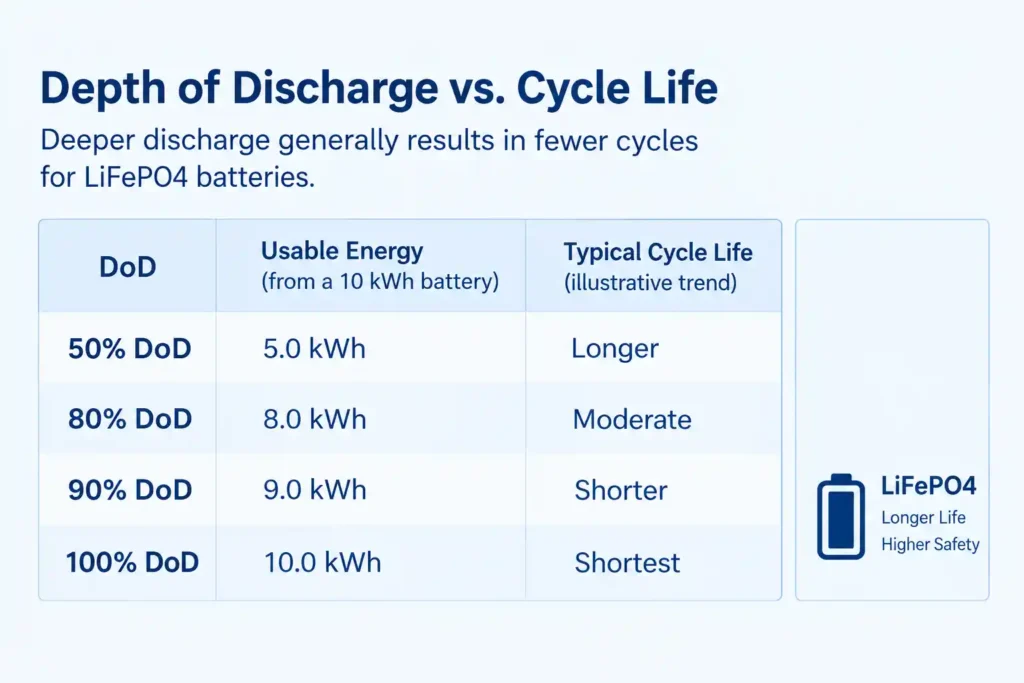
| DoD | Energy Used from a 10 kWh Battery | Relative Battery Stress | Usable Energy per Cycle |
|---|---|---|---|
| 50% | 5 kWh | Lower | 5 kWh |
| 80% | 8 kWh | Moderate | 8 kWh |
| 90% | 9 kWh | Higher | 9 kWh |
| 100% | 10 kWh | Highest | 10 kWh |
These figures show energy utilization, not guaranteed cycle life.
Actual cycle life varies with temperature, C-rate, voltage limits, cell construction, charging conditions and the manufacturer’s test method. Therefore, a buyer should not assume that reducing DoD by a specific percentage will increase cycle life by a predictable percentage.
The useful comparison is the cycle-life rating at the stated DoD.
Why Does Deeper Discharge Reduce LiFePO4 Battery Life?
Repeated charge-discharge cycling gradually changes the electrochemical condition of a battery.
As cycling continues, capacity can decline and internal resistance can increase. Deeper cycling subjects the cells to a wider operating range during each cycle, which can increase cumulative degradation under otherwise comparable conditions.
Research on LiFePO4/graphite cells has also linked aggressive discharge conditions with changes in electrode interfaces and other degradation mechanisms.
DoD is not the only variable. Temperature, current rate and SOC range can also change the rate of battery aging. A LiFePO4 battery operating at a moderate DoD under unfavorable temperature or current conditions may age differently from one operating at a higher DoD under controlled conditions.
For this reason, cycle-life data should be evaluated as a set of test conditions rather than as a single number.
What Does a Deep Discharge Battery Mean for LiFePO4 Systems?
A deep discharge battery is designed to tolerate repeated discharge to a relatively low SOC within its specified operating limits.
The term describes how a battery is operated; it does not by itself identify a particular battery chemistry.
For example, an energy storage system operating at 80% DoD uses considerably more of its rated capacity during each cycle than one operating at 50% DoD.
LiFePO4 chemistry is commonly used in stationary energy storage because it can support repeated cycling, but that does not mean a battery should be discharged beyond its specified voltage or BMS limits.
This distinction is important when evaluating battery deep discharge performance. A product can be rated for a high DoD while still having a different cycle-life rating at that operating point.
What Does VoltCrave Power’s LiFePO4 Battery Data Show?
VoltCrave Power’s residential LiFePO4 battery specifications provide a useful example of how DoD and cycle life should be evaluated together.
Its 51.2V 32kWh LiFePO4 Battery Storage System is specified with:
- 32,000Wh battery energy
- 51.2V rated voltage
- 628Ah nominal capacity
- 10,000W rated output power
- 6,000 cycles at ≥90% DoD
- 10,000 cycles at ≥80% DoD
- 150A maximum continuous charge current
- 200A maximum continuous discharge current
- RS485, RS232 and CAN communication
The important procurement point is the relationship between the DoD and cycle-life figures.
The system has a specified cycle life of 6,000 cycles at ≥90% DoD and 10,000 cycles at ≥80% DoD. That is a direct example of why cycle count should not be compared without checking the associated DoD.
For a residential energy storage project, the difference can affect usable capacity calculations, expected cycling requirements and long-term battery replacement planning.
How Does an 80% DoD Rating Translate to Usable Battery Capacity?
Consider a 10.24kWh LiFePO4 battery.
At 80% DoD:
10.24 kWh × 80% = 8.192 kWh
Approximately 8.19 kWh of the rated capacity is used within that discharge window.
VoltCrave Power’s 10.24kWh stackable ESS specifies 6,000+ cycles at 80% DoD. The system uses a 51.2V battery architecture and integrates a hybrid inverter for residential energy storage applications.
This illustrates why nominal capacity and cycle life should be evaluated together.
A battery with a higher nominal capacity is not automatically the better choice if the application does not need that capacity. Conversely, restricting usable capacity too much can require a larger battery bank to meet the same daily energy demand.
Does 100% DoD Mean a LiFePO4 Battery Will Fail Faster?
A high DoD does not automatically mean that a LiFePO4 battery will fail prematurely.
If the battery is designed and tested for a high DoD, that operating condition can be part of its specified use. The important point is that higher DoD generally provides more usable energy per cycle while reducing cycle life compared with shallower cycling under comparable conditions.
It is also important to distinguish between 100% DoD of the manufacturer’s specified usable window and discharging a battery below its permitted voltage limits.
These are not the same thing.
A properly configured BMS can monitor cell voltage, current and temperature and protect the battery when operating limits are reached. For example, VoltCrave Power’s 51.2V 32kWh battery system specifies over-discharge protection, over-current protection, low-temperature charging lock, cell voltage balancing and automatic low-SOC sleep.
Its specified discharge cut-off voltage is 44V.
Users should therefore follow the manufacturer’s operating limits rather than treating 100% DoD as permission to continue discharging below the specified voltage range.
What Other Factors Affect LiFePO4 Battery Cycle Life?
Temperature
Temperature has a direct effect on battery aging and operating performance.
The 51.2V 32kWh VoltCrave Power battery system specifies a discharge temperature range of -20°C to 55°C and a charge temperature range of 0°C to 55°C.
For energy storage projects exposed to outdoor temperature changes, these operating limits should be considered alongside the planned DoD.
Charge and discharge rate
The current used to charge or discharge a battery also affects its operating conditions.
Two LiFePO4 batteries with the same capacity and DoD can have different cycle-life results if they are tested at different charge or discharge rates.
For procurement, check the continuous current rating rather than evaluating the battery only by its kWh capacity.
SOC operating range
DoD and SOC are directly related.
A system that normally operates between 20% and 100% SOC has a different cycling profile from one that operates between 10% and 100% SOC.
The BMS and inverter settings therefore affect how the battery’s rated DoD is applied in an actual energy storage system.
Charging conditions
Charging voltage, current, temperature and control strategy also affect battery aging.
This is why the cycle-life specification of a complete energy storage system should be evaluated using its stated test conditions rather than by looking only at the LiFePO4 cell chemistry.
How Should You Choose DoD for Solar and Home Energy Storage?
For solar battery storage and residential energy storage, DoD should be selected according to the home’s actual energy demand and the required battery service life.
Suppose a home needs approximately 8 kWh of stored energy overnight and uses a 10.24kWh battery.
The required DoD would be approximately:
8 kWh ÷ 10.24 kWh × 100% ≈ 78%
That is close to an 80% operating point.
If the same home only needs 5 kWh:
5 kWh ÷ 10.24 kWh × 100% ≈ 49%
The battery would operate at approximately 50% DoD.
This shows why there is no single DoD that is optimal for every residential energy storage system.
The design needs to balance:
- Required usable energy
- Installed battery capacity
- Daily cycling pattern
- Backup requirements
- Rated cycle life
- Battery replacement considerations
A system that regularly needs most of its stored energy may justify a higher DoD. A system with lower daily energy demand may benefit from operating within a shallower window.
A Real VoltCrave Power Example: 10.24kWh Residential ESS
VoltCrave Power’s 10.24kWh stackable ESS provides a practical example for residential energy storage.
Its published specifications include:
- 10.24kWh battery capacity
- 51.2V battery voltage
- 10kW hybrid inverter
- 80% DoD
- 6,000+ cycles
- 120–450VDC MPPT input
- 100A maximum continuous discharge current
- RS232, RS485, CAN and WiFi communication
At 80% DoD, the nominal energy used per cycle is approximately:
10.24 kWh × 80% = 8.19 kWh
For a household whose daily battery requirement is close to this level, the system’s specified operating point provides a useful reference when sizing the storage capacity.
The same calculation can be applied to other battery sizes. Start with the required usable energy, then determine the battery capacity needed for the intended DoD rather than choosing capacity first and checking energy demand afterward.
What Should Buyers Ask a LiFePO4 Battery Manufacturer About DoD?
For OEM buyers, distributors, solar installers and energy storage integrators, cycle-life specifications should be checked against the actual operating conditions.
| Procurement Question | Why It Matters |
|---|---|
| What DoD was used for the cycle-life test? | Cycle count depends on the discharge depth. |
| What is the end-of-life capacity threshold? | Cycle counts are not comparable if the EOL criteria differ. |
| What temperature was used? | Temperature affects battery aging. |
| What charge and discharge rate was used? | C-rate affects operating stress and test results. |
| What are the charge and discharge voltage limits? | These define the actual operating window. |
| Does the cycle rating apply to cells or the complete battery system? | Cell data does not necessarily represent system-level performance. |
| What BMS protections are included? | Protection functions help keep the battery within its operating limits. |
| What DoD is covered by the warranty? | The warranty conditions may define how the battery can be operated. |
A supplier’s cycle count is much more useful when these conditions are documented.
DoD vs Cycle Life: What Is the Practical Conclusion?
Depth of discharge is a key variable in LiFePO4 battery cycle life.
Under otherwise comparable conditions:
Higher DoD → more usable energy per cycle, but generally fewer cycles
Lower DoD → less energy used per cycle, but generally more cycles
The relationship is not independent of temperature, C-rate, SOC range, charging conditions or the manufacturer’s test method.
VoltCrave Power’s published residential battery data illustrates this clearly. Its 51.2V 32kWh system specifies 6,000 cycles at ≥90% DoD and 10,000 cycles at ≥80% DoD. Its 10.24kWh stackable ESS specifies 6,000+ cycles at 80% DoD.
For procurement, the useful comparison is therefore not simply the highest cycle count.
Check cycle life at the DoD your application actually requires, together with the test temperature, charge/discharge rate and end-of-life definition.
Key Takeaways for LiFePO4 Battery Buyers
- Depth of discharge (DoD) measures the percentage of usable battery capacity discharged during a cycle.
- Deeper discharge generally reduces LiFePO4 battery cycle life when other operating conditions are comparable.
- DoD should be evaluated together with temperature, C-rate, SOC range and charging conditions.
- A cycle-life number is incomplete without its associated DoD and test conditions.
- An 80% DoD operating point can provide a practical balance between usable capacity and cycle life for many residential energy storage applications.
- A high DoD is not inherently unsuitable when the battery is designed and tested for that operating condition.
- Battery sizing should start with the application’s required usable energy and then account for the selected DoD.
- Buyers should ask suppliers for cycle-life data at a clearly defined DoD, temperature, C-rate and end-of-life threshold.
- VoltCrave Power’s published battery specifications provide a concrete example of why DoD and cycle life should be evaluated together.
FAQs
What is depth of discharge in a battery?
Depth of discharge is the percentage of a battery’s usable capacity that has been discharged. An 80% DoD means approximately 80% of the specified usable capacity has been used during the discharge window.
Is 80% DoD good for a LiFePO4 battery?
80% DoD can provide a useful balance between usable energy and battery cycle life. The appropriate operating point depends on the battery’s specifications and the energy requirements of the application.
Does deeper discharge reduce LiFePO4 battery cycle life?
Generally, yes. Higher DoD normally results in fewer cycles than shallower cycling under comparable conditions. The exact effect depends on temperature, C-rate, SOC range, charging conditions and battery design.
What is a deep discharge battery?
A deep discharge battery is designed to tolerate repeated discharge to a relatively low SOC within its specified operating limits. The term describes the battery’s operating profile rather than a specific chemistry.
Can a LiFePO4 battery be discharged to 100% DoD?
A LiFePO4 battery can be designed and rated for high DoD operation, but users should follow the manufacturer’s specified voltage and BMS limits. 100% DoD should not be interpreted as permission to discharge below the specified operating range.
How does DoD affect solar battery life?
Deeper daily cycling generally allows more energy to be extracted from each cycle but can reduce the number of cycles available over the battery’s service life. The appropriate DoD depends on battery capacity, daily energy demand, backup requirements and the manufacturer’s cycle-life specification.
What should I check when comparing LiFePO4 battery cycle life?
Check the rated DoD, test temperature, charge and discharge rate, end-of-life capacity threshold, voltage limits and whether the cycle rating applies to the cells or the complete battery system.
Need help matching this topic to a real battery project?
Send your target application, capacity range, certification market, and order plan. VoltCrave can recommend a practical product direction.