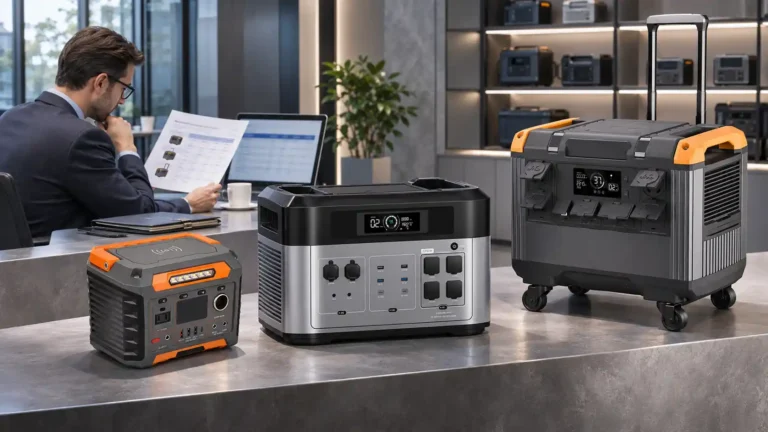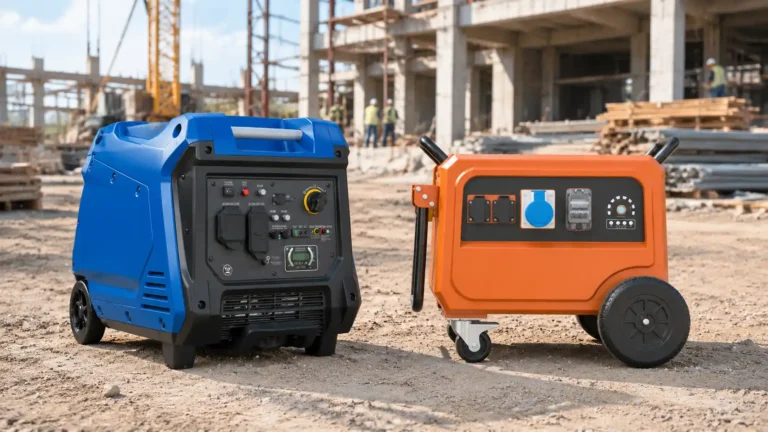
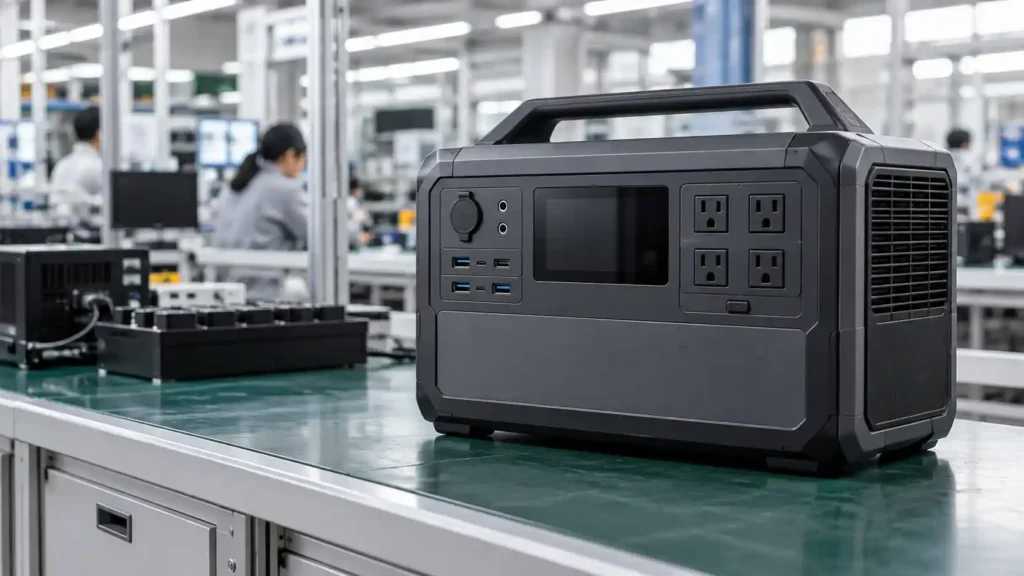
The question arrives with a photo of a 2048Wh unit and one line: can you put my logo on it. The answer is yes, and it takes a day. The follow-up questions take a quarter.
Most factories quote a custom portable power station with logo as a print job, so the price comes back quickly. The print is the cheapest part of a private label program and the part buyers negotiate hardest. What actually changes when that logo goes on the housing is the name on the declaration of conformity, the identity of the importer of record, the model number printed next to the certification mark, the durability of the label the customs officer reads, and, for smaller units, whether the battery can be opened at all after February 2027. None of that appears on a print proof.
This is the requirement set to settle before a tool is cut or a container is booked, written for the buyer who wants a brand rather than a sticker.
Four levels of custom, and only one of them is about the logo
A custom portable power station with logo can mean four quite different jobs, and suppliers quote all four as “OEM”. Mixing them up is why budgets move after the sample is approved.
Level 1: mark on a stock unit. Pad printing, laser marking or a metal nameplate on an existing housing. The artwork changes, the label content changes, the carton changes. No tooling, no re-test, shortest lead time. This is what most first orders are.
Level 2: cosmetic customisation. Colour, texture, handle, grille, carton structure. Colour adds a minimum paint or masterbatch quantity and a colour-matching approval; a new carton adds a die and a print run.
Level 3: configuration. Different output set, different battery capacity, different inverter, firmware and app skin. This is where certification scope starts to move, because the tested construction is no longer the shipped construction.
Level 4: new enclosure or platform. Industrial design, mould, DFM, drop test, construction review, and a MOQ step that is an order of magnitude above Level 1. Starting from an existing certified platform such as a 2048Wh expandable platform is a different commercial proposition from starting with a blank sheet, even when the finished product looks equally custom.
VoltCrave Power publishes a standard OEM minimum of 100 units per model, with ODM projects that need new tooling able to start from a pilot scope before scaling. That structure is typical of the category, and it tells you what to ask: the MOQ for each level separately, not one number for “custom”. The portable and outdoor range shows what already exists as a base.
The logo makes you the manufacturer, not the factory
In the European Union this is not a metaphor. Regulation (EU) 2023/1542 defines the manufacturer of a battery as the person who has the battery designed or manufactured and sells it under their own name or trademark. Put your logo on the case and sell it, and you are the manufacturer for the purposes of the regulation, whatever the contract with the factory says.
Consequences follow in a chain. The CE declaration of conformity is issued in your name and address. The technical file is yours to keep for ten years. Battery and WEEE producer registrations in each member state are yours, under your brand. The name and registered trade mark printed on the battery are yours. The factory becomes what it always was, a contract manufacturer, and its own certificates stop being a substitute for your compliance file.
The date to plan around is 18 February 2027. From then, every battery placed on the EU market must carry a QR code, and where the battery is not visible to the end user the code has to appear on the battery and in the accompanying documents. The Commission’s guidance on removability, C(2025)214, sets out how the “readily removable” test will be read.
In the United States the mechanism is different but the effect is similar. You are the importer of record, so you are the party that answers for the marking. 19 U.S.C. 1304 requires every imported article to be marked in a conspicuous place, “as legibly, indelibly, and permanently as the nature of the article will permit”, with the English name of the country of origin. Failure is not a warning letter: the statute adds a duty of 10 per cent ad valorem on the article. A “Made in China” sticker that lifts off in a warehouse is a 10 per cent margin problem.
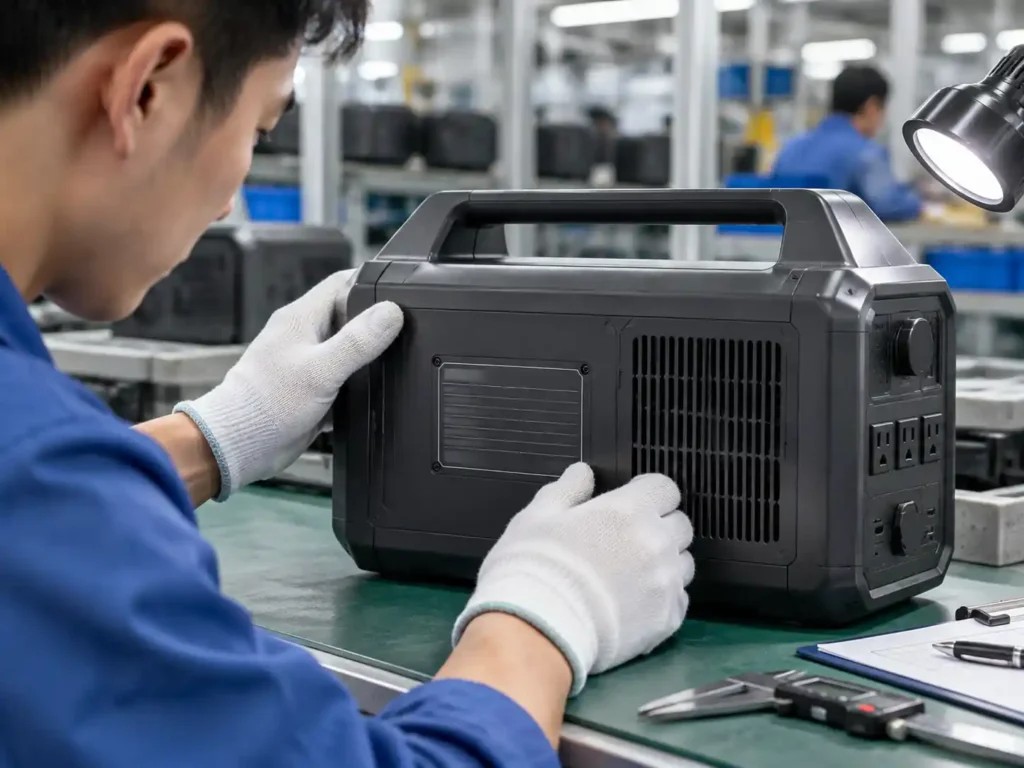
The nameplate is a legal document with a fixed field list
Most nameplate arguments are about logo size and placement. The fields underneath are the ones that get shipments refused.
| Field | Why it is there | Reference |
|---|---|---|
| Model number | Must match the test report and certificate exactly, character for character | Certificate or listing file |
| Watt-hour rating | Required on the outside case of every lithium-ion battery | 49 CFR 173.185(a)(5), in force since 10 May 2024 |
| Input and output ratings | The tested ratings, not the marketing peak | Test report |
| Manufacturer or importer name and address | The entity that answers for the product | EU conformity rules; US importer of record |
| Country of origin | Legible, indelible, permanent | 19 U.S.C. 1304 |
| FCC ID | Only if the unit contains a certified radio module | 47 CFR 2.925, 2.935 |
| Certification marks | Only the marks you are entitled to use | Listing, not test report |
| Serial or lot number | Traceability and warranty | Your own quality system |
Two of these are routinely mishandled.
The first is the FCC identifier. A unit with Bluetooth or Wi-Fi contains a certified module, and the FCC ID normally has to be visible on the device. 47 CFR 2.925(d) defines the label as permanently affixed only if it is etched, engraved, stamped, indelibly printed, or a nameplate on permanent adhesive that lasts the expected life of the equipment and cannot be readily detached, which rules out most of the stickers used in this category. If the unit has a display, 47 CFR 2.935 allows the identifier to be shown electronically, but only with access in no more than three steps from the settings menu, without a passcode, and the device or its packaging must still carry an identifier for import and resale. That is a firmware and packaging requirement, not a label design choice, and it is usually discovered late.
The label obligations that come with a radio do not stop at the identifier. A unit with a radio also has to carry the Part 15 statement in the exact wording, in a conspicuous location and at four-point type or larger, or in the manual and on the packaging where the housing cannot take it, under 47 CFR 15.19. That statement is not decorative. It is the condition under which the device may be marketed at all.
The second is the relationship between the mark and the file. A UL or ETL mark means the product is covered by a listing, with follow-up inspections at the factory. A UL 2743 test report means a sample passed a test. They are not interchangeable, and a supplier that sends a report when you asked for a listing has answered a different question. VoltCrave Power’s certification documents are a useful reference for what a complete package looks like: report, standard edition, applicant, factory address, model list.
What happens to the certificate when your name goes on it
Three regimes, three different answers.
North America, UL or ETL. The listing is tied to the factory, the construction and the model. To sell under your brand you either hold your own file with the factory named as the manufacturer, or you add your brand to the factory’s existing file through a multiple listing. Both routes need the factory’s cooperation, both keep the follow-up inspection, and both mean a construction change is a file change. A new housing, a different cell, a different BMS or a relocated label can each trigger a re-evaluation. UL 2743 itself covers single-person portable equipment, which testing labs summarise as units of 18 kg or less or fitted with wheels, up to 20 kWh of battery energy; above that the product moves toward stationary storage standards.
Europe, CE. You sign the declaration, so you own the argument. The test report has to cover the exact build you ship, which is why a supplier that quietly changes the cell supplier after certification has invalidated your file without telling you. Ask for the report’s construction details, not just the pass page.
Transport, UN38.3. The test summary is not optional paperwork. 49 CFR 173.185(a)(3) requires the manufacturer, and each subsequent distributor, to make a summary available, and the summary must include the product model number and the watt-hour rating. As the brand owner you are a distributor. If the summary names only the factory’s model, you have a gap that shows up when a forwarder asks for documents before an air shipment.
The practical test is a single page. Ask for the cover page of the report and read four things: who the applicant is, which model numbers are listed, which factory address is named, and which edition of the standard was used. If the applicant is the factory and your model number is absent, you do not yet have a certificate you can sell under.
Label durability is where cheap branding fails first
A flame-retardant ABS or PC housing has a low surface energy, and that is the enemy of every printing method. Pad print and screen print need the surface flame-treated or plasma-treated, or a primer, or the ink sits on top of the plastic and leaves with the first alcohol wipe. UV inkjet on a textured surface is the most common failure in this category, because it looks correct on the approval sample and disappears in service.
The methods that survive are the ones that go into the material or replace it: laser marking that removes pigment rather than adding it, in-mould labelling, two-shot moulding with the logo in the second shot, or a properly specified nameplate with an adhesive system evaluated for the substrate. Nameplate and label systems in North America are evaluated to UL 969 for adhesion and legibility after conditioning. The EU wording is shorter and stricter: the marking must be indelible.
Whatever the method, agree a test and put it in the approval. Fifty rubs with isopropyl alcohol on the installed label, 24 hours at 60°C and 90% relative humidity, a tape pull, a coin scratch, then read it under the lighting a customs officer or a returns clerk would use. If the logo is on a nameplate, test the nameplate bonded to the actual housing, not to a flat test plaque, because the texture and the curvature decide the result.
Position matters as much as ink. The label next to the AC outlets takes heat and plug abrasion every day. The label on the underside takes abrasion from every surface the unit is set down on. Neither is a good home for the only copy of the watt-hour rating.
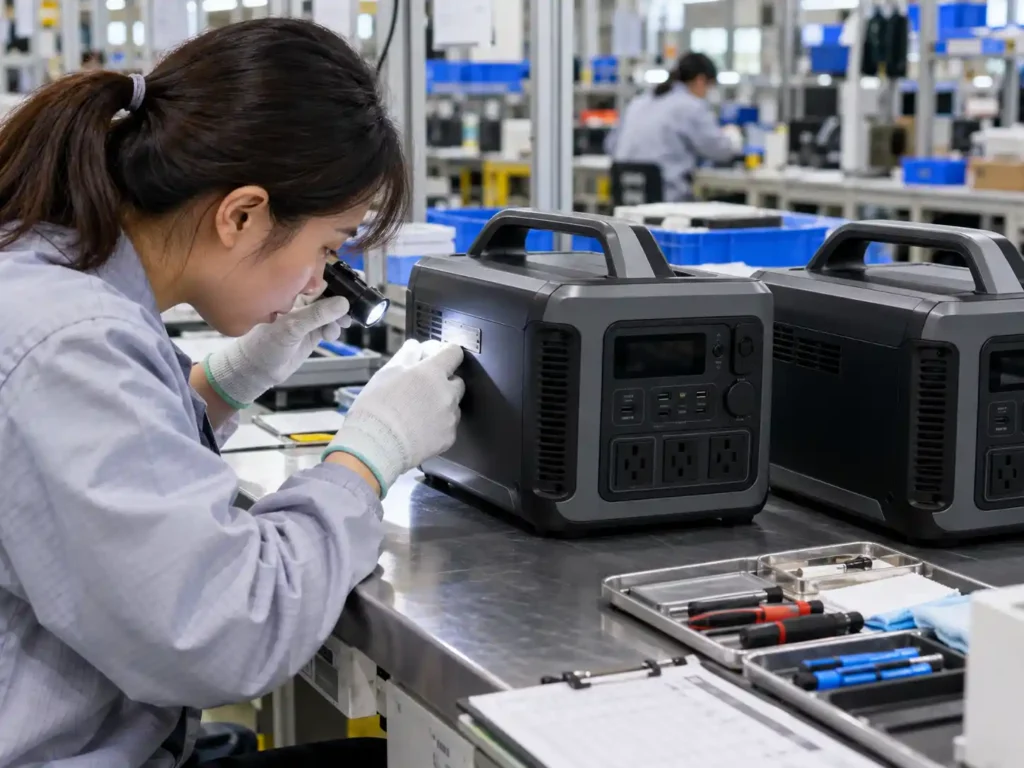
The 2027 rule that decides whether a small unit can be sealed
The removability requirement in Article 11 of Regulation (EU) 2023/1542 applies from 18 February 2027 to portable batteries and to light means of transport batteries built into products. Portable batteries must be removable and replaceable by the end user with commercially available tools, without damaging the device or the battery. The exceptions are narrow and have to be justified.
The category line matters more than most buyers expect, because “portable battery” in the regulation is a battery of 5 kg or less. A 300Wh camping unit carries a pack of a few kilograms, so it is a portable battery and the rule bites. A 2kWh unit typically carries a 15 to 20 kg pack, which falls outside that definition and into a different set of obligations. Two products in the same catalogue, sold under the same logo, can sit on opposite sides of the line.
If Europe is in the plan for 2027 and beyond, the design decision belongs in the RFQ, not in a change request after tooling. That means a battery door with captive screws rather than a glued seam, a connectorised pack rather than spot-welded leads, a documented replacement procedure, and a spare pack SKU that a distributor can actually stock. Retrofitting any of those into a sealed housing is a new mould.
The QR code arrives on the same date and is easier to absorb if the label artwork is designed once, with space reserved, rather than redesigned later.
Packaging, manuals, and the parts buyers forget to spec
A branded unit is usually a branded carton, and the carton carries obligations the product does not.
The country of origin has to appear on the article, and in practice on the retail packaging as well. The barcode has to be yours: a GS1 prefix registered to your company, not the factory’s, or the retailer’s system will treat two brands as one supplier. The lithium battery mark goes on the outer package for shipments of lithium-ion batteries, 100 mm by 100 mm with red hatching, and an overpack needs the word OVERPACK at 12 mm or more.
The manual is a compliance document. Warning text has to match the certified construction, the language set has to match the market, and the warranty has to be issued by the entity that will actually answer the claim. A manual that names the factory as manufacturer while the label names you creates a contradiction that a market surveillance officer will enjoy.
Air transport is worth deciding early because it constrains the product, not just the freight. A lithium-ion battery of 100Wh or less in equipment travels without airline approval. Between 100Wh and 160Wh it needs approval, and above 160Wh it is forbidden as passenger baggage. If a 300Wh model is going to be marketed as cabin friendly, that claim needs a legal review before it goes on the box.
What the OEM agreement has to say
The commercial document decides most of the technical arguments later.
- Tooling and artwork ownership. Who owns the mould, the print plates, the carton die and the source files, and on what terms they transfer if the relationship ends.
- Exclusivity. By market, by channel, by term. A factory selling the same housing with a different logo to your competitor is normal unless the contract says otherwise.
- Change control. Any change to cell supplier, BMS, inverter, firmware or housing requires written notice, and someone pays for the re-test. Name the someone.
- Certificate handling. Which file, in whose name, who pays the multiple listing fee, who holds the report.
- Warranty split. DOA rate, field failure rate, who pays freight both ways, who stocks spare packs and outlet modules.
- Regulatory responsibility matrix. Importer of record, WEEE and battery EPR registrations, declaration of conformity, UN38.3 summary holder, label approval.
- Golden sample. A signed unit with the approved label, print method and carton, held by both parties, is the only reliable reference for a dispute eighteen months later.
Ten questions for the first call
- Which certificate covers this exact model, in whose name, and can I see the cover page before I pay a deposit?
- What is the exact label artwork, including model number, Wh rating and country of origin?
- Which print method, on which housing material, and what abrasion test proves it?
- What changes, technically and commercially, between a logo on an existing housing and a new mould?
- Is the pack under 5 kg, and is it user-replaceable to the Article 11 test?
- What is the MOQ at each of the four levels, quoted separately?
- Who is the importer of record in my market, and who registers EPR?
- Which BOM substitutions would void the report?
- What is the spare parts and service commitment in years, not adjectives?
- What is in the golden sample, and who signs it?
A supplier that answers all ten without a meeting is either very good or has not understood question one. VoltCrave Power’s OEM/ODM process runs requirement review, technical proposal, prototype, safety and reliability testing, certification, then production, which is the right order for those answers to arrive in. Evaluation units before a volume commitment are the cheapest way to test the label as well as the product, and the sample evaluation route exists for that. What the samples cannot tell you is whether the batch holds the standard; that is the job of a QA test plan for OEMs, agreed before the first production run rather than after the first complaint.
FAQs
Can I put my logo on a portable power station without paying for tooling?
Yes. On an existing housing the logo goes on by pad print, laser marking or a nameplate, and the changes are artwork, label content and packaging. Tooling only enters at a new enclosure or a structural change. Ask for the print plate and carton die costs separately so you can see what is one-time.
How many units do I need for a custom portable power station with logo?
It depends on the level, not the logo. VoltCrave Power publishes 100 units per model as a standard OEM minimum, with pilot scopes for ODM work that needs new tooling. Other suppliers in the category quote similar or higher figures, and a quote that ignores the difference between printing and moulding is not comparable.
Does my logo change the certification?
The listing or report stays with the model and the factory file, but your brand has to be added through a multiple listing or covered by your own file, and the label and housing are part of the certified construction. A logo that changes the label layout is a construction change, so notify the certification body rather than deciding it is cosmetic.
Do I need my own UL file to sell on a marketplace?
Marketplaces commonly ask for a UL 2743 test report, and a report is not a listing. In most listing reviews the report has to name your model, which means either your own file or a listing that includes your brand. Check the applicant and the model list before you accept a PDF as proof.
What must be printed on the unit itself?
At minimum the model number, the watt-hour rating, the input and output ratings, the manufacturer or importer name and address, and the country of origin. Add the FCC ID if there is a radio, and the EU symbols and QR code where the battery regulation applies. Anything beyond that is a marketing decision, and every extra mark is another thing that can be wrong on the label.
Summary
Work backwards from who signs the paperwork. A custom portable power station with logo is a compliance decision wearing a print job. If the first answer is the factory, you are buying a private label in the narrow sense: a mark on someone else’s certificate, with the compliance file sitting in another company’s name. If the answer is you, the logo is the last item on the list, after the label fields, the certificate route, the UN38.3 summary in your model number, and the battery door that has to open in 2027.
The rule that separates the two: a brand owns the declaration, the importer record and the label, and a sticker owns none of them. Decide which one you are buying before the mould is cut, because after that the only cheap change left is the logo.
Need help matching this topic to a real battery project?
Send your target application, capacity range, certification market, and order plan. VoltCrave can recommend a practical product direction.