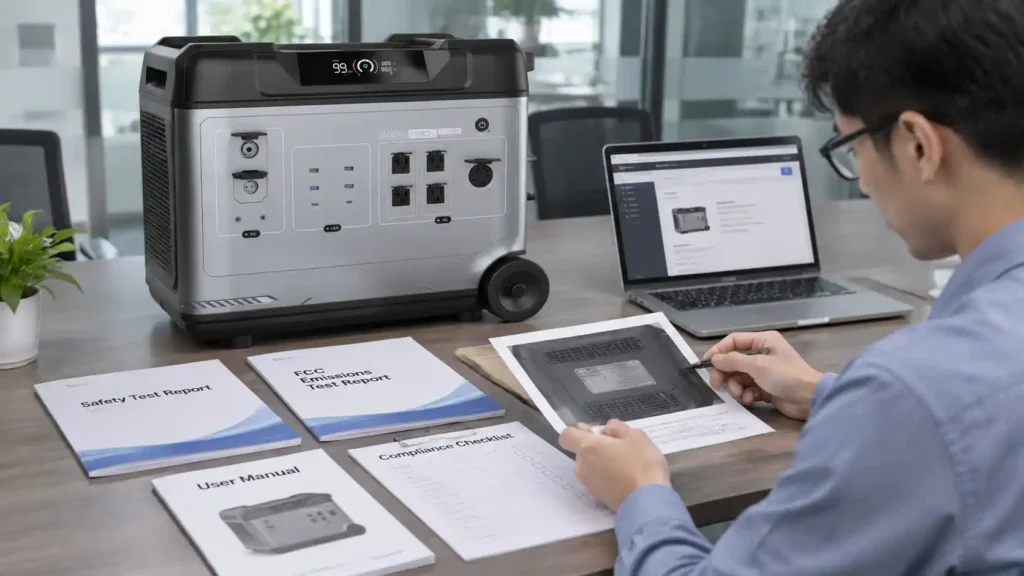
A document pack for a 2 kWh portable power station usually arrives as three PDFs and a photo of the rear label. The UL 2743 report has a cover page. The FCC compliance file has a test report number. The label photo shows a mark and a model number. Each document is real. None of them proves that the unit in the carton is covered.
The two claims are different in kind. UL 2743 is a safety standard for the complete portable power pack, and a UL listing is a private certification with factory follow-up. FCC Part 15 is a federal rule for radio-frequency devices, and for a unit without a radio it is satisfied by a supplier’s declaration, not a certificate. Suppliers write it as UL2743, UL 2743 or with the ANSI/CAN prefix. The spelling changes nothing about the check.
What follows is the sequence for a buyer who has a quote, a sample and a ship date. It is written for portable power stations, not for residential storage or phone power banks, because the standard boundaries are where most claims fail.
What UL 2743 covers, and where the scope ends
ANSI/CAN/UL 2743 is the North American safety standard for portable power packs. The current third edition was published on September 24, 2025, with ANSI and SCC approval on the same date. The scope covers portable and movable packs with one or more internal batteries or electrochemical capacitors, one or more inputs and outputs, and optional functions such as an air compressor, a light, an inverter or a booster for a 24 V dc vehicle battery.
The capacity ceiling is set by chemistry, not by marketing. Table 1.1 of the standard sets the aggregate capacity thresholds:
| Chemistry | Aggregate capacity | Above the threshold |
|---|---|---|
| Lithium-ion or sodium-ion | 20 kWh (72 MJ) | UL 9540 |
| Lead-acid or valve-regulated nickel | 70 kWh (252 MJ) | UL 9540 |
| Electrochemical capacitors | 3 kWh (10.8 MJ) | UL 9540 |
Three exclusions matter in a supplier conversation. Power banks are covered by UL 2056, not UL 2743. Packs that are permanently connected to premises wiring, or that can supply premises wiring, or that have a utility-interactive function, are covered by UL 9540. Stationary batteries are covered by UL 1973. A cell is covered by UL 1642. Those are boundaries, not side topics: a supplier that sends a UL 1642 cell report in answer to a system-level request has answered a different question.
The third edition also added or clarified several construction and test points, including AC pass-through UPS operation, the drop test for packs with wheels, sodium-ion and valve-regulated nickel chemistries, and backpacked packs. A report to the second edition is not automatically obsolete, but the transition needs an explanation. “We have UL 2743” without an edition and a date is not a document, it is a sentence.
FCC compliance is not a certificate, and that changes the request
Part 15 Subpart B covers unintentional radiators: the inverter, the switching supply, the control board, the display. A portable power station marketed for home and outdoor use is normally evaluated as a Class B digital device, with conducted emissions under 15.107 and radiated emissions under 15.109.
For a Class B digital device, the manufacturer or importer can choose certification or a Supplier’s Declaration of Conformity (SDoC). In practice, a unit without a radio goes the SDoC route. The responsible party makes the measurements or has them made, signs the compliance information statement, and keeps the file. The responsible party must be located in the United States. The statement has to accompany the product, in the manual or on a separate sheet, and it has to identify the product, state compliance and give the US party’s name, address and contact details.
That is why the phrase “FCC certified” is a useful tell. For a non-radio power station there is no FCC certificate. There is a declaration and a test report. A supplier that says “FCC certified” may be translating loosely, or may be describing a certificate that does not exist.
A unit with Bluetooth or Wi-Fi is a different case. The radio is an intentional radiator under Part 15 Subpart C and needs an FCC ID, which means a grant of certification and a grantee who is responsible for the radio. The module grant may cover the radio if the integration stays inside the grant conditions, but the host still needs its Part 15B declaration. A label that shows a module’s FCC ID with “Contains FCC ID” is normal. A label that shows an FCC ID which resolves to a different product is not acceptable.
| Route | When it applies | What the buyer should receive | Who is accountable |
|---|---|---|---|
| SDoC, Part 15B | No radio | Compliance information statement, test report to 15.107 and 15.109 | US responsible party named on the statement |
| Certification, Part 15C | Bluetooth, Wi-Fi, cellular | FCC ID, grant, test report | Grantee of the FCC ID |
| Both | Radio plus digital electronics | Both sets, plus the module integration conditions | Grantee for the radio, US party for the host SDoC |
The three documents buyers confuse
A test report, a certificate of compliance and a listing are not interchangeable. The difference is who issued it and what happens after the sample.
| Document | Issued by | What it proves | What it does not prove |
|---|---|---|---|
| UL 2743 test report | A testing laboratory | A sample was tested to the named edition | That the factory is authorized to mark the model |
| Certificate of compliance | A lab or certification body | A summary of the evaluation | That a listing file exists, unless the file number is on it |
| UL listing | UL Solutions, recorded in UL Product iQ | The construction and factory are under a file with follow-up | That every model in the catalog is covered |
| FCC test report | A testing laboratory | Emissions were measured against Part 15 | That a declaration was made or a grant issued |
| FCC SDoC statement | The responsible party | The US party declares compliance | That the FCC reviewed or approved it |
| FCC ID grant | The FCC, on application | The radio equipment is authorized | That the host product’s Part 15B file is complete |
Most bad document packs are not forgeries. They are real documents for a different model, a different standard or a different applicant. The verification job is to find out which.
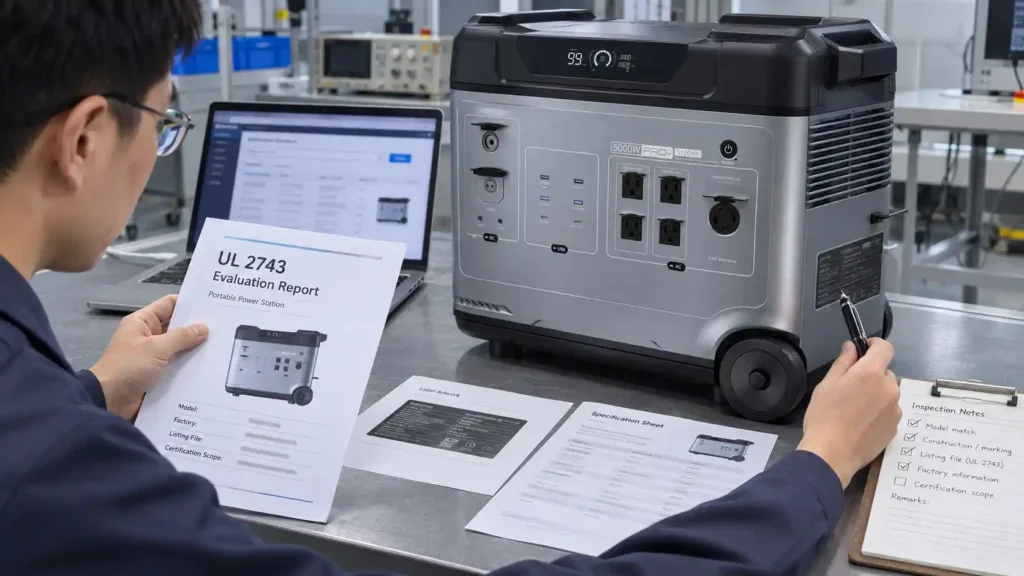
How to verify a UL 2743 claim in five checks
1. Read the edition and the date. The third edition has been current since September 24, 2025. A report to an earlier edition can still support an existing listing, but a new claim should explain the transition. Check that the test date is after the design freeze, not before it.
2. Match the scope line. Confirm the chemistry, the aggregate capacity and the product type. A 5.12 kWh lithium unit is inside the scope. A 25 kWh unit is not. A DC-only power bank belongs to UL 2056. A unit with a premises-wiring connection belongs to UL 9540.
3. Match the construction. The report should name the model, the battery cell, the BMS, the inverter and the factory. A family listing can cover several models, but the model list and the construction description have to include the one you are buying. A cell change, a BMS change or a new enclosure after the test is a file change, not a paperwork detail.
4. Find the file in UL Product iQ. The directory is at productiq.ulprospector.com. Search the UL file number, which is usually an E-number, or the company name. Open the record and read the status, the product category, the model designations and the factory. A report number is not a file number. If the supplier cannot give a file number, ask whether the product is listed at all.
5. Check the mark and the factory. A UL mark on the unit, a file number on the label and a factory address in the file are three parts of the same claim. The listing also brings follow-up inspections. An ETL, CSA or TÜV mark can be an NRTL listing under the same standard, but the same check applies through that body’s directory. A “UL Recognized Component” mark is for a component, not for the complete power station.
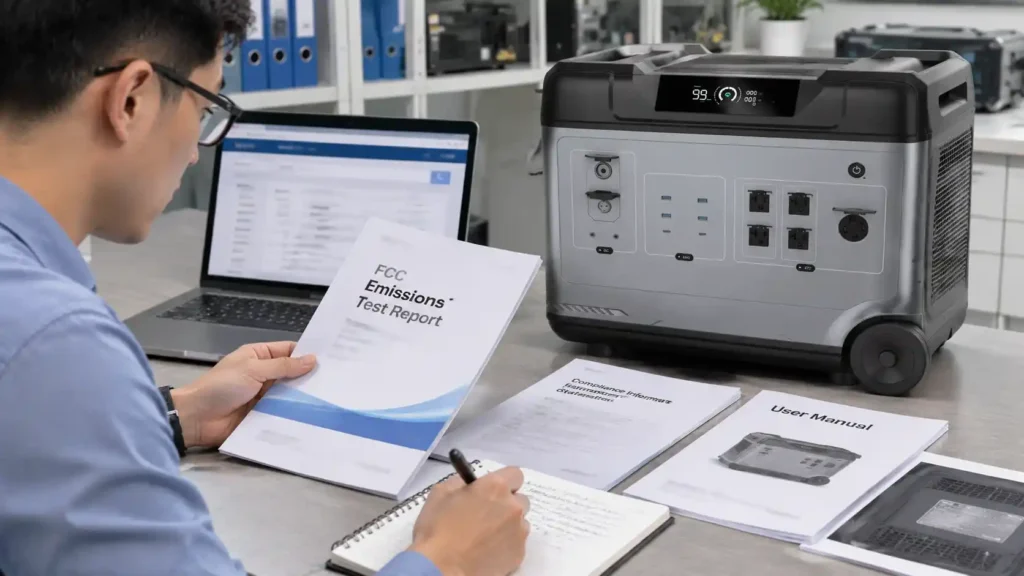
How to verify FCC compliance in four checks
1. Identify the radio. Bluetooth or Wi-Fi means Part 15C certification and an FCC ID. A cellular modem is authorized under the applicable licensed-service part, but it still produces an FCC ID. No radio means Part 15B and an SDoC. A unit can have both, and often does.
2. For an SDoC, read the statement and the report. The compliance information statement has to identify the product, state compliance and name a US responsible party. The test report should show 15.107 and 15.109, the Class B limits, the model, the lab and the date. A report without the statement is half the file. A statement without a report is a promise.
3. For an FCC ID, search the database. The FCC ID search is at fcc.gov/oet/ea/fccid. Enter the grantee code and the product code. Read the applicant, the equipment class, the frequency range, the grant date and whether the grant is for a module. Then compare the grant to the label and to the model in the manual. An FCC ID that belongs to the Bluetooth module supplier is not evidence that the host was evaluated; it is evidence that the module was.
4. Check the label and the manual. The Part 15 statement required by 15.19(a)(3) reads: “This device complies with part 15 of the FCC Rules. Operation is subject to the following two conditions: (1) This device may not cause harmful interference, and (2) this device must accept any interference received, including interference that may cause undesired operation.” A Class B unit also needs the 15.105(b) user notice in the manual. The FCC ID has to be permanently affixed under 2.925(d), not a sticker that lifts off in a warehouse.
The red flags that survive a clean-looking PDF
| Red flag | What it usually means | What to ask for |
|---|---|---|
| “UL certified” with no file number | A test report or a consultant’s certificate | The UL file number and the Product iQ record |
| Report names a different applicant or model | The report belongs to the factory’s own model | A report or listing that names your model |
| UL 2054, UL 1642 or UL 2056 presented as UL 2743 | A component or power bank standard | The system-level report or listing |
| “FCC certified” on a unit with no radio | An SDoC described as a certificate | The SDoC statement and the Part 15B report |
| FCC ID resolves to the module maker | A module grant, not a host authorization | The grant and the module integration conditions |
| Report predates the current edition or a design change | The shipped construction is untested | A current edition report or a delta evaluation |
| Lab is not ISO/IEC 17025 accredited (NVLAP, A2LA or equivalent) | The report may not survive a review | The lab’s accreditation and scope |
| Certificate “valid for one year” | A marketplace review window, not a standard rule | The underlying listing and report dates |
What VoltCrave Power publishes, and what it does not
VoltCrave Power’s certification portfolio lists FCC Part 15B under EMC and radio compliance, alongside UL 1973, UL 9540A, IEC 62619, IEC 62133-2, UL 1642 and UN 38.3. The page states 450+ certifications, 30+ countries and 15+ testing bodies. UL 2743 does not appear in the standards list on that page.
That is not unusual. A portfolio page shows what a company holds across a product range; it is not a per-model file. The portable and outdoor range is where the model-level claims sit, and those pages are more specific than the portfolio. The BP2000 2200W 2048Wh lists CE, FCC, PSE, UN38.3, EMC, LVD, RoHS and MSDS. The BP5000 Pro Max 5120Wh lists the same set. The BP3000 3200W lists the same set and adds Bluetooth with an app.
The Bluetooth line is the one to follow up. A unit with a radio needs an FCC ID, not only an EMC report. If the file contains only an EMC report, the radio function has not been shown to be authorized. Ask for the FCC ID and the grant, then check the grantee. That question is fair for any supplier, including VoltCrave Power.
The product pages also carry a disclaimer that certification availability varies by product model and target market. That is the correct way to read any portfolio page. For a UL 2743 file, ask VoltCrave Power’s compliance team for the model-specific report or listing. If it exists, it will name the model, the factory and the edition. If it does not, the model is not covered yet, and that is the answer to plan around. A logo on a web page is not a substitute for a file number.
A document request list that ends the argument
Send this before the sample is approved, not after the purchase order.
| # | Document | What to read on it |
|---|---|---|
| 1 | UL 2743 report cover | Applicant, factory, model list, edition, test date |
| 2 | UL Product iQ record | File number, status, category, model designations |
| 3 | FCC SDoC statement | Product ID, US responsible party, 15.19 statement |
| 4 | FCC Part 15B test report | Lab, accreditation, 15.107 and 15.109, model, date |
| 5 | FCC ID grant, if radio | Grantee, product code, equipment class, frequency, module or host |
| 6 | Label artwork | Model, Wh, input and output ratings, FCC statement, FCC ID, UL mark |
| 7 | User manual | Class B notice, warnings, language set |
| 8 | UN38.3 test summary | Model, Wh, test date |
| 9 | IEC 62133-2 and UL 1642 documents | Cell and pack level, not system level |
| 10 | Change notification process | How the supplier tells you about cell, BMS or inverter changes |
A supplier that can answer this list in a day has a compliance file. A supplier that answers with a logo has a marketing file. The difference shows up at customs, at a marketplace review, or at the first insurance question.
FAQs
Is UL 2743 required by law in the United States?
No federal statute requires it. It is a consensus safety standard. It becomes a practical requirement through marketplace compliance programs, retailer and insurer conditions, and workplace rules that call for listed equipment. The FCC side is different: Part 15 is mandatory for marketing.
What is the difference between a UL 2743 test report and UL certification?
A test report says a sample passed the tests in the named edition. A UL listing says an NRTL has evaluated the construction and the factory and maintains a file with follow-up inspections. A report can be genuine and still not be a listing.
Does FCC certification cover UL 2743?
No. FCC Part 15 covers electromagnetic emissions and radio authorization. The standard covers product safety. They are separate files from separate bodies, and one does not imply the other.
Can a portable power station be FCC compliant without UL 2743?
Yes. FCC authorization is required to market the product. UL 2743 is not a federal statute. A unit can have a complete Part 15B file and no such listing. That is exactly why the two claims have to be checked separately.
How do I check a UL file number?
Search UL Product iQ by the file number or the company name. Open the record and compare the category, the model designations and the factory with the unit you are buying. If the model is not in the record, the listing does not cover it.
How do I check an FCC ID?
Search the FCC ID database by grantee code and product code. Read the applicant, equipment class, frequency, grant date and module status. Then compare the grant with the label and the manual. If the grant is for a module, ask for the integration conditions.
The decision rule
Two files, two questions. For UL 2743: does the Product iQ record name this model, this factory and this edition? For FCC: does the route match the radio, and does the FCC ID or the SDoC statement name this model and a US responsible party?
If either answer is no, the document is not proof for the unit in the carton. The cheapest time to ask is before the sample. The most expensive is after the container is loaded.
Need help matching this topic to a real battery project?
Send your target application, capacity range, certification market, and order plan. VoltCrave can recommend a practical product direction.