When selecting an inverter for an energy storage system, rated power is only part of the decision. The output waveform can also affect how connected equipment operates, particularly when the system includes motors, compressors, sensitive electronics, chargers, or other loads with specific power-quality requirements.
This is why buyers often compare pure sine wave vs modified sine wave inverters before selecting an inverter for solar storage, backup power, or off-grid applications.
For a basic resistive load, a modified sine wave inverter may be sufficient in some applications. For a broader range of electronic and motor-driven loads, a pure sine wave inverter generally provides a cleaner AC output and wider compatibility.
The right choice therefore depends less on which waveform sounds “better” and more on what the energy storage system needs to power, how the loads behave, and what the project requires from the inverter.
What Is a Pure Sine Wave Inverter?
A pure sine wave inverter converts DC electricity from a battery or other DC source into AC electricity with a sinusoidal output waveform designed to closely resemble utility-grid AC power.
For energy storage systems, this type of inverter is commonly considered when the system needs to supply a mixture of electronic equipment, appliances, motor loads, and other AC devices.
The main advantage is compatibility.
A properly designed pure sine wave inverter can provide a stable AC output for applications where waveform quality matters. This is particularly relevant when an energy storage system is expected to operate a variety of loads rather than a single simple appliance.
VoltCrave Power’s inverter portfolio includes products with pure sine wave output across different power ranges. For example, its SR-1K 1kW Pure Sine Wave Solar Inverter is specified for 110V/220V applications, while its larger hybrid inverter products include pure sine wave output for residential and energy-storage applications.
What Is a Modified Sine Wave Inverter?
A modified sine wave inverter produces an AC waveform that approximates a sinusoidal waveform using stepped voltage levels rather than a smooth sine wave.
This design can make the inverter simpler and potentially less expensive for applications where the connected loads do not require a high-quality sinusoidal output.
However, compatibility depends on the equipment being powered.
Some basic loads may operate normally, while certain motors, chargers, audio equipment, electronic power supplies, or other sensitive devices may produce additional noise, heat, vibration, reduced performance, or abnormal operation when supplied by a non-sinusoidal waveform.
For this reason, the question is not simply whether a modified sine wave inverter can produce AC power. The more useful purchasing question is:
Will the waveform be suitable for every important load in the energy storage system?
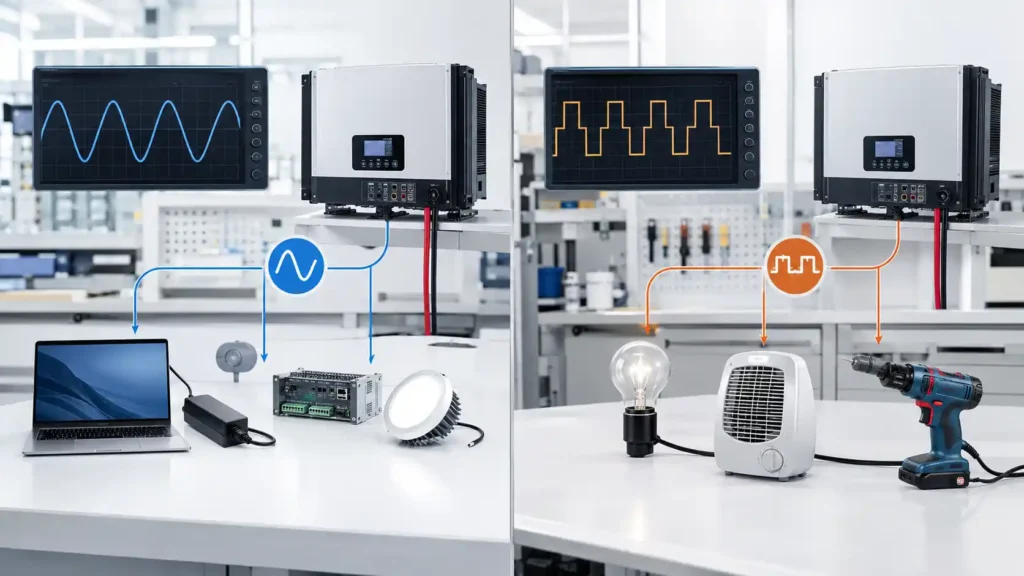
Pure Sine Wave vs Modified Sine Wave: What Is the Difference?
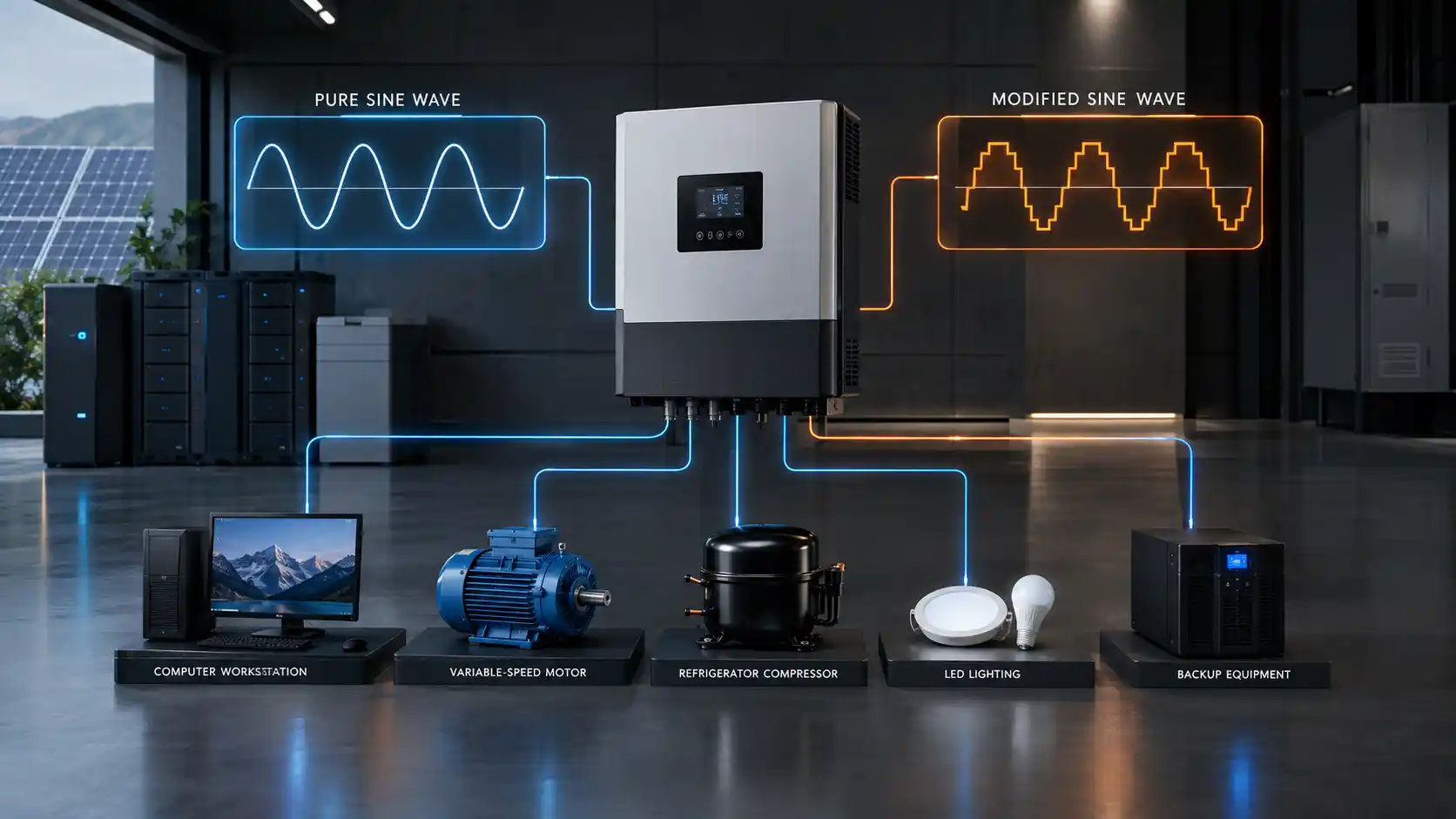
The fundamental difference is the shape of the AC output waveform.
| Factor | Pure Sine Wave | Modified Sine Wave |
|---|---|---|
| Output waveform | Smooth sinusoidal waveform | Stepped approximation of a sine wave |
| Load compatibility | Broad compatibility | More dependent on the load |
| Sensitive electronics | Generally suitable | Compatibility should be verified |
| Motor-driven equipment | Generally better suited | May produce noise, heat, or vibration depending on the equipment |
| System applications | Solar storage, backup, UPS, residential and commercial ESS | Simpler backup and basic loads |
| Cost | Usually higher | Usually lower |
| Selection priority | Compatibility and power quality | Application requirements and cost |
This comparison should not be interpreted as “pure sine wave is always better.”
A modified sine wave inverter can still be appropriate when the connected equipment is known to be compatible and the project does not require a sinusoidal output.
For an energy storage project, however, buyers should evaluate the complete load profile rather than choosing an inverter only according to its price or rated wattage.
Which Loads Are Better Suited to a Pure Sine Wave Inverter?
The load profile is one of the most important factors when deciding between pure sine wave and modified sine wave.
Sensitive Electronic Equipment
Electronic equipment often uses switching power supplies and internal control circuits that can respond differently to non-sinusoidal AC power.
Examples may include:
- Computers and networking equipment
- Communication equipment
- Certain battery chargers
- Audio equipment
- Control systems
- Monitoring equipment
- Other sensitive electronic loads
For an energy storage system supplying a mixture of these devices, a pure sine wave output can simplify compatibility considerations.
Motor and Compressor Loads
Motors and compressors can present both continuous and starting-power requirements.
Examples include:
- Refrigerators
- Pumps
- Fans
- Air-conditioning equipment
- Compressors
- Power tools
The inverter therefore needs to be evaluated not only for its continuous output rating but also for its ability to handle the load’s starting or surge demand.
This is one reason an inverter that appears large enough based only on the appliance’s running wattage may still be unsuitable for a particular application.
For larger solar-plus-storage applications, VoltCrave’s 8.6kW / 11kW 48V Hybrid Solar Inverter provides another example of a pure sine wave hybrid inverter platform.
Critical Backup Loads
In a backup power system, the priority is often not simply to keep the lights on.
A project may need to maintain:
- Network equipment
- Monitoring equipment
- Control systems
- Refrigeration
- Pumps
- Security systems
- Communications equipment
When the backup system serves critical loads, waveform compatibility becomes part of the system reliability assessment.
Can a Modified Sine Wave Inverter Be Used for Energy Storage?
Yes, depending on the application.
A modified sine wave inverter can be suitable when the connected equipment is compatible with its output waveform and the project does not require the broader compatibility of a pure sine wave output.
For example, simple resistive loads can be less demanding from a waveform perspective.
However, an energy storage system is rarely limited to one fixed load throughout its operating life. A residential backup system, portable power system, or commercial ESS may be connected to different equipment over time.
That creates an important procurement question:
Are you selecting an inverter for today’s load, or for the loads the system may need to support during its service life?
For integrators and distributors, the second question is often more important.
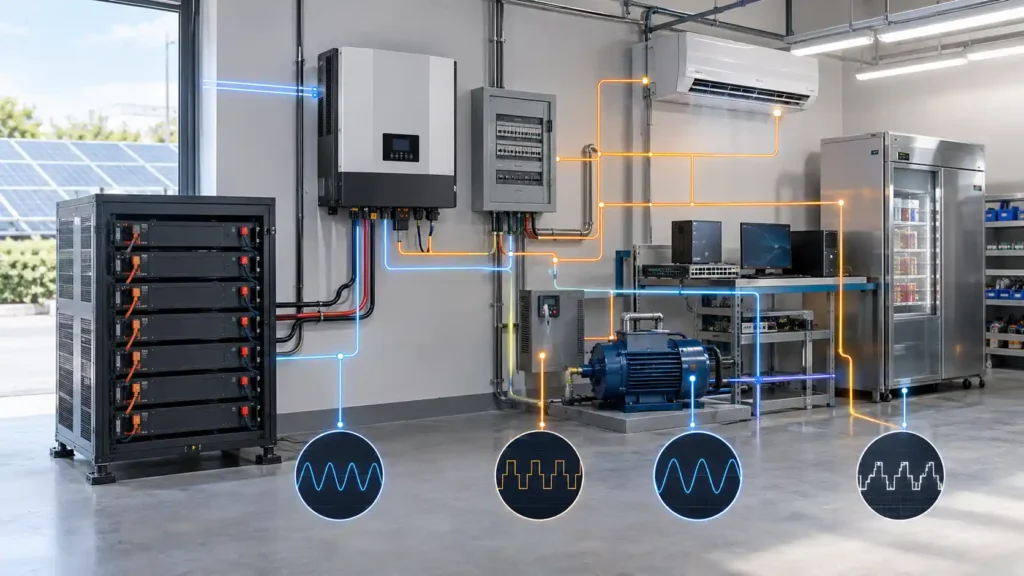
Pure Sine Wave vs Modified Sine Wave for Energy Storage Systems
The waveform decision becomes more important when the inverter is part of a complete energy storage system.
An ESS typically combines:
Battery → Inverter → AC Loads
The battery provides stored DC energy. The inverter determines how that energy is converted into usable AC power for the connected equipment.
The inverter therefore has to be evaluated together with:
- Battery voltage
- Continuous output power
- Surge power
- Load type
- AC voltage and frequency
- Charging requirements
- System operating mode
- Protection functions
- Communication requirements
- Future system expansion
This is particularly important for systems that combine solar generation, battery storage, grid power, and backup loads.
VoltCrave’s product range illustrates the range of system architectures involved. Its catalog includes 24V/48V hybrid inverters, 48V hybrid inverters, all-in-one residential ESS products, portable power stations, and larger commercial energy storage platforms.
How Does Waveform Choice Affect Solar + Battery Systems?
Consider a typical solar-plus-storage system:
PV → Hybrid Inverter → Battery → AC Loads
During the day, solar energy can supply loads and charge the battery. When solar production is insufficient or the grid is unavailable, the battery can provide DC energy to the inverter, which converts it into AC power.
The waveform becomes particularly relevant when the backup load includes a combination of:
- Electronics
- Motors
- Appliances
- Chargers
- Communications equipment
- Control equipment
A pure sine wave inverter can therefore reduce the number of waveform-compatibility questions that need to be resolved during system design.
VoltCrave’s hybrid inverter products include 24V/48V models with MPPT charging and BMS communication, as well as larger 48V models with dual MPPT and parallel operation. These specifications show why inverter selection in an ESS is a system-level decision rather than simply a comparison of output wattage.
For buyers evaluating different solar inverter solutions, the waveform should therefore be considered together with the system’s load profile, battery architecture, PV input, and operating requirements.
Pure Sine Wave vs Modified Sine Wave for Backup Power
Backup power adds another consideration: load priority.
Suppose a backup system is designed to support only lighting and basic resistive equipment. The waveform requirements may be relatively straightforward.
Now consider a backup system supporting:
- A refrigerator
- Network equipment
- Computers
- Pumps
- Communication equipment
- Battery chargers
The inverter must accommodate a much more varied load profile.
This is why backup system designers should identify the critical loads first, then select the inverter based on the combined requirements of those loads.
VoltCrave’s project portfolio includes residential solar-plus-storage systems, off-grid systems, commercial ESS projects, and data-center backup applications. For example, the published cases include a 10kW/10kWh hybrid solar system in Nigeria, a 150kW/450kWh hybrid solar project in the Philippines, a 24kW/40kWh rooftop solar project, and data-center battery backup applications. These examples represent different system scales and load requirements, reinforcing the importance of application-specific inverter selection.
Does Pure Sine Wave Mean Higher Efficiency?
Not necessarily.
It is easy to assume that pure sine wave automatically means higher efficiency, but inverter efficiency depends on the specific inverter design, operating point, load, switching technology, thermal design, and other factors.
When comparing two inverter products, buyers should therefore look at the manufacturer’s actual efficiency specifications rather than using waveform type alone as a proxy for efficiency.
More importantly, consider the behavior of the complete system.
An inverter that has a suitable waveform but is poorly matched to the load can still result in inefficient operation. Likewise, an inverter with an appropriate power rating but insufficient surge capability may struggle with motor-starting loads.
For procurement, waveform should therefore be treated as one selection parameter among several, not as a standalone performance score.
What Should You Check Before Buying an Inverter for an Energy Storage System?
For project buyers, the following checklist is more useful than simply asking whether an inverter is pure sine wave or modified sine wave.
1. Output Waveform
Confirm whether the inverter provides pure sine wave or modified sine wave output.
If the system contains sensitive electronics, motors, or mixed loads, verify compatibility carefully.
2. Continuous Output Power
Calculate the expected simultaneous running load.
Do not size the inverter only from the largest individual appliance.
3. Surge Power
Identify equipment with high starting demand.
Motors, compressors, pumps, and some power supplies can require significantly more power during startup than during normal operation.
4. Battery Voltage
The inverter must match the battery system architecture.
Common ESS configurations include 24V and 48V/51.2V battery systems, but the acceptable input-voltage range depends on the specific inverter.
5. BMS Communication
For lithium battery systems, communication between the battery BMS and inverter can be important for coordinated operation.
Depending on the system, interfaces may include CAN or RS485.
6. Solar Input
For hybrid solar applications, check:
- MPPT voltage range
- Maximum PV input power
- Maximum PV current
- Number of MPPT channels
- PV operating voltage
7. Protection Functions
Check the available protection features, including:
- Overload protection
- Short-circuit protection
- Over-temperature protection
- Over-voltage protection
- Low-voltage protection
8. System Expansion
If the project may grow, confirm whether the inverter supports:
- Parallel operation
- Additional battery modules
- Multiple inverter operation
- Communication and monitoring
For example, VoltCrave’s 6.6kW–10.6kW 48V IP66 Hybrid Solar Inverter supports parallel operation of up to nine units according to its published product specifications.
A Practical Selection Example: From Load Profile to Inverter
Consider a small energy storage system designed to provide backup power for a combination of household and electronic loads.
The first step is not to ask:
“Should I buy a pure sine wave inverter?”
Instead, define:
Step 1 — Identify the loads
For example:
- Refrigerator
- Network equipment
- Lighting
- Computer
- Small pump
Step 2 — Calculate running power
Add the expected simultaneous operating loads.
Step 3 — Identify starting loads
Determine whether the refrigerator or pump has a significant starting surge.
Step 4 — Check waveform requirements
Because the system contains motors and electronic equipment, waveform compatibility becomes an important part of the selection process.
Step 5 — Check battery compatibility
Confirm battery voltage, discharge capability, BMS communication, and charging parameters.
Step 6 — Select the inverter
Only after these requirements are known should the inverter’s continuous power, surge capability, waveform, and system features be compared.
This process is more reliable than selecting an inverter solely from a product headline such as “5kW” or “10kW.”
Why Inverter Selection Changes Between Residential and Commercial ESS
The same waveform decision can have different implications at different project scales.
Residential Energy Storage
Residential systems may combine:
- Lighting
- Refrigerators
- Air conditioning
- Electronics
- Home networking
- Pumps
The load profile can change throughout the day, so compatibility and surge capability are important.
Commercial & Industrial Energy Storage
C&I systems may involve:
- Motors
- Pumps
- HVAC
- Production equipment
- Control systems
- Critical backup loads
The system design becomes more dependent on the actual electrical load profile, operating schedule, and expansion requirements.
VoltCrave’s project portfolio includes both small systems such as a 5kW/5.12kWh agricultural backup project and large commercial systems such as 300kWh and 1000kWh C&I ESS projects.
This is why an inverter should be selected as part of the system architecture rather than treated as an isolated component.
Pure Sine Wave vs Modified Sine Wave: Which Should You Choose?
There is no universal answer based on waveform alone.
A modified sine wave inverter may be appropriate when:
- The connected loads are known to be compatible
- The application uses relatively simple loads
- Cost is a major project constraint
- Broad load compatibility is not required
A pure sine wave inverter is generally the more appropriate consideration when:
- The system contains sensitive electronics
- Motor-driven loads are present
- The backup system supports mixed loads
- The inverter will be integrated into a broader solar-plus-storage system
- Future load changes are expected
- The project requires broader AC-load compatibility
For energy storage projects, the practical question is therefore:
Which inverter provides the required waveform, power, surge capability, battery compatibility, and system features for the actual load profile?
That is the question procurement teams should bring to an inverter supplier.
What Should You Ask an Inverter Supplier Before Placing an Order?
Before requesting a quotation, prepare the following information:
- Required AC output voltage
- Required frequency
- Battery voltage
- Continuous load power
- Peak or surge load
- Load types
- Solar PV capacity
- Required MPPT range
- Backup operating requirements
- BMS communication requirements
- Parallel operation requirements
- Monitoring requirements
- Certifications required for the target market
- Expected quantity and delivery schedule
For OEM and ODM projects, also confirm:
- Custom firmware requirements
- Communication protocols
- Display requirements
- Housing design
- Branding and labeling
- Packaging
- Certification requirements
- Production samples
- Validation requirements
This is where an experienced energy storage manufacturer can add value beyond simply supplying an inverter.
How VoltCrave Power Approaches Inverter Selection for Energy Storage Projects
VoltCrave Power’s inverter and energy storage portfolio covers applications ranging from portable power and residential ESS to commercial and project-scale systems. The company states that it has operated in the industry since 2011 and provides lithium battery cells, battery packs, portable power stations, solar systems, inverters, and residential energy storage solutions for OEM and ODM partners.
Its published product portfolio includes pure sine wave solar inverters, 24V/48V hybrid inverters, 48V hybrid inverters, all-in-one ESS platforms, and larger energy storage systems.
That range matters because inverter selection rarely ends with one specification.
A project may start with a required output power, but the final configuration can depend on:
Load profile → Battery voltage → PV input → Waveform → Surge demand → BMS communication → System architecture → Expansion requirements
For OEM, distributor, installer, and project customers, evaluating these requirements before production or procurement can reduce the risk of selecting an inverter that looks suitable on paper but does not perform as expected in the complete energy storage system.
Final Takeaway
The difference between a pure sine wave and modified sine wave inverter is not simply a matter of waveform shape.
For an energy storage project, the more important question is how that waveform interacts with the actual loads, battery system, solar input, operating mode, and future system requirements.
If the project only requires simple, known-compatible loads, a modified sine wave inverter may be sufficient.
If the system needs to support mixed loads, sensitive electronics, motors, or broader backup applications, a pure sine wave inverter can provide a more broadly compatible AC output.
For buyers, the best selection process is therefore not:
“Pure sine wave or modified sine wave?”
It is:
“What does my energy storage system need the inverter to do?”
Once the load profile, power requirements, battery architecture, PV input, communication requirements, and expansion plans are defined, the appropriate inverter configuration becomes much easier to determine.
Need help matching this topic to a real battery project?
Send your target application, capacity range, certification market, and order plan. VoltCrave can recommend a practical product direction.