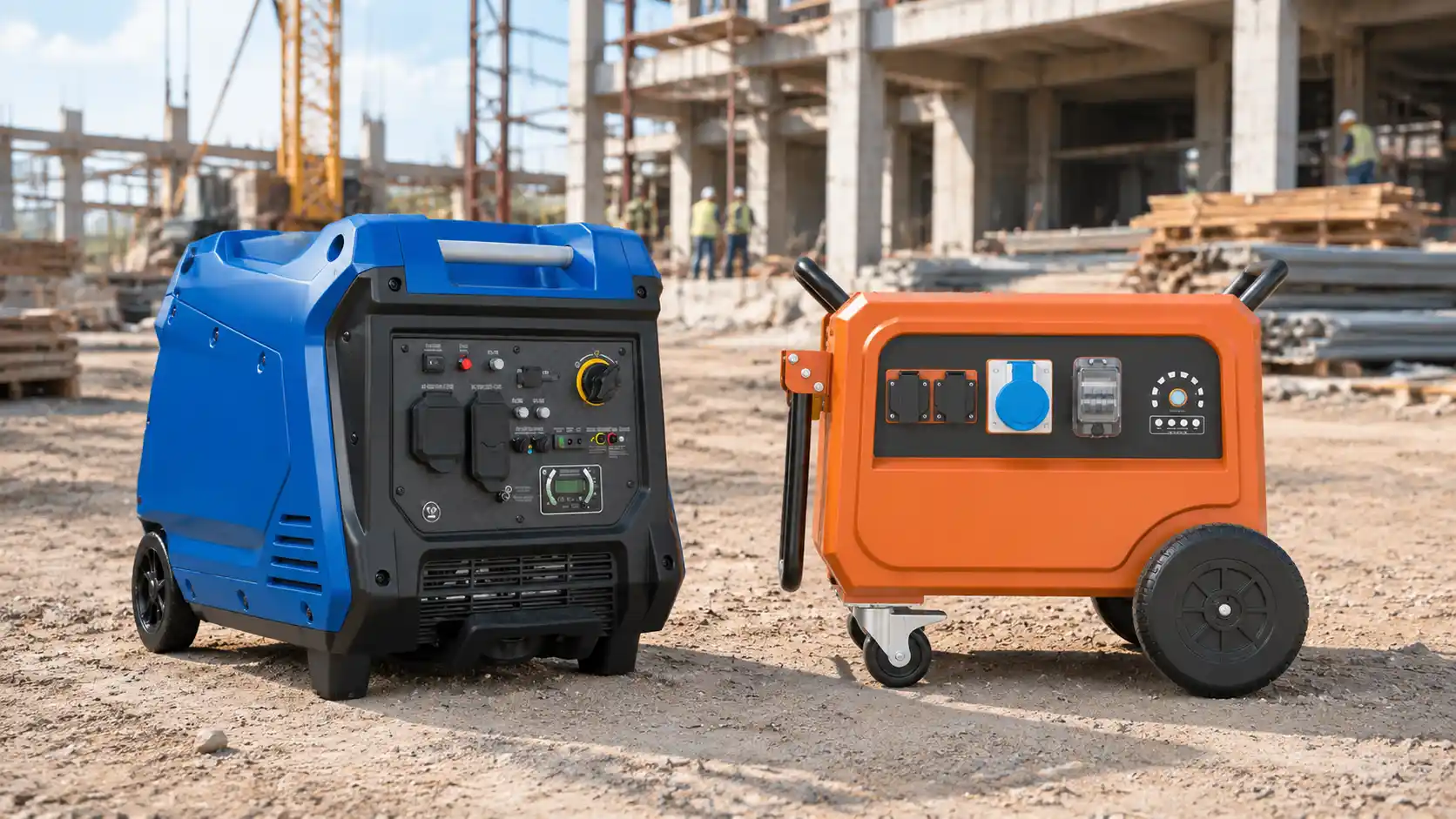
A 5,000 watt generator and an industrial power station can both put power on a job site, and on paper the numbers look close enough to compare directly. In practice they solve different problems. One burns fuel to make electricity on demand, the other stores electricity and releases it silently. The right choice depends less on the watt figure than on shift length, enclosure, noise limits, and who is responsible for refuelling.
This comparison puts a popular 5,000 watt inverter generator next to the VoltCrave Power industrial power station range, using published specifications for both, and sets out which one fits which kind of site.
Why this comparison matters on a job site
Power decisions on site get made early, when equipment is scheduled and the crew layout is set. Get the power source wrong and the cost shows up later as idle labour, complaints from neighbours, or a generator that has to be shut down whenever the work moves indoors.
The 5,000 watt class is the default answer for small and mid-size sites because it is widely available and familiar. The industrial power station is the newer option, and it changes some of the constraints rather than all of them. The comparison below is about which constraints matter for a given job, not about declaring one technology the winner.
Sites that need backup power for a building rather than a work area have a different set of trade-offs, which the battery storage vs generator comparison for home backup covers separately.
The two products compared
Both units in this comparison are real products with published specifications. The generator figures come from Westinghouse’s own product page for the iGen5000cv. The power station figures come from the VoltCrave Power product pages for each model.
Westinghouse iGen5000cv: a 5,000 watt inverter generator
The iGen5000cv is a gasoline inverter generator with a 224cc OHV four-stroke engine. It produces 3,900 running watts and 5,000 peak watts at 120V, with total harmonic distortion held to 3% or less. It runs on a 3.4 gallon tank for up to 18 hours at 25% load, and the manufacturer rates noise at 52 dBA.
It starts by recoil only. Outlets are a duplex 120V 5-20R, a 120V TT-30R, and two USB ports. Protection covers automatic low oil shutdown, carbon monoxide shutdown, overload protection and voltage regulation. Dry weight is 104.7 lb (47.5 kg) and dimensions are 24.5 × 17.5 × 20 inches. Warranty is three years residential and one year commercial.
VoltCrave Power industrial power stations
VoltCrave Power builds lithium iron phosphate (LiFePO4) industrial power stations across a range of output and capacity classes. The line spans 2,640Wh to 16,076Wh and 3,600W to 13,500W rated output, with peak capability from 10,000W to 27,000W depending on model.
All models share the same protection architecture, an 8-layer battery management system covering over-charge, over-discharge, over-current, short circuit, high temperature cutoff, low temperature charging lock, cell balancing and auto-disconnect at low state of charge. Charging is accepted from 0°C to 45°C and discharging from -20°C to 45°C.
The model closest to the 5,000 watt class is the BP500A, a 5,000W continuous / 5,120Wh unit, which is where the direct product comparison starts.
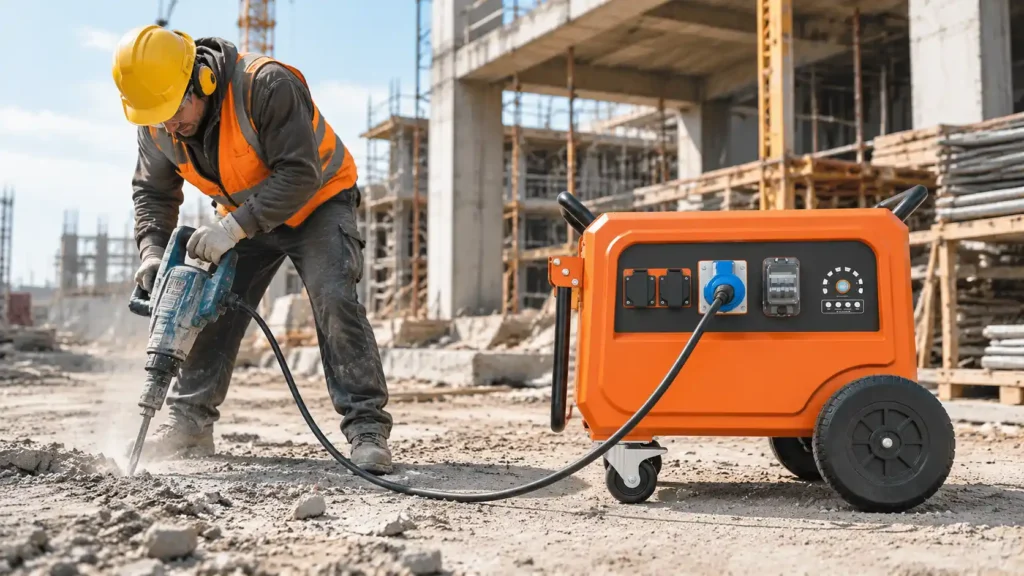
Power output: 3,900W running vs 5,000W continuous
The headline numbers are easy to misread. The generator’s 5,000 watts is a peak figure, and its continuous rating is 3,900 watts. The BP500A’s 5,000 watts is a continuous rating, with 10,000 watts available for short peaks.
That difference changes what each unit can carry at the same nominal class.
| Westinghouse iGen5000cv | VoltCrave Power BP500A | |
|---|---|---|
| Continuous output | 3,900W | 5,000W |
| Peak output | 5,000W | 10,000W |
| Output form | 120V / 60Hz, ≤3% THD | Pure sine wave |
| Energy source | 3.4 gal gasoline tank | 5,120Wh LiFePO4 |
| Runtime | Up to 18 h at 25% load | Depends on load and capacity |
| Noise | 52 dBA | Low-noise operation |
| Weight | 104.7 lb (47.5 kg) | ~65 kg |
| Protection rating | Not published as IP | IP54 |
| Start method | Recoil | Instant, no engine start |
A tool drawing 4,200 watts continuous sits inside the BP500A’s rating and above the generator’s continuous rating, even though both are described as 5,000 watt units. Peak ratings do not carry a continuous load.
What the peak rating actually covers
Peak output on a generator exists to handle motor starting, when a compressor or a saw pulls several times its running current for a second or two. The iGen5000cv’s 1,100 watt gap between running and peak exists for that purpose.
The BP500A’s peak allowance is larger in absolute terms at 10,000W, and it is delivered without an engine having to spin up, so the response is immediate rather than after a recoil pull or a choke adjustment.
Motor-driven tools are the usual deciding factor. A circular saw, a compressor or a site hoist all draw a surge on start, and the surge is what pushes a marginal power source into overload. A unit with headroom above the running load absorbs that surge without tripping, while a unit sized exactly to the running load will trip on start. Sizing on the running figure plus a margin matters more than matching the peak number to the tool label.
Energy, runtime and the fuel question
Runtime is where the two technologies diverge most, and it is the factor that most often decides the choice on a multi-shift site.
Converting watt hours to a working day
Battery capacity is stated in watt hours (Wh), which describes stored energy. Load multiplied by hours gives the energy drawn. A 5,120Wh pack running a 1,000 watt load delivers roughly five hours before losses, and a 2,500 watt load roughly two hours.
The generator’s tank works the other way: fuel is consumed at a rate tied to load, and the tank can be refilled without limit. That makes the generator better suited to long continuous demand and the battery better suited to intermittent demand.
Runtime across a shift
At 25% load the iGen5000cv runs about 18 hours, which covers more than two standard shifts on a single tank. At higher load the runtime shortens, and fuel consumption rises with it.
A power station’s runtime is fixed by its capacity. The BP500A carries 5,120Wh, the BP360H 3,600W / 5,120Wh unit carries the same 5,120Wh in an IP54 housing, the BP360C Pro carries 5,120Wh, and the BP1500A carries 16,076Wh for larger demand. Where a shift exceeds the stored energy, a recharge break or a second unit is needed.
Refuelling downtime vs charging downtime
Fuel means a trip, a storage container, and a safe handling procedure on site. It also means the work stops when the tank is empty, typically at the least convenient moment.
Charging means a connection to site power, a generator, or solar. The BP500A accepts up to 2,500W AC input with roughly two hours to full, or up to 6,000W of PV input with roughly one hour. The BP360H and BP360C accept 860W AC with about six hours, and 600W PV with about 8.5 hours. The BP1500A accepts 12,000W AC in about two hours, or up to three PV strings at 3,600W each in about 2.5 hours.
For sites with a power supply available between shifts, recharge time is a scheduling detail. For sites without one, the generator’s refuel model is simpler.
Noise, emissions and enclosed or indoor work
This is often the constraint that decides the question, and it is not captured by a watt rating.
52 dBA against a sub-45 dBA rating
The iGen5000cv is rated at 52 dBA, which is quiet for a generator of its class. The BP360H is specified at below 45 dB(A), and the BP360C and BP360C Pro are specified at below 35 dB(A).
The difference matters near residential boundaries, in shared compounds, and on night work. Sound falls off with distance but not enough to make 52 dBA acceptable where a low limit applies.
Combustion emissions and confined spaces
A gasoline generator produces carbon monoxide and must never run in an enclosed or poorly ventilated space. The iGen5000cv includes automatic CO shutdown as a safety backstop, but the shutdown protects people from exposure rather than allowing indoor operation.
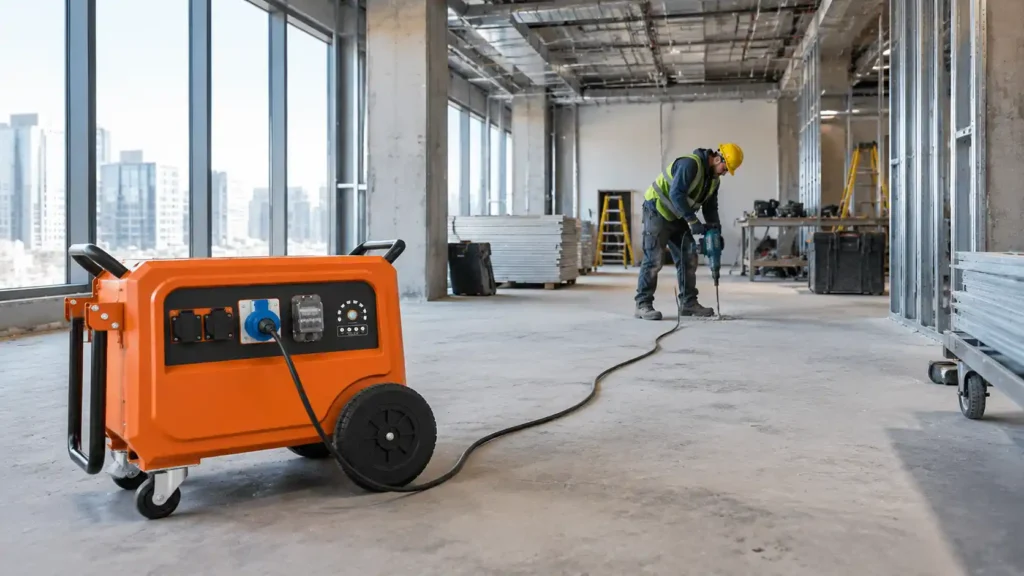
A battery power station produces no combustion emissions during operation, so it can run indoors, in a basement, in a trench with limited airflow, or inside a partially enclosed structure. For interior fit-out, renovation, and works inside occupied buildings, this removes a constraint the generator cannot remove.
Job site conditions: IP rating, temperature and handling
Dust, rain and cold are normal conditions on site, and both products have to survive them.
IP54 and IP66 protection
The BP500A, BP360H and BP1500A are rated IP54, which covers dust ingress and water splashing from any direction. The BP360C, BP360C Pro and the BP360G 3,600W / 2,640Wh model are rated IP66, which covers dust ingress and powerful water jets, making them the better fit for washdown areas and exposed outdoor work.
Westinghouse does not publish an IP rating for the iGen5000cv, so a direct protection comparison is not available. The generator is an engine-driven unit with a fuel system, which places different requirements on housing and siting than a sealed battery enclosure.
Discharge temperature and cold mornings
The VoltCrave Power models discharge from -20°C to 45°C, which covers winter conditions on most sites without derating the operating window. Charging is limited to 0°C to 45°C, so a cold pack has to warm before it accepts charge, a normal lithium constraint rather than a product limitation.
A gasoline generator starts in cold conditions with more difficulty, since cold oil thickens and the recoil start becomes heavier. Neither technology is immune to cold, but the failure modes differ.
Weight, mobility and where the unit lives
The iGen5000cv weighs 104.7 lb (47.5 kg) with wheels and a telescoping handle, which makes it movable by one person on flat ground. The BP500A weighs about 65 kg and the BP360H about 73 kg, comparable in handling terms.
The heavier models change the logistics. The BP360C weighs about 68 kg and the BP360C Pro about 100 kg. The BP1500A 13,500W / 16,076Wh unit weighs about 220 kg and measures 603.3 × 788.7 × 875 mm, which makes it a fixed installation rather than something carried between floors.
Cost of ownership over a project cycle
Purchase price is the smallest part of the comparison over a project, but it is the part most often used to decide. The larger costs sit in fuel, maintenance and downtime.
Fuel and maintenance cost structure
A generator carries fuel as a recurring cost that scales with running hours, plus engine maintenance at manufacturer intervals, plus the labour to leave site and refuel. A site running a generator through two shifts a day accumulates fuel cost quickly, and the cost is not fixed because fuel prices move.
A power station carries electricity as a recurring cost, priced at the site’s supply rate, plus no engine maintenance schedule. The trade-off is a higher upfront cost and a capacity ceiling that fuel does not have.
> Prices and fuel rates vary by region, supplier and contract. Any cost figures used in a project estimate should come from current local quotes rather than from generic assumptions.
Three factors move the total more than anything else: the number of running hours per week, whether the site has a power supply for recharging, and whether noise or emissions restrictions force a shutdown that would otherwise not happen.
A site with mains power between shifts and a noise restriction tends to favour the power station. A site with no power supply, long continuous demand and no restriction on engine noise tends to favour the generator.
Which one fits which job site
The decision usually comes down to four questions: how long is the shift, is there a power supply to recharge from, are there noise or emissions limits, and how much surge do the tools need.
When a 5,000 watt generator is the right choice
Choose the generator when the site has no reliable recharge source and demand runs close to continuous for more than a shift. It also fits when the power source has to move frequently, refuelling is simple, and the work happens outdoors where no noise or emission limit applies.
It is also the lower-cost entry point for a single small job where the equipment will not be used again for months.
When an industrial power station is the right choice
Choose the power station when work happens indoors or in confined spaces and noise limits apply. It also fits when the site has power available between shifts, or when the work is intermittent enough that stored energy covers the demand.
It is also the stronger option where the same unit has to serve several small jobs without fuel logistics, and where a sealed IP66 enclosure has to survive washdown or heavy weather.
A quick decision table
| Site condition | Better fit |
|---|---|
| No power supply, multi-shift continuous demand | Generator |
| Indoor, basement or confined space work | Power station |
| Noise limit below 50 dBA | Power station |
| Washdown or exposed outdoor site | Power station, IP66 model |
| Single short job, lowest entry cost | Generator |
| Frequent moves between small jobs | Power station |
| Demand above 3,900W continuous | Power station, or a larger generator |
| Very long continuous runtime, fuel available | Generator |
The selection criteria behind these rows are set out in more detail in the guide to choosing an industrial power station for construction sites, which covers capacity sizing, voltage configuration and recharge planning.
How VoltCrave Power covers the industrial power station range
The five models below cover the range from compact intermittent use up to heavy equipment demand. The BP500A is the direct counterpart to the 5,000 watt generator class; the others cover cases the generator class cannot reach.
| Model | Rated / peak output | Capacity | Protection | Charging | Weight |
|---|---|---|---|---|---|
| BP360G | 3,600W / 18,000W | 2,640Wh | IP66 | MPPT solar, 100–240V output options | not published |
| BP360C / BP360C Pro | 3,600W / 18,000W | 3,072Wh / 5,120Wh | IP66 | 860W AC, 600W PV | ~68 kg / ~100 kg |
| BP360H | 3,600W / 18,000W | 5,120Wh | IP54 | 860W AC, 600W PV | ~73 kg |
| BP500A | 5,000W / 10,000W | 5,120Wh | IP54 | 2,500W AC, 6,000W PV | ~65 kg |
| BP1500A | 13,500W / 27,000W | 16,076Wh | IP54 | 12,000W AC, 3×3,600W PV, 380V output | ~220 kg |
The BP360C and BP360C Pro support 150% overload for 600 seconds, 200% for 100 seconds and 250% for 15 seconds, which matters when a tool draws a sustained surge rather than a brief one. All five models use LiFePO4 cells and pure sine wave AC output.
Configurations including capacity, housing, output voltage and branding can be adapted for distributors, rental fleets and OEM projects.
FAQs
Can a 5,000 watt generator run a whole job site?
It can run a small site’s essentials within its 3,900W continuous rating, but the peak figure is not a continuous capacity. Tools that push past 3,900W running will trip the unit, and motor startup surges need headroom above the running load.
How long will a 5,120Wh power station run site tools?
Divide the capacity by the load, then allow for losses. A 1,000W load runs roughly five hours and a 2,500W load roughly two hours. Intermittent demand stretches that considerably.
Is a power station quieter than a generator?
Yes. The BP360C and BP360C Pro are specified below 35 dB(A) and the BP360H below 45 dB(A), against 52 dBA for the iGen5000cv. Below 35 dB(A) is close to background level in a quiet room.
Can I use an industrial power station indoors?
Yes. It produces no combustion emissions during operation, so it can run in basements, trenches and enclosed structures where a gasoline generator would create a carbon monoxide hazard.
Do industrial power stations work in cold weather?
The VoltCrave Power models discharge from -20°C to 45°C. Charging is limited to 0°C and above, so a cold pack must warm before it accepts charge.
Is a generator or a power station cheaper to run?
It depends on running hours and local energy prices. A generator’s fuel cost scales with hours and rises with fuel prices, while a power station’s running cost is electricity at the site rate with no engine maintenance. Compare current local quotes rather than generic figures.
Final verdict
Neither option wins across every site. The 5,000 watt generator wins where fuel is available, demand is long and continuous, and nothing restricts engine noise or emissions. The industrial power station wins where work moves indoors, where noise limits apply, where the site has power between shifts, and where a sealed enclosure has to survive weather.
The single number that most often settles it is the continuous rating, not the peak. Check the running watts against the actual load, add margin for motor startup, then confirm the runtime against shift length.
Need help matching this topic to a real battery project?
Send your target application, capacity range, certification market, and order plan. VoltCrave can recommend a practical product direction.