An all in one energy storage system combines battery storage and power conversion equipment to manage electricity from solar panels, the utility grid, and stored energy. In a residential installation, it can help supply household loads during the day, store surplus solar generation for later use, and provide backup power when the grid is unavailable.
Understanding how this system works requires looking beyond the battery itself. Its actual operation depends on the relationship between the hybrid inverter, battery management system, solar input, grid connection, and household electrical loads.
What Is an All in One Energy Storage System for Home Use?
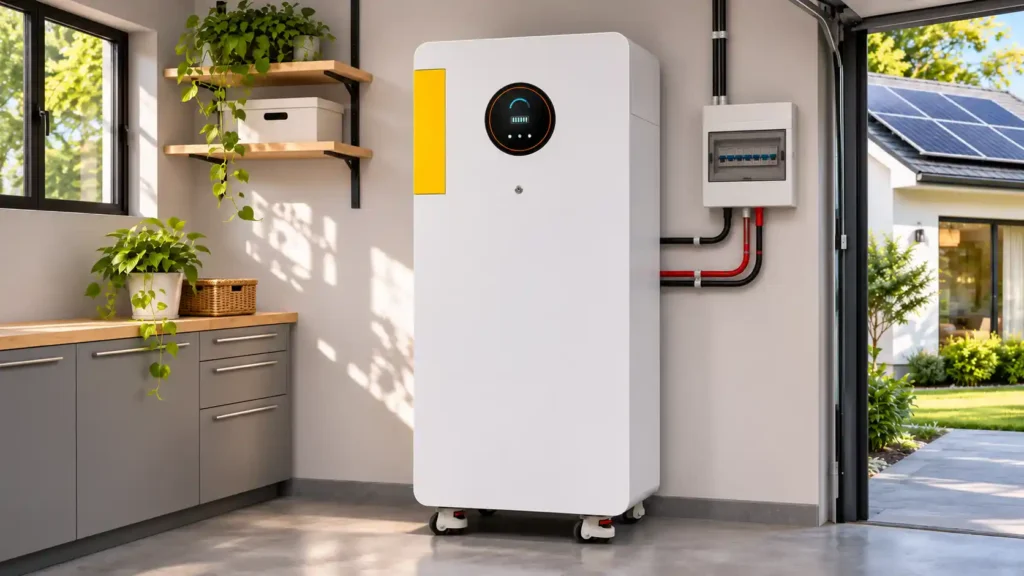
An All in One Energy Storage System (ESS) is an integrated residential energy solution that combines a battery system, inverter, and associated control functions within one coordinated platform. Depending on the model, it may also include a built-in solar MPPT controller and other energy management functions.
Unlike a conventional battery-only system, which requires a separate compatible inverter to convert stored DC electricity into AC electricity, an all-in-one system integrates these functions into a more unified configuration.
A typical residential installation connects four main elements:
- Solar Panels: Generate DC electricity from sunlight and provide an energy source for the system.
- All-in-One ESS: Manages solar input, battery charging and discharging, and power conversion.
- Utility Grid: Provides electricity when solar generation and available battery energy are insufficient, if grid charging and grid-connected operation are supported.
- Household Loads: Consume the electricity supplied by the system, such as lighting, refrigeration, air conditioning, and other appliances.
The exact integration level varies between manufacturers and models. Solar panels, distribution boards, meters, external protection devices, and backup switching equipment may still need to be installed separately.
Therefore, an all-in-one system should be understood as an integrated energy storage platform rather than a complete solar installation contained in a single cabinet.
What Components Make Up a Residential All in One ESS?
Although the components are integrated into one system, each performs a different function in managing household electricity.
Battery Module
The battery stores electrical energy for later use. Residential systems commonly use lithium iron phosphate (LiFePO4) batteries, which store energy during charging and release it when the household requires additional electricity.
The battery’s nominal energy capacity, measured in kWh, indicates how much energy it can store. Its usable capacity depends on the manufacturer’s operating limits and battery management settings.
Hybrid Inverter
The hybrid inverter manages power conversion between the solar panels, battery, grid, and household loads.
It converts DC electricity into AC electricity for household appliances and, in supported configurations, converts AC electricity into DC for battery charging. It also manages power flow according to the system’s operating settings.
MPPT Controller
Maximum Power Point Tracking (MPPT) regulates the electrical operating point of the solar input to extract available power from the PV array.
When MPPT is integrated into the hybrid inverter, a separate external solar charge controller may not be necessary. This depends on the system architecture.
Battery Management System (BMS)
The BMS monitors battery operating conditions, including cell voltage, current, and temperature. It also manages battery protection functions and communicates relevant battery information to the inverter.
Energy Management and Monitoring Functions
The system controller coordinates charging and discharging according to available solar generation, battery state of charge, household demand, and configured operating priorities.
Depending on the model, users may also have access to monitoring through a display or remote monitoring platform.
The important distinction is that the inverter handles electrical conversion and power control, while the BMS protects and monitors the battery. These functions work together but are not interchangeable.
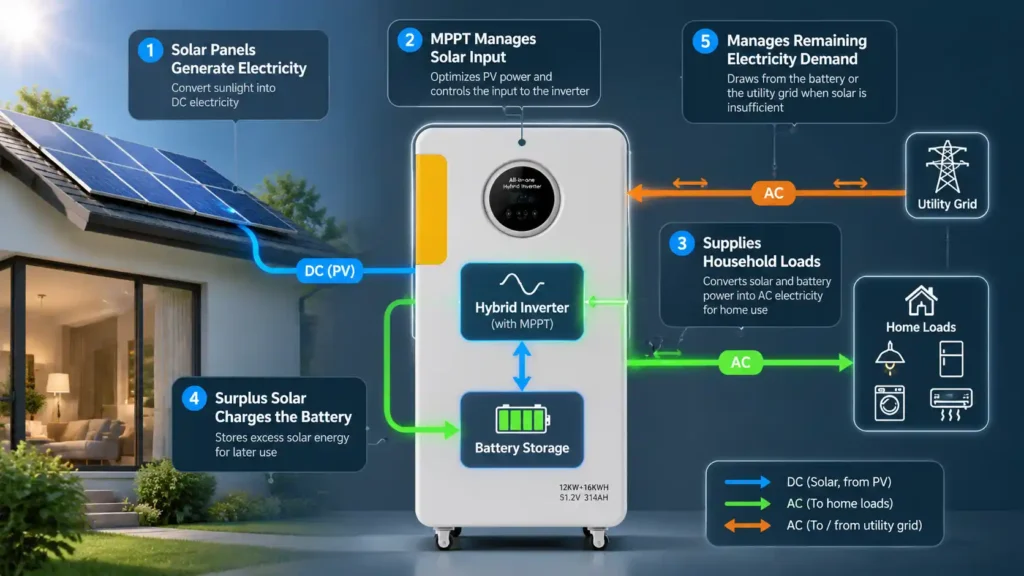
How Does an All in One Energy Storage System Work with Solar Panels?
The main purpose of integrating solar panels with residential battery storage is to use electricity when it is generated and store surplus energy for periods when solar production is unavailable or insufficient.
A typical solar-plus-storage system follows this process.
Step 1: Solar Panels Generate Electricity
During daylight hours, photovoltaic panels convert sunlight into DC electricity. The amount generated varies with sunlight intensity, panel orientation, shading, weather, and system configuration.
Step 2: The MPPT Controller Manages Solar Input
The solar electricity enters the integrated inverter through its PV input. The MPPT controller adjusts the operating point of the solar array to manage the available PV power.
The supported PV voltage and current must remain within the inverter’s specified input limits.
Step 3: Solar Energy Supplies Household Loads
The hybrid inverter converts the available electricity into AC power for compatible household circuits.
When solar generation is sufficient, the system can supply household demand directly without first storing all the electricity in the battery.
Step 4: Surplus Solar Energy Charges the Battery
When solar generation exceeds the household’s immediate electricity demand, the available surplus can charge the battery, subject to its charging limits and configured operating strategy.
This allows energy generated during the day to be used later.
Step 5: The System Manages Remaining Electricity Demand
If solar generation cannot meet household demand, the system can draw additional energy from the battery or utility grid, depending on battery availability and operating settings.
Any surplus electricity exported to the grid depends on inverter capability, local regulations, and the installation’s grid connection arrangements.
The basic energy flow can be summarized as:
Solar Panels → Hybrid Inverter → Household Loads
Surplus Solar Energy → Battery Storage → Later Household Consumption
This arrangement allows a household to use solar generation at different times rather than relying entirely on electricity being consumed at the moment it is produced.
How Does an All in One Energy Storage System Power a Home at Night or During an Outage?
Solar generation changes throughout the day. A residential energy storage system manages this variation by using stored battery energy and, where available, electricity from the grid.
Its operation differs depending on whether the grid is available.
Nighttime Operation
After sunset, solar panels stop producing electricity. The system can discharge the battery to supply household loads through the hybrid inverter.
When the battery reaches its configured minimum state of charge, the system may switch to grid electricity if grid power is available and the operating settings allow it.
Low Solar Generation
During cloudy weather or periods of insufficient solar generation, the system can combine available solar energy with battery discharge or grid electricity.
The actual energy source priority depends on the inverter’s operating mode and user settings.
Grid Outage Operation
When utility power fails, a standard grid-connected solar inverter generally disconnects from the grid for electrical safety reasons.
A battery storage system designed for backup operation can isolate the household backup circuit from the utility grid and establish a local power supply through its inverter.
This allows designated household loads to continue operating without depending on the utility supply.
However, backup operation requires compatible inverter functionality, appropriate grid isolation, and a properly configured backup circuit. Simply having solar panels and a battery does not guarantee that a home will receive electricity during an outage.
Solar Charging During an Outage
Some solar-plus-storage systems can continue using PV generation while operating independently from the grid.
This requires an inverter capable of supporting the relevant off-grid or backup operating mode and managing solar input while the utility connection is unavailable.
The following table summarizes the different operating conditions.
| Operating Condition | Available Energy Source | Typical Power Flow |
|---|---|---|
| Sunny daytime | Solar | Solar → Home Loads → Battery |
| Nighttime | Battery / Grid | Battery or Grid → Home Loads |
| Cloudy weather | Solar + Battery / Grid | Available sources → Home Loads |
| Grid outage | Battery / Supported Solar | ESS → Backup Loads |
| Battery reaches minimum SOC | Grid, if available | Grid → Home Loads |
The U.S. Department of Energy explains that properly configured solar-plus-storage systems can operate in an islanded mode during grid interruptions. The ability to do so depends on the inverter and storage system design.
Reference: Solar and Resilience Basics – U.S. Department of Energy.
How Much of a Home Can an All in One Energy Storage System Power?
The amount of a home that an All in One Energy Storage System can support depends on two separate specifications: inverter output power and battery energy capacity.
These specifications describe different aspects of system performance.
Inverter Output Power (kW)
The inverter’s rated output power determines how much electrical load it can supply at a given time.
For example, a 6kW hybrid inverter has a rated output power of 6kW under its specified operating conditions. This does not mean that every household appliance can be operated simultaneously.
The combined load must remain within the inverter’s continuous output rating and any applicable phase, temperature, and overload limitations.
Battery Energy Capacity (kWh)
Battery capacity indicates the amount of energy stored for later consumption.
A larger battery can provide more stored energy, but it does not automatically increase the inverter’s output power.
For example, a system with a 16kWh battery and a 6kW inverter still has a 6kW rated inverter output. Increasing battery capacity alone does not change that power rating.
Appliance Starting Power
Some household appliances require additional power when their motors start.
Air conditioners, refrigerators, water pumps, and other motor-driven equipment may have starting requirements above their normal running power.
Therefore, a system’s surge rating, overload duration, and supported load characteristics should be checked before connecting these appliances.
Essential Loads vs. Whole-Home Backup
There is also an important difference between supporting essential household circuits and supplying an entire home.
Essential loads may include:
- Refrigerators and freezers
- Lighting circuits
- Internet routers and communication equipment
- Selected electrical outlets
- Essential water pumps
Whole-home backup requires a broader assessment of the household’s electrical demand, distribution arrangement, and available inverter output.
A system that can support selected essential loads may not be capable of operating all household appliances simultaneously.
A Real Residential Configuration Example
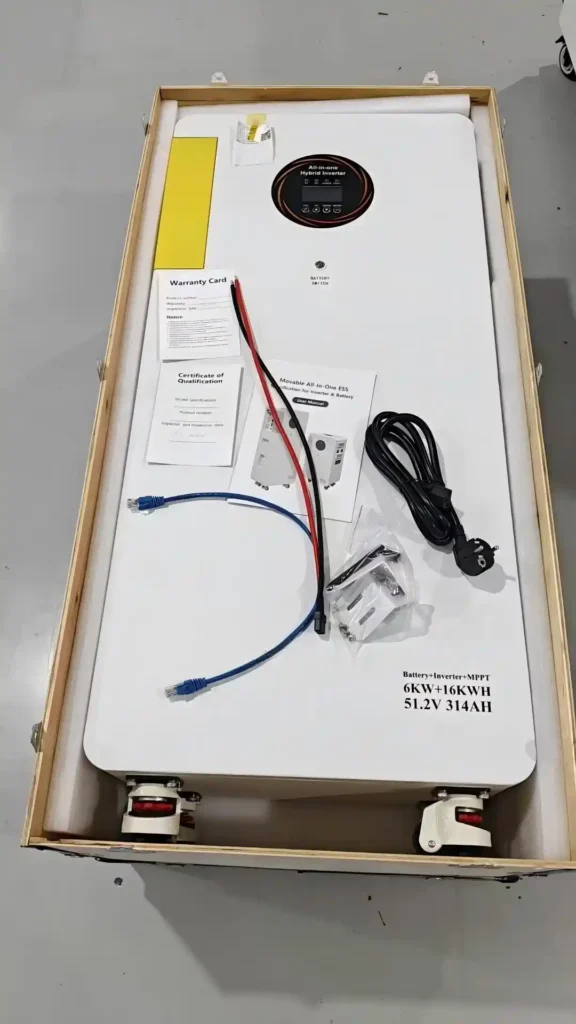
A residential system listed on the VoltCrave Power website illustrates how inverter power and battery capacity are combined in an integrated configuration.
The 6kW 16kWh All-in-One Residential Energy Storage System has the following published specifications:
| Parameter | Published Specification |
|---|---|
| Inverter Power | 6kW Hybrid Inverter |
| Battery Capacity | 16kWh |
| Battery Type | LiFePO4 |
| Battery Configuration | 51.2V 314Ah |
| Built-in MPPT | Yes |
| PV Charging Voltage | 60–450V |
| AC Output Voltage | 220–240V |
| Output Frequency | 50Hz / 60Hz |
These specifications illustrate the relationship between the system’s power conversion rating, stored energy capacity, and solar input configuration.
They do not establish how long the system can power a particular home. Actual runtime depends on usable battery energy, conversion losses, connected loads, operating conditions, and battery reserve settings.
All in One ESS vs. Separate Battery and Inverter: Which Is Better for a Home?
Residential energy storage systems generally use either an integrated configuration or separately installed battery and inverter equipment.
The main difference is how the components are selected, connected, and maintained.
| Comparison Factor | All-in-One ESS | Separate Battery and Inverter |
|---|---|---|
| System Architecture | Integrated platform | Independently installed components |
| Component Matching | Preconfigured combination | Requires compatibility verification |
| Installation | Fewer connections between separate core units | More independent equipment connections |
| Expansion | Depends on supported system configuration | More flexibility in selecting components |
| Maintenance | Depends on internal component accessibility | Individual units can be serviced or replaced |
| System Customization | Depends on available models | More independent configuration options |
| Residential Application | Standardized solar and storage installations | Customized or existing system installations |
When an All-in-One System Makes Sense
An integrated system can be suitable for new residential solar installations where the battery, inverter, and solar input requirements can be matched within one platform.
It can also simplify equipment selection because the main components are designed to operate together.
When Separate Equipment May Be More Suitable
A separate configuration may be more appropriate when an existing solar inverter needs to remain in service, when the project requires specific component combinations, or when independent equipment replacement and expansion are priorities.
Neither configuration is automatically better for every home.
The decision should be based on the existing electrical installation, solar system architecture, backup requirements, and future expansion plans.
What Should Installers Consider When Connecting an All in One ESS to a Home?
Although an integrated system can reduce the complexity of connecting separate battery and inverter units, it still requires careful electrical planning.
Several technical factors should be checked before installation.
1. Solar PV Input Compatibility
Installers should check the inverter’s maximum PV input voltage, operating voltage range, input current, MPPT configuration, and maximum PV input power.
The solar panel string arrangement must remain within the manufacturer’s specified electrical limits.
2. Grid Voltage and Frequency
The inverter must support the electrical characteristics of the installation location.
Important parameters include AC voltage, frequency, single-phase or three-phase configuration, and local grid interconnection requirements.
A system designed for one market should not automatically be assumed compatible with another market’s electrical standards.
3. Household Load and Backup Circuit Design
The total household demand must be compared with the inverter’s rated output and surge capabilities.
Installers should also determine which circuits require backup power and whether a separate critical-load distribution board or external transfer equipment is necessary.
4. Battery Charging and Expansion Limits
The battery configuration must match the inverter’s supported voltage, charging current, discharging current, and communication requirements.
If additional battery modules may be installed later, the maximum supported configuration and expansion method should be confirmed in advance.
5. Installation Environment and Electrical Protection
The installation location should meet the system’s requirements for temperature, ventilation, enclosure protection, and maintenance access.
Appropriate circuit protection, grounding, disconnect devices, and wiring arrangements must also follow the product documentation and applicable local electrical regulations.
These requirements show why an integrated system still needs professional system design. Factory integration does not eliminate the need to verify the complete residential installation.
Frequently Asked Questions About All in One Energy Storage Systems
Does an All in One Energy Storage System Work Without Solar Panels?
Yes, some systems can operate without solar panels if their hybrid inverters support charging from the utility grid or another compatible AC source.
In this configuration, the battery can store electricity from the available source and supply household loads later. The available charging functions depend on the specific inverter model.
Can an All in One Energy Storage System Power a Home During a Blackout?
Yes, if the system supports backup or off-grid operation and has the required grid-isolation and backup output arrangements.
The available backup power depends on inverter output, battery energy, connected loads, and the system’s operating limits.
Not every grid-connected solar-plus-battery installation automatically provides backup power.
Does an All in One Energy Storage System Include a Hybrid Inverter?
Most residential All-in-One ESS configurations integrate a hybrid inverter with the battery system.
However, the term All-in-One does not guarantee that every product includes the same inverter functions, MPPT channels, backup switching equipment, or energy management features.
The product specification sheet should be checked to confirm the actual configuration.
Can an All in One ESS Run Air Conditioners and Other High-Power Appliances?
It depends on the inverter’s continuous output power, surge capability, appliance starting requirements, and the electrical configuration.
An air conditioner may operate within the inverter’s rating under suitable conditions, but multiple high-power appliances operating simultaneously can exceed the system’s available output.
A load assessment should be completed before selecting the system.
Can You Expand an All in One Home Energy Storage System Later?
Some All-in-One ESS products support additional battery modules or parallel system configurations.
However, expansion is not universal. The supported battery quantity, voltage configuration, communication protocol, inverter limits, and firmware compatibility must be confirmed with the manufacturer before adding capacity.
Conclusion
An All in One Energy Storage System powers a home by coordinating solar generation, battery storage, inverter conversion, and utility grid interaction within an integrated platform.
During the day, solar electricity can supply household loads and charge the battery with surplus energy. At night, stored energy can be converted into AC electricity for household consumption. During a grid outage, a properly configured backup system can supply designated loads independently of the utility grid.
Understanding the distinction between inverter power (kW) and battery capacity (kWh), as well as the system’s backup architecture, is essential when evaluating residential applications.
For a broader view of available configurations, explore the Home & Residential Energy Storage Systems category.
Need help matching this topic to a real battery project?
Send your target application, capacity range, certification market, and order plan. VoltCrave can recommend a practical product direction.