
An All-in-One Energy Storage System (ESS) combines battery storage and power conversion equipment in one integrated system. But what happens when the original battery capacity is no longer sufficient? Can you add more batteries without replacing the entire system?
The answer depends on the system’s battery architecture, inverter specifications, BMS communication, and manufacturer-approved configuration. Some models support additional battery modules, while others have a fixed configuration or require a separate storage solution.
For homeowners, solar installers, and energy storage distributors, understanding these limitations before installation can prevent compatibility problems and unnecessary equipment replacement.
Can an All-in-One ESS Be Expanded After Installation?
Yes, an All-in-One ESS can be expanded after installation if its design supports additional battery modules or an approved parallel configuration. However, this is not a standard capability of every integrated energy storage system.
The term “All-in-One” describes how system components are integrated. It does not tell you whether the battery capacity can be increased later.
There are two common system designs:
- Fixed-capacity systems: These have a defined battery configuration. Adding more batteries may not be supported unless the manufacturer provides an approved expansion method.
- Expandable systems: These use a modular battery architecture with compatible connections and BMS communication to support additional storage modules.
For example, the VoltCrave Power 10kWh All-in-One Residential ESS combines a 6kW hybrid inverter with two 5.12kWh LiFePO4 battery packs, providing 10.24kWh of combined nominal battery energy.
Its product specifications identify a dedicated battery connection supporting parallel CAN/RS485 communication. They also list 5kWh and 10kWh battery-layer options.
These details help buyers understand the system’s battery architecture. However, they should not be interpreted as confirmation that additional modules can automatically be connected after installation. The permitted expansion configuration must be confirmed with the manufacturer.
What Are the Ways to Expand an All-in-One ESS?
The available expansion method depends on the original system design. In most cases, buyers should distinguish between adding battery modules to an existing system and installing additional storage equipment.
Adding compatible battery modules
For a modular All-in-One ESS, additional battery modules may be connected to the existing battery bank through manufacturer-approved connections.
This increases the amount of stored energy without necessarily requiring a complete system replacement.
The new modules must meet the manufacturer’s requirements for voltage, capacity, battery chemistry, communication, and configuration.
Connecting additional battery units
Some systems support parallel battery connections. This allows compatible battery units to operate as part of a larger battery bank.
Matching nominal voltage is not enough to establish compatibility. Battery models, BMS protocols, current limits, protection settings, and wiring arrangements must also be checked.
Connecting multiple ESS units
Certain systems support parallel operation between complete ESS units. This can provide a way to increase both storage capacity and available system power, depending on the inverter architecture.
However, the inverter and control system must explicitly support the proposed configuration. Two identical All-in-One ESS units cannot automatically be assumed to work together.
Installing a separate battery storage system
If the original All-in-One ESS cannot accept additional battery modules, a separate storage system may be considered.
This requires an assessment of the existing electrical architecture, inverter compatibility, energy management, and installation conditions. Depending on the design, additional power conversion equipment may be required.
The following table summarizes the main differences.
| Expansion method | Main purpose | What must be confirmed |
|---|---|---|
| Add battery modules | Increase stored energy | Module compatibility and maximum capacity |
| Add parallel battery units | Increase battery-bank capacity | BMS, voltage, current and parallel support |
| Connect multiple ESS units | Expand system capacity and potentially power | Inverter and system-level parallel capability |
| Install separate storage | Add an independent storage arrangement | Electrical integration and control architecture |
What Limits the Expansion Capacity of an All-in-One ESS?
Even when an All-in-One ESS supports expansion, the maximum battery capacity is determined by the entire system rather than the number of available battery connections.
Inverter specifications
The inverter must support the voltage range and charging and discharging currents required by the expanded battery configuration.
Adding battery modules does not automatically increase the inverter’s maximum charging or discharging current. If the inverter has reached its rated limit, additional stored energy may not translate into higher available power.
BMS communication
The Battery Management System monitors battery operating conditions and manages functions such as cell voltage monitoring, temperature monitoring, and battery protection.
When additional modules are connected, the BMS must support the expanded configuration and communicate correctly with the inverter.
CAN and RS485 are common communication interfaces in energy storage systems. However, using the same interface does not guarantee that two battery models are compatible. The communication protocol and supported configuration must also match.
Battery voltage and configuration
Battery voltage, chemistry, capacity, and module configuration must comply with the manufacturer’s requirements.
For example, two batteries can both use LiFePO4 chemistry and have a nominal voltage of 51.2V without necessarily being suitable for connection to the same battery bank.
Victron Energy’s Lithium NG battery installation documentation explains that battery compatibility requirements differ between parallel, series, and series-parallel configurations. Its guidance also specifies matching capacity and model requirements for certain series arrangements.
This is why the proposed battery configuration should be checked against the relevant manufacturer’s documentation rather than selected by nominal voltage alone.
Reference: Victron Energy – Lithium NG Battery Installation.
Maximum supported battery modules
Every expandable system has a defined configuration limit. The maximum number of modules depends on the battery architecture, inverter, BMS, electrical protection, and manufacturer-approved connections.
For example, the VoltCrave Power 25kW Stackable ESS has a documented configuration of five 51.2V 100Ah LiFePO4 modules. Together, these provide 51.2V, 500Ah, and 25.6kWh of nominal battery energy.
Its published specifications also identify CAN, RS485, and RS232 communication interfaces.
This makes it a useful example of a stacked battery architecture. However, the documented five-module configuration does not establish that additional modules can be added beyond that configuration after installation.
Does Adding More Batteries Increase the Power Output of an All-in-One ESS?
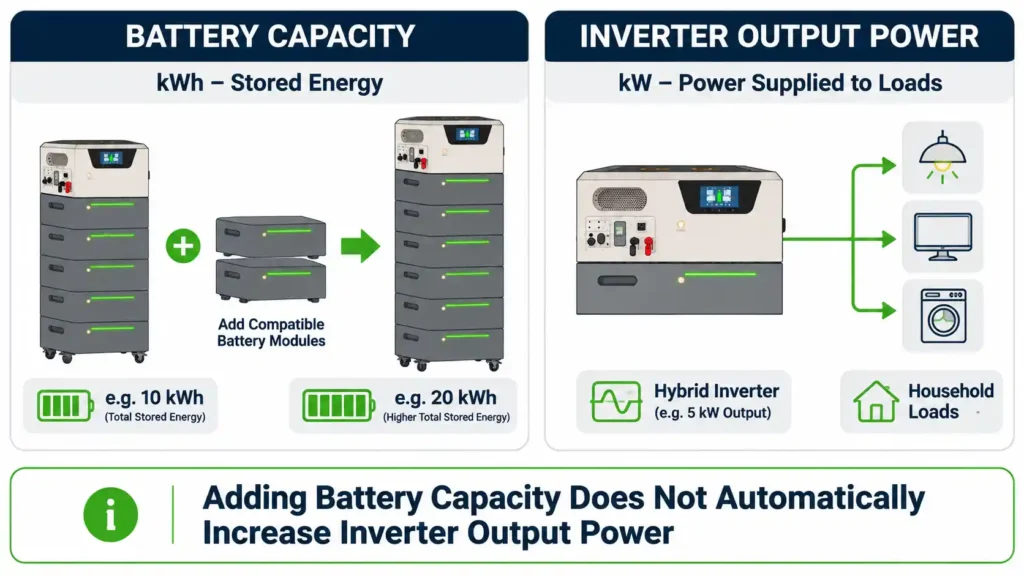
No. Increasing battery capacity does not automatically increase inverter output power.
Battery capacity and inverter output power describe different system characteristics:
- Battery capacity (kWh): The amount of electrical energy the battery can store.
- Inverter output power (kW): The rate at which the system can supply electrical power to connected loads.
The U.S. Energy Information Administration (EIA) defines power capacity as the maximum continuous instantaneous power output and energy capacity as the total energy that can be stored or discharged. These are separate measurements of an energy storage system.
Reference: EIA – Energy Storage for Electricity Generation.
Consider the VoltCrave Power 10kWh residential configuration:
- Battery energy: 10.24kWh (2 × 5.12kWh).
- Hybrid inverter rated output: 6kW.
If the system supports additional compatible battery modules, its available stored energy may increase. This can extend the potential backup duration, depending on usable battery capacity, connected loads, and system operating limits.
However, the inverter remains rated at 6kW. Adding battery modules does not change that rating.
| Characteristic | Battery capacity | Inverter output power |
|---|---|---|
| Unit | kWh | kW |
| What it measures | Stored energy | Power supplied to loads |
| Main effect of increasing it | More available stored energy | Higher potential load capacity |
| Typical limitation | Battery and system capacity limits | Inverter rated power and current limits |
If a project requires longer backup duration, additional battery capacity may be sufficient. If it requires higher instantaneous power, the inverter configuration must also be evaluated.
How Do You Know If Your Existing All-in-One ESS Supports Battery Expansion?
Before purchasing additional battery modules, review the original product documentation and confirm the manufacturer’s approved configuration.
The following checks help determine whether an existing system can accept additional storage.
1. Check the product datasheet
Look for specifications such as:
- Expandable battery capacity.
- Maximum battery module quantity.
- Parallel battery support.
- Battery communication interfaces.
- Supported battery models.
If the datasheet does not clearly describe expansion, request confirmation from the manufacturer.
2. Review the existing battery configuration
Identify the installed battery model, nominal voltage, capacity, chemistry, and number of modules.
These details help determine whether the proposed modules meet the system’s requirements.
3. Check the inverter specifications
Review the inverter’s battery voltage range, maximum charge current, maximum discharge current, and supported battery configuration.
The inverter must operate within its specified limits after expansion.
4. Confirm BMS compatibility
Check whether the additional modules use a compatible communication protocol and whether the existing system can recognize the expanded battery bank.
The physical communication interface alone is not enough. Protocol compatibility and supported system configurations must also be verified.
5. Confirm installation and warranty requirements
Ask the manufacturer whether expansion requires additional protection equipment, firmware updates, revised system settings, or professional commissioning.
Also confirm whether the proposed modification is covered by the product warranty.
These checks should be completed before purchasing additional batteries or changing the original electrical connections.
Is It Better to Expand an Existing All-in-One ESS or Install a New System?
When an existing All-in-One ESS no longer meets the required energy capacity, adding battery modules is not necessarily the only option.
The decision depends on the original system’s expansion limits, inverter capacity, installation conditions, and the reason additional storage is needed.
Expand the existing system
This is worth considering when the original system supports additional battery modules and the inverter can accommodate the intended configuration.
It allows the existing installation to remain in place, provided the additional batteries meet the manufacturer’s requirements.
Install a separate battery system
A separate storage system may be suitable when the original All-in-One ESS has reached its supported battery limit but the site has room for additional equipment.
However, the electrical and control architecture must be assessed before installation. A separate battery cannot always be connected directly to the original system.
Replace the existing system
Replacement may be more appropriate when the inverter is undersized, the battery architecture cannot be expanded, or the required system configuration differs substantially from the original design.
| Option | Suitable situation | Main consideration |
|---|---|---|
| Add battery modules | Original system supports expansion | Compatibility and remaining capacity limits |
| Install separate storage | Original system has limited expansion options | Electrical integration |
| Replace the system | Existing architecture no longer meets requirements | New system sizing and installation |
The decision should be based on the complete system configuration rather than battery capacity alone.
What Should You Look for When Buying an Expandable All-in-One ESS?
If future expansion is important, evaluate the battery architecture and inverter specifications before purchasing the system.
A larger initial battery capacity does not necessarily mean that a system offers greater expansion flexibility.
The following points should be included in the technical evaluation:
- Modular battery architecture: Confirm whether the battery design supports additional modules after installation, rather than only offering different configurations at the time of purchase.
- Maximum supported capacity: Request the initial configuration, maximum supported capacity, and permitted number of battery modules.
- Inverter specifications: Check the battery voltage range, charging and discharging limits, and whether parallel inverter operation is supported if higher output power is required.
- BMS communication: Confirm the supported protocols, battery models, and system-control requirements.
- Future technical support: Ask whether compatible modules, installation documentation, and configuration assistance will remain available for future expansion.
For example, the VoltCrave Power 25kW Stackable ESS uses five 51.2V 100Ah LiFePO4 battery modules, providing 25.6kWh of nominal battery energy and a 25kW system power rating.
Its documented five-module architecture gives buyers a clear reference when comparing stacked battery configurations. The key purchasing question is whether the manufacturer can confirm the required expansion arrangement for the intended project, not simply whether the product is described as stackable.
Buyers comparing residential storage configurations can also review the Home & Residential ESS product range to evaluate different battery and system architectures.
For distributors, installers, and brands developing their own energy storage products, expansion requirements should be discussed during the initial system design. This includes battery capacity, voltage platform, inverter matching, BMS communication, and the intended module configuration.
VoltCrave Power’s OEM and ODM energy storage services cover product design, battery configuration, BMS integration, inverter matching, prototype development, and testing support. These discussions allow buyers to define the required system configuration before production.
Frequently Asked Questions About Expanding an All-in-One ESS
Can You Add More Batteries to an All-in-One ESS After Installation?
Yes, if the system is designed to support additional battery modules. The new batteries must meet the manufacturer’s requirements for voltage, capacity, BMS communication, and maximum supported configuration.
Can You Mix Different Battery Brands in an All-in-One ESS?
Not automatically. Different battery brands may use different BMS protocols, protection settings, and operating parameters. Even when their nominal voltage and chemistry match, compatibility must be confirmed by the manufacturer.
Will Adding More Batteries Require a New Inverter?
Not necessarily. If the existing inverter supports the expanded battery configuration and its electrical limits are not exceeded, it may be possible to retain the original inverter. A higher output power requirement, however, may require a different inverter configuration.
How Many Batteries Can an All-in-One ESS Support?
There is no universal number. The maximum depends on the battery architecture, inverter specifications, BMS capabilities, and manufacturer-approved configuration. Check the datasheet for the specific model.
Does Expanding an All-in-One ESS Void the Warranty?
It depends on the manufacturer’s warranty conditions. Unauthorized modifications, incompatible battery connections, or installation outside the approved configuration may affect warranty coverage. Confirm the requirements before making changes.
Conclusion
An All-in-One ESS can be expanded after installation only when its original design supports the required battery configuration.
Before adding modules, check battery compatibility, inverter limits, BMS communication, and the manufacturer’s maximum supported capacity. If the existing system cannot accommodate the additional storage, a separate battery system or complete replacement may be more appropriate.
For buyers planning a residential ESS project, these requirements should be confirmed during supplier evaluation. A documented expansion configuration is more useful than relying on a general claim that a system is modular or stackable.
Need help matching this topic to a real battery project?
Send your target application, capacity range, certification market, and order plan. VoltCrave can recommend a practical product direction.