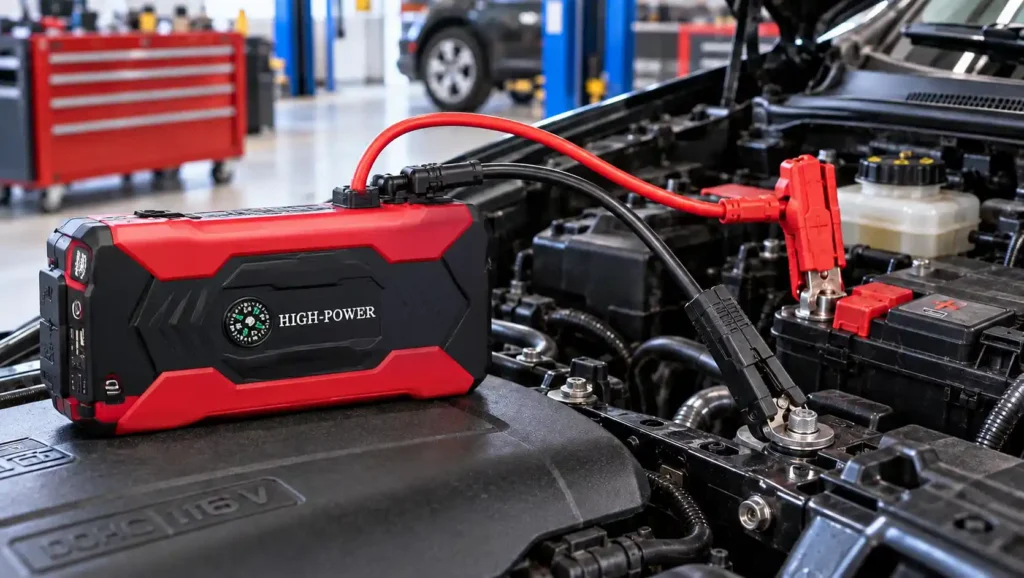
A jump starter’s amp rating only means something when it is matched to the engine it has to turn over. A compact unit that starts a 1.6L sedan without effort will struggle on a 6.0L diesel, and a heavy-duty pack rated for commercial trucks is more weight and cost than a motorcycle owner needs. Displacement, fuel type, compression, battery condition and temperature all shift the number.
Here is how many amps different engines need, why peak amps and cranking amps are not the same figure, and how to read the rating on a jump starter label before you buy.
How many amps does a car jump starter need? Quick answer by engine size
For most passenger cars, a jump starter rated between 600 and 1,500 peak amps covers the common range. Small cars and motorcycles need less. Diesel engines and heavy-duty trucks need more, often well above 2,000 amps.
The table below gives a practical starting point. Treat it as an estimate rather than a specification, because the exact draw varies with engine design, temperature and the condition of the vehicle battery.
| Engine type | Typical displacement | Recommended jump starter rating |
|---|---|---|
| Motorcycle, scooter, small car | 0.5L–1.5L gasoline | 400A–600A |
| Compact and mid-size car | 1.5L–2.5L gasoline | 600A–1,000A |
| Full-size sedan, small SUV | 2.5L–3.5L gasoline | 1,000A–1,500A |
| Large SUV, pickup truck | 3.5L–5.0L gasoline | 1,500A–2,000A |
| Diesel car, light diesel van | 1.5L–2.5L diesel | 1,500A–2,000A |
| Diesel truck, commercial vehicle | 4.0L+ diesel | 2,000A–4,000A |
The pattern behind the numbers is simple: the larger the engine and the higher its compression, the more current the starter motor draws to turn the crankshaft.
Amps needed for small cars and motorcycles
Engines in the 0.5L–1.5L range, including motorcycles, scooters, and subcompact cars, usually start on 400A–600A. A 600A peak jump starter handles most of this group, which is why compact units are common in motorcycle and small-car emergency kits.
If the vehicle has a small battery or a low-compression engine, even the low end of this range is enough. What matters more here is portability and storage, since these units are often carried on the bike or in a small car. A compact unit in this class, like the T29B-02 300A start / 600A peak jump starter, suits this group and light starting duty in general.
Amps needed for mid-size sedans and SUVs
The 2.0L–4.0L range covers most family cars, crossovers, and mid-size SUVs on the road. These engines typically need 800A–1,500A. A 1,000A unit is a common and reasonable minimum, and a 1,350A unit gives a comfortable margin. A unit in this class, such as the C01 80Wh sodium-ion jump starter with 1350A peak, covers the whole group with room for a cold start.
This is also the range where cold weather starts to matter. A vehicle that starts easily at 20°C in summer can demand noticeably more current at -10°C, because cold oil thickens and the battery’s own output drops.
Amps needed for trucks and large SUVs
Gasoline V6 and V8 engines in trucks and large SUVs, up to roughly 5.0L, generally need 1,500A–2,000A. The larger rotating mass and higher compression raise the current the starter motor pulls on the first turn.
For this group, a unit below 1,500A peak may work on a warm engine with a healthy battery but leave too little margin when the battery is flat and the engine is cold. Buying at the top of the range is a practical way to cover both conditions.
Amps needed for diesel and heavy-duty engines
Diesel engines need more amps than gasoline engines of similar displacement. Higher compression ratios mean the starter has to work harder to build the pressure needed for ignition, and diesel starting current commonly falls in the 2,000A–4,000A range for trucks and commercial vehicles.
For fleet and commercial applications, the jump starter is a piece of equipment rather than a personal tool, and the rating should be chosen around the largest engine in the fleet, not the average one.
Quick reference: engine size vs required amps
Two rules cover most of the range. Gasoline engines roughly follow the displacement bands above. Diesel adds a step: a 2.0L diesel often needs the current of a gasoline engine two sizes larger.
Buyers who know only the engine displacement can use the table to pick a class, then check it against the vehicle’s own cranking requirement if that figure is listed in the manual.
Peak amps vs cranking amps: what the rating really means
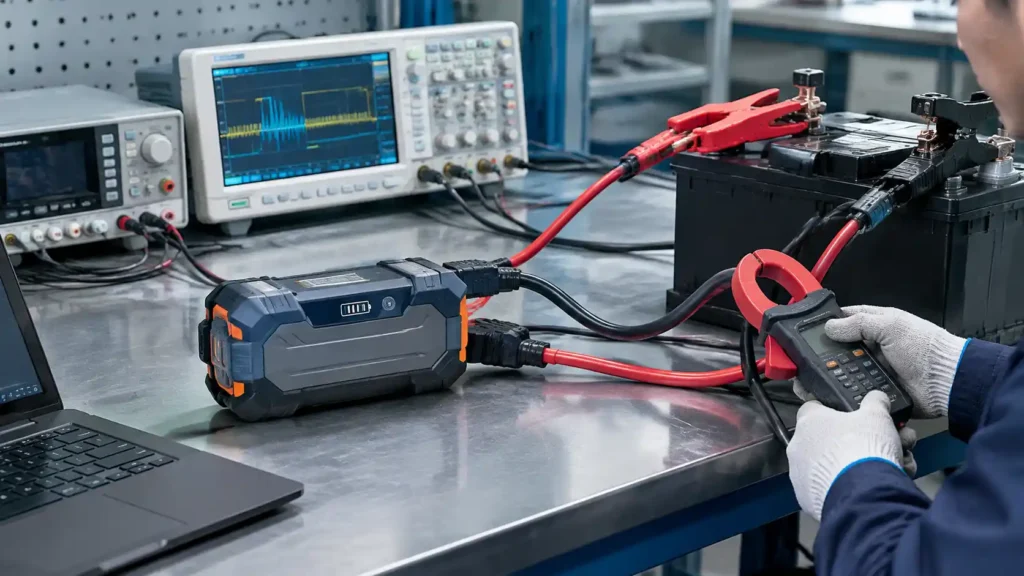
The number printed largest on a jump starter box is usually the peak amp rating. It is not the same as the current the unit delivers for the several seconds a starter motor actually turns.
This distinction is the most common source of confusion when matching a jump starter to an engine.
Why peak amps overstate real starting power
Peak amps describe the highest current a unit can deliver for a very short instant, often a fraction of a second. A starter motor does not draw that figure for the whole cranking cycle. It draws a sustained current, which is lower.
Two jump starters with the same 1,000A peak rating can therefore behave differently on the same engine. The difference comes down to how long each can hold current and how its cells and wiring handle the load.
Cranking amps and cold cranking amps explained
Cranking amps (CA) and cold cranking amps (CCA) are the ratings that describe sustained starting current. CCA specifically refers to current delivered at -18°C, which is why it is the figure that matters in cold climates.
A lead-acid battery label shows CCA directly. A lithium jump starter may not carry a CCA number at all, in which case the useful figure is the unit’s real starting current, not its peak.
How to read a jump starter amp label correctly
When a label gives both a peak and a starting figure, use the starting figure for matching the engine. When only a peak figure is given, treat it as an upper bound and expect the real cranking current to be lower.
For any unit intended for commercial or fleet use, ask the supplier for the continuous starting current and for how many seconds the unit can hold it.
What determines how many amps you actually need?
Amp requirements are not fixed by displacement alone. Several factors push the real draw above or below the estimate in the table.
Engine displacement and compression ratio
Displacement sets the scale, but compression ratio changes the load. A high-compression gasoline engine can demand more starting current than a larger low-compression one. That is why displacement gives the starting point for the estimate rather than the final answer.
Diesel vs gasoline starting demand
Diesel engines ignite fuel by compression rather than a spark, so the starter must turn the engine fast and hard enough to create ignition temperature and pressure. That extra work is why diesel starting currents sit one to two classes above gasoline.
Battery condition and state of charge
A jump starter supplements the vehicle battery. It does not always replace it. If the battery is deeply discharged or failing internally, the jump starter carries more of the starting load and needs more capacity to do it. A healthy but flat battery is an easier job than a weak battery that cannot accept charge.
Cold weather: why you need 20 to 50 percent more amps
Cold temperatures thicken engine oil and reduce the battery’s own ability to deliver current, so the jump starter takes on a larger share of the work. In freezing conditions, adding 20% to 50% to the estimated rating is a common rule of thumb.
For vehicles parked outdoors through winter, sizing at the upper end of the range avoids a second failed start on the coldest morning.
Battery voltage and vehicle electrical systems
Almost all passenger cars and light trucks use a 12V system, so a 12V jump starter matches. Commercial vehicles may run 24V systems. A single 12V unit is not the right match there, and the correct configuration has to be confirmed.
Voltage must match the vehicle. Amp rating is a separate question and does not compensate for a voltage mismatch.
Matching jump starter amps to your vehicle
Once the engine class is known, matching is a matter of choosing a rating with enough margin for real-world conditions.
Small cars, motorcycles and powersports
For this group, a 600A peak unit is usually sufficient, and portability is the deciding factor. Compact units are easier to store on a bike or in a small glovebox, and the amp requirement is low enough that capacity does not have to be large.
Family cars and mid-size SUVs
A 1,000A to 1,350A unit covers most family vehicles with margin for cold starts. This is the largest single group of drivers, and it is where a one-size-fits-most rating makes sense for distributors building a general-purpose product line.
Trucks, vans and large SUVs
For gasoline trucks and large SUVs, choose 1,500A or above. Vehicles used for towing, in cold regions, or with older batteries benefit from the higher end of the range so the unit still works when conditions are worst.
Diesel trucks and commercial fleets
For diesel fleets, size around the largest engine in the fleet, then consider whether one 2,000A+ class unit covers all vehicles or whether the fleet needs two classes. A single heavy-duty model that covers everything is simpler to manage but heavier and more expensive than a mixed fleet.
Is more amps always better? Sizing trade-offs
A higher-amp jump starter will not damage a vehicle’s electrical system, because the starter motor only draws the current it needs. The real trade-offs are weight, size, and cost.
Why a higher-amp unit is safe but not always necessary
A 2,000A unit connected to a small car will not push 2,000A through the system; it simply has more reserve than the engine needs. There is no harm in the extra capacity, only the extra cost and bulk of carrying it.
That said, matching the unit to the vehicle avoids paying for capacity that will never be used. For a distributor, the product line should cover the engine classes its market actually drives.
Portability, weight and capacity trade-offs
Higher current ratings usually come with larger cells and more weight. A heavy-duty unit that starts a diesel truck is not convenient to store in a compact car, and a pocket-sized unit rated for small engines will not reliably start a V8.
Capacity and current are related but not identical: a unit needs enough stored energy to hold the cranking current long enough to start the engine, and enough current to turn it in the first place.
Capacity (mAh / Wh) vs peak amps: two different specs
Capacity measures how much energy the unit stores, in milliamp-hours (mAh) or watt-hours (Wh). Peak amps measure how much current it can deliver at once. A jump starter needs both: enough energy and enough current. The same distinction between stored energy and output shapes how portable power is sized, as covered in this guide to portable power station sizing.
A unit with high capacity but low current may hold a charge for many starts yet fail on a large engine, while a high-current unit with modest capacity starts the engine once but has less reserve for repeat attempts. The Q08 8000mAh jump starter with air pump sits at the higher-capacity end of this trade-off, pairing a larger battery with a digital pressure display for tire inflation.
Features that matter beyond amp rating
Amp rating is the first specification to check, but several other features decide how useful a jump starter is in practice.
Air compressor and multi-function units
Some jump starters include a built-in air pump, which turns the unit into a tire inflation tool as well as an emergency starter. For roadside use, this reduces the number of separate devices a driver has to carry. Units with a digital pressure display show readings in PSI, BAR, KPA and KG/CM². The G963 6000mAh jump starter with air pump is one example, combining a 600A peak rating with an integrated pump and LED light.
The air pump does not change the amp requirement, but it does affect weight and the size of the unit.
Battery chemistry: lithium, sodium-ion and lead-acid
Lithium and sodium-ion jump starters deliver high current from a small, light package and hold charge longer between uses than lead-acid units. Sodium-ion is notable for cold-weather tolerance, which matters for starting current in winter. Lead-acid jump starters are heavier and lose charge faster but cost less.
The chosen chemistry affects how much current the unit can deliver and how it behaves in low temperatures, so it belongs in the same decision as the amp rating.
Safety protection and reverse-polarity design
Modern jump starters use a battery management system (BMS) to monitor and protect the unit. Common protections include over-charge, over-discharge, over-current, short-circuit, high-temperature cutoff, low-temperature charging lock, cell balancing and auto-disconnect at low state of charge.
Reverse-polarity protection matters most in emergency use, when clamps are connected in poor light or in a hurry. It prevents damage to the vehicle and the unit when the clamps are reversed.
USB-C PD output and portable power function
Many jump starters double as power banks with USB-C Power Delivery output, which can charge phones, tablets and other devices on the road. For a vehicle emergency kit, this adds a second use to equipment that would otherwise sit unused.
How VoltCrave Power matches jump starter amps to fleet and B2B applications
For distributors, fleet operators and OEM buyers, the specification decision is made once and applied across many vehicles, which puts more weight on covering the range than on any single unit.
Matching amp classes to a fleet vehicle mix
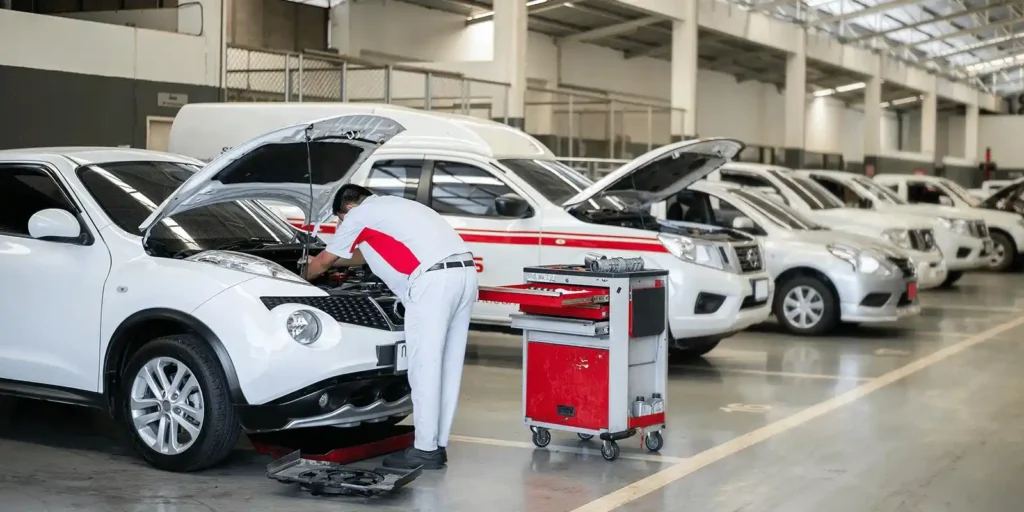
The right product mix follows the fleet. A fleet of compact cars needs one class; a mixed fleet of vans, trucks and diesel vehicles may need two. Sizing around the largest engine ensures every vehicle is covered, but carrying only the largest class everywhere is unnecessary weight and cost.
A practical approach is to define the engine classes in the fleet, assign a rating to each class with cold-weather margin, then choose the smallest set of models that covers them.
Customisation, branding and certification for distributors
For distributors and importers, jump starters are commonly supplied with configured capacity, current, housing and accessories, plus private-label branding and packaging. This is the same OEM and ODM model used across custom battery products. Certifications such as CE, UL, IEC and UN38.3 are documentation requirements that vary by target market and should be confirmed against each product model.
Configuration changes can affect lead time and minimum order quantity, so these should be settled early in a project rather than after the specification is fixed.
FAQs
Is 1000 peak amps good enough for a car?
For most passenger cars and mid-size SUVs, 1,000A peak covers the common range, especially in mild conditions. For trucks, large SUVs, diesel engines or cold-weather use, a higher rating gives a safer margin.
Is a 1500 amp jump starter enough?
A 1,500A unit covers most gasoline cars, SUVs and light trucks, and it is a sensible rating for a general-purpose product. It may be marginal on large diesel engines, where 2,000A or more is a better match.
What size jump leads do I need?
Jump lead gauge should match the current the engine draws. Undersized leads add resistance and reduce the current reaching the starter. For heavier vehicles, thicker gauge leads are needed to carry the higher current.
How many amps does a diesel truck need?
Diesel trucks commonly need 2,000A to 4,000A, because diesel engines use higher compression than gasoline engines and demand more current to turn over, especially when cold.
Can too many amps damage my car?
No. The starter motor draws only the current it needs, so a higher-amp jump starter does not force extra current into the system. The main effect of a higher rating is more reserve, plus more weight and cost.
How many amps to jump start a car?
For most gasoline cars, a jump starter rated 600A to 1,500A peak will start the engine. Match the rating to the engine size, and add 20% to 50% for cold weather or a deeply discharged battery.
Final answer: sizing your jump starter by engine type
The amp rating on a jump starter should match the engine it has to start. Small cars and motorcycles are covered by 400A–600A, mid-size cars and SUVs by 800A–1,500A, gasoline trucks by 1,500A–2,000A, and diesel or heavy-duty engines by 2,000A–4,000A. Peak amps describe a brief maximum, while cranking amps describe the sustained current a starter motor actually draws, so the starting figure is the one to match against the engine.
Before buying, confirm the engine displacement and fuel type, check the vehicle’s voltage, and add margin for cold weather or a weak battery. The amp class follows the engine, and the model within that class is a question of capacity, portability and the extra functions you actually want.
Need help matching this topic to a real battery project?
Send your target application, capacity range, certification market, and order plan. VoltCrave can recommend a practical product direction.