
Wholesale buyers sourcing portable power stations for the Middle East need to evaluate more than battery capacity and rated output. Operating temperature, solar input, battery chemistry, product certification, and after-sales support all affect whether a model is suitable for the intended market.
For importers, distributors, and private-label brands, the purchasing decision also involves supplier documentation, product consistency, customization requirements, and the ability to support repeat orders. Buyers can explore VoltCrave Power’s portable power stations to review available models and product configurations.
The following criteria provide a practical framework for evaluating portable power station models and suppliers before placing a wholesale order.
How Do Middle East Climate Conditions Affect Portable Power Station Selection?
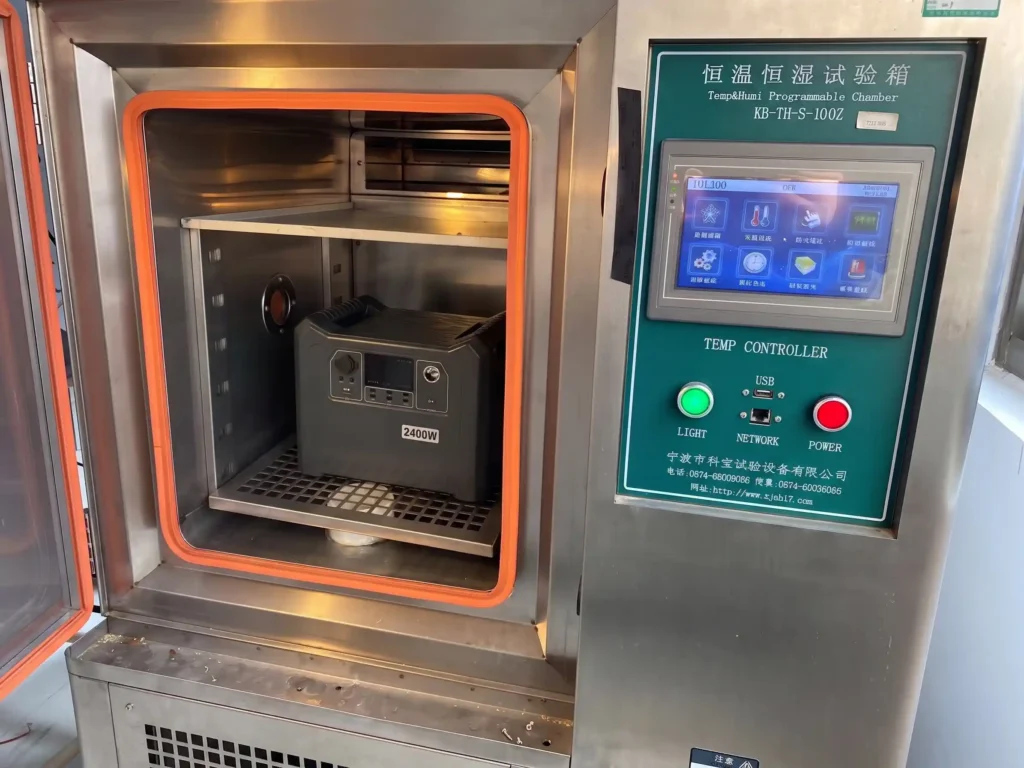
High ambient temperatures, direct sunlight, dust, and outdoor operating conditions can affect portable power station performance. Buyers should check the manufacturer’s specified operating limits rather than assuming that a product designed for outdoor use can operate reliably in every Middle Eastern climate.
Check the operating temperature range
Battery charging and discharging can have different temperature limits. This distinction matters when a product will be stored, charged, or used outdoors in a hot environment.
Two examples from VoltCrave Power’s portable power station range illustrate why buyers need to review model-specific thermal information:
| Product | Rated output | Battery capacity | Published thermal information |
|---|---|---|---|
| 1200W 1000Wh LiFePO4 Portable Power Station | 1,200W | 1,008Wh | BMS protection information includes high-temperature cutoff and low-temperature charging lock; exact temperature thresholds are not listed |
| BP240A | 2,400W | 2,560Wh | Product page describes ventilation openings for heat dissipation; exact charging and discharging temperature limits are not listed |
The 1200W model’s product page identifies high-temperature cutoff and low-temperature charging lock as BMS protection functions. However, these functions do not establish the exact temperature at which charging or discharging is permitted.
The BP240A product page describes dedicated ventilation openings, but this does not replace a specified operating temperature range.
For either model, buyers targeting markets with high summer temperatures should request the manufacturer’s charging, discharging, and storage temperature limits. Also confirm whether output power is derated at elevated temperatures and whether the product requires shaded or ventilated placement.
Evaluate dust and enclosure protection
Dust exposure is another consideration for outdoor and industrial applications. An IP rating helps buyers understand the level of enclosure protection, but it should not be treated as a general guarantee against every environmental condition.
Before selecting a model, confirm:
- Whether the enclosure has a documented IP rating.
- Whether connectors, ventilation openings, and accessory ports have the same protection level.
- Whether cooling openings can be exposed to dust during normal operation.
- Whether the product requires a shaded or ventilated installation area.
- Whether the supplier provides cleaning, inspection, and maintenance instructions.
Do not assume that every portable power station has the same enclosure protection. Request the exact model’s documentation before making a product claim or committing to a wholesale order.
Which Battery Technology and BMS Features Should Wholesale Buyers Prioritize?
Battery chemistry affects product characteristics, while the battery management system (BMS) controls and protects the battery pack within its operating limits. Buyers should evaluate both when comparing portable power station models.
Compare LiFePO4 and NMC battery options
LiFePO4 and NMC are two lithium-ion battery chemistries used in portable power products. Neither should be selected based on a chemistry label alone. The appropriate choice depends on the product’s intended use, design, operating requirements, and commercial positioning.
| Evaluation point | LiFePO4 | NMC |
|---|---|---|
| Chemistry | Lithium iron phosphate | Nickel manganese cobalt |
| Common selection consideration | Thermal stability and cycle-life requirements | Energy density and product size requirements |
| Buyer evaluation | Check pack design, rated capacity, operating limits, and cycle-life test conditions | Check cell specifications, thermal management, operating limits, and cycle-life test conditions |
| Key procurement question | What cycle-life conditions and warranty terms apply to the complete product? | What thermal protection and operating limits apply to the complete product? |
The 1200W 1000Wh portable power station listed by VoltCrave Power uses LiFePO4 cells. The BP240A product page specifies its output and capacity but does not clearly identify the battery chemistry. Buyers should confirm the chemistry of the exact BP240A configuration before comparing it with LiFePO4 models.
Do not compare cycle-life figures without checking the test conditions. Charge and discharge rates, depth of discharge, temperature, and end-of-life criteria can all affect the result. Ask suppliers to state the conditions behind any cycle-life claim.
Confirm the BMS protection functions
A BMS should monitor battery operating conditions and protect the pack when specified limits are exceeded. For wholesale procurement, ask the supplier for the BMS protection specifications rather than relying on a general statement that the product includes battery protection.
Depending on the product design, relevant functions may include:
- Cell overvoltage and undervoltage protection.
- Charge and discharge overcurrent protection.
- Short-circuit protection.
- Temperature monitoring and protection.
- Cell balancing.
- Communication with the inverter or system controller, where applicable.
The 1200W 1000Wh model’s product page lists overcharge, over-discharge, overcurrent, short-circuit, over-temperature, and battery-status monitoring functions. The BP240A page identifies overcharge protection, short-circuit protection, and voltage equalization. These are model-specific published details, not a guarantee that every model in the product range has identical protection functions.
For OEM or ODM projects, confirm whether BMS parameters can be customized and whether any changes affect certification, product testing, or compatibility.
What Capacity and Output Power Should Buyers Source for the Middle East Market?
Capacity and output power describe different aspects of a portable power station.
- Capacity (Wh): The amount of energy the battery stores.
- Rated output power (W): The maximum continuous power the unit is designed to supply under specified conditions.
- Peak or surge power (W): A temporary output level that may support loads with higher starting current.
A model with a large battery capacity does not necessarily support high-power equipment. Buyers should match both capacity and output power to the intended application.
Match product specifications to the application
The following examples illustrate how different product configurations can serve different market segments. They are sourcing references, not universal recommendations for every application.
| Product example | Rated output | Battery capacity | Battery chemistry | Potential buyer segment |
|---|---|---|---|---|
| 1200W 1000Wh LiFePO4 Portable Power Station | 1,200W | 1,008Wh | LiFePO4 | Outdoor equipment suppliers, camping product distributors, and emergency power providers |
| BP240A | 2,400W | 2,560Wh | Confirm exact configuration with supplier | Buyers sourcing higher-output portable power and backup products |
The 1200W model provides 1,200W continuous AC output through four pure sine wave AC outlets. Its published specifications also include multiple USB, Type-C, and DC output interfaces.
The BP240A is listed with 2,400W output and 2,560Wh capacity. Its product page describes it as a portable power station for higher-power portable energy and backup applications. Buyers should request the complete electrical specifications, including surge power, AC output voltage, frequency, and supported load conditions, before matching it with specific equipment.
For a wholesale product range, consider whether the supplier can provide models with different output and capacity levels. A range of configurations can help distributors address different customer requirements without relying on one model for every application.
Before confirming a product, ask for:
- Rated continuous output and peak output.
- Battery capacity and, where available, usable capacity.
- AC output voltage and frequency.
- Supported load types and starting-current limits.
- Charging methods and input limits.
- Product weight and dimensions for storage, transport, and handling.
Regional AC voltage and frequency requirements should be confirmed before ordering. The same product name does not necessarily mean that every regional version has identical electrical output specifications.
Why Is Solar Charging Important for Portable Power Stations in the Middle East?
Solar charging can be a useful feature in markets with strong solar resources and applications where access to grid power is limited. However, buyers should evaluate the actual PV input specifications rather than assuming that a product can connect to any solar panel.
Check the PV input range and maximum power
The solar input determines which panel configurations the power station can support. Important parameters include:
- Maximum PV input power.
- PV input voltage range.
- Maximum PV input current.
- Connector type and polarity.
- Supported solar charging conditions.
The 1200W 1000Wh LiFePO4 Portable Power Station provides a documented example:
| Parameter | 1200W 1000Wh LiFePO4 Portable Power Station |
|---|---|
| Solar charging | MPPT |
| Solar input voltage | 12–50V |
| Maximum solar charging power | 350W |
The BP240A product page does not provide a complete PV input specification. Buyers considering this model for solar charging should request its maximum PV input power, voltage range, current limit, and connector details before selecting compatible panels.
Do not select solar panels based on wattage alone. The panel or array’s operating voltage and current must remain within the power station’s specified input limits.
Confirm solar charging performance under local conditions
Actual solar charging time depends on more than the maximum PV input rating. Solar irradiance, panel orientation, shading, temperature, wiring, and conversion efficiency all affect the energy delivered to the battery.
For wholesale orders, ask the supplier for the recommended panel configuration and the conditions behind any stated charging-time figure. If the product will be sold with solar panels, verify that the panel specifications and connectors are compatible with the power station.
What Certifications and Import Requirements Should Buyers Check in the Middle East?
Import requirements vary by country, product classification, and applicable technical regulations. Buyers should not assume that one certificate automatically covers every Middle Eastern market.
Before placing an order, identify the destination country, product category, HS code, and applicable conformity route. Confirm the requirements with the local importer, conformity-assessment body, or customs broker.
Saudi Arabia: Check the SABER requirements
Saudi Arabia uses the SABER platform for product and shipment conformity procedures. Depending on the product classification, regulated products may require a Product Certificate of Conformity (PCoC) and a Shipment Certificate of Conformity.
Buyers should confirm:
- Whether the product is classified as regulated or non-regulated.
- Which technical regulation and product category apply.
- Whether a PCoC is required.
- What documents are needed for the shipment certificate.
- Whether the model details on the certificate match the imported product.
The applicable route should be checked through the official SABER platform. Do not assume that every portable power station follows the same certification process.
United Arab Emirates: Confirm the applicable conformity route
In the UAE, the Ministry of Industry and Advanced Technology (MoIAT) manages conformity certification for products covered by relevant technical regulations.
Buyers should establish whether the specific product falls under an applicable regulation and whether a conformity certificate or test report is required. The requirements depend on product classification and the relevant regulation. The official MoIAT services provide the appropriate starting point for checking the current process.
Request lithium battery transport documentation
Portable power stations contain lithium batteries, so transport documentation should be checked before shipment.
For applicable lithium battery shipments, buyers should request the UN 38.3 test summary and confirm that the documentation corresponds to the battery type being shipped. Other documents may include the safety data sheet and transport-related information required by the carrier or destination market.
Also confirm the product’s applicable electrical safety, EMC, and other conformity documents. A certificate listed for one model or battery configuration should not be assumed to cover every product in a supplier’s catalogue.
VoltCrave Power’s certification documents and standards information can be used as a starting point for document review. Buyers should request the exact model-specific certificates and test reports before making a compliance decision.

How Should Wholesale Buyers Evaluate a Portable Power Station Supplier?
A supplier’s product catalogue is only one part of the evaluation. Importers and distributors also need to understand how the supplier manages product specifications, customization, quality control, and after-sales support.
Review manufacturing and customization capabilities
For private-label brands and distributors, OEM and ODM support may include changes to branding, enclosure design, battery configuration, BMS parameters, inverter matching, and communication protocols, depending on the product and engineering requirements.
Before discussing customization, provide the supplier with a clear product brief covering:
- Target market and intended application.
- Required rated output and battery capacity.
- AC voltage, frequency, and outlet configuration.
- Battery chemistry and operating temperature requirements.
- Solar input requirements.
- Branding, packaging, and labeling needs.
- Required certificates and test documents.
Ask which changes are standard options and which require engineering work or a new validation process. Customization can affect development time, MOQ, cost, and certification scope, so these points should be agreed before production.
VoltCrave Power’s OEM and ODM services provide information about its customization scope and product development process.
Ask how product quality is controlled
Buyers should request information about the checks performed during production and before shipment. The specific process will vary by product, so ask the supplier to identify which inspections and tests apply to the model being purchased.
Useful questions include:
- Are incoming battery cells checked against the approved specifications?
- How are battery packs and BMS functions inspected?
- Are AC output and charging functions tested?
- Are protection functions checked during product testing?
- Is a finished-product inspection report available?
- Can the supplier provide test records linked to the production batch?
Avoid relying on broad statements such as “strict quality control” without supporting inspection records or a defined test process.
Evaluate after-sales and spare-parts support
Portable power stations contain battery, inverter, charging, and control components. A distributor should understand how product issues will be handled after delivery.
Confirm the warranty terms, technical support process, spare-parts availability, fault diagnosis procedure, and responsibility for shipping costs in warranty cases. Also ask whether the supplier can provide troubleshooting documentation and technical training for the distributor’s service team.
What Should Buyers Verify Before Placing a Wholesale Order?
Before confirming a purchase order, buyers should review the final product configuration and supporting documents. A sample evaluation can identify specification or compatibility problems before they affect a larger shipment.
Evaluate a sample against the intended application
A sample should be tested against the requirements agreed with the supplier. Depending on the product, the evaluation may cover:
- AC output voltage, frequency, and rated load.
- Battery capacity and charging behavior.
- Solar input compatibility.
- Protection functions and temperature limits.
- Display, controls, connectors, and accessories.
- Packaging, labeling, and branding.
Record the test conditions and results. If the sample includes custom specifications, make sure the approved configuration is documented and carried into the mass-production order.
VoltCrave Power’s sample request and evaluation process can help buyers review product performance, compatibility, quality, branding, and packaging before proceeding.
Confirm the purchase-order details
The purchase order should identify the exact model and configuration. Avoid relying only on a product name or catalogue image.
| Item to confirm | What the buyer should document |
|---|---|
| Product configuration | Model number, rated output, capacity, battery chemistry |
| Electrical specifications | AC output, frequency, PV input, charging limits |
| Environmental limits | Charging and discharging temperature, IP rating |
| Accessories | Cables, adapters, connectors, and included components |
| Compliance documents | Applicable certificates, test reports, and transport documents |
| Branding and packaging | Approved artwork, labels, carton specifications |
| Commercial terms | MOQ, unit price, lead time, payment terms, and warranty |
| Quality requirements | Inspection criteria, test records, and acceptance conditions |
The final approved sample, specification sheet, and purchase order should describe the same product. Any change to cells, BMS, inverter components, enclosure, or electrical configuration should be reviewed before production.
FAQs
Are LiFePO4 portable power stations suitable for the Middle East market?
LiFePO4 models can be considered for the market, but suitability depends on the complete product design and its documented operating limits. Buyers should check charging and discharging temperature ranges, BMS protection, enclosure rating, and the intended installation conditions.
What capacity should wholesalers source for the Middle East?
There is no single capacity suitable for every buyer. The required capacity depends on the equipment being powered and the expected operating time. Wholesale buyers should compare battery capacity in Wh with rated output in W, then select models that match their target applications.
Do portable power stations need SABER certification in Saudi Arabia?
The applicable conformity route depends on product classification and regulatory requirements. Some regulated products require a PCoC and shipment certificate, while other products may follow a different route. Buyers should verify the product category and HS code through SABER before shipment.
Can portable power stations be charged with solar panels in high-temperature environments?
Solar charging is possible when the panel configuration stays within the power station’s specified PV input limits. However, high temperatures can affect charging conditions and battery operation. Buyers should check the product’s charging temperature range and obtain the manufacturer’s installation and operating guidance.
What should importers check before placing a bulk order?
Importers should approve the exact product configuration, evaluate a sample, verify model-specific compliance documents, and agree on MOQ, lead time, warranty, packaging, inspection criteria, and after-sales responsibilities before issuing the purchase order.
Conclusion
For Middle East wholesale buyers, portable power station selection should start with the intended application and the product’s documented operating limits. Battery chemistry, BMS protection, rated output, capacity, PV input, and enclosure protection determine whether a model fits the target use.
Before committing to a bulk order, verify the destination market’s import requirements, review model-specific certificates, evaluate a sample, and document the approved configuration. These checks give distributors and importers a clearer basis for comparing suppliers and reducing avoidable sourcing risks.
Need help matching this topic to a real battery project?
Send your target application, capacity range, certification market, and order plan. VoltCrave can recommend a practical product direction.