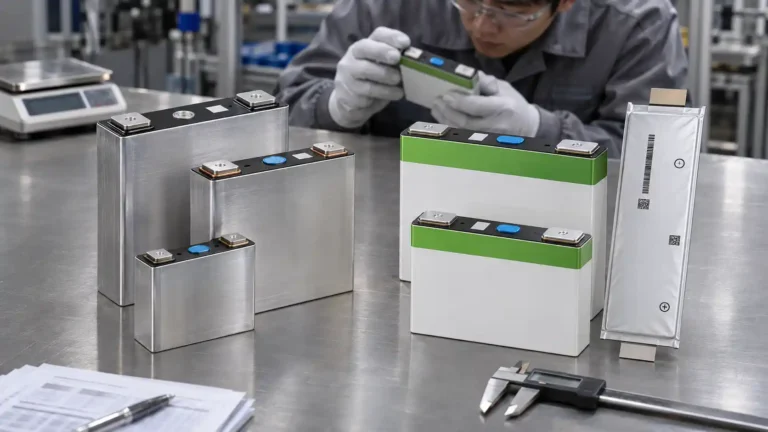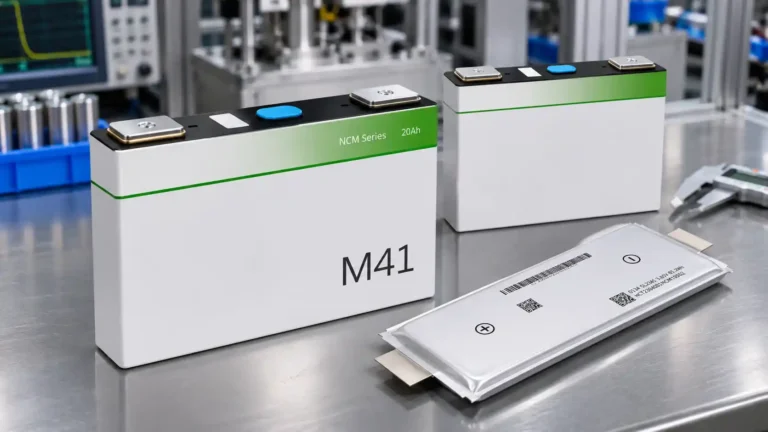
LiFePO4 batteries are known for their long cycle life, but this performance comes from specific characteristics of their cathode material and how the cell handles repeated charging and discharging.
The main reason is the olivine crystal structure of lithium iron phosphate (LiFePO4). It supports repeated lithium-ion insertion and extraction while maintaining a relatively stable structural framework. This helps the cathode withstand repeated electrochemical reactions.
However, the chemistry alone does not determine how long a battery lasts. Cell design, manufacturing quality, operating temperature, charging rate, and storage conditions all affect battery degradation.
Understanding these factors requires looking at both the material structure and the aging processes inside the cell.
What Makes LiFePO4 Chemistry Different?
LiFePO4 stands for lithium iron phosphate, a cathode material used in rechargeable lithium-ion batteries. It is the active material in the positive electrode, not the complete battery cell.
A typical LiFePO4 cell also contains a graphite anode, electrolyte, separator, and other components that support electrochemical operation.
Three characteristics help explain its cycling performance.
Olivine crystal structure
LiFePO4 has an olivine-type crystal structure. Its arrangement of iron-oxygen octahedra (FeO6) and phosphate tetrahedra (PO4) provides a structural framework for lithium-ion movement during charging and discharging.
Reversible lithium-ion movement
During charging, lithium ions leave the positive electrode and move toward the negative electrode. During discharging, they return to the positive electrode. This reversible process allows the cell to store and release energy repeatedly.
Iron phosphate-based cathode material
The cathode uses lithium iron phosphate, giving the cell different electrochemical and thermal characteristics from batteries based on other cathode materials.
These characteristics form the basis of LFP’s cycling performance. For a broader explanation of the differences between lithium iron phosphate and nickel manganese cobalt chemistries, see LFP vs NMC Batteries: What Are the Key Differences?.
Why Does the Olivine Structure Help LiFePO4 Batteries Last Longer?
The olivine structure is one of the main reasons LiFePO4 cathodes can withstand repeated charging and discharging.
During battery operation, lithium ions move into and out of the cathode. The material must accommodate these changes without losing its ability to participate in subsequent electrochemical reactions.
LiFePO4 has several structural characteristics that support this process.
A relatively stable phosphate framework
The FeO6 octahedra and PO4 tetrahedra form the characteristic olivine structure. This framework supports the reversible transition between lithium-rich LiFePO4 and lithium-depleted FePO4 during battery operation.
Defined lithium-ion diffusion channels
Lithium ions move through one-dimensional diffusion channels within the olivine structure. These channels provide pathways for lithium-ion transport between different states of charge.
However, defects and impurities can obstruct these pathways, affecting ion movement and electrochemical performance.
Structural changes during cycling
As lithium ions leave and return to the cathode, the material transitions between LiFePO4 and FePO4. The olivine framework accommodates this phase change, helping the cathode maintain its structural characteristics through repeated cycling.
Material engineering improves transport
LiFePO4 has relatively low inherent electronic conductivity. Battery manufacturers therefore use techniques such as carbon coating, particle-size optimization, and morphology control to improve electronic conductivity and lithium-ion transport.
These approaches address the material’s transport limitations and help maintain electrochemical performance.
A 2024 review published in ChemPhysChem, Life Cycle of LiFePO4 Batteries: Production, Recycling, and Market Trends, examines the olivine structure, FeO6 and PO4 structural units, lithium-ion diffusion channels, and material-engineering methods used to improve LFP performance.
The important distinction is that structural stability helps LFP achieve long cycle life, but it does not prevent all forms of battery degradation.
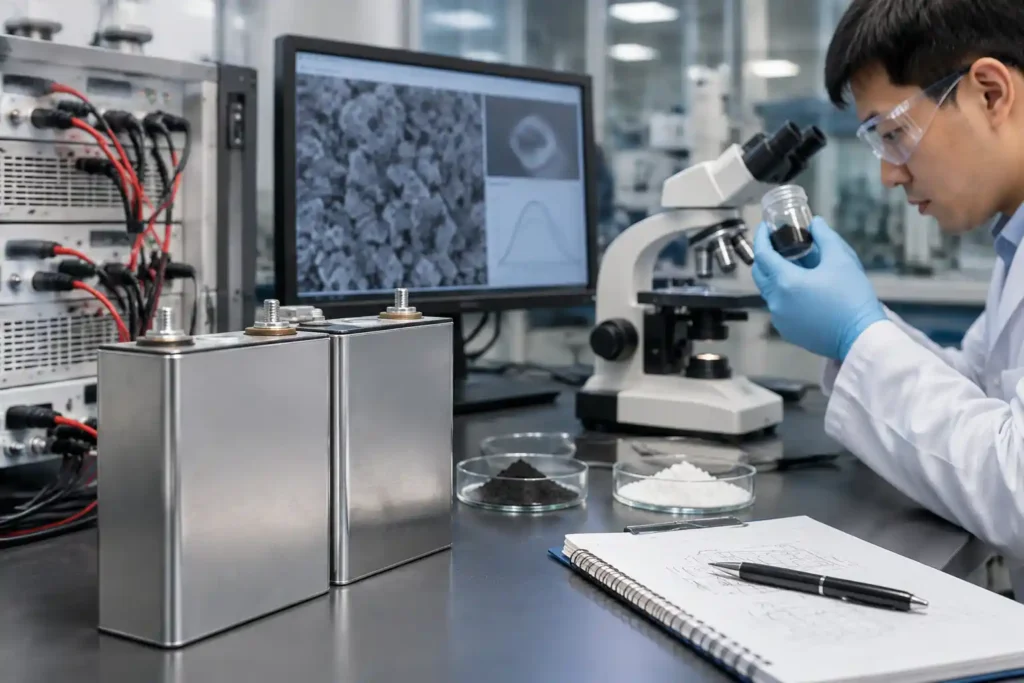
How Does LiFePO4 Chemistry Affect Lithium Battery Cycle Life?
Lithium battery cycle life describes how many charging and discharging cycles a battery can complete before reaching a specified end-of-life condition.
In a LiFePO4 cell, the cathode undergoes a reversible chemical reaction as lithium ions move between the positive and negative electrodes.
The process involves two stages.
During charging
- Lithium ions leave the LiFePO4 cathode.
- They move through the electrolyte toward the graphite anode.
- Electrons travel through the external charging circuit.
- The cathode transitions from LiFePO4 toward FePO4 as iron is oxidized from Fe2+ to Fe3+.
During discharging
- Lithium ions move back from the graphite anode toward the positive electrode.
- Electrons flow through the external circuit to supply electrical power.
- The cathode transitions from FePO4 toward LiFePO4.
- The reversible reaction allows the cell to deliver energy again.
The cathode reaction can be summarized as:
LiFePO₄ ⇌ FePO₄ + Li⁺ + e⁻
During charging, lithium ions leave the LiFePO₄ cathode, forming FePO₄. During discharging, the reaction reverses as lithium ions return to the cathode.
This reaction explains why the LFP cathode can participate in repeated charge and discharge cycles.
Three aspects connect this chemistry to cycle life:
- Reversible electrochemical reactions: Lithium ions can repeatedly move between the electrodes, allowing the battery to store and release energy.
- Cathode structural stability: The olivine framework accommodates the transition between LiFePO4 and FePO4 during cycling.
- Electrode and material engineering: Particle size, carbon coating, and electrode design influence how effectively the cell manages ion and electron transport.
Repeated cycling can still cause side reactions, loss of active lithium, and changes in electrode properties. These processes gradually reduce battery capacity and increase internal resistance.
Therefore, LiFePO4 chemistry provides a favorable foundation for long cycle life, while the actual number of cycles depends on the complete cell design and its operating conditions.
What Factors Affect LiFePO4 Battery Lifespan Beyond Chemistry?
Two LiFePO4 cells can have different cycle-life ratings even when they use the same cathode chemistry. Their operating conditions and internal construction influence how quickly degradation develops.
Operating temperature
Temperature affects the speed of electrochemical reactions inside the cell. Elevated temperatures can accelerate unwanted side reactions, contributing to capacity loss and increasing internal resistance.
Low temperatures create a different challenge. Charging a lithium-ion battery at an unsuitable rate when the cell is cold can cause lithium plating on the graphite anode.
Charging rate
C-rate describes the charging or discharging current relative to the battery’s rated capacity. High-rate charging increases electrochemical stress, particularly when combined with low operating temperatures.
Charging conditions should therefore remain within the limits specified for the particular cell.
State of Charge and Depth of Discharge
The SOC operating window determines the range over which a battery is charged and discharged. Repeated cycling across wider or higher SOC ranges can accelerate degradation under certain conditions.
DoD also affects cycle-life ratings. A cycle-life figure obtained at one discharge depth cannot automatically be applied to another. For a more detailed explanation, see How Does Depth of Discharge Affect LiFePO4 Battery Cycle Life?.
Cell design and manufacturing
Electrode thickness, active material distribution, particle size, electrolyte formulation, and manufacturing consistency all influence battery performance.
Differences in these factors help explain why two cells using LiFePO4 chemistry can have different cycle-life ratings.
A 2025 experimental study published in Applied Sciences, Study on Influencing Factors of Calendar Aging and Cycle Aging of LFP Batteries, investigated the effects of SOC, temperature, pressure, and cycling conditions.
The researchers found that calendar aging was strongly influenced by storage SOC and temperature, while cycle aging was particularly affected by charging rate, SOC window, and temperature. High-rate charging at low temperatures also induced lithium plating under the tested conditions.
These findings help explain why battery lifespan depends on more than cathode chemistry. The results apply to the tested cells and conditions, rather than providing a universal lifetime prediction for every LiFePO4 product.
How Do Cycle Aging and Calendar Aging Differ in LiFePO4 Batteries?
LiFePO4 battery lifespan involves two distinct aging processes: cycle aging and calendar aging.
Both can reduce capacity and increase internal resistance, but they develop under different conditions.
| Comparison | Cycle Aging | Calendar Aging |
|---|---|---|
| Main cause | Repeated charging and discharging | Passage of time |
| When it occurs | During battery cycling | During storage and operation |
| Main influencing factors | Charging rate, SOC window, temperature and cycling conditions | Storage SOC, temperature and time |
| Typical effects | Capacity loss and resistance increase | Capacity loss and resistance increase |
| Can occur without cycling? | Not through repeated cycling itself | Yes |
Cycle aging
Cycle aging develops through repeated charge and discharge operations.
During cycling, electrochemical reactions and side reactions can gradually consume active lithium and change electrode properties. Over time, these changes reduce the battery’s available capacity.
Cycle life measures how many cycles a battery completes before reaching a specified end-of-life threshold, such as a defined remaining capacity or State of Health (SOH).
Calendar aging
Calendar aging develops as the battery gets older, even when it is not regularly charged or discharged.
Side reactions continue during storage and normal operation. Temperature and storage SOC influence the rate of these reactions.
This means a battery can lose capacity without accumulating a large number of charge and discharge cycles.
The 2025 LFP aging study examined both processes and demonstrated that their dominant influencing factors are different. This is why cycle-life ratings alone cannot describe the complete service life of a battery.
For an accurate lifespan assessment, cycle aging, calendar aging, and the specified end-of-life condition all need to be considered.
What Do VoltCrave Power’s Published LiFePO4 Cell Data Show?
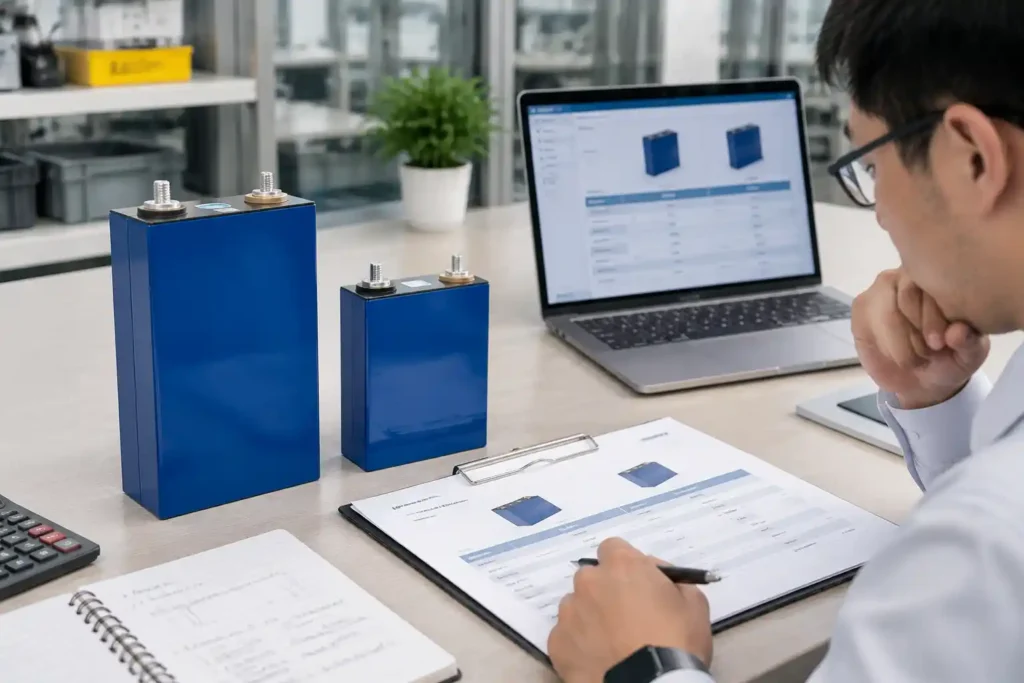
VoltCrave Power supplies 3.2V prismatic LiFePO4 battery cells for residential energy storage, commercial ESS modules, solar battery packs, and OEM battery projects.
The following examples show the published specifications of two LiFePO4 cell models.
| Product | Nominal Voltage | Capacity | Published Cycle-Life Reference |
|---|---|---|---|
| 3.2V LiFePO4 Prismatic Cell | 3.2V | 184Ah | 2,500 cycles |
| 3.2V LiFePO4 Prismatic Cell | 3.2V | 280Ah | 6,000 cycles |
Source: VoltCrave Power’s published product specifications. These are product-specific reference figures, not independently verified comparative test results.
For the complete specifications, see the 184Ah LiFePO4 Battery Cell and the 280Ah LiFePO4 Prismatic Cell.
The two products have different published cycle-life ratings. However, this difference does not establish that a larger-capacity cell automatically lasts longer.
Before comparing cycle-life figures, buyers should check several test conditions:
- End-of-life threshold: Whether the rating is based on a specified remaining capacity or SOH.
- Depth of Discharge: Whether both cells were tested across the same discharge range.
- Charging and discharging rates: Whether the same C-rate was used.
- Temperature: Whether testing took place under comparable environmental conditions.
- Test method: Whether the same voltage limits, procedures, and other testing requirements were applied.
The published figures should be evaluated as individual product specifications rather than treated as results from a controlled comparison.
The Battery Cells & Components category provides an overview of VoltCrave Power’s 3.2V prismatic LiFePO4 cells, with capacity options from 50Ah to 280Ah.
For projects requiring customized battery configurations, cell integration, or battery pack development, VoltCrave Power OEM/ODM Services provide support for project-specific design and manufacturing requirements.
FAQs
1. Why Do LiFePO4 Batteries Have a Longer Cycle Life Than Many Other Lithium-Ion Batteries?
LiFePO4 batteries benefit from the structural characteristics of their olivine cathode material. Its framework supports repeated lithium-ion insertion and extraction while maintaining relatively stable structural characteristics.
Actual cycle life also depends on cell design, manufacturing quality, and operating conditions.
2. Does the Olivine Structure Prevent LiFePO4 Batteries From Degrading?
No. The olivine structure contributes to cathode stability, but it cannot completely prevent battery aging.
Side reactions, active lithium loss, electrode degradation, and increasing internal resistance can still occur during long-term operation.
3. Can LiFePO4 Batteries Lose Capacity Even When They Are Not Being Used?
Yes. LiFePO4 batteries experience calendar aging even when they are not regularly cycled.
Storage temperature and SOC influence the rate of degradation, so battery lifespan is not determined by cycle count alone.
4. Do All LiFePO4 Batteries Have the Same Cycle Life?
No. Different LiFePO4 cells can have different cycle-life ratings because of variations in electrode materials, cell construction, manufacturing processes, and testing conditions.
The end-of-life threshold, temperature, charging rate, and discharge range must also be considered when comparing specifications.
5. Does a 6,000-Cycle Rating Mean a LiFePO4 Battery Will Last for 16 Years?
Not necessarily. A 6,000-cycle rating describes performance under specified cycling conditions, not a guaranteed calendar lifespan.
Actual service life depends on cycling frequency, operating conditions, storage conditions, and calendar aging. A battery may reach its practical end of life before completing its rated cycle count.
Need help matching this topic to a real battery project?
Send your target application, capacity range, certification market, and order plan. VoltCrave can recommend a practical product direction.