Comparing the 18650 vs 21700 for a custom pack is not a choice between a good cell and a better one. Both carry the same nominal voltage for a given chemistry, and the cell-level energy density gap is far narrower than most comparison pages suggest.
What actually changes is the pack: how many cells it takes, how many joints must be welded, how many channels the BMS has to watch, and how the cells fit inside the enclosure.
Start with the arithmetic. It settles most of the argument.
18650 vs 21700: what the model numbers mean
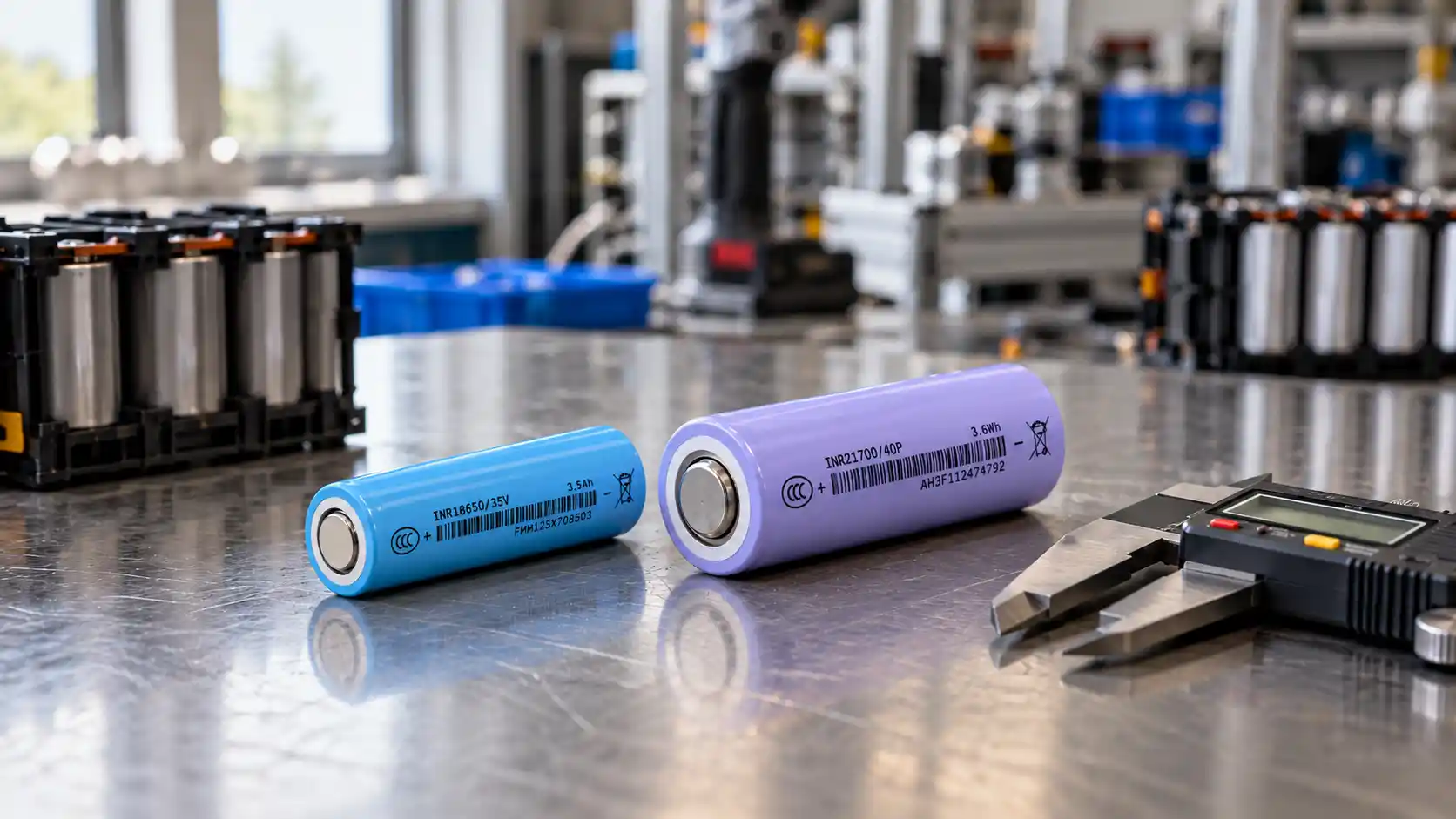
The name is a set of dimensions. The first two digits are the diameter in millimetres, the next two the length. An 18650 is 18 mm across and 65 mm long. A 21700 is 21 mm across and 70 mm long. The same convention runs through the 26650 and the 4680.
Both are cylindrical cells with a metal can, a jelly-rolled electrode assembly, and a top cap with a vent. Neither format implies a chemistry. An 18650 and a 21700 can both be built as NMC, NCA, or LFP, and the nominal voltage follows the chemistry rather than the can. A 3.6–3.7 V nominal cell is a nickel-based chemistry; an LFP cell in either format sits near 3.2 V nominal.
That distinction matters at the RFQ stage. “21700, 3.6 V, 5 Ah” and “21700, 3.2 V, 5 Ah” describe two different products with different cycle life, different charging profiles, and different BMS settings.
Capacity: the difference is in the volume, not the chemistry
A cylindrical cell’s volume is πr²h. Run the numbers:
- 18650: π × 9² × 65 ≈ 16,540 mm³, or about 16.5 cm³
- 21700: π × 10.5² × 70 ≈ 24,240 mm³, or about 24.2 cm³
The 21700 has roughly 46% more internal volume. Typical capacity ranges track that closely: 2,300–3,600 mAh for the 18650 and 4,000–5,000 mAh for the 21700. The extra capacity is mostly extra can. Measured as capacity per cell, the 18650 vs 21700 difference follows the volume closely; measured as Wh/kg, it almost disappears.
VoltCrave Power’s own published datasheets make the point better than any comparison chart. The company’s 18650 cell is rated up to 263 Wh/kg at 3,500 mAh. Its 21700 cell is rated 264 Wh/kg at 5,000 mAh. Two formats, 43% apart in capacity per cell, and effectively identical energy density.
| Parameter | 18650 | 21700 |
|---|---|---|
| Dimensions | 18 × 65 mm | 21 × 70 mm |
| Can volume | ~16.5 cm³ | ~24.2 cm³ |
| Typical capacity | 2,300–3,600 mAh | 4,000–5,000 mAh |
| Nominal voltage | Chemistry-dependent | Chemistry-dependent |
| Typical cell weight | ~45–50 g | ~68–70 g |
| Typical energy per cell | ~8–13 Wh | ~14–18 Wh |
| Wh/kg advantage | Baseline | Roughly 2–6% |
Pack builders who compare the two formats directly put the 21700’s Wh/kg gain in the single digits, varying with the manufacturer’s internal construction. Comparisons quoting “about 250 Wh/kg for 18650 versus 300 Wh/kg for 21700” are usually comparing a mid-grade 18650 against a top-grade 21700, not comparing one format against the other.
Capacity in Ah only becomes comparable once voltage is fixed, and the difference between Ah and kWh is exactly this: one is charge, the other is energy. A 5 Ah cell at 3.6 V holds 18 Wh; the same 5 Ah at 3.2 V holds 16 Wh.
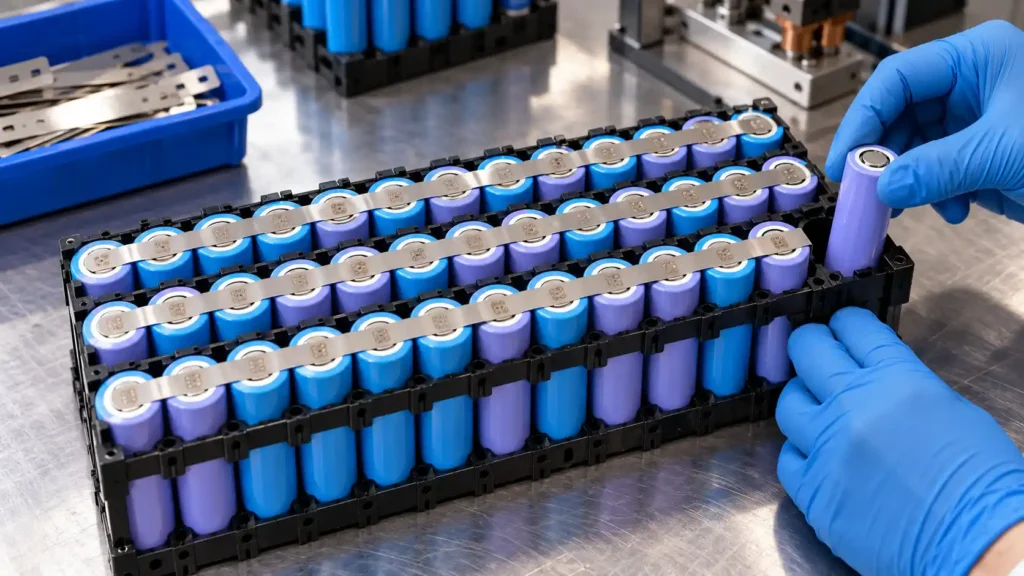
What the format does to pack architecture
Take a 48 V nominal, 100 Ah pack of about 4.8 kWh, built in a 13-series arrangement, which is the usual configuration for 48 V packs using 3.6–3.7 V cells. Series and parallel configuration is what turns a cell choice into a pack design.
Using the published capacities of the two VoltCrave Power cells above:
- 21700 at 5.0 Ah: 20 parallel strings → 13 × 20 = 260 cells
- 18650 at 3.5 Ah: 29 parallel strings → 13 × 29 = 377 cells
| 18650 build | 21700 build | |
|---|---|---|
| Series cells | 13 | 13 |
| Parallel strings | 29 | 20 |
| Total cells | 377 | 260 |
| Welded tab joints (2 per cell) | 754 | 520 |
| Pack cell mass | ~18.5 kg | ~17.9 kg |
| Cell volume occupied | ~6.2 L | ~6.3 L |
Two results are worth pausing on.
The cell volume is almost identical. 377 × 16.5 cm³ and 260 × 24.2 cm³ both land near 6.2–6.3 litres. The 21700 does not give you a smaller box for the same energy. It gives you the same box with 117 fewer cells inside it.
Pack mass barely moves either, around 3% here. The Wh/kg advantage is real but small, and it is easily consumed by a heavier enclosure or thicker busbar.
Where the 21700 wins clearly is part count. That is 234 fewer welded joints, 117 fewer cells to place, test, and trace. On a volume line that means less welding time, fewer chances of a cold joint, and a shorter end-of-line test. It is an assembly-cost advantage rather than a performance advantage, which is why the format took hold in power tools and e-mobility well before stationary storage.
What actually drives cost
In a straight 18650 vs 21700 cost comparison, cell price per Wh at equivalent grade is broadly similar; the can size does not set the price. The difference sits in everything around the cells.
- Fewer cells means less nickel strip, fewer welded joints, shorter harness runs, and fewer BMS sense wires.
- Fewer cells also means less placement labour and less handling per pack.
- Against that sits one-time tooling: new cell holders, a new welding jig, new test fixtures, and a revised BMS harness.
That trade sets the decision at low volume. If an 18650 holder, jig, and harness already exist, changing format is a retooling project with a fixed cost that has to be recovered across units. At pilot quantities the retooling usually outweighs the per-unit saving. At volume the reverse is true, and the saving per pack compounds. The break-even is a straightforward calculation: retooling cost divided by per-unit saving, against the expected volume. Whether custom battery pack manufacturing is worth re-tooling for is a question about that volume, not about the cells.
When the 21700 is the better choice
- Volume production, where joint count and assembly labour dominate unit cost
- High-drain packs, where fewer parallel strings mean fewer parallel paths and lower interconnect resistance
- A fixed enclosure volume where you want the most kWh inside the existing box
- Designs where fewer cells simplify traceability and end-of-line testing
When the 18650 is still the better choice
- Thin packs. An 18 mm cell allows a two-cell stack of roughly 40 mm; a 21700 stack is closer to 46 mm. In a slim enclosure that dimension decides the design.
- Low or pilot volumes, where the existing tooling already fits and the 18650 catalogue is broader.
- Drop-in replacement, where holders, jigs, and BMS harness already exist.
- Retrofits where a 21 mm cell will not physically fit.
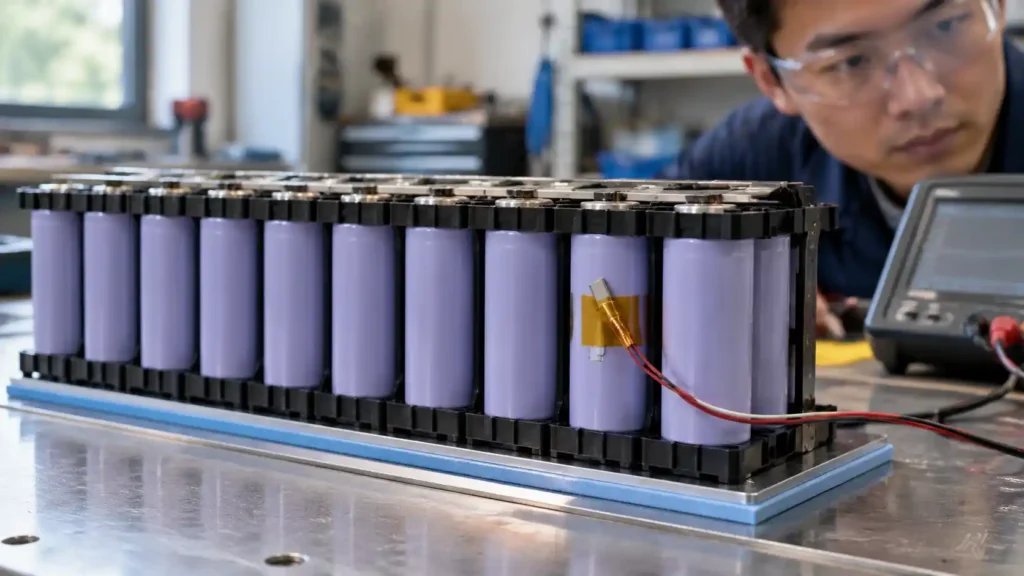
Heat, spacing, and safety
Cylindrical geometry scales badly for cooling. As diameter grows, surface area per unit of stored energy falls, so a 21700 has less cooling surface relative to the heat it can produce. Pack builders note that 21700 cells can run hotter even though internal resistance is lower.
Why a wider cell cools less efficiently
Surface area rises more slowly than volume as the can grows in both diameter and length. That is why the 21700’s cooling path is relatively longer, and why the same thermal load produces a higher cell temperature in a denser module. Spacing between cells carries more weight in a 21700 pack than in an 18650 pack of equivalent energy.
What that changes in the pack design
Fewer cells means fewer hot spots and fewer joints that can loosen, but each cell now holds roughly 40% more energy, so a single-cell thermal event releases more. Cell spacing, thermal interface material, and BMS temperature thresholds have to be set for the format actually chosen, not copied from the previous pack.
Cylindrical cells are built to vent at the top cap. The pack should give that vent a path out, and should not trap gas in a sealed enclosure without a pressure-relief provision.
Chemistry is a separate decision from format
This is where a format comparison can lead a buyer into an expensive mistake.
The 18650-versus-21700 question is about the can. The chemistry question is about cycle life, thermal stability, cost per kWh, and voltage. For stationary storage that cycles daily, whether home backup, peak shaving, or commercial and industrial sites, an LFP cell rated for several thousand cycles is normally the better economic choice than a high-energy nickel-based cylindrical cell rated at around a thousand.
Both VoltCrave Power cells above are rated at 800–1,000 cycles. That is a sensible figure for an e-mobility or power-tool pack and a poor fit for a battery that cycles every day for a decade. Choosing the 21700 format does not make a pack suitable for stationary storage. Choosing LFP, and the right cycle rating for the duty cycle, does.
For stationary systems, prismatic LFP is the more common format because it stacks efficiently into rack modules and is easier to cool and service at module level.
What to put in the RFQ
A format name is not a specification. A usable request should state:
The specification lines
- Format and model designation, for example 21700
- Chemistry and nominal voltage
- Rated capacity and nominal energy per cell
- Continuous and peak discharge current, quoted per cell
- Standard and maximum charge rate
- Cycle life, with its test conditions: depth of discharge, C-rate, temperature, and the capacity-fade threshold that defines end of life
- Operating and storage temperature range
- Cell mass and dimensions
- Pack configuration: series count, parallel count, and the BMS specification, including topology and communication protocol
- Cell holder, welding, and insulation requirements
- Transport and safety documentation: UN38.3 test summary, IEC 62133-2 report, and a UL 1642 cell report where the US market requires it
- Batch traceability and a sample evaluation plan
The line buyers leave vague
Cycle life is the one buyers most often leave vague. “1,000 cycles” means very little without the depth of discharge, the C-rate, and the fade threshold behind it. Ask for the test conditions in writing, then compare like with like.
FAQs
Are 18650 and 21700 batteries interchangeable?
Mechanically, no. A 21700 is 3 mm wider and 5 mm longer and will not fit a holder machined for 18650 cells. Electrically they are not drop-in either: the series and parallel count, the BMS current limits, and the charger profile are all built around one specific cell.
Can you charge a 21700 in an 18650 charger?
Not safely. Most 18650 chargers have bays sized for an 18 mm cell and current limits set for a smaller capacity. A 21700 needs a charger rated for its dimensions and its charge current.
Is 21700 better than 18650?
Neither is better in general. The 21700 wins on part count, assembly cost, and energy per cell. The 18650 wins on thin-pack geometry, catalogue availability at low volume, and retrofit compatibility.
Which format has higher energy density?
The 21700, but only marginally, typically a few percent at cell level. Its much larger capacity per cell comes mostly from 46% more volume rather than from better Wh/kg.
Why do some EV makers still use 18650?
Because a validated pack design, an existing welding line, and a qualified cell supply are expensive to replace. Format migration is an engineering and commercial decision, not a purely technical one.
Summary
The 18650 vs 21700 decision comes down to four numbers, and none of them is energy density. Check the enclosure’s internal dimensions, the cell count the target kWh requires at your series count, the continuous current each cell must carry, and the cycle life your duty cycle actually needs.
If the pack has to stay thin, or the holders and welding jig already exist, the 18650 is normally the lower-risk answer. If annual volume is high and the enclosure has room, the 21700 cuts part count, welding time, and assembly cost without improving Wh/kg in any meaningful way. Pull the four numbers from the cell datasheet and the enclosure drawing before the format is fixed, and the rest of the specification follows from them.
Need help matching this topic to a real battery project?
Send your target application, capacity range, certification market, and order plan. VoltCrave can recommend a practical product direction.