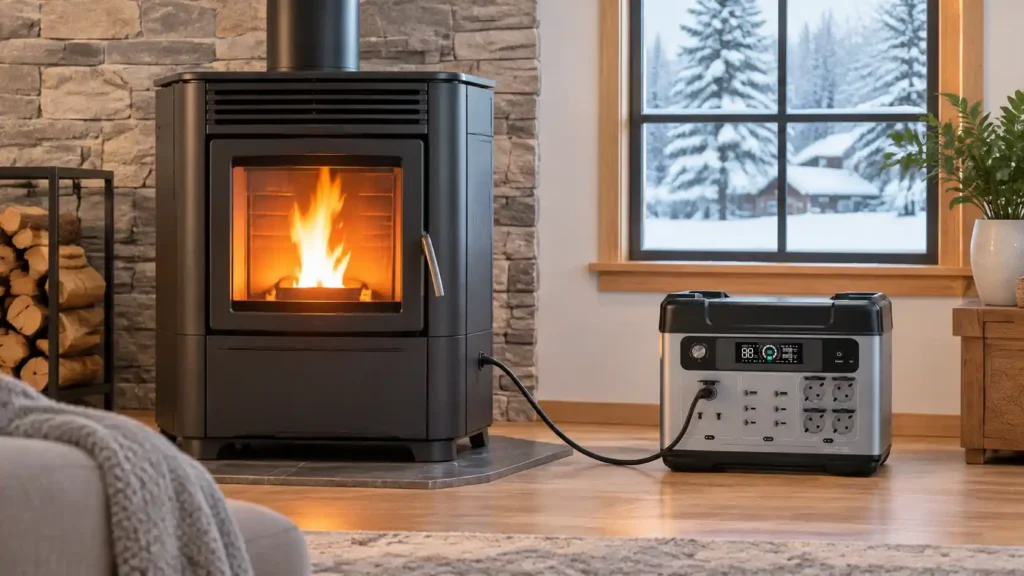
A pellet stove burns pellets, but it can’t run without electricity. The igniter, auger, blowers and control board all need power, so when the grid goes down the stove goes down with it, even with a full hopper. A battery backup solves that only if it fits two things: your stove’s electrical requirements and the length of outage you actually expect.
This guide takes the numbers in the order you’ll need them. First what the stove draws, then how much energy an outage takes, what the backup must match, and how to test the setup before winter. We make portable power stations at VoltCrave Power, so we use two of our models as worked examples. They are examples only. Your stove’s owner’s manual has the final say.
Why a Pellet Stove Stops When the Power Goes Out
Five electrical parts keep a pellet stove running:
- Igniter: heats up to light the pellets on a cold start.
- Auger motor: feeds pellets from the hopper into the burn pot.
- Combustion (exhaust) blower: moves air through the burn pot and pushes exhaust out.
- Convection fan: blows heated air into the room.
- Control board and thermostat: run the start-up sequence and adjust the feed rate.
Cut the power and the pellets stop moving, the airflow stops and the control logic goes dark. A full hopper doesn’t change that.
That’s why a backup’s first job is a controlled stop, not extra heat. Your manual describes what the stove does after a shutdown command, and the backup should be able to cover that sequence. Heating through the outage comes second, and it’s the part that depends on how big a battery you buy.
A backup also won’t fix problems that exist on grid power, like a dirty burn pot or a blocked vent. If the stove misbehaves with the grid up, sort that out first.

How Many Watts Does a Pellet Stove Use? Startup vs. Running Load
There is no single wattage for pellet stoves. You’ll see “100 watts” repeated across the web, but the real figure depends on the stove, the heat setting, the blower speed and the igniter design. It also changes through the burn:
- Cold startup: igniter, blowers, auger and controls run together. This is usually the peak.
- Steady burn: the igniter is off, so the load is typically lower.
- High heat: a higher feed rate and faster blowers can pull more than a low setting.
- Shutdown: fans and controls may keep running while the fire winds down.
Owner’s manuals show how much stoves differ. Both of these list a US rating of 115 V, 60 Hz:
- The Harman Advance manual gives 4.2 A at start and 2.8 A running.
- Quadra-Fire’s Castile pellet stove and insert manuals give 4.1 A at start and 1.1 A running.
The start currents are almost identical. The running currents differ by more than a factor of two. Multiply amps by volts and you get roughly 480 VA at start and 320 VA running for the Harman, and 470 VA and 130 VA for the Castile. Those are VA, not watts, and nameplate figures are limits, not averages. A plug-in watt meter will tell you what your own stove draws at startup, at steady burn and at shutdown.
Manuals also set output requirements. Quadra-Fire’s Castile pellet insert manual (2011 edition) says to have at least 600 W available from a generator, or at least 800 W from an inverter, during the start cycle (manual text). Harman’s owner’s manuals, including the XXV, carry a note that some generator or battery backup systems may not be compatible with the stove’s micro-processor electronics. They tell owners to consult the power supply manufacturer.
So the two numbers do two different jobs. The manual’s electrical requirement decides whether a backup is strong enough. Your measured watts decide how long it lasts.
How Big a Battery Do You Need? Match Capacity to Outage Length
Start with the outage you want to cover. Energy in watt-hours (Wh) is average watts multiplied by hours. Output in watts (W) is a separate spec: a station rated at 1,800 W does not store 1,800 Wh.
Table 1: Stove energy needed (Wh) = average load × hours
| Average stove load | 4 hours | 8 hours | 12 hours |
|---|---|---|---|
| 100 W | 400 Wh | 800 Wh | 1,200 Wh |
| 150 W | 600 Wh | 1,200 Wh | 1,800 Wh |
| 200 W | 800 Wh | 1,600 Wh | 2,400 Wh |
| 250 W | 1,000 Wh | 2,000 Wh | 3,000 Wh |
These loads are examples, not measurements of any particular stove. Swap in your own meter readings.
A battery never delivers 100% of its rated capacity to the stove. Inverter losses take a share, and you’ll want a margin left for the shutdown cycle. For planning, we assume 85% of rated capacity is usable. That’s our planning assumption, not a product spec, and you can adjust it.
Here’s what that looks like with two VoltCrave Power models. This is arithmetic, not lab testing:
- P1000 PLUS (1,024 Wh): about 870 Wh usable. That’s roughly 8.7 hours at 100 W, 5.8 hours at 150 W and 3.5 hours at 250 W.
- P2001 Plus (2,048 Wh): about 1,740 Wh usable. That’s roughly 17.4 hours at 100 W, 11.6 hours at 150 W and 7.0 hours at 250 W.
Don’t forget ignition. If a stove drew 450 W for a 10-minute ignition (a hypothetical figure), that’s 75 Wh. It’s small against hours of burning, but repeated restarts add up.
Reading the table against outage length: a 1 kWh-class battery suits a short outage or a safe shutdown. A full 8-hour night at 150 W needs 1,200 Wh before losses, which puts you in the 2 kWh class. Anything beyond a day needs a way to recharge.
What Your Backup Must Match: Output, Pure Sine Wave and Switchover
Capacity only matters if the station can start the stove. Check three specs.
Output. The rated AC output and surge rating must cover the manual’s start requirement with headroom. The P1000 PLUS is rated at 1,800 W with 3,600 W surge. The P2001 Plus is rated at 2,400 W with 4,800 W surge. Both sit well above the 800 W inverter figure in the Quadra-Fire example, but the figure that counts is the one for your stove.
Waveform. Both list a pure sine wave inverter. A pellet stove combines motors with electronic controls, so pure sine wave is the safer default unless your manual says otherwise.
Switchover. Both list an EPS function with switching time under 10 ms. The stove stays plugged into the station and the station stays plugged into the wall, so the stove rides through the change. A fast transfer doesn’t guarantee that your stove’s control board will accept it, so it needs a test. We haven’t published pellet-stove test results for these models, so we don’t claim compatibility with any specific stove.
A word on computer-style UPS units. Many are built to bridge short interruptions so electronics can shut down cleanly. Capacity, waveform and start-up capability vary widely. Use one only after checking it against your stove manual.
If your manual tells you to ask the power supply maker about compatibility, do it. Send them your stove’s model and electrical rating.
Power Station, UPS or Generator: Which Backup Fits Which Outage
Table 2: Backup options compared
| Option | Strength | Limitation | Best for |
|---|---|---|---|
| Computer-style UPS | Automatic transfer, small footprint | Capacity, waveform and startup capability vary | Brief interruptions, if verified against the manual |
| Backup approved by your stove maker | Matched to your stove | Model-specific; check capacity and what the maker lists | Owners who want the maker’s endorsed setup |
| Portable power station with EPS | Large Wh capacity, pure sine wave, quiet, rechargeable | Must be tested with your stove; weight; temperature limits | Overnight and multi-hour outages |
| Fuel generator | Runs as long as there’s fuel | Noise, fuel storage, carbon monoxide; outdoors only | Long outages where outdoor placement is practical |
| Small battery for shutdown only | Simplest and smallest | No heat | Short outages, if your manual’s shutdown sequence allows |
Match the option to the outage. For a few hours, a small system that gets the stove through a controlled stop may be enough. For an overnight outage, size a power station from Table 1. For several days, plan the recharge first: solar, wall power when it returns, or a generator running outdoors.
If you use a fuel generator, the EPA says to keep it outdoors at least 20 feet from any building, and never in a garage, on a porch or in a basement. A battery station avoids exhaust entirely, which is a large part of why people choose one.
Pellet Stove Power Outage Plan: Set Up and Test Before Winter
Run this test on a calm day, not in the middle of a storm:
- Read the manual. Find the electrical rating, any backup requirements and the shutdown sequence.
- Charge the station to full.
- Cold-start the stove on station power. Watch for overload alarms, a failed ignition, resets or unusual fan noise.
- Simulate an outage. With the stove running through the station, cut the wall supply following the station’s instructions. The stove should keep running normally.
- Restore wall power. Confirm a normal transfer back, then a normal shutdown.
While you’re there, record your stove’s watts at each stage.
Cold weather matters. The P2001 Plus lists an operating temperature of 0–40°C (32–104°F). Both product pages list a low-temperature charging lock among their BMS protections. The P1000 PLUS page doesn’t state an operating range, so ask before you assume. Keep the station indoors in a heated space, not in an unheated garage or on a porch. Our guide on how cold weather affects LiFePO4 charging covers the charging limits in more detail.
Placement and wiring. Choose a dry, ventilated spot clear of the stove’s hot surfaces, exhaust path and ash. The P1000 PLUS weighs 12 kg and the P2001 Plus 22 kg, so decide where it will sit before you need it. Plug the stove straight into the station’s AC outlet. Never backfeed a wall outlet or panel. Permanent home integration is a job for a licensed electrician.
Alarms. A pellet stove burns fuel, so keep working smoke and carbon monoxide alarms in the home.
Recharging. Both models accept up to 500 W of MPPT solar input. That’s an input limit, not daily output, and short, cloudy winter days produce far less. On wall power, the P1000 PLUS accepts up to 1,200 W and the P2001 Plus up to 1,800 W. Our P2001 Plus page says it can reach 80% in about an hour under suitable conditions. Charge to full when a storm is forecast.
Choosing a Pellet Stove Battery Backup: A Checklist (and Where VoltCrave Power Fits)
Before you buy, confirm:
- Your stove model, electrical rating and backup requirements from the manual
- Measured watts at startup, steady burn and shutdown
- The outage length you want to cover, converted to Wh with a margin
- Rated AC output and surge above the manual’s start requirement
- Pure sine wave output
- Transfer behavior verified with your own stove
- The station’s operating temperature range, and a heated place to keep it
- A recharge plan: wall, solar or both
VoltCrave Power has made lithium batteries since 2011, with production bases in Dongguan, Hunan and Thailand. Our portable power stations range from 200 W camping units to 13,500 W industrial stations. Two models fit the sizing examples above:
- P1000 PLUS: 1,024 Wh LiFePO4, 1,800 W rated and 3,600 W surge, pure sine wave, EPS under 10 ms, 4,000 cycles to 80% of original capacity, 12 kg.
- P2001 Plus: 2,048 Wh LiFePO4, 2,400 W rated and 4,800 W surge, pure sine wave, EPS under 10 ms, 0–40°C operating temperature, 22 kg.
Certification documents vary by model and market, so ask for the files that apply to the model you’re considering. If you’re a dealer or brand building a pellet-stove backup offer, we also supply OEM/ODM versions.
FAQs
Can I run a pellet stove from a car battery and an inverter?
Some owners do it with a deep-cycle battery and a pure sine wave inverter, but you’re sizing and wiring the system yourself, including fusing and cable gauge. The inverter still has to meet your manual’s start requirement, such as the 800 W figure in the Quadra-Fire example. A car’s starter battery isn’t built for long, deep discharges. A power station arrives with these parts already matched.
Will my stove restart by itself when the grid comes back?
It depends on the model, and your manual is the place to look. Don’t assume. Check it during step 5 of the test above, when you restore wall power.
Can I leave the stove plugged into the power station all season?
EPS mode exists for exactly this kind of pass-through use. Before you rely on it, read the station’s manual for continuous-use and ventilation guidance, keep it within its operating temperature range, and run the full test.
Is it safe to keep a power station near the stove?
Keep it dry and ventilated, and away from the stove’s hot surfaces, exhaust path and falling ash. Follow the clearance guidance in the station’s manual.
How much capacity do I need if I only want a safe shutdown?
Far less than for heating. The formula is measured watts × shutdown minutes ÷ 60. As a hypothetical, 150 W for 20 minutes is 50 Wh. Measure your own shutdown and keep a margin.
Conclusion
Three steps keep a pellet stove backup honest. Check your manual’s start requirement, size the battery to the outage you want to cover, and test the whole setup before the first storm. Do those and you’ll know your stove will keep warm when the grid goes quiet, or at least shut down cleanly. For stove-specific questions about our models, VoltCrave Power’s engineers are the right people to ask.
Need help matching this topic to a real battery project?
Send your target application, capacity range, certification market, and order plan. VoltCrave can recommend a practical product direction.