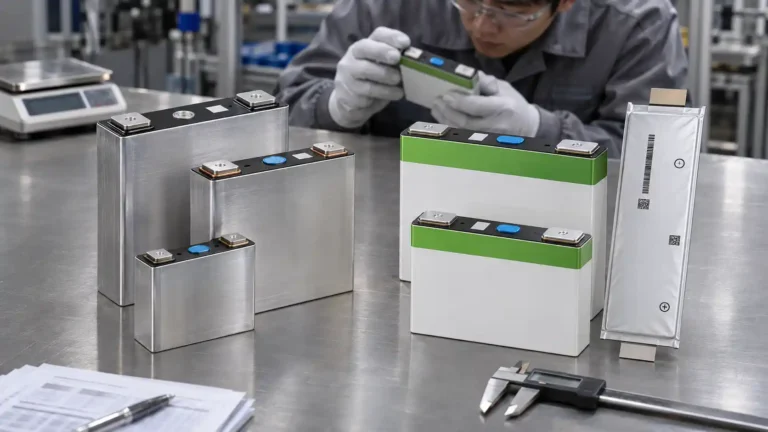
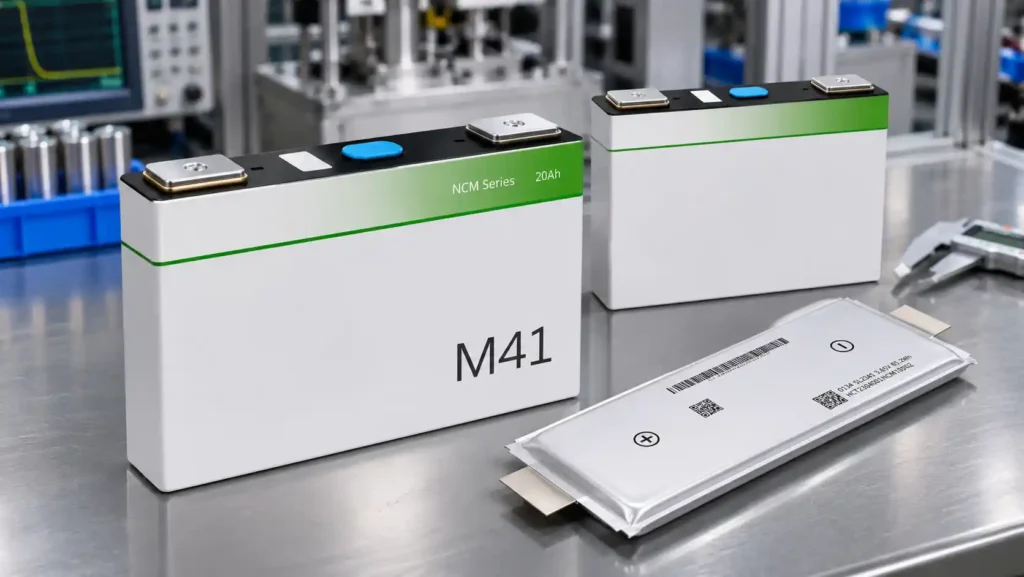
An NCM battery is a lithium-ion battery whose cathode is made from lithium nickel cobalt manganese oxide. NCM batteries are widely chosen for electric vehicles, forklifts, e-bikes and other products where weight and space matter, because the chemistry stores more energy per kilogram than lithium iron phosphate (LFP). This guide explains how the chemistry works, which numbers on an NCM cell datasheet actually matter, and how to compare NCM with LFP before you source cells.
What Does NCM Stand For?
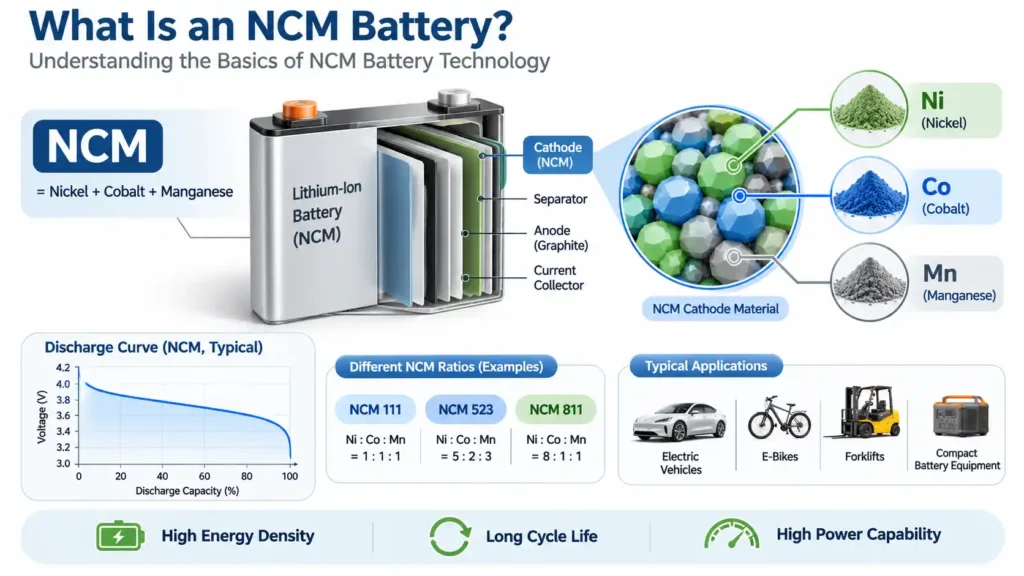
NCM stands for nickel, cobalt, manganese, the three transition metals blended in the cathode. You will also see the same chemistry written as NMC. The two names refer to the same family of materials, and the order of the letters is mostly a regional habit. Even on VoltCrave Power’s own product pages you can find both spellings, for example the M11 listed as an “NCM battery cell” and the D25 listed as an “NMC pouch cell.”
Within the family, the ratio of the three metals changes the behavior. A cathode labeled 811 has nickel, cobalt and manganese in an 8:1:1 ratio. As a general rule, more nickel raises capacity and energy density, while a lower share of cobalt reduces cost and cobalt dependence but can make the material less stable. That trade-off is why two “NCM” cells can have very different datasheets.
NCM Battery Voltage: Nominal Voltage and Discharge Curve
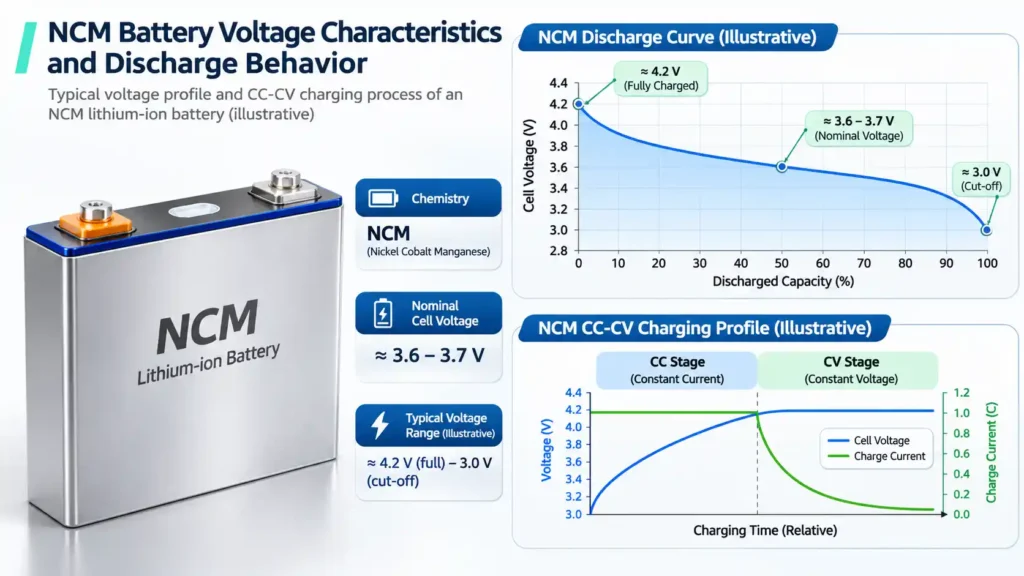
A lithium-ion discharge curve plots cell voltage against how much capacity has been drawn. For NCM cells the curve slopes gradually downward as the cell empties, instead of sitting on a long flat plateau the way LFP does. In practice this means a battery management system can estimate state of charge from voltage more easily on NCM than on LFP.
Real datasheets give you the anchor points:
- The M21-INP58P lists a nominal voltage of 3.62V.
- The D25 lists 3.65V nominal with an operating voltage range of 2.50V to 4.20V.
When you read any li-ion battery discharge curve from a supplier, check three things: the discharge current (rate) the curve was measured at, the temperature, and the cut-off voltage. A curve measured at 1/3C and room temperature will not match what you see in a high-power application.
The Charge Window
The lithium ion charge curve for NCM follows the usual constant-current, then constant-voltage pattern, and the upper limit is the key number. On the D25 that limit is 4.20V, with a standard charge current of 17.3A (1/3C). Charging is also temperature-limited: the D25 is specified for charging from -20°C to 55°C, while its discharge range is wider, -30°C to 55°C. Always confirm the charge limits for the exact cell you plan to use, because they differ by model.
Energy Density of NCM Cells
Energy density is the main reason to choose NCM. The D25 pouch cell lists 246Wh/kg, with a minimum energy of 182Wh in a 740g cell. You can verify that: 182Wh ÷ 0.74kg ≈ 246Wh/kg.
For the M21-INP58P, the page gives 58Ah, 3.62V and 860 ± 15g. Multiplying 58Ah by 3.62V gives roughly 210Wh, which works out to about 244Wh/kg. This is our own calculation from the listed figures, not a number printed on the datasheet.
Form factor matters as well. The D25 is a slim pouch cell at 301.5 × 99.7 × 16.8mm, while the M21-INP58P is a compact rectangular cell at 95.21 × 148.20 × 26.72mm. Choosing between them is partly a question of how your pack is laid out.
NCM Battery Cycle Life
Cycle life tells you how many charge-discharge cycles a cell completes before capacity falls to a defined level. Listed values on VoltCrave Power’s NCM cells include:
| Cell | Listed cycle life |
|---|---|
| M11 114Ah | ≥1500 cycles |
| D25 50.5Ah | 1600 cycles at SOH ≥80% |
| M21-INP58P 58Ah | 2700 cycles (3000 cycles at 25°C) |
Treat these as starting points rather than a ranking. Cycle-life figures depend on depth of discharge, charge rate and temperature, and not every product page states the full test condition. Before you compare lithium ion cycle life between suppliers, ask for the test conditions behind the number.
Advantages of NCM Batteries
The main lithium-ion battery advantages of the NCM chemistry for B2B products are:
- High energy density. More energy in less weight, as shown by the 246Wh/kg D25.
- Compact formats. Slim pouch and compact prismatic cells make it easier to fit limited space.
- Wide temperature capability on some cells. The D25 is specified to discharge down to -30°C.
- Design flexibility. VoltCrave Power lists custom specifications for the M11, M21-INP58P and D25.
Pros and Cons of NCM Lithium-Ion Batteries
The same chemistry has real drawbacks. NCM generally has lower thermal stability than LFP, so pack design and the BMS carry more responsibility. It also depends on nickel and cobalt, which exposes cost and supply to those markets. And the working window can be narrow: the M11 is specified for 0°C to 35°C and the M21-INP58P for 0°C to 45°C, so cold or hot environments need checking.
Cost per kWh
Lithium-ion battery cost per kWh depends mainly on cathode materials, cell format, volume and certification scope. Nickel and cobalt prices move, so quotes for NCM cells can shift more with raw materials than quotes for LFP. We do not publish a generic price here, because a useful figure needs your cell model, quantity and delivery terms. Request a quote against a specific datasheet instead.
NCM vs LFP: Which Chemistry Fits Your Project?
Using figures from VoltCrave Power’s own product pages (different cells and test conditions, so read this as a guide, not a head-to-head test):
| NCM (examples) | LFP (280Ah cell) | |
|---|---|---|
| Nominal voltage | 3.62V (M21), 3.65V (D25) | 3.2V |
| Energy density | 246Wh/kg (D25) | about 169Wh/kg* |
| Cycle life (listed) | ≥1500 to 2700 cycles | 6000 cycles (reference) |
| Typical fit | Electric vehicles, forklifts, e-bikes, weight-sensitive packs | Energy storage systems, high-capacity packs |
*Calculated from the listed 280Ah × 3.2V = 896Wh and 5.3kg weight.
The pattern is simple. Choose NCM when weight and volume limit the design. Choose LFP when cycle life and stationary storage matter more. You can browse the LFP options on the battery cells & components page.
Where NCM Batteries Are Used
Based on the applications listed for these cells:
- Electric vehicles and electric forklifts. The M11 114Ah NCM battery cell is listed for both, with up to 8 cells per module.
- E-bikes, scooters, wheelchairs and forklifts. The M21-INP58P 58Ah NCM cell lists these applications alongside electric vehicles.
- Slim, space-constrained packs. The D25 50.5Ah NMC pouch cell is listed for e-bikes and scooters, electric vehicles and solar energy storage systems.
NCM Cell Safety: UL 1642 and Other Documents
For cell sourcing, certifications are part of the RFQ. UL 1642 is the safety standard for lithium cells, and it is cell-level, not system-level. IEC 62133-2 covers the safety of sealed secondary lithium cells and batteries, and UN38.3 covers the transport tests required to ship lithium batteries.
VoltCrave Power’s NCM product pages show a UL 1642 cell component document and state clearly that it is not a certification of a complete energy storage system. They also note that certification availability varies by product model and target market. The D25 spec table lists CE, RoHS, UN38.3 and MSDS.
What to Check Before You Source NCM Cells
- Capacity and nominal voltage for your pack design.
- Voltage window, including charge and discharge limits.
- Charge and discharge current, listed in C-rate and amps.
- Cycle life and its test condition (depth of discharge, temperature, end-of-life threshold).
- Temperature ranges for charge and discharge separately.
- Cell dimensions and weight, to check fit and Wh/kg.
- Certification documents that match your model and target market.
FAQs
Is an NCM battery the same as an NMC battery?
Yes. Both names describe lithium nickel cobalt manganese oxide cathodes.
Is NCM better than LFP?
Neither is better in every case. NCM offers higher energy density; LFP typically offers longer listed cycle life and is the usual choice for stationary storage.
How many cycles does an NCM battery last?
It depends on the cell and test conditions. VoltCrave Power’s listed NCM cells range from ≥1500 to 2700 cycles.
Can NCM batteries be customized?
VoltCrave Power lists customized specifications for its NCM cells according to project requirements.
Choosing NCM Cells for Your Battery Project
An NCM battery is a strong fit when weight, space and energy per kilogram drive your design, and a weaker fit when long cycle life or a wide temperature window comes first. The most reliable way to decide is to compare datasheets for the cells you are considering, read the test conditions behind each figure, and match the voltage window and charge limits to your BMS. If you are weighing NCM against LFP for a new pack, the engineers at VoltCrave Power are happy to talk through your target voltage, capacity, format and application, so you can narrow the options before you commit to samples.
Need help matching this topic to a real battery project?
Send your target application, capacity range, certification market, and order plan. VoltCrave can recommend a practical product direction.