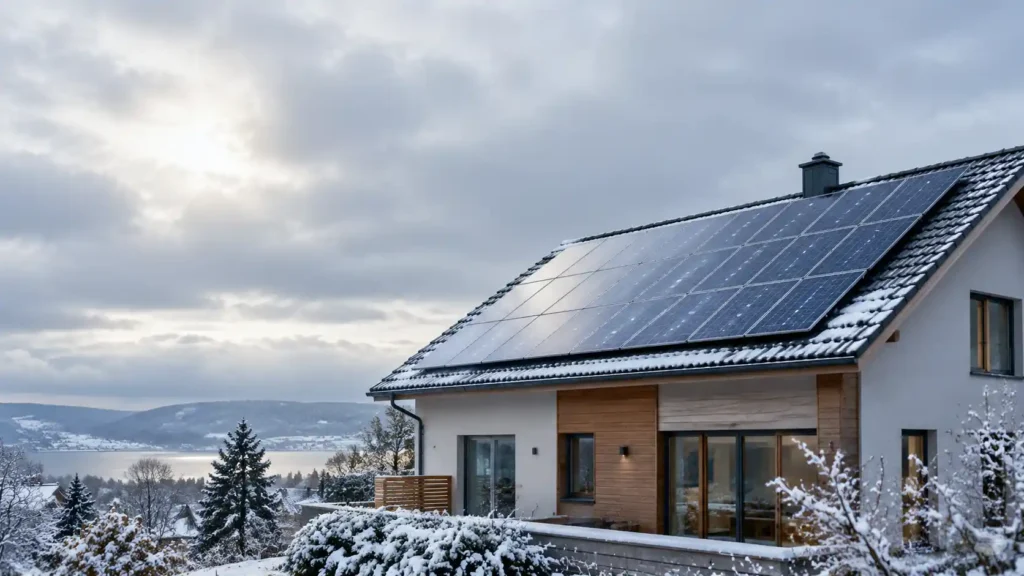
Do solar panels work on cloudy days? Yes, and the useful part of the answer is the number attached to it: a panel under thick overcast makes roughly 10 to 25% of what it makes under a clear sky, and a panel under a bright, thin cloud layer can hold 50% or more.
That is the short answer. The longer answer explains why the same question gets a different number from a homeowner in Manchester, an installer in Sydney and a distributor in Dubai, and why a system that looks broken in January is usually behaving exactly as designed.
Do solar panels work on cloudy days? The short answer
A solar panel is a current source driven by photons, not by heat or by direct sun. Any light that reaches the cells frees charge carriers, including the diffuse light that fills a grey sky. What changes under cloud is the intensity of that light, and module current scales almost linearly with it.
At 1,000 W/m², the 550W module in the VoltCrave Power range produces its rated 550W. At 300 W/m², roughly the brightness of a bright overcast day, it produces about 165W. At 100 W/m², a dark rain cloud, about 55W. The voltage holds up better than the current, which is why the inverter keeps tracking long after the output has collapsed.
Three practical consequences follow, and they matter more than the headline percentage:
- Output never reaches zero under cloud, but it can fall below what the inverter needs to run.
- The annual energy lost to cloud is smaller than the daily shock suggests, because most cloudy hours are marginal hours.
- A system designed only on clear-sky numbers will look oversized in June and undersized in December.
So do solar panels work on cloudy days strongly enough to matter? At 55W, the answer is yes for a battery charger and no for an air conditioner. That gap is the whole story of this article.
What the data says about cloudy skies
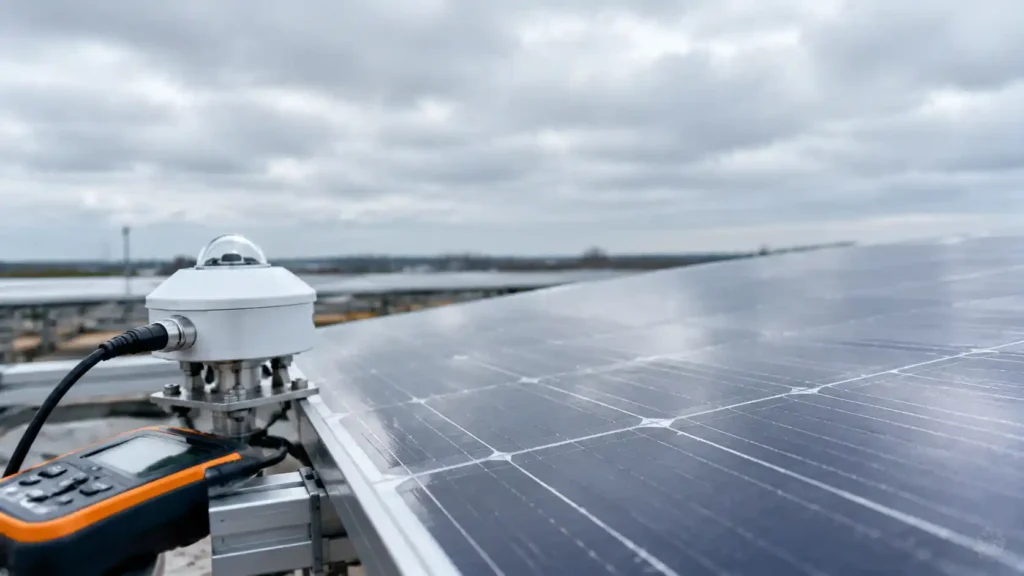
“Cloudy” is not one condition. It runs from a thin cirrus haze that costs 10% to a storm cell that costs 95%, and a monthly average hides both. The cleanest way to see the range is to compare the irradiation a location actually receives against what it would receive under a clear sky.
The table below uses NASA POWER climatology, which reports both figures on a horizontal plane, for five cities in different climates. Values are daily averages in kWh/m²/day.
| City | December all-sky | December clear-sky | All-sky share | Winter diffuse share | June all-sky |
|---|---|---|---|---|---|
| Munich | 0.81 | 1.47 | 55% | 61% (December) | 5.69 |
| London | 0.66 | 1.14 | 58% | 55% (December) | 5.30 |
| Dubai | 3.71 | 4.12 | 90% | 40% (December) | 7.35 |
| Singapore | 4.15 | 6.20 | 67% | 60% (December) | 4.41 |
| Sydney | 2.36 (June) | 3.18 (June) | 74% (June) | 40% (June) | 6.56 (December) |
Two numbers in that table do most of the work. The all-sky share tells you what cloud costs: 45% of the available irradiation in Munich in December, 10% in Dubai, 26% in Sydney in June. The diffuse share tells you how much of the remaining light arrives from the whole sky rather than from the sun’s disc: 61% in Munich in December, 40% in Dubai, 40% in Sydney in June.
The annual picture is gentler than the December one. Over a full year, Munich receives 69% of its clear-sky irradiation and London 65%, while Dubai receives 94%. Cloud is a seasonal tax, not a permanent one.
Why diffuse light is not as useless as it looks
Diffuse light arrives from every direction, so a panel does not need to face the sun to collect it. In a cloudy December that narrows the gap between a south roof and an east-west split, because most of the light is coming from the whole sky. It does not close the gap: the low winter sun still rewards a south-facing plane, and an east-west split loses more in December than it does across the year. What the split buys is a longer, flatter production window, which matters on a day when a single cloud can erase the two hours a south array depends on.
Diffuse light is also blue-shifted relative to direct sun. For crystalline silicon the spectral effect is small, a percent or two either way depending on the module, and not something to design around. It is one reason a grey day delivers slightly more than a linear guess from lux would suggest, but no more than that.
What diffuse light does not do is concentrate. There is no optical gain to be had from tilt, tracking or mirroring under an overcast sky, so a tracker earns nothing on a fully grey day. That is the day a fixed array catches up.
Winter is two effects pulling in opposite directions
Winter reduces the light and improves the conversion. Both are real, and the first one wins by a wide margin in northern latitudes.
Munich’s December irradiation, 0.81 kWh/m²/day, is 14% of its June figure. London’s is 12%. Sydney, in the southern hemisphere, sees its winter month at 36% of its summer month. Those ratios are set by sun angle and day length, not by temperature, and no module technology changes them.
Conversion efficiency moves the other way. A crystalline module is rated at 25°C cell temperature, and a cell in full summer sun sits far above that, often near 60°C. In winter the same panel might run at 0°C.
The cold bonus, quantified
Using a typical power coefficient of −0.35%/°C, which must be replaced with the figure on the actual module datasheet:
- At a 0°C cell, the module makes about 8.8% more than its 25°C rating.
- At a 60°C cell, it makes about 12.3% less.
- For the same irradiance, a winter panel therefore delivers roughly 24% more than a summer panel.
That is a genuine effect, and it is why cold, bright February mornings produce the highest instantaneous readings of the year. It is also why the effect is invisible in the monthly bill: a 24% gain applied to 14% of the June irradiation is still a small number.
| Condition | Cell temperature | Power vs 25°C rating |
|---|---|---|
| Winter, bright, low sun | 0°C | +8.8% |
| Spring, clear | 25°C | 0% |
| Summer, clear | 60°C | −12.3% |
| Winter vs summer, same irradiance | 0°C vs 60°C | +24% |
Snow, frost and a lower sun
Snow is the one condition that does take output to zero. A covered panel produces nothing until the snow slides or melts, and a roof at a shallow pitch can hold it for days. Steeper mounting sheds faster, and a dark panel warms and clears from the bottom up once a strip is exposed.
Frost is a different case. A thin frost layer costs a few percent until the sun burns it off, and scraping it risks the coating and the cells. Do not.
The lower winter sun also changes shading. A tree, a chimney or a neighbouring roof that clears the array in June can cut into it in December, because the sun’s arc is lower and shadows are longer. Row-to-row spacing designed on a June sun will shade the back row all winter. This is one of the few winter effects that is entirely under the designer’s control, and it is usually the first thing to check when a customer reports a sudden December drop.
What this changes in a system design
The seasonal swing is not a reason to avoid solar. It is a reason to design for the worst month rather than the average one, and to be explicit about which month the system is optimised for.
For a grid-tied system, the array is sized on annual yield and the grid absorbs the seasonal difference. A DC/AC ratio of 1.2 to 1.3 lifts winter and shoulder-season production at the cost of some clipping in June, which is usually the right trade in a cloudy climate and the wrong one in Dubai.
For an off-grid or backup-led system, December is the design month. A bank that carries three days of winter load is a different size from one that carries three days of summer load, and the difference is often a factor of three. The hybrid inverter range covers both cases, but the sizing arithmetic does not transfer between them.
The MPPT floor is a winter problem
Every MPPT has a minimum operating voltage, and it binds hardest exactly when the light is worst. As irradiance falls, module voltage sags with it: Vmp at a few hundred W/m² runs roughly 10 to 15% below the STC figure.
Take the 550W module at 41.97V Vmp. Three in series is 125.9V at STC, which clears a 120V floor with nothing to spare. At 200 W/m² the same string sits near 109V, below the floor, and the tracker drops out. Four modules, 167.9V at STC and about 146V at low light, stays tracking.
| Inverter | MPPT floor | Minimum 550W modules in series | Why |
|---|---|---|---|
| 6kW hybrid | 120V | 4 | Three modules sag below 120V in low light |
| 8.6kW / 11kW dual MPPT | 90V | 3 | Three modules hold about 109V |
| 12kW all-in-one | 60V | 2 | Two modules hold about 73V |
The same logic runs the other way at the top of the window. Cold raises open-circuit voltage, so a string that is comfortable at 25°C can exceed the 500V input limit on a −10°C morning. Eight 550W modules in series reach 438.8V at −10°C, which is the safe configuration; nine reach 493.6V, which leaves no room for a colder night than the design case.
A third parameter, current, is what usually limits the array in practice. The 6kW model accepts 20A of PV input, and two strings of 550W modules at 13.11A each is 26.2A, outside the rating. A single string of eight, 4.4kWp, is the practical ceiling with this module: nine modules fits the 20A but leaves almost no voltage margin on a cold morning. That is worth knowing before someone quotes a 6kW inverter against a 6kW array.
A worked example: 5.5kWp in Munich
Ten 550W modules, 5.5kWp, on a roof in Munich, with a hybrid inverter and a 10kWh battery.
At 21.3% module efficiency, 1 kWp occupies about 4.7 m², and on a horizontal plane the daily yield in kWh per kWp is numerically close to the daily irradiation in kWh/m². That makes the estimate a one-line calculation rather than a simulation.
| Month | Irradiation (kWh/m²/day) | Yield before losses (kWh/day) | At 80% system efficiency |
|---|---|---|---|
| December | 0.81 | 4.5 | 3.6 |
| March | 3.06 | 16.8 | 13.5 |
| June | 5.69 | 31.3 | 25.0 |
| September | 3.47 | 19.1 | 15.3 |
A 10kWh battery in December is a three-day battery, not an overnight one, and most of its charge will come from the grid on a cheap tariff rather than from the roof. That is not a failure of the system. It is the correct expectation for the latitude, and it is the number a customer should be given at quotation rather than in February.
Two corrections belong on top of the table. A 35° tilt in Munich adds roughly 20 to 30% in December against the horizontal plane and loses a little in June, so the real winter figure is better than 3.6 kWh/day. Shading, soiling and snow pull it back the other way. The horizontal-plane method is a sanity check, not a bankable yield study.
What to tell a customer who calls in January
The call is predictable: the system produced a third of what it did in summer and the customer thinks something broke. Underneath it is one question, do solar panels work on cloudy days at all, and the answer that helps is a number rather than a yes. Three checks settle most of these before anyone drives out.
Compare against the right month. A Munich system at 14% of its June output in December is working. At 5% it is not.
Look at the snow line. A partially covered array produces a strange-looking curve, often with one string flat and the rest normal. It is not a fault.
Read the battery temperature. A cold pack refuses charge, so the array curtails in the middle of a bright cold day while the house imports. The cold-weather charging guide covers the BMS behaviour behind that, and the fix is thermal, not electrical.
If none of those explain it, then check for new shading. A hedge that grew, a new extension, or a panel that shifted in a storm will show up as a winter problem first, because the sun is low enough for the obstruction to matter.
FAQs
Do solar panels work on cloudy days at all?
Yes. Output falls to roughly 10 to 25% of the clear-sky figure under thick overcast, and higher under thin cloud. It never drops to zero from cloud alone, though it can fall below the inverter’s start threshold at dawn, dusk or in heavy rain.
Do solar panels work in winter?
Yes, at lower output. December irradiation in Munich is about 14% of June, and London’s is about 12%, so winter production is a small fraction of summer even though cold temperatures improve conversion by roughly 24% for the same irradiance. Snow cover is the only condition that stops production entirely.
Do panels need direct sunlight?
No. Diffuse light from a grey sky is enough to generate, and it is why an east-west layout performs respectably in winter. Direct sun simply delivers far more power per square metre, so the same panel produces several times more under a clear sky.
Can cloudy weather damage panels or shorten their life?
No. Cloud reduces current, not voltage stress, and the modules are rated for the same conditions whether the sky is clear or not. The stresses that matter are UV, thermal cycling and moisture ingress, and all three are present in sunny climates too.
Is solar worth it in a cloudy climate?
Usually yes, because the annual figure is better than the winter figure suggests: Munich still receives 69% of its clear-sky irradiation across the year. The system has to be sized on annual yield for grid-tied use, and on December yield for off-grid use. Mixing the two is the most common sizing error in grey climates.
Why does my system produce almost nothing on a rainy day?
Heavy rain can push irradiance below 50 W/m², at which point a 550W panel makes under 30W and the inverter’s own consumption eats most of it. Add a full battery and the system has nowhere to put the energy, so it curtails. Both are normal, and both reverse within minutes of the cloud breaking.
Summary
Do solar panels work on cloudy days? Yes, and the number attached to that yes is set by latitude and season more than by cloud.
For an installer or distributor, three rules carry most of the value. Quote annual yield for grid-tied systems and December yield for anything that has to run off the battery, because the two answers differ by a factor of three to seven. Check the MPPT floor against the low-light voltage of the shortest string on the roof, not against its STC voltage, because that is where a winter morning finds the gap. And give the customer the December number at handover, written down, so that the January call is a conversation about weather rather than a warranty claim.
Everything else, the diffuse light, the cold bonus, the snow, is detail on top of those three. The physics is not in question: a panel in Munich in December makes about one seventh of what it makes in June, and it makes it every year.
Need help matching this topic to a real battery project?
Send your target application, capacity range, certification market, and order plan. VoltCrave can recommend a practical product direction.