When comparing stackable battery suppliers, check the module specification, the expansion rules, inverter communication, the scope of each certificate and the warranty on the exact model, in addition to capacity and price per kWh. A stackable home battery is rarely a one-time purchase. An installer may sell a 10 kWh system now and return two years later to add capacity, and a distributor may sell the same model across several production batches and markets. The supplier therefore also has to keep modules, firmware and documentation consistent over time.
This guide is written for installers, distributors, integrators and OEM buyers. It covers architecture, module expansion, communication, mechanical design, documentation and commercial terms. General battery sizing and market overviews are covered in other articles on this blog.
What stackable means in a residential ESS project
“Stackable” describes several different product designs, and the supplier conversation goes faster when you say which one you need.
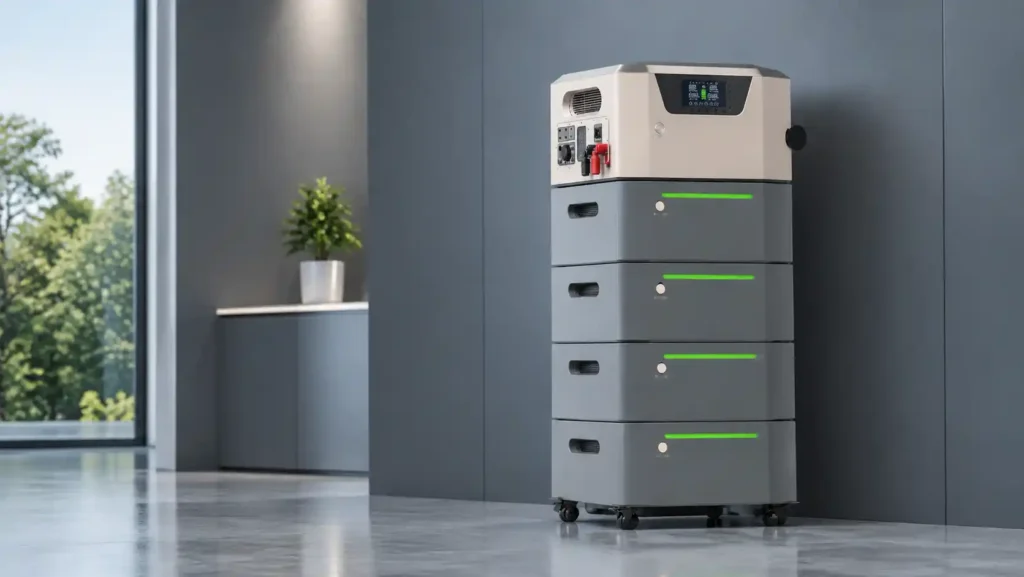
- All-in-one stack: a hybrid inverter and battery modules in one vertical system.
- Battery-only modules: stackable LiFePO4 battery modules that connect to an inverter you choose.
- OEM-configured stack: a custom enclosure, module count, firmware or branding built to your specification.
Two models from VoltCrave Power’s range show the all-in-one type. The 10 kW / 10.24 kWh stackable ESS uses two 51.2 V 100 Ah modules under a hybrid inverter. The 20.48 kWh stacked system uses four of the same 5.12 kWh modules with a 5.5 kW hybrid inverter in a floor-standing vertical design. In both, capacity scales with the number of modules while the inverter is a fixed part of the stack. Most stackable sourcing questions come from this relationship.
Low voltage or high voltage
This decision narrows the supplier list more than any other, so make it first. A low voltage stackable battery usually sits at roughly 48 to 51.2 V nominal. A high voltage stackable battery typically runs at a few hundred volts, depending on the design.
| Low voltage stack | High voltage stack | |
|---|---|---|
| Current for a given power | Higher, so cable and busbar sizing matter | Lower |
| Inverter choice | Wide, including many 48 V hybrid inverters | Limited to HV-compatible inverters |
| Installation | Familiar to most installers | Needs HV-trained installers and HV safety handling |
| Confirm with the supplier | Per-module current limits, paralleling rules | Voltage window, inverter compatibility list, HV safety documentation |
Neither is better in every case. The choice depends on the target inverter, local installer skills and the markets you sell into. A supplier that makes only one type will usually steer you toward it, so ask whether they can document both.
Module specifications
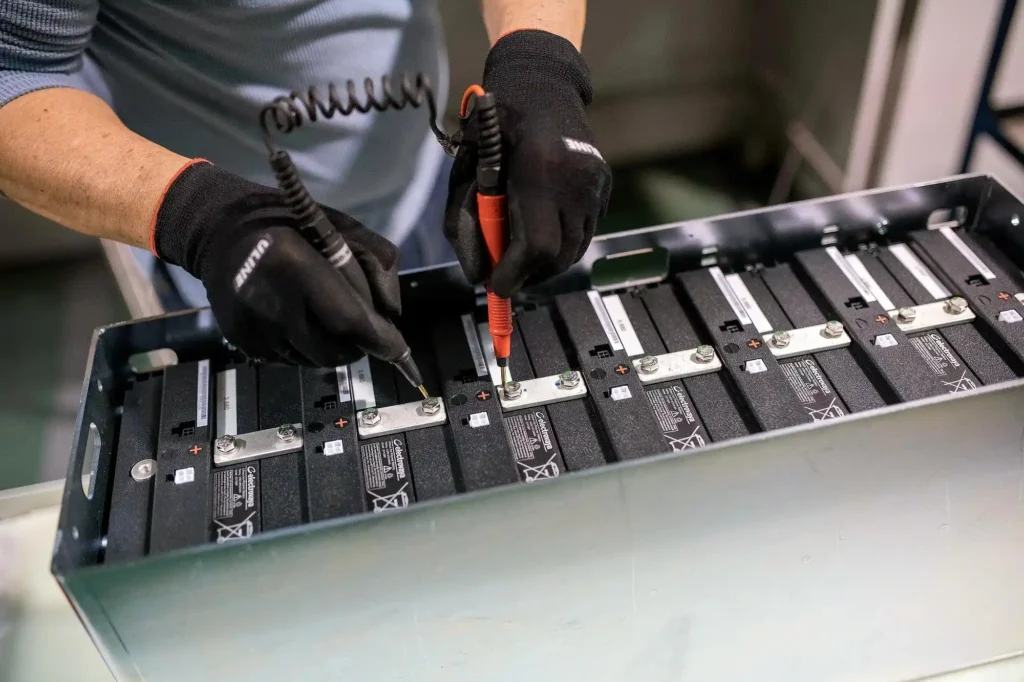
In a stack, the module is the unit you buy, ship, install and replace. Ask for these details per module.
Cell and pack configuration
The 10.24 kWh VoltCrave Power stack above is listed as LiFePO4 in a 16S1P configuration. Ask any stackable LiFePO4 battery supplier for the equivalent: cell format, cell origin, series and parallel layout, and whether the same cells are used in every batch.
BMS protections
The BMS should cover over-charge, over-discharge, over-current, short-circuit, high-temperature cutoff, low-temperature charging lock and cell balancing. Low-temperature charging protection matters in cold climates because LiFePO4 should not be charged below its permitted temperature. Ask for the actual thresholds, not only the feature names.
Cycle life with test conditions
A figure such as “6000+ cycles at 80% depth of discharge” means little without the temperature, charge and discharge rate, and the end-of-life capacity it refers to.
Usable energy
Nominal and usable capacity differ. If a 10.24 kWh system is rated at 80% depth of discharge, plan around roughly 8.2 kWh of usable energy, and confirm what the supplier’s rating assumes.
How expansion works
Expansion is the main reason buyers choose stackable systems, so test the supplier’s answers here most closely.
- Maximum modules per stack and per inverter. Get this in writing for each model.
- Battery current against inverter rating. 100 A at 51.2 V is about 5.1 kW. If a system pairs a larger inverter with a battery rated at 100 A, confirm whether the figure applies per module or per system, because it decides whether the battery can deliver the inverter’s rated power.
- Adding modules later. Ask whether a module built a year or two later can be mixed with the original ones, whether spare modules stay in supply, and how BMS firmware versions are kept compatible. A “yes” without detail is not an answer.
- Parallel connection rules. Read the installation manual to see how modules connect.
Inverter integration
With an all-in-one stack, the inverter and battery are designed together, which removes most compatibility risk. With battery-only modules, integration is your risk.
For battery-only stacks, ask for the communication protocol document (CAN or RS485 are the common options) and a written list of tested inverter models and firmware versions. A statement that the battery is compatible with all major brands is not enough for a project.
For all-in-one stacks, check the monitoring options. The 10.24 kWh model above lists RS232, RS485, CAN and WiFi communication and a local LCD, which is the level of detail a spec sheet should give.
Installation and mechanical design
Installers handle weight, footprint and cabling on every job, so these details affect your reputation as much as the electrical specifications do.
- Module weight and dimensions, and whether one or two people can lift a module.
- Floor-standing, rack or wall mounting, and whether the stack needs anchoring.
- Cable and connector design between modules, and whether connections are tool-free or need wiring on site.
- Cooling method and noise. The 10.24 kWh model lists active cooling, noise below 50 dB and an operating range of −20°C to 60°C.
- Transport packaging, UN38.3 documents and dangerous-goods paperwork.
Certificates and what they cover
Certificates are where careless suppliers are easiest to spot. Request certificates and test reports for the exact model you plan to buy, then check four points:
- The model number on the report matches the product.
- The issuing lab and report number can be verified.
- The certificate covers the right level: cell, module or complete system.
- The certificate is relevant to your target market.
The third point is the one most often missed. VoltCrave Power’s product pages list a UL 1642 document and state that it is a cell component document, not a certification of the complete energy storage system. Expect that level of clarity from any supplier. System-level approvals are compared in UL 9540 vs UL 9540A: ESS approval explained. Requirements also vary by country and utility, so confirm them for your own market before ordering.
Commercial terms
Stackable battery wholesale involves more than the unit price. Clarify these points before comparing quotations:
- Sampling. Can you order a sample before volume, and is it the same configuration as the production unit?
- Warranty. Read the term on the exact model. Warranty length can differ between models from the same supplier.
- Lead time and batch consistency. Ask how the supplier controls consistency between production batches.
- After-sales. Ask who handles a failed module and how replacements are shipped.
- OEM and ODM options. If you need a custom enclosure, branding or firmware, ask which changes are possible and whether they affect certification.
Supplier scorecard
| Area | What to ask | Evidence to request |
|---|---|---|
| Architecture | LV or HV, module size, maximum modules | Datasheet per model |
| Module quality | Cells, BMS protections, cycle-life conditions | Cell spec, BMS spec, test conditions |
| Expansion | Mixing batches, spare supply, firmware policy | Written policy |
| Inverter integration | Tested inverters, protocol | Protocol document, compatibility list |
| Installation | Weight, dimensions, cabling | Manual, drawings |
| Certification | Which documents cover which level | Reports matching your model |
| Commercial terms | Warranty, sampling, lead time | Quotation with terms |
Red flags
- Cycle life or capacity claims with no test conditions.
- Certificates that do not show your model number or cover only the cell.
- Compatibility with “all inverters” and no tested list.
- No stated policy on adding modules later.
- Different specifications for the same model on the datasheet, the website and the quotation.
- Reluctance to provide a sample.
Testing a sample before volume
A sample order is the cheapest way to verify the answers above. A practical pilot checks:
- Documents against hardware. The label, BMS data and datasheet should agree.
- Capacity. A controlled charge and discharge test should match the rated energy.
- Integration. The system should communicate correctly with your target inverter.
- Expansion. Adding a module should work as the manual describes.
- Installation. Record how long a real install takes and what the installer found awkward.
FAQs
Can I mix stackable battery modules from different production batches?
It depends on the supplier’s design and firmware. Ask for the policy in writing and test it on a sample before relying on it in a project.
Is a high voltage stackable battery better than low voltage?
Not automatically. High voltage reduces current for a given power but needs a compatible inverter and HV-trained installers. Low voltage allows a wider choice of inverters. Choose based on your inverter, market and installer base.
What should I request before placing a first stackable battery wholesale order?
A datasheet for the exact model, certificates matching that model, the communication protocol, the warranty terms and a sample for testing.
What is the difference between a stackable battery supplier and a stackable battery manufacturer?
A manufacturer makes the modules and designs the BMS in its own facilities. A supplier may assemble, rebrand or trade products made elsewhere. Neither is automatically better, but the difference determines who can fix a technical problem, change firmware or guarantee batch consistency. Ask who designs the BMS, where the modules are assembled and who handles after-sales for a failed module.
Should I choose an all-in-one stackable system or battery-only modules?
An all-in-one stack combines the inverter and battery modules, so compatibility risk is lower and installation is simpler. Battery-only modules let you choose the inverter, but you need the communication protocol document and a tested inverter list. The better choice depends on whether you sell complete systems or integrate around a specific inverter.
Can a stackable battery supplier customize the system for my brand?
Stackable systems can often be customized under OEM and ODM terms. VoltCrave Power’s product pages list custom enclosure, branding, firmware and packaging among the available options. Ask exactly which changes are possible, what the minimum order is for customized units, and whether any change affects existing certificates or test reports.
Where VoltCrave Power fits
VoltCrave Power lists stackable systems on its home and residential energy storage page, alongside wall-mount, all-in-one and high voltage series, with OEM and ODM support. To compare a stackable battery manufacturer for a specific project, send your requirements with the target market, inverter model, capacity range and expected volume, so the quotation matches your actual configuration.
Need help matching this topic to a real battery project?
Send your target application, capacity range, certification market, and order plan. VoltCrave can recommend a practical product direction.