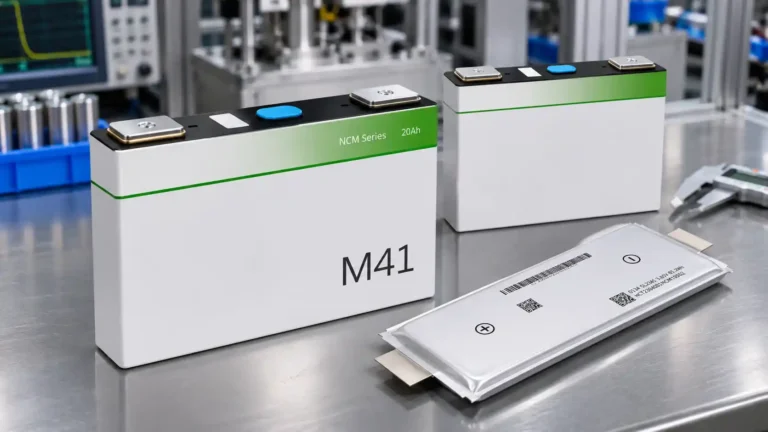
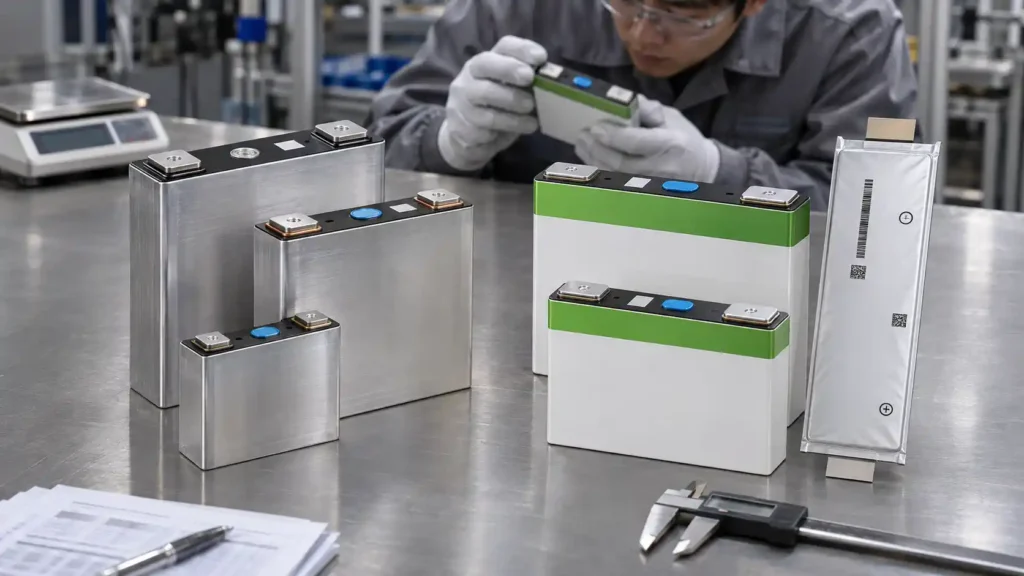
The key differences between LFP and NMC batteries split into two groups: five that hold for every cell of that chemistry, and four that change from part to part. Most LFP vs NMC comparisons list all nine as though they carried the same weight.
The fixed five: the cathode material, the nominal cell voltage (3.2V to 3.22V against 3.60V to 3.66V), the presence of cobalt and nickel, how the cathode behaves under heat, and the direction of the energy density gap.
The variable four: cycle life, temperature window, rate capability, and how large that density gap actually is. All four swing by a factor of two or more between two cells carrying the same chemistry label. That is why a chemistry-level comparison can be perfectly true and still useless for a purchase order.
| Difference | LFP | NMC | Holds for every cell? |
|---|---|---|---|
| Cathode | Lithium iron phosphate, olivine structure | Lithium nickel manganese cobalt oxide, layered structure | Yes |
| Nominal cell voltage | 3.2V to 3.22V | 3.60V to 3.66V | Yes |
| Cobalt and nickel | Neither present | Both present | Yes |
| Cathode behaviour under heat | Resists thermal decomposition | Less resistant | Yes |
| Which chemistry is denser per kilogram | Lower | Higher | Direction only, not size |
Everything below is drawn from VoltCrave Power’s published cell pages rather than from chemistry averages. Where a figure is calculated from listed capacity, voltage and weight, the arithmetic is shown so it can be checked against the datasheet you were quoted.
The difference LFP does not have: cobalt and nickel
LFP uses no cobalt and no nickel. NMC uses both, in ratios that change between the 111, 622 and 811 blends. That absence is the whole basis of the supply-chain argument in this comparison, and it is easy to over-read in both directions.
It does not make an LFP cell cheap. Format, capacity and order volume move a quotation further than the cathode does, which is why VoltCrave Power prices against a model and a quantity rather than publishing a per-kWh figure for either chemistry. What the absence of cobalt and nickel does mean is that an NMC programme carries raw-material exposure an LFP programme does not, and that exposure belongs in a multi-year agreement as a validity period or a raw-material clause rather than as a lower unit price.
Nor does the presence of nickel make an NMC cell unsafe or short-lived. It makes the cathode more sensitive to how the cell is built, which is why two NMC cells can sit at opposite ends of the cycle-life range below.
VoltCrave Power spells the chemistry both ways on its product pages, NCM and NMC, which is a regional habit rather than a different material. The M21-INP58P and the M11 are listed as NCM, the D25 and D21 as NMC. If the cathode itself is the part you need explained, what an NCM battery is covers the blends and what shifting the nickel share changes.
3.2V against 3.65V, and what it does to the cell count
Nominal cell voltage is the least discussed difference in the list and the one with the largest physical consequence, because it sets the number of cells in series.
Divide the target pack voltage by the cell voltage and the difference stops being a datasheet line.
| Pack class | LFP series at 3.2V | LFP charge at 3.65V/cell | NMC series at 3.65V | NMC charge at 4.20V/cell |
|---|---|---|---|---|
| 12V | 4S = 12.8V | 14.6V | 3S = 11.0V | 12.6V |
| 24V | 8S = 25.6V | 29.2V | 7S = 25.6V | 29.4V |
| 36V | 12S = 38.4V | 43.8V | 10S = 36.5V | 42.0V |
| 48V | 15S = 48.0V | 54.75V | 13S = 47.5V | 54.6V |
| 51.2V | 16S = 51.2V | 58.4V | 14S = 51.1V | 58.8V |
Read the 48V row twice. A 13S NMC pack charges at 54.6V. A 15S LFP pack charges at 54.75V, a difference of 0.15V, so one charger fills either string. That is the only LFP configuration that moves into a 13S NMC frame without a new charger, and it is why 15S is the number worth remembering rather than 16S.
The 16S string is a different product. It charges at 58.4V, and that is the configuration behind the 51.2V LFP packs in the range. Put one on a 54.6V charger and it runs permanently part-charged. The pack still works; the capacity that was paid for does not arrive.
VoltCrave Power’s 48V 20Ah NCM downtube battery shows the 13S pattern without needing the cells in hand: it lists a 54.6V charge voltage and a 36.4V discharge cut-off, which is 4.20V and 2.80V per cell across thirteen cells.
Two consequences follow. The BMS is specified per string length, so sixteen balance channels and sixteen sense lines against thirteen of each, and a protection board built for one configuration will not run the other. And at the same cell capacity the LFP string uses two more cells, which is two more interconnects, more sense wiring and more assembly time. That is where a voltage difference turns into money.
LFP vs NMC energy density: 27 to 48 per cent, not a generation
Both chemistries are denser than the ranges usually attached to them. The LFP figure that gets repeated, 90 to 160Wh/kg, describes cells from several product generations ago. The NMC figure of 150 to 220Wh/kg is closer but still low against current parts.
| Cell | Chemistry | Capacity | Nominal V | Energy | Weight | Wh/kg |
|---|---|---|---|---|---|---|
| D25 pouch | NMC | 50.5Ah | 3.65V | 182Wh minimum | 740g | 246, listed |
| M21-INP58P | NMC | 58Ah | 3.62V | 210.0Wh, calculated | 860g | 244, calculated |
| A41-V3 | LFP | 122Ah | 3.22V | 392.8Wh | 2035g | 193, calculated |
| A22 | LFP | 178.1Ah | 3.2V | 573.5Wh | 3170g | 181, calculated |
| MB31 | LFP | 314Ah | 3.2V | 1004.8Wh | 5600g | 179, calculated |
| LF105 | LFP | 105Ah | 3.2V | 336Wh | 1980g | 170, calculated |
| LF280K | LFP | 280Ah | 3.2V | 896Wh, calculated | 5420g | 165, calculated |
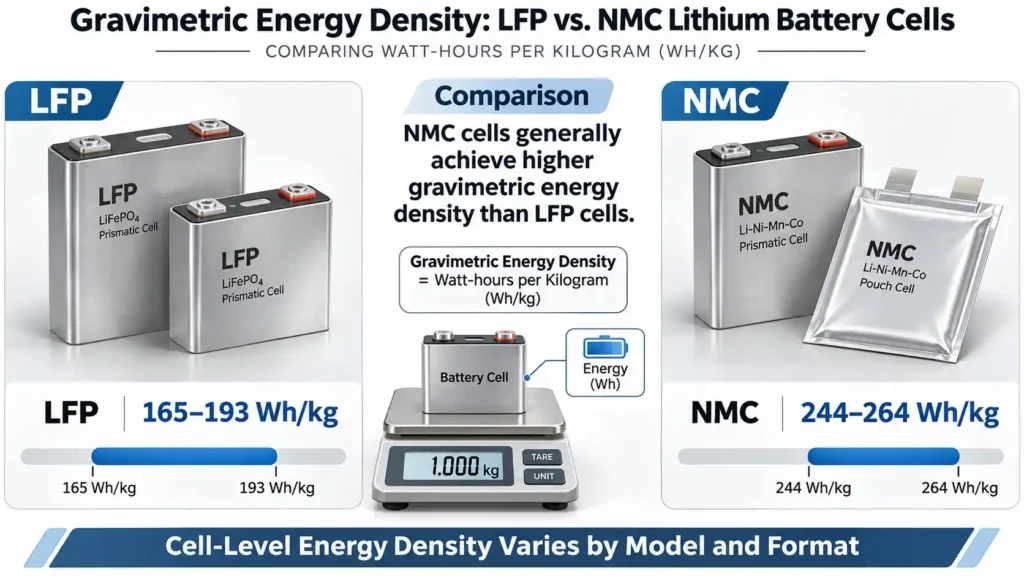
Read it as two ranges rather than two numbers. The LFP cells run from 165 to 193Wh/kg, the NMC cells from 244 to 264Wh/kg. The gap between the top of each range is 27 per cent; between the bottom of each, 48 per cent. That is a real advantage and a smaller one than “NMC is denser” usually implies.
The spread inside the LFP column is the part worth studying. A 314Ah cell and a 122Ah cell are both LFP prismatics and sit 14Wh/kg apart. Density is not a chemistry constant. It is what the cell designer traded capacity against, which is why the A41-V3 reaches 193Wh/kg from 392.8Wh over 2.035kg while the 280Ah LF280K works out to 165Wh/kg from 280Ah × 3.2V over 5.42kg.
Volume does not follow mass. Taking the bounding box from each published dimension, the M21-INP58P comes out at 557Wh/L, the MB31 at 389Wh/L, LF230 at 379Wh/L and the D25 pouch at 360Wh/L. The NMC prismatic is the densest of the four and the NMC pouch the least dense, because a 16.8mm pouch spends more of its envelope on tabs and sealed edges. An enclosure sized from a Wh/kg figure alone can come out wrong.
The ratio does survive to pack level, since both chemistries give up a similar share of mass to enclosure, BMS and busbar. What does not survive is the shape. The D25 pouch is 301.5 × 99.7 × 16.8mm, the M21-INP58P is 95.21 × 148.20 × 26.72mm, and the LFP cells in the table are 2kg to 5.6kg blocks. The LFP prismatics are grouped on the LiFePO4 battery cells and components page, while each NMC cell is listed as its own product.
LFP vs NMC cycle life: the comparison that is least comparable
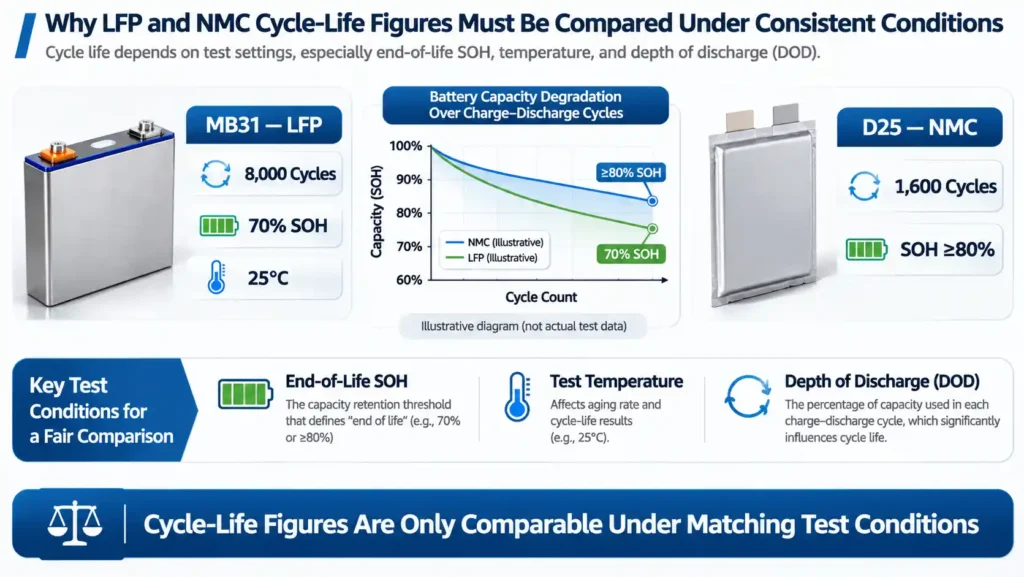
Cycle life is the difference most often quoted and least often comparable, because the headline count depends on three things that usually sit outside it: the end-of-life threshold, the temperature, and the depth of discharge.
| Cell | Chemistry | Listed cycle life | Stated condition |
|---|---|---|---|
| MB31 | LFP | 8000 | 70% SOH at 25°C |
| LF280K | LFP | 8000 | 8000 cycles with fixture |
| LF100LA | LFP | 5000 | ≥5000 at 25°C, ≥3500 at 35°C |
| LF105 | LFP | 5000 | 5000 cycles with fixture |
| LF230 | LFP | 4000 | 4000 at 25°C, 2000 at 45°C |
| A41-V3 | LFP | 4000 | not stated |
| A41-V2 | LFP | 2000 | not stated |
| D21 | NMC | 3000 | not stated |
| M21-INP58P | NMC | 2700 | 3000 at 25°C |
| D25 | NMC | 1600 | SOH ≥80% |
| M11 | NMC | ≥1500 | not stated |
Three things in that table matter more than the ranking.
The threshold. MB31’s 8000 cycles run to 70% state of health. D25’s 1600 run to 80%. Ten points of capacity is worth thousands of cycles at the tail of a fade curve, so those two figures are not on the same scale and subtracting one from the other means nothing.
The spread. A41-V3 lists 4000 and A41-V2 lists 2000, both LFP prismatic cells. D21 lists 3000 and D25 lists 1600, both 50.5Ah NMC cells at the same nominal voltage. The cathode sets the ceiling. Electrode design, formation and the test protocol decide where inside that ceiling a given cell lands.
The temperature, which is where a widely repeated claim falls apart. The usual line is that NMC loses 40 to 50 per cent of its cycle life at 45°C while LFP loses 20 to 30 per cent. VoltCrave Power’s LFP data does not show that. The LF230 is listed at 4000 cycles at 25°C and 2000 at 45°C, a 50 per cent loss. LF100LA holds 5000 at 25°C and 3500 at 35°C, a 30 per cent loss at a much lower temperature. The claim does not describe the LFP cells in this range.
The practical consequence is that an 8000-cycle figure at 25°C is not an 8000-cycle warranty. A pack in a hot plant room should be sized on the derated figure, and the derating is a property of the cell rather than of the cathode.
One phrase in that table needs explaining. Large prismatic cells are cycled under mechanical compression, because the stack needs clamping force to behave as specified. It is standard practice, and it is also a condition the enclosure has to reproduce.
Temperature: where the usual rule reverses
The received version is that NMC handles heat better and LFP handles cold better. The datasheets support neither half consistently.
| Cell | Chemistry | Charge | Discharge |
|---|---|---|---|
| D25 | NMC | −20°C to 55°C | −30°C to 55°C |
| 18650 3300–3500 | Li-ion | 0°C to 45°C | −20°C to 66°C |
| LF230 | LFP | −10°C to 65°C | −35°C to 65°C |
| LF280K | LFP | 0°C to 55°C | −20°C to 55°C |
| MB31 | LFP | 0°C to 60°C | −30°C to 60°C |
| LF105 | LFP | 0°C to 55°C | −20°C to 55°C |
Two of those six cells charge below 0°C and four do not. The four that do not include three LFP cells, so cold charging is not a chemistry split. The widest discharge window in the set belongs to an LFP cell at −35°C.
The genuinely restricted cells are the smallest NMC parts. The M11 is specified for 0°C to 35°C and the M21-INP58P for 0°C to 45°C, both as single working ranges rather than separate charge and discharge limits. Neither is a poor cell. Both are the wrong cell for an application that quotes a wider ambient band, and the cathode is not the reason.
The asymmetry that does hold across the range is charge against discharge. A cell that discharges to −20°C often charges only from 0°C. LF280K discharges to −20°C and charges from 0°C. MB31 discharges to −30°C and charges from 0°C. LF105 discharges to −20°C and charges from 0°C. Sub-zero charging is the binding constraint in most of this range, and it is a BMS and heater question rather than a chemistry one.
Rate: the difference that stopped existing
The other assumption worth retiring is that NMC is the power chemistry and LFP is the energy chemistry. That was reasonable when LFP meant a thick-electrode storage cell. It does not describe this range.
| Cell | Chemistry | Listed discharge | Capacity |
|---|---|---|---|
| A27 | LFP | 1C, and 5C for ≥60s at 25°C | 127Ah |
| A28 | LFP | 1C, 3C maximum | 87Ah |
| A41-V2 / A41-V3 | LFP | 3C | 116Ah / 122Ah |
| A24 | LFP | 3C | 172.1Ah |
| LF100LA | LFP | 1C continuous, 2C for 30s | 102Ah |
| LF230 | LFP | 0.5C | 230Ah |
| LF280K | LFP | 0.5C | 280Ah |
| D25 / D21 | NMC | 1/3C, 17.3A | 50.5Ah |
| 18650 3300–3500 | Li-ion | up to 3C | 3.3–3.5Ah |
The pattern to notice is that the 87Ah to 127Ah LFP cells carry the high rates and the 230Ah and 280Ah cells settle at 0.5C. Same cathode, different electrode design. Rate capability tracks how the cell was built, not which chemistry it uses, which is why “LFP for energy, NMC for power” describes the cells most buyers happen to see rather than the cathode.
For a 48V 20Ah e-bike pack drawing 30A, the requirement is 1.5C, and both chemistries clear it. The NCM triangle packs are listed at 3C and 5C discharge with a 30A to 60A BMS on 18650 and 21700 cells, and the packs themselves sit in the e-mobility range. Rate does not decide the chemistry at that size. Cell count and charger voltage do.
Where rate does decide something is a short traction peak, and that no longer forces NMC either: the A27 127Ah cell holds 5C for 60 seconds at 25°C on a 1C continuous rating.
Thermal stability, and what the documents can prove
The cathode difference is real. The olivine structure of LFP resists thermal decomposition better than the layered oxide of NMC. That is a material property rather than a test result, and it is why NMC packs normally carry heavier thermal management and propagation provisions.
It is also the difference a buyer can prove least from a quotation, because the evidence sits per model rather than per chemistry.
UL 1642 is a cell component document, not a certification of an assembled energy storage system, and VoltCrave Power’s cell pages say so explicitly. IEC 62133-2 covers cell and battery safety. UN38.3 covers transport testing. Beyond those, the document sets differ: the D25 lists CE, RoHS, UN38.3 and MSDS. LF105 lists IEC, UN38.3, MSDS and UL 1642. LF304 lists CE, UN38.3, MSDS and IEC. The M21-INP58P carries IEC 62133-2, CE/EMC, UN38.3, RoHS, MSDS and UL 1642.
Two questions decide whether any of that is worth something in a tender. Does the document cover the cell or the assembled pack, and does it name the exact model being ordered? A UL 1642 component document for one cell does not travel to a pack built from a different one, and a chemistry-level assurance is not a document at all.
What the differences add up to in one pack
Take a pack in the 5kWh class at the 51.2V end of the range and build it both ways.
From LFP: 105Ah LF105 cells at 336Wh each, sixteen in series. That is 5.38kWh, 31.7kg of cell mass and sixteen cells.
From NMC: 50.5Ah D25 pouches at 184.3Wh each, fourteen series positions of two in parallel. That is 5.16kWh, 20.7kg and twenty-eight cells.
Twelve more cells buy eleven kilograms less mass and 0.22kWh less energy. The parallel pair halves the current each NMC cell carries at a given pack current, which reduces heat per cell and relaxes the per-cell C-rate. Against that, twelve more cells to weld or bolt, more busbar, more sense wiring and more assembly time.
No published per-kWh number would let you price that trade. VoltCrave Power quotes against a model, a quantity and a BMS specification, because a figure without those is a guess with units attached.
FAQs
Which is better, LFP or NMC?
Neither, in the abstract. LFP wins where the pack sits on the ground and cycle count is the purchase criterion. NMC wins where the pack has to be light and thin enough to fit a frame, a wheel hub or a fixed enclosure volume. The cells decide the rest, and the four variable differences above are where that decision gets made.
Does LFP use nickel or cobalt?
No, neither. The LFP cathode is lithium iron phosphate, so a cobalt or nickel price movement does not pass through to an LFP cell the way it does to an NMC cell. That is a supply-chain property rather than a price guarantee: format, capacity and volume still set the quotation.
How many LFP cells are in a 48V battery?
Fifteen at 3.2V nominal, giving 48.0V, or sixteen for a 51.2V pack. A 13S NMC pack is also sold as 48V, at 47.5V nominal, which is why the label alone does not tell you what is inside. Check the cell count or the charge voltage instead.
Why is NMC more energy-dense than LFP?
Two effects. At the same capacity a 3.65V cell stores about 14 per cent more watt-hours than a 3.2V cell, which accounts for part of it. The rest is mass: the layered oxide stores more lithium per unit of electrode mass, so an NMC cell of a given capacity weighs less. The D25 delivers 182Wh from 740g; the 105Ah LF105 delivers 336Wh from 1980g.
Does LFP always last longer than NMC?
No. The range holds an 8000-cycle LFP cell and a 1600-cycle NMC pouch, which is a real gap. It also holds a 2000-cycle and a 4000-cycle cell in the same LFP format. The chemistry sets the ceiling and the cell sets the number. Compare only figures that state the depth of discharge, the temperature and the end-of-life threshold.
How to use the differences
Use the fixed five to narrow the field and the variable four to choose.
The fixed five rule a chemistry out in about a minute. If the charger tops out at 54.6V, a 16S LFP string is gone. If the programme cannot carry nickel and cobalt exposure across a multi-year agreement, NMC is gone. Neither judgement needs a datasheet, and neither is a matter of opinion.
What survives gets decided on the datasheet, one part number at a time. Cycle life, temperature window and rate are properties of the cell you are about to order, not of the chemistry printed on the box, and the only comparison worth running is between the two cells that would actually appear on the purchase order.
Need help matching this topic to a real battery project?
Send your target application, capacity range, certification market, and order plan. VoltCrave can recommend a practical product direction.