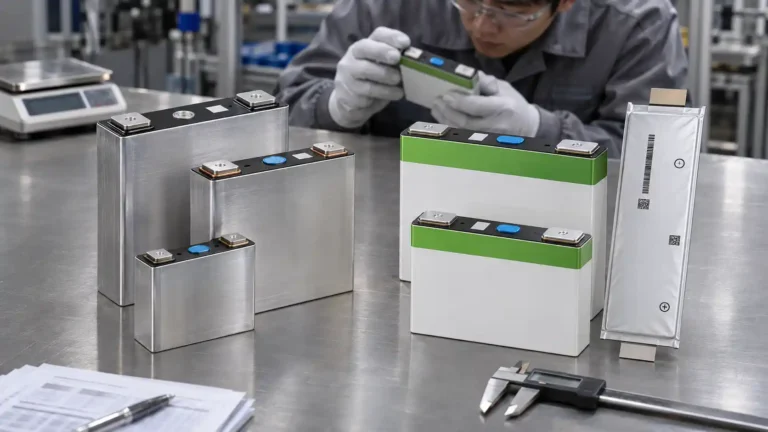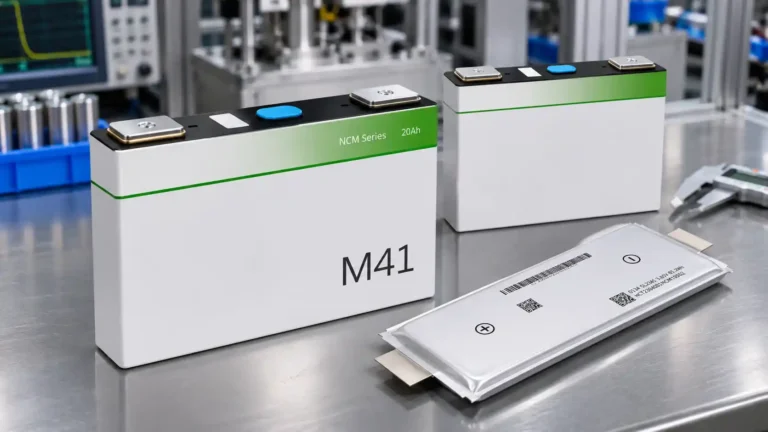
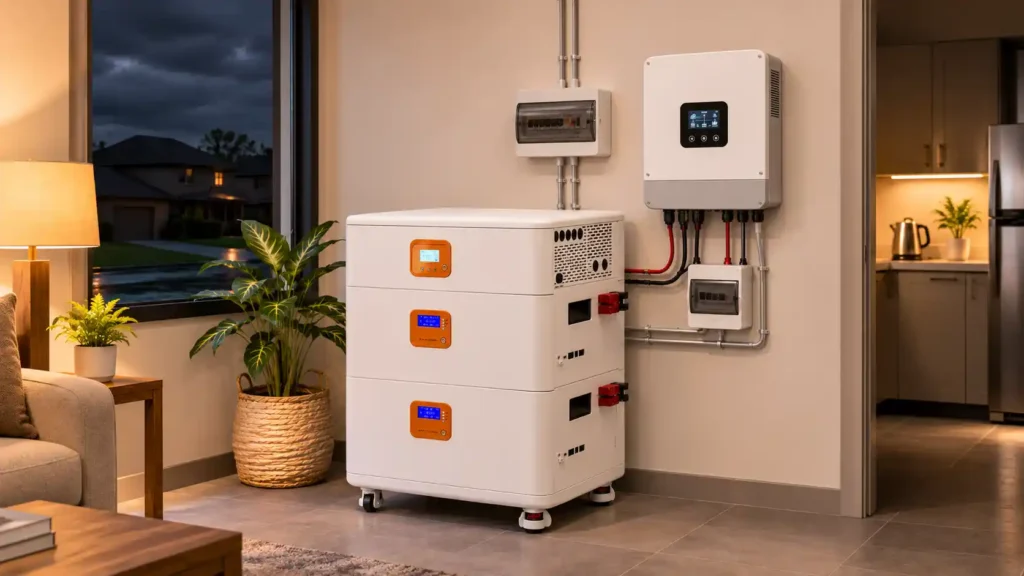
A grid failure does not switch a house off all at once. It removes the voltage and frequency reference that a grid-tied inverter follows, and everything depending on that reference stops within a cycle or two: the PV inverter, the boiler’s control board, the well pump, the router. A home backup battery puts that reference back from stored DC, at 50 or 60 Hz, with no fuel and nobody present to start it.
That is the electrical reason. The practical one is narrower. An outage only becomes a problem when it interrupts something that fails in a way you cannot undo: a split pipe, a flooded basement, a freezer full of food, medication that has to stay cold. Those loads are what make a battery worth installing, and whether it holds them depends on conditions that have nothing to do with the capacity label.
What an outage interrupts, and in what order
Sort the loads in a house by what happens when they lose power, not by how important they seem. That order tells you whether a few hours of storage is enough or whether the number has to be larger.
Loads that stop the moment the grid drops
A forced-air gas furnace runs its blower and control board on mains, so a gas house goes cold with a full tank. An oil boiler needs power for the burner and the circulator. A submersible well pump stops, which means no water pressure and no flushing. A sump pump stops with the pit still filling. Garage doors need the opener or the manual release. The fiber or cable termination box and the router go down, so a VOIP line dies with the grid and a mobile phone becomes the only working line. Security panels, cameras and recorders fall back to whatever internal battery they carry, and that reserve is measured in hours.
Loads that fail after a few hours
Refrigeration is the obvious one, and also the one people misjudge, because a closed freezer holds temperature far longer than an open fridge. Insulin and some other medication have to stay inside a temperature band, and a kitchen fridge sitting at room temperature is not a substitute. Pipes in an unheated crawlspace, garage or outbuilding come under pressure once the heating stops and outdoor temperature falls. Aquarium heaters, hydroponic pumps and sump pits during rain belong here too. Add the work-from-home load: a laptop has its own battery, a monitor and a desk router do not.
Loads that fail permanently
Water damage from a split pipe, a flooded basement, spoiled food and medication, a home business that loses perishable stock, a security gap that cannot be reconstructed afterwards. These are the loads that justify the capital, because the cost of one event is often larger than the equipment.
Why a solar array does not cover this by itself
Grid codes require a grid-tied inverter to detect a de-energized grid and stop exporting, so that a line being repaired is not fed from a roof. That requirement is why a house with a large PV array goes dark at the same instant as a house without one. The array is still producing, and the inverter still refuses to use it.
The reason is structural. A PV array is a DC current source, and the inverter connecting it to the grid is built to follow a waveform that already exists. Neither part can create voltage and frequency on its own, so once the grid is gone an islanded array has no waveform to follow and nowhere to send energy. A battery is a voltage source, so it can form the AC side and give the array something to charge into. That is the difference between a solar system that saves money and a solar system that keeps the lights on.
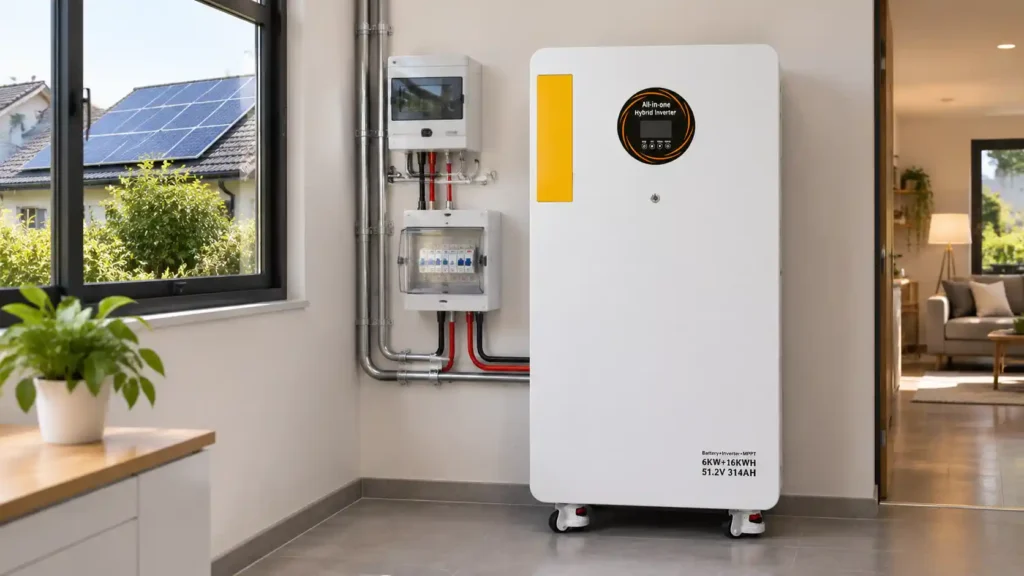
In an all-in-one unit, the sequence is reflected in the specification sheet: PV enters through the built-in MPPT, the battery maintains the AC output at 220–240 V, and the load receives power. Product documentation from VoltCrave Power describes the same process from the other direction, explaining that adding solar input allows the system to recharge during an extended outage instead of waiting for the grid to return.
One caveat catches people out: PV only contributes during daylight. If the outage starts at 21:00, the first ten hours come out of the bank, and the state of charge at that moment is the whole story.
Four conditions that decide whether the battery carries the house
A battery on a wall is not backup. Backup is a set of conditions, and all four have to hold at once.
Transfer time has to suit the loads you keep. VoltCrave Power’s published transfer figure is 10–20 ms, fast enough that routers, computers and LED drivers ride through without rebooting. A fridge or heat-pump compressor is a different case: restarting against residual head pressure can trip it on overload, and a boiler that loses flame supervision can go to lockout and wait for a manual reset. Ask what happens to each load, not only how fast the switch is.
The circuit has to be on the backup output. A battery feeds what is wired to it. If the panel was never split, or the circuits that matter sit on a sub-panel that is not connected to the backup port, the battery will run the lights and nothing else. The method for choosing those circuits is set out in home battery backup without solar, which treats the load list as the first decision rather than the last.
Something has to recharge the pack before it empties. An outage longer than the stored energy needs a source: PV through the hybrid’s MPPT by day, a generator on the AC input, or the grid coming back. Where none of those exists, duration is fixed by bank size at the moment of failure.
The pack has to be able to accept charge where it is installed. LiFePO4 discharges down to -20 °C but cannot be charged below 0 °C, and the BMS on these systems blocks charging below that point to avoid lithium plating. A unit in an unheated garage can carry the house through the night and then sit unable to recharge until the cells warm. Self-heating options exist for exactly this case, and the 10 kW stacked model lists an operating range of -15 °C to 50 °C, a figure worth checking against the actual install location rather than the showroom.
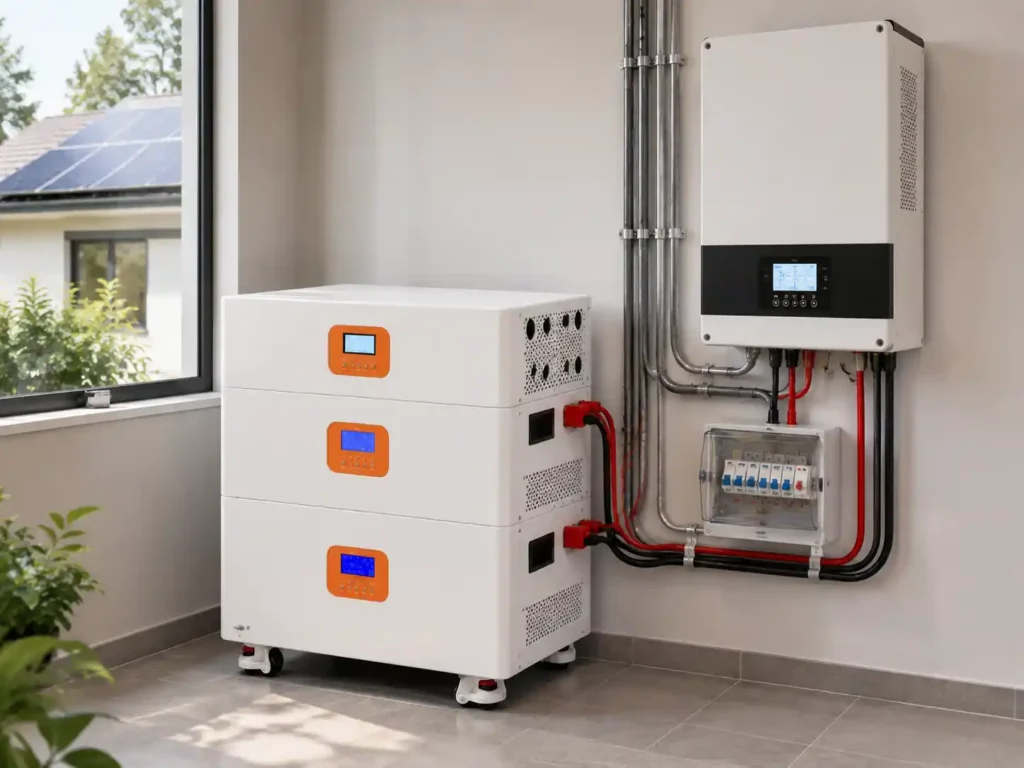
Output power is the limit people discover too late
On a home backup battery, capacity decides how long. Output power decides whether the load starts at all, and it is the specification buyers read last. A 20 kWh bank behind a 3.6 kW inverter is a 3.6 kW house with a long duration, not a whole-home system.
The range shows the split clearly. The 7.68 kWh model pairs its battery with a 3.6 kW hybrid inverter on a 25.6 V pack. The 10.24 kWh and 16 kWh cabinets both use a 6 kW inverter on 51.2 V. The stacked 10 kW model states 11,000 W continuous output with 200 A maximum continuous discharge, and the 15 kWh mobile unit states 10 kW. One chemistry, four power ceilings.
Two things follow. The inverter’s continuous rating and the BMS discharge limit cap what the house can run, and adding battery modules does not raise that cap. Lower DC voltage also costs current: 3.6 kW at 25.6 V draws roughly twice the current of the same power at 51.2 V, which is why 24 V platforms stop at modest output while 48 V platforms go higher. Motor loads add a starting surge on top of the running rating, so ask for the peak figure in the datasheet instead of assuming the continuous number covers a compressor start.
Where a home backup battery is not the essential purchase
Four situations argue against a battery, or against a battery on its own.
An outage pattern measured in days, not hours. A battery covers the first block of an event well and the fourth day badly. That is a case for a battery and generator hybrid design, not for a larger bank.
A house dominated by electric resistance heat or a large heat pump. The energy is there in principle, the continuous and surge power usually are not, and the honest answer is that the battery protects everything except the heating.
A service panel that cannot be reconfigured, or a rented property where it cannot be touched. If only a handful of circuits can be backed up, the value of the whole system depends on whether those circuits are the ones that matter.
Siting. A pack in a cold garage, a pack in a room that floods, and a pack with no ventilation are installation decisions made after the purchase that go on to decide the outcome.
Matching a system to the house it protects
Matching a home backup battery to a house starts with the circuit list and the power ceiling. The range includes a 5.12 kWh all-in-one that carries a 6 kW hybrid inverter and 210–230 V output in one vertical cabinet, which suits an apartment or a small house with a short list of backed-up circuits.
For a standard house with a backed-up sub-panel and up to about 6 kW of simultaneous load, the 10.24 kWh all-in-one ESS uses a single 51.2 V 200 Ah pack in a 1040 × 460 × 240 mm cabinet on casters. Where the same 6 kW ceiling has to last longer, the 16 kWh cabinet holds a 51.2 V 314 Ah pack rated at ≥8,000 cycles.
For a larger house, or a project built in phases, the 10 kW stacked battery system scales from 15.36 kWh to 61.44 kWh across four models, with three PV string inputs and 6000 cycles at DOD ≥ 90%, and accepts additional modules as the load list grows.
The home and residential ESS category page lists the full span from about 2.5 kWh to 32 kWh with CAN/RS485 compatibility for Deye, Growatt, Victron, SMA, Solis and Luxpower inverters. For a distributor or installer building a product line rather than a single installation, that page is a better starting point than any individual model.
What to confirm before a system is called outage-ready
Ask for the continuous and peak output, and for the list of circuits the backup port can feed. Confirm whether the inverter can run PV while islanded, and across what PV voltage window. Request the BMS charge cut-off temperature and whether a heating option is fitted. Then check the documents against the destination market: the unit pages carry IEC 62133-2, CE/EMC, UN38.3, RoHS and MSDS files, UL 1973 and UL 9540A apply to selected models, and availability varies by model and market. Commercial terms come last: MOQ and OEM lead time differ by model, so ask for both against the exact unit being quoted.
FAQs
Is a home backup battery the same thing as a UPS?
No. A UPS is sized to carry a load for minutes so equipment can shut down in order, and most units use lead-acid blocks that degrade under repeated deep discharge. A home backup battery is sized in kilowatt-hours, wired into the panel, and expected to run for hours. The overlap is transfer behavior, which is why UPS-class switching of 10–20 ms appears in both categories.
Will my solar panels keep producing during an outage?
Only if the inverter is built to run islanded with a battery. A standard grid-tied inverter shuts down when the grid is lost, whatever the array is producing. A hybrid inverter with a battery can form its own AC and let PV charge through the MPPT, and that is the configuration in which a home backup battery turns an existing array into an outage resource.
How long will a battery last during an outage?
Divide usable energy by the average load, then test the result against the peak. A 10.24 kWh system carrying 500 W averages about 20 hours before losses; the same system carrying a 4 kW heat pump averages about two and a half hours. The load list matters more than the capacity label, and an installer quoting a system should run the same division against the customer’s own figures rather than against a brochure.
Can it run a furnace, a well pump or an air conditioner?
It depends on starting surge and on whether the circuit sits on the backup output. A well pump and a compressor both draw a starting current well above their running current, and the inverter has to supply that surge without tripping. Bring nameplate figures for those three loads to the sizing conversation instead of the square footage of the house.
Can I add capacity later?
On most of the range, yes. The stacked model adds modules up to 61.44 kWh, and packs run in parallel over CAN/RS485 so capacity can grow without replacing what is already installed. Voltage, chemistry and BMS generation have to match, so expansion is easier when the first purchase leaves room for it.
A home backup battery earns the word backup when four things hold. The transfer suits the loads on the list, so nothing on it locks out or trips. The circuits you cannot lose are wired to the backup output. Something can put energy back into the pack, whether that is PV, a generator or the returning grid. And the pack can accept charge where it stands, including through a cold night in an unheated garage. Miss one and the equipment still works, but it has stopped being backup. Take the load list and the outage pattern into the sizing conversation, and ask for those four answers in writing before anything is ordered.
Need help matching this topic to a real battery project?
Send your target application, capacity range, certification market, and order plan. VoltCrave can recommend a practical product direction.